
Coleus forskohlii Briq. is the name used for Gandira root in the Ayurvedic Pharmacopoeia of India (API). Current Kew taxonomy treats that name as a synonym of Coleus barbatus var. barbatus, while Plectranthus barbatus is a synonym of Coleus barbatus. The root contains diterpenes including forskolin, an important experimental activator of adenylyl cyclase and cyclic AMP (cAMP). That mechanism is established, but claims that oral Coleus products reliably treat obesity, hypothyroidism, glaucoma, or heart failure exceed the clinical evidence.
Botanical Profile and Ayurvedic Context
The API identifies Gandira as the dried mature root of Coleus forskohlii Briq., synonym C. barbatus Benth., family Lamiaceae. It describes a perennial branched aromatic herb found in the subtropical western Himalayas, Nilgiri hills, Gujarat, and Bihar and cultivated in Maharashtra. Its official Sanskrit synonym is Gandira (Sthalaja). The API calls the identity controversial and provisionally accepts this species as the terrestrial, or Sthalaja, Gandira, so older vernacular names should not be treated as botanically conclusive.
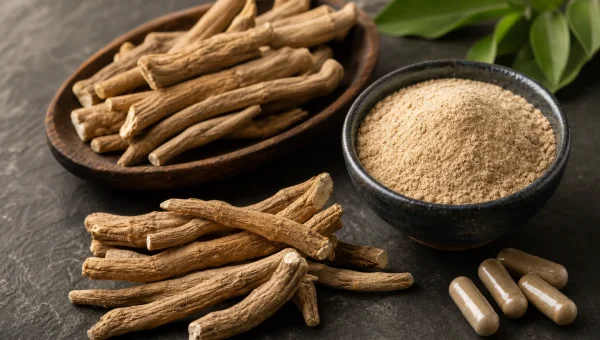
The root is described as light brown, wrinkled, tapering, pleasantly aromatic, and slightly bitter and pungent. Listed constituents include diterpenes, coleonol, coleosol, deoxy-coleonol, forskohlin, naphthopyrone, and coleoforsine. This constituent list does not mean that every raw root or commercial extract has an identical chemical profile.
Ayurvedic Properties According to the API
The API records rasa as katu, tikta, and kashaya; guna as ruksha, sara, and tikshna; virya as ushna; and vipaka as katu. Listed karma are kaphahara, vatahara, tridoshahara, vranashodhana, and vidahi. These are traditional Ayurvedic descriptors, not modern receptor-level mechanisms.
Therapeutic uses listed in the monograph are shula, shotha, arsha, gulma, kasa, krimi, kushtha, udara, dushta vrana, hutavisha, pliharoga, mandagni, mutrabandha, and malabandha. The named formulation is Krimighna Kashaya Churna. These entries document recognized Ayurvedic use; they do not by themselves prove efficacy for a biomedical diagnosis.
Mechanism of Action: Adenylyl Cyclase and cAMP
Classic experiments showed that forskolin directly activates adenylyl cyclase in isolated membranes and intact cells (PMID: 6267587). The enzyme converts ATP to cAMP, which can signal through protein kinase A, exchange proteins directly activated by cAMP, and other effectors. Responses vary by cyclase isoform, tissue, concentration, and experimental conditions, so the claim that forskolin uniformly raises cAMP in every cell is too broad.
- Adipose tissue: forskolin is used experimentally to raise cAMP and stimulate lipolytic signaling; this does not itself prove sustained human fat loss.
- Thyroid tissue: forskolin can reproduce cAMP-dependent aspects of thyrotropin signaling, iodine metabolism, and secretion in experimental preparations, not clinical hypothyroidism treatment.
- Cardiovascular tissue: cAMP can alter contractility and vascular tone, explaining historical intravenous studies but not validating oral root products.
- Eye: topical forskolin has been studied for lowering intraocular pressure by reducing aqueous-humor inflow; oral supplements are a different intervention.
Forskolin is therefore a useful research tool, but a plausible pathway is not proof of therapeutic benefit. Route, dose, formulation, target tissue, duration, clinical endpoints, and adverse effects must be tested directly.
Clinical Evidence for Body Composition
A randomized 12-week trial enrolled 30 overweight or obese men: 15 received 250 mg of a 10% forskolin extract twice daily and 15 received placebo. The study reported lower body-fat percentage and fat mass, increased bone mass, and higher serum free testosterone relative to placebo. Lean body mass showed only a trend (p=0.097), not a significant increase. The trial was small and has not been confirmed by a large independent replication (PMID: 16129715).
A separate randomized trial in mildly overweight women used the same nominal regimen for 12 weeks, with 19 participants in the reported analysis. It found no significant benefit for body weight, fat mass, fat-free mass, lean mass, or body-fat percentage. No clinically significant changes in heart rate, blood pressure, thyroid hormones, routine laboratory measures, or reported side effects were detected, but this small short trial cannot establish long-term safety (PMID: 18500958).
A later study combined 250 mg of extract twice daily with a hypocaloric diet for 12 weeks; 30 adults completed it. Some insulin-related measures improved in the extract group, while anthropometric changes occurred in both groups. The small sample and simultaneous calorie restriction prevent this trial from proving that forskolin alone causes meaningful weight loss (PMID: 26593941).
Thyroid, Eye, and Cardiovascular Research
Forskolin stimulated adenylyl cyclase, cAMP accumulation, iodine metabolism, and thyroid-hormone secretion in experimental thyroid preparations (PMIDs: 6298030 and 6327383). These studies clarify signaling but do not demonstrate that an oral supplement treats subclinical or overt hypothyroidism. No adequately powered randomized clinical trial establishing such a benefit was identified.
Topical ocular research found reduced intraocular pressure through lower aqueous inflow (PMID: 6538189). This does not support oral or non-sterile self-treatment; glaucoma requires an ophthalmologist. Small historical studies of intravenous forskolin in congestive or dilated cardiomyopathy reported acute reductions in preload, afterload, and pulmonary pressures or improved left-ventricular function (PMIDs: 1696672 and 3593453). They do not establish oral Gandira or forskolin supplements as heart-failure therapy.
Evidence Overview
The verified studies below separate experimental pharmacology from limited clinical outcomes and show why route and formulation must always be stated.
| Study | PMID | Population/model | Exposure | Interpretation |
|---|---|---|---|---|
| Seamon et al. | 6267587 | Membranes and intact cells | Experimental forskolin | Adenylyl cyclase activation and higher cAMP |
| Godard et al. | 16129715 | 30 overweight or obese men | 250 mg of 10% extract twice daily, 12 weeks | Lower fat percentage and mass; lean-mass change not significant |
| Henderson et al. | 18500958 | 19 women analyzed | Same nominal regimen, 12 weeks | No significant body-composition benefit |
| Loftus et al. | 26593941 | 30 adults completing trial | Extract plus hypocaloric diet, 12 weeks | Some insulin-related improvement; isolated weight effect unproven |
| Baumann et al. | 1696672 | Congestive cardiomyopathy | Acute intravenous forskolin | Monitored hemodynamic effects, not evidence for oral supplements |
cAMP Signaling Pathway Infographic
This mechanism map summarizes experimental relationships; it is not a list of proven clinical indications.
experimental activator
ATP → cAMP
PKA and EPAC signaling
experimental lipolytic signaling
ex vivo iodine and secretion responses
acute inotropic and vascular effects
topical reduction of aqueous inflow
Safety Considerations
Small 12-week oral trials did not reveal major safety signals, but they cannot establish long-term safety or safety in pregnancy, breastfeeding, children, surgery, or serious heart, blood-pressure, bleeding, eye, liver, kidney, or thyroid disorders. Commercial products may also differ from the trial extracts.
Forskolin has cardiovascular activity, and laboratory research found inhibition of human platelet aggregation (PMID: 6818975). People using antihypertensive, antiplatelet, anticoagulant, heart-failure, rhythm, thyroid, or glaucoma medicines should not add Coleus without professional review. Seek care for fainting, marked dizziness, palpitations, unusual bleeding, chest pain, breathing difficulty, or acute visual symptoms. Consult a qualified Ayurvedic practitioner and an appropriate healthcare provider before use, especially with a diagnosed condition or prescription medicine.
Dosage and Product Quality
The API gives an adult oral dose of 3-5 g for dried Gandira root. This is not interchangeable with a concentrated extract. The regimen of 250 mg of 10% extract twice daily, nominally 50 mg forskolin per day, is a dose studied in small body-composition trials, not a universally established therapeutic dose.
API standards include foreign matter not more than 2%, total ash not more than 9%, acid-insoluble ash not more than 1.5%, alcohol-soluble extractive not less than 16%, water-soluble extractive not less than 23%, essential oil not less than 0.1%, and coleonol not less than 0.15%. A finished extract claiming a forskolin percentage needs a suitable validated assay and batch-specific quality control; the API root monograph does not certify every commercial extract.
Conclusion
Gandira has an authentic API monograph defining its identity, Ayurvedic properties, uses, dose, and quality standards. Forskolin has a verified role as an experimental activator of adenylyl cyclase and cAMP signaling. Clinical evidence is narrower: two small body-composition trials were inconsistent, thyroid evidence is preclinical, ocular findings concern topical use, and cardiovascular findings largely concern intravenous administration. Coleus should therefore not be promoted as a proven treatment for obesity, hypothyroidism, glaucoma, or heart failure. Safe use requires correct identification, a suitable preparation, realistic claims, and qualified supervision.
References
- Ayurvedic Pharmacopoeia of India
- Powo (powo.science.kew.org)
- Powo (powo.science.kew.org)
- Forskolin: unique diterpene activator of adenylate cyclase in membranes and in intact cells (1981), PubMed
- Forskolin as an activator of cyclic AMP accumulation and lipolysis in rat adipocytes (1982), PubMed
- Body composition and hormonal adaptations associated with forskolin consumption in overweight and obese men (2005), PubMed
- Link (link.springer.com)
- Coleus forskohlii Extract Supplementation in Conjunction with a Hypocaloric Diet Reduces the Risk Factors of Metabolic Syndrome in Overweight and Obese Subjects: A Randomized Controlled Trial (2015), PubMed
- Stimulation by forskolin of the thyroid adenylate cyclase, cyclic AMP accumulation and iodine metabolism (1983), PubMed
- Forskolin stimulation of thyroid secretion of T4 and T3 (1984), PubMed
- Forskolin lowers intraocular pressure by reducing aqueous inflow (1984), PubMed
- Cardiovascular effects of forskolin (HL 362) in patients with idiopathic congestive cardiomyopathy–a comparative study with dobutamine and sodium nitroprusside (1990), PubMed
- Effects of forskolin on left ventricular function in dilated cardiomyopathy (1987), PubMed
- Forskolin (a powerful inhibitor of human platelet aggregation) (1982), PubMed
- Uptake of bilirubin by the liver (1983), PubMed
- Immunohistochemical localization of CA 125 antigen in formalin-fixed paraffin sections of ovarian tumors with the use of Pronase (1986), PubMed
- The fungal hydrophobin RolA recruits polyesterase and laterally moves on hydrophobic surfaces (2005), PubMed
- Radiographic diagnosis of dental caries (2001), PubMed
- Pubchem (pubchem.ncbi.nlm.nih.gov)
I have been following the thyroid research on Coleus forskohlii for 3 years. The TSH reduction effect is documented but the clinical relevance for subclinical hypothyroid patients versus those with normal thyroid function is not well established. This article handles that nuance correctly.
My doctor isn’t familiar with Ayurveda. How do I discuss this with them without getting dismissed?
the tips at the end are gold. love the actionable steps not just theory
I am on levothyroxine and have read that Coleus can affect thyroid hormone levels. My endocrinologist has not commented on this because I have not disclosed my use. Reading the mechanism described here makes me want to disclose and discuss before continuing.
reading this with my morning chai. couldnt ask for a better start to the day
I liked the practical side of Coleus forskohlii. I appreciate that it does not oversell the result.
This is the kind of content that makes Ayurveda accessible to beginners without dumbing it down.
This helped me understand Coleus forskohlii without too much jargon. The examples make the advice less abstract.
I tried a Coleus forskohlii supplement for weight management for 3 months. No meaningful change in body composition. The clinical studies referenced here used doses and formulations that differ from most commercial products. The quality problem is the same as with all botanical supplements.
The professional background you bring to this discussion is really valuable. Thank you for reading and contributing.
The glaucoma application for Coleus eye drops is something I have been curious about since seeing it mentioned in classical ophthalmology texts. The intraocular pressure mechanism through the cAMP pathway is the same as some pharmaceutical glaucoma treatments. That convergence is remarkable.
My Ayurvedic practitioner actually disagrees with several points made here. This is one area where Ayurveda itself has diverse opinions.
What a wonderful question. The short answer is that individual constitution matters enormously here. I’d recommend starting gently and adjusting based on your body’s response.
what’s the best time of year to start this? Does the season matter for effectiveness?
Valid concerns. Ayurveda works best as a complementary approach, not a replacement for evidence-based medicine. Thank you for highlighting this important distinction.
I liked the practical side of Coleus forskohlii. The safety notes could be expanded a little.
I appreciate the content but the formatting could use work. Hard to follow without clear numbered steps or a summary section.
The way you connect traditional wisdom with modern understanding is brilliant.
How long should I continue this before expecting results? I’m on week two with no change yet.
I’ve been looking for exactly this information for weeks. Thank you for being so thorough
Great to hear this is working for you. Your grandmother’s wisdom was ahead of its time!
I’ll be honest, I spent quite a bit on the recommended herbs and supplements with minimal results. Buyer beware
My partner was skeptical but tried it after reading this. Now they’re a convert.
The section on timing is something I’ve never seen addressed elsewhere. So important
I found the section on traditional Indian use of Makandi as a digestive carminative interesting. Its more modern application as a metabolic supplement in supplement marketing is almost the opposite framing from its classical use. The herb has been reassigned rather than studied in its original context.
Finally something that doesnt oversimplify OR go too technical. great balance
Are there food interactions with thyroid that I should be aware of? My Ayurvedic doctor mentioned something about dairy but wasn’t specific.
I took Coleus supplements during perimenopause for metabolism support. My GP was not aware I was taking it and started me on an antihypertensive during the same period. Looking back, the potential interaction between Coleus vasodilation and the antihypertensive should have been on someone’s radar.
The explanation of how forskolin activates adenylyl cyclase helped me see why many supplements highlight cAMP pathways.
The article correctly positions Coleus as one of few Ayurvedic herbs to have generated a pure pharmacological tool compound in research. That is a rare distinction. Most Ayurvedic herbs remain whole plant preparations. Coleus’ contribution to molecular pharmacology through forskolin is unique.
I wonder if the dried root dose of 3-5 grams mentioned in the API would be practical for everyday use.
Researchers note that the thyroid studies are still preclinical, so oral extracts aren’t proven for hypothyroidism.
It’s interesting that the Ayurvedic monograph lists uses like shula and kasa, which aren’t directly comparable to modern fat loss claims.
The safety note about consulting a practitioner before combining with blood thinners feels responsible.
I tried looking for a standardized extract but found the coleonol content varies widely between brands.
The trial where men took 250 mg of a 10% extract twice daily showed modest fat mass changes but no clear lean mass gain.
Because the cardiovascular data mostly come from intravenous forskolin, I’m cautious about expecting heart failure benefits from capsules.
tried the comparison with other fat-loss herbs in section 4 , genuinely surprised it worked for me. Will continue.
This makes sense for Coleus forskohlii. The examples make the advice less abstract.
Tried the comparison with other fat-loss herbs in section 4 for 2 months and saw no improvement. not everyone responds the same.
tried the 250mg 10% extract dosage you mentioned for 2 months and saw no improvement. not everyone responds the same.
reading about the comparison with other fat-loss herbs in section 4 here for the first time. need to research more.
This makes sense for Coleus forskohlii. Good starting point for a cautious reader.
first time reading about the comparison with other fat-loss herbs in section 4. havent tried it yet but planning to.
where are the RCTs for the cAMP mechanism you explained? traditional use isn’t the same as clinical evidence.
I would like more detail on Coleus forskohlii. I would still ask a practitioner before changing medicines.
does the comparison with other fat-loss herbs in section 4 work differently for men vs women? curious about this.
disagree slightly on the comparison with other fat-loss herbs in section 4. my experience after 8 weeks was mixed at best.
the benefits for the comparison with other fat-loss herbs in section 4 are real but overstated here. took 5 months for mild improvement.
asked my vaidya about the 250mg 10% extract dosage you mentioned. he agreed but said to add triphala first.
I would like more detail on Coleus forskohlii. This would be easier to follow with a one-week sample plan.
does the comparison with other fat-loss herbs in section 4 work differently for men vs women? curious about this ✨
the thyroid connection was new to me , I tried something similar last year but different brand. hard to compare.
for the comparison with other fat-loss herbs in section 4, is morning or evening application better?
Good to know.
What’s the source for the thyroid connection was new to me? asking because I want to look at the original research.
I would like more detail on Coleus forskohlii. Good starting point for a cautious reader.
I appreciate the write-up but the 250mg 10% extract dosage you mentioned caused me stomach upset after 4 days.
Useful post on Coleus forskohlii. The practical details matter more than people think.