
You’ve tried the vitamin C serums. You’ve tried alpha arbutin. You may even have tried a prescription cream that made your skin peel and feel raw. And those dark spots along your cheekbones, around your mouth, or on your forehead may still be there: slightly lighter, maybe, but not gone.
Hyperpigmentation is one of the most stubborn skin concerns, especially on melanin-rich Indian skin. The Ayurvedic approach to dark spot treatment is not a quick bleaching routine; it is a steadier protocol that works on two levels: calming the skin locally and supporting the Pitta-Rakta terrain internally when that pattern is present.
Why Dark Spots Form: The Ayurvedic Explanation
In Ayurveda, facial dark patches are commonly discussed under Vyanga, a condition described as painless dark or bluish-brown patches on the face. The skin is also understood through Bhrajaka Pitta, the Pitta function associated with complexion, radiance, skin temperature, and the processing of substances applied to the skin. When Pitta and Rakta are disturbed, the skin may show heat, redness, inflammation, uneven tone, or darkened patches.
Modern dermatology describes hyperpigmentation as an uneven increase in melanin. Melasma and post-inflammatory dark marks can be aggravated by sunlight, visible light, pregnancy, oral contraceptives, some medications, stress, acne inflammation, and irritating skin products. This is why harsh scrubs, repeated peeling, and aggressive “brightening” products can make pigmentation worse on sensitive or darker skin tones.
The practical Ayurvedic approach is therefore simple: reduce unnecessary heat and irritation, use classical complexion-supporting herbs thoughtfully, apply topical treatments gently, and protect the skin from sun and visible light every day.
Internal Support: Clarifying Pitta and Rakta
Internal herbs are most appropriate when pigmentation is part of a broader Pitta-Rakta pattern: recurring inflammatory acne marks, redness, heat sensitivity, burning sensations, hormonal-looking facial pigmentation, or a tendency for small irritations to leave long-lasting dark marks. These herbs should be selected by a qualified Ayurvedic practitioner, especially if you are pregnant, breastfeeding, taking hormonal medicines, managing liver disease, or using long-term medications.
Manjistha (Rubia cordifolia): The Key Rakta-Skin Herb
Manjistha is a central Ayurvedic herb for skin and Rakta-related conditions. The Ayurvedic Pharmacopoeia of India lists Manjistha as Varnya and includes Vyanga among its therapeutic uses. It is also listed with actions such as Kaphapittashamaka, Shothaghna, Kushthaghna, and Shonitasthapana. Its classical profile is not simply “cooling”; its virya is listed as ushna, so it is best used with proper assessment rather than treated as a casual daily supplement.
Traditional dose reference: the Ayurvedic Pharmacopoeia of India lists Manjistha drug dose as 2-4 g. Extract capsules vary widely by concentration, so label directions and practitioner guidance matter more than generic dosing.
Supporting Herbs
These herbs may be used alongside or instead of Manjistha depending on constitution, digestion, menstrual or hormonal context, heat signs, and medication history. A formula is usually better than taking many single herbs at once.
| Herb | Verified Ayurvedic role | Practical use note |
|---|---|---|
| Sariva (Hemidesmus indicus) | Listed as Shita in virya and Raktashodhaka; used in Rakta and skin-related conditions. | Often selected when heat, burning, redness, or Pitta-Rakta signs are prominent. |
| Amalaki (Emblica officinalis) | Listed as Rasayana, Tridoshajit, Shita in virya, and a natural source of ascorbic acid and tannins. | Useful when the goal is gentle antioxidant, Pitta-supportive daily nourishment. |
| Guduchi (Tinospora cordifolia) | Listed as Rasayana, Tridoshashamaka, and Raktashodhaka. | Use only with guidance if there is liver disease, autoimmune disease, or complex medication use. |
| Yashtimadhu / Mulethi (Glycyrrhiza glabra) | Traditionally used as a soothing, complexion-supporting herb and also valued topically. | Better used externally for this protocol unless a practitioner recommends internal use. |
External Treatment: The 8-Week Protocol
External treatment should be steady, gentle, and non-irritating. The aim is not to strip the skin; the aim is to support an even tone while keeping the barrier calm. Patch-test every new oil, pack, or cleanser on the jawline or inner arm before applying it to the whole face.
Nightly: Kumkumadi Taila Application
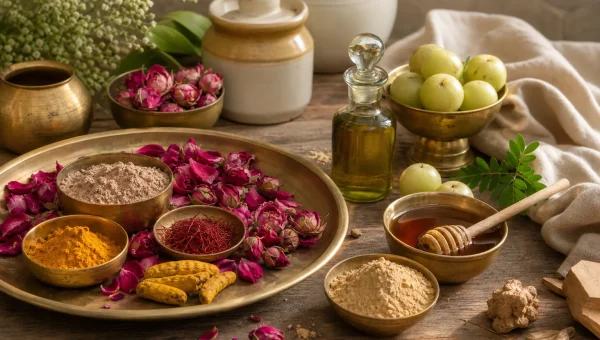
Kumkumadi Taila is a classical medicated oil used in Ayurvedic skincare and cosmetic practice for complexion, uneven tone, and facial blemishes. Classical references and marketed versions vary, but Kumkuma (saffron), Yashtimadhu, and Tila Taila are common ingredients across reviewed formulas. Some classical versions also include ingredients such as Lodhra, Priyangu, Laksha, milk or goat milk, and in certain references mineral or animal-derived ingredients. For facial use, choose a reputable manufacturer that clearly lists the ingredients and intended external use.
- Cleanse your face with lukewarm water and a gentle, non-scrubbing cleanser. Pat dry.
- Take 2-4 drops of Kumkumadi Taila on your fingertips.
- Apply first to dark spots and uneven areas, then spread any remaining oil lightly over the face.
- Massage gently for 1-3 minutes using upward and outward strokes. Do not rub hard.
- If your skin is oily, acne-prone, or sensitive, leave it on for 30-60 minutes and wash off. If your skin tolerates oils well, it may be left overnight.
- Wash off in the morning with lukewarm water and apply sunscreen after your morning routine.
Sourcing caution: authentic Kumkumadi Taila is costly to make because real saffron is expensive. Avoid products that make extreme whitening promises, do not disclose ingredients, or cause burning and stinging. Irritation can darken existing spots.
Twice Weekly: Mulethi-Saffron Spot Pack
Yashtimadhu or Mulethi is one of the most practical external herbs for uneven tone. Licorice contains glabridin, a constituent associated with tyrosinase and pigmentation pathways in preclinical dermatology work, which is one reason licorice derivatives are used in modern brightening formulas.
DIY Mulethi-Saffron Pack:
- 1 tablespoon Mulethi powder
- 2-3 saffron strands soaked in 1 tablespoon milk, plain water, or rose water for 10 minutes
- Enough liquid to make a smooth paste
- Apply only to hyperpigmented areas or to the full face if your skin tolerates it.
- Leave for 10-15 minutes, then rinse with cool water.
- Make fresh each time. Do not store.
Do not use this pack on broken skin, active rashes, freshly waxed areas, or immediately after retinoids, peels, lasers, or exfoliating acids. If it stings, burns, or leaves redness, stop using it.
The Non-Negotiable: Sun and Visible-Light Protection
Every dark spot protocol depends on daily protection. Sunlight can darken existing melasma and trigger new patches. Visible light can also worsen melasma, especially in darker skin tones, which is why tinted sunscreens with iron oxides are often useful for pigmentation-prone skin.
- Use a broad-spectrum sunscreen with SPF 30 or higher every day.
- For melasma or stubborn facial pigmentation, consider a tinted sunscreen containing iron oxides.
- Reapply at least every two hours when outdoors, and after sweating or swimming.
- Wear a wide-brimmed hat and seek shade during strong sun.
- Choose gentle, fragrance-free skincare if your skin is easily irritated.
This is not optional. Without photoprotection, even the best herb, oil, or face pack will struggle because the skin keeps receiving the signal to produce more pigment.
Realistic Timeline: What to Expect
Weeks 1-2: Focus on tolerance. The skin should feel calmer, not raw. If you notice burning, stinging, new redness, or more breakouts, reduce frequency or stop the topical product.
Weeks 3-4: The skin may look slightly more even and less dull if the oil and sunscreen are suitable. Early changes are usually subtle, so photos in the same light are more reliable than memory.
Weeks 5-8: Superficial post-inflammatory marks may start to soften. Deeper melasma usually needs longer and often requires professional care.
Months 3-12: Melasma can be long-lasting and recurrent. Dermatology guidance commonly frames melasma improvement in months, not days, especially when the pigment has been present for a long time.
When to See a Dermatologist
Ayurvedic care can support uneven tone, but some presentations need medical evaluation before home treatment. A dermatologist can confirm whether the pigmentation is melasma, post-inflammatory hyperpigmentation, acanthosis nigricans, a medication effect, a hormonal sign, or another skin condition.
- Any dark spot that changes size, shape, color, border, or begins itching, hurting, or bleeding
- Pigmentation that appears suddenly without a clear trigger
- Pigmentation with fatigue, weight change, hair loss, irregular periods, or other systemic symptoms
- Dark, velvety pigmentation around the neck, underarms, or folds
- Pigmentation that does not improve after 3 months of consistent, non-irritating care and sun protection
Dermatological treatments such as prescription creams, azelaic acid, chemical peels, microneedling, or laser procedures may be appropriate for some people. If you combine Ayurveda with dermatology, tell both practitioners what you are using so that oils, herbs, exfoliants, and procedures do not conflict.
Hyperpigmentation did not appear overnight, and it rarely disappears overnight. A consistent 8-week routine built around practitioner-guided internal support, Kumkumadi Taila if tolerated, a gentle Mulethi pack, and rigorous sun protection gives the skin a realistic chance to become calmer and more even. Take a clear photo at the start, then repeat it at 4 and 8 weeks in the same lighting and angle.
Disclaimer: This article is for informational purposes only and is not a substitute for medical care. Always patch-test new topical products. Consult a qualified Ayurvedic practitioner and your healthcare provider before taking internal herbs, especially if you are pregnant, breastfeeding, using hormonal medication, managing liver disease, autoimmune disease, or taking prescription medicines.
References
- Management of Vyanga (facial melanosis) with Arjuna Twak Lepa and Panchanimba Churna (2014), PubMed Central
- Ayushdhara (ayushdhara.in)
- Aad (aad.org)
- Aad (aad.org)
- Skin Hyperpigmentation in Indian Population: Insights and Best Practice (2016), PubMed Central
- Ayurvedic Pharmacopoeia of India
- Ayurvedic Pharmacopoeia of India
- NCBI
- Ijapr (ijapr.in)
- Pdfs (pdfs.semanticscholar.org)
- The inhibitory effect of glabridin from licorice extracts on melanogenesis and inflammation (1998), PubMed
- Aad (aad.org)
- Aad (aad.org)
- Aad (aad.org)
I started applying Kumkumadi oil three times a week about two months ago on post-acne marks along my jaw. The marks are noticeably less dark now, though I can’t tell yet if the texture has changed. My skin is Pitta-dominant and prone to redness, and I haven’t had any irritation from it, which I did not expect given how reactive my skin usually is to oils.
How long is a realistic timeline for seeing visible change with a Manjistha-based protocol? I’ve read anywhere from four weeks to six months in different places and I can’t tell if the variation is about formulation, dosage, or skin type. The mechanism described here makes sense to me but I want to go in with realistic expectations before I commit.
The Kumkumadi tailam that’s widely sold commercially varies enormously in quality. My Vaidya stressed that saffron adulteration in cheaper formulations makes a significant difference to outcomes. A note on what to look for on a label — or at least a warning about synthetic saffron substitutes — would make this article more practical for readers who can’t source it traditionally.
This helped me understand Dark Spot Treatment without too much jargon. Would be useful to see a short checklist next.
My grandmother used to apply a homemade Manjistha paste every Sunday and had the most even complexion well into her sixties. I never connected it to the herb until I read something like this. Seeing the mechanism explained — the lymphatic clearing and the Pitta-reducing action — was a recognition moment for something I watched as a child without understanding it.
This helped me understand Dark Spot Treatment without too much jargon. This is the kind of detail readers can test slowly.
The explanation of Bhrajaka Pitta really clarified why my cheekbone spots keep coming back after using vitamin C.
This helped me understand Dark Spot Treatment without too much jargon. The article avoids making it sound like a quick fix.
I’d want to see a clearer note about patch testing before applying Kumkumadi oil, especially for anyone with reactive or sensitized skin. The oils are potent and on compromised skin barriers the saffron and other actives can sometimes cause initial irritation. The efficacy information is great but a caution for first-time users seems worth including.
Taking manjistha powder with warm water twice daily might be easier to remember if paired with meals.
I have the same dark patches along my cheekbones and honestly nothing from the pharmacy has worked long-term. Does Manjistha need to be taken internally or is topical use enough for the kind of hyperpigmentation that comes from old sun damage? I ask because I have a sensitive stomach and I’m hesitant to add another internal herb.
It makes sense that internal heat from spicy food could be aggravating the pigmentation around my mouth.
This helped me understand Dark Spot Treatment without too much jargon. This would be easier to follow with a one-week sample plan.
The kumkumadi oil massage technique described, upward and outward strokes for three to five minutes, seems like a nice addition to my nightly skincare.
Has anyone tried the potato saffron mask and noticed a difference in post acne marks after a couple weeks?
The warning about cheap kumkumadi versions lacking real saffron is helpful; I’ll look for a reputable brand before buying.
The suggestion to patch test any new topical herb mixture feels like a practical step before committing to the eight week protocol.
It’s interesting that the article links liver overload to melasma, something I hadn’t considered before.
Curiosity about guduchi’s role in reducing inflammatory pigmentation makes me wonder if it’s safe to combine with other supplements.
Seeing the timeline of weeks three to four for first signs of improvement gives me a realistic expectation to stay patient.
The protocol’s inclusion of a weekly break to reassess after eight weeks of internal herbs seems wise rather than staying on them indefinitely.
The mention of hormonal fluctuations during pregnancy and PCOS as pitta triggers matches what my dermatologist said about my melasma.
Taking a photo at the same angle and lighting every four weeks seems like a simple way to track progress without guesswork.
The advice to reapply mineral sunscreen every two to three hours outdoors is a reminder I needed for my weekend hikes.
I’m a nurse and while I remain evidence-based, some of these herbs do have decent clinical data. amla in particular has several RCTs behind it.
This is the first Ayurveda article I’ve read that mentions liver monitoring for long-term herb use. More should do this.
Just started my Ayurveda journey at 45. Better late than never. The dosage chart in this post is very helpful for beginners.
Exactly what I was thinking. Same results on my end after about 9 weeks.
I liked the practical side of Dark Spot Treatment. I would still ask a practitioner before changing medicines.
My sleep has always been my biggest health challenge. The herbs mentioned here for Vata imbalance are exactly what my practitioner prescribed.
Reading this in 2027, still very relevant. The information about brahmi quality sourcing is especially important now.
Reading this from Singapore where good Ayurvedic practitioners are hard to find. Self-managing based on articles like this until I can afford to visit India.
This helped me understand Dark Spot Treatment without too much jargon. I would still ask a practitioner before changing medicines.
Started this protocol after seeing my thyroid get worse over winter. Only 2 weeks in so can’t say much yet.
Do you need to cycle off ginger after a few months or can it be taken continuously?
Doing a proper elimination diet alongside the herbal protocol. Hard to separate which intervention is producing which result but overall feeling better.
The article got the dosage range right for guduchi. two capsules twice daily is what most studies use. ❤️
My anxiety testing shows measurable improvement at the 3-month mark. The herbal protocol is one of several changes I made but it’s likely contributing.
The advice around Dark Spot Treatment is specific enough to be useful. A few more examples would still help.
I’m a nurse and while I remain evidence-based, some of these herbs do have decent clinical data. brahmi in particular has several RCTs behind it.
For what it’s worth, I’ve tried most mainstream approaches for my sleep with limited success. Now giving this a proper 6-month trial.
The mention of 600mg KSM-66 as the research-backed dose for brahmi aligns with what I see in the PubMed abstracts I’ve been reading.
Been experimenting with brahmi for my hair loss for about a month. Still early days but the bloating is slightly less.
Grew up in a household where turmeric was just part of the kitchen. Now understanding the science behind it in adulthood is satisfying.
I’ve now tried this protocol for two full seasons. The winter results were better than summer for my particular condition, which matches Vata theory.