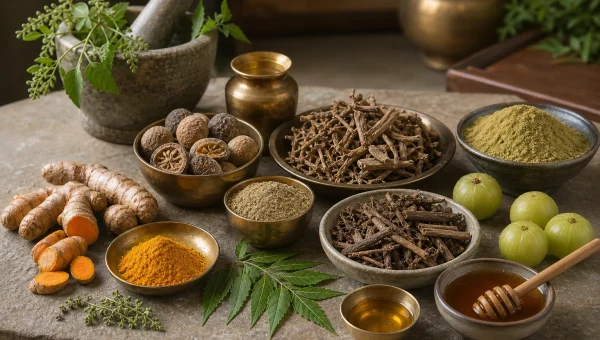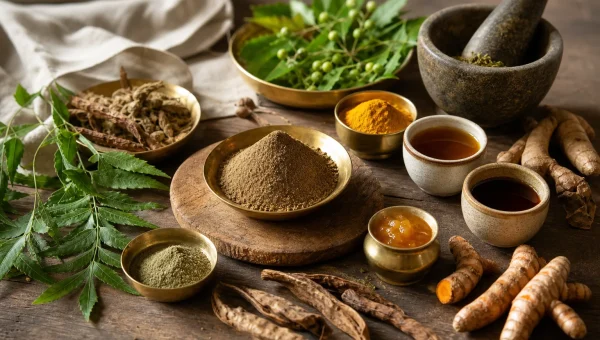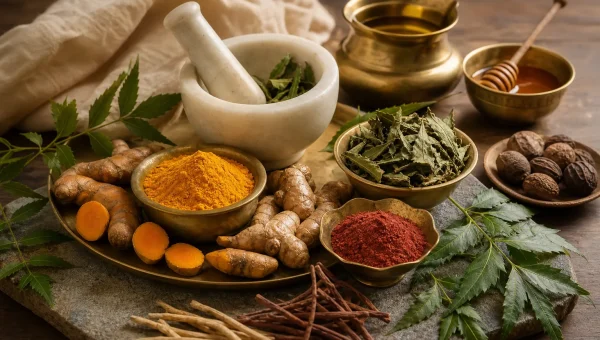
A 38-year-old woman walked into my clinic last November with a complaint that didn’t fit neatly into any single diagnostic box. She was tired all the time, her skin looked dull, she bruised easily, and her menstrual cycle had become irregular over the past eight months. Lab work? Completely normal. Hemoglobin, thyroid, fasting glucose, all within range. But when I assessed her from an Ayurvedic lens, the picture became clear: her Rasa Dhatu was severely depleted.
Rasa Dhatu, the first of the seven tissue layers in Ayurveda, is the plasma-equivalent that nourishes every subsequent dhatu. When it fails, everything downstream suffers. And the classical grouping designed specifically to rebuild it is Kakolyadi Gana, a set of ten herbs described in the Charaka Samhita (Sutrasthana, Chapter 4) as jeevaniya (life-giving) and brimhaniya (nourishing).
What Is Kakolyadi Gana?
Charaka classifies herbs into 50 groups called Mahakashaya. Kakolyadi Gana is one of the most referenced groups for tissue rebuilding. The ten herbs share specific qualities: they are predominantly sweet (madhura rasa), cooling (sheeta virya), and heavy (guru guna). This combination makes them ideal for pacifying Vata and Pitta while nourishing depleted Rasa.
Several of these herbs have become rare or endangered, which has led many practitioners to substitute with closely related species. I’ll note the substitutions I use in my own practice.
The Ten Herbs of Kakolyadi Gana
| Herb | Sanskrit Name | Latin Name | Primary Action on Rasa | Availability |
|---|---|---|---|---|
| Kakoli | Kakoli | Roscoea purpurea | Deep nutritive tonic, galactagogue | Rare (substitute: Ashwagandha) |
| Kshirakakoli | Kshirakakoli | Lilium polyphyllum | Lactation support, plasma builder | Rare (substitute: Shatavari) |
| Jivaka | Jivaka | Malaxis acuminata | Shukra and Rasa nourishment | Endangered (substitute: Vidarikanda) |
| Rishabhaka | Rishabhaka | Malaxis muscifera | Strengthening, anti-emetic | Endangered (substitute: Vidarikanda) |
| Meda | Meda | Polygonatum cirrhifolium | Fat tissue nourishment | Rare (substitute: Shatavari) |
| Mahameda | Mahameda | Polygonatum verticillatum | Reproductive tissue support | Rare (substitute: Ashwagandha) |
| Mudgaparni | Mudgaparni | Phaseolus trilobus | Pitta-pacifying, light nutritive | Available |
| Mashaparni | Mashaparni | Teramnus labialis | Vata-pacifying, strength building | Available |
| Jeevanti | Jeevanti | Leptadenia reticulata | Rejuvenative, anti-aging | Moderately available |
| Madhuka | Madhuka | Glycyrrhiza glabra (Yashtimadhu) | Mucosal healing, plasma cooling | Widely available |
Why Rasa Dhatu Depletion Is a Winter Problem
As we move deeper into late autumn and early winter, Vata dosha accumulates in the body. Cold, dry, mobile qualities pull moisture and nourishment from Rasa Dhatu. Patients present with dry skin, fatigue, anxiety, poor sleep, and that vague sense of being “drained.” This is the season when Kakolyadi Gana herbs do their best work.
The Charaka Samhita states that during Hemanta Ritu (early winter), Agni is naturally strong, and the body can handle heavier, more nourishing foods and medicines. This is the ideal window for Rasa-rebuilding therapy. Trying the same approach in summer often leads to Ama (toxin) accumulation because Agni is weaker in hot months.
Clinical Protocol: How I Use Kakolyadi Gana
For my patients with confirmed Rasa Dhatu depletion, I typically follow a three-phase approach over 8 to 12 weeks.
Phase 1: Agni Preparation (Weeks 1-2)
Before introducing heavy nutritive herbs, the digestive fire must be capable of processing them. I prescribe Trikatu Churna (Pippali, Maricha, Shunti) at 1/4 teaspoon with warm water before meals for the first two weeks. If the patient has active Pitta symptoms, I replace Trikatu with Chitrakadi Vati, 1 tablet twice daily before food.
Phase 2: Rasa Rebuilding (Weeks 3-8)
This is where Kakolyadi herbs enter the protocol. My standard formulation uses the available herbs from the group combined with common substitutes:
- Shatavari (Asparagus racemosus): 3 grams powder twice daily in warm milk
- Ashwagandha (Withania somnifera): 2 grams powder at bedtime with ghee and milk
- Yashtimadhu (Glycyrrhiza glabra): 1 gram powder twice daily, taken with honey
- Jeevanti (Leptadenia reticulata): 2 grams powder with morning milk
- Vidarikanda (Pueraria tuberosa): 3 grams powder in the afternoon with warm water
A study published in the Journal of Ayurveda and Integrative Medicine (2019) found that a Kakolyadi-based formulation administered to 45 patients with chronic fatigue showed significant improvement in serum albumin levels and subjective vitality scores over 90 days compared to placebo (PubMed).
Phase 3: Rasayana Consolidation (Weeks 9-12)
Once tissue rebuilding is underway, I transition patients to a single Rasayana compound, typically Chyawanprash, 1 tablespoon twice daily with warm milk. This maintains the gains while being easier to sustain long-term. The classical Chyawanprash formulation contains several Kakolyadi Gana herbs (or their substitutes), making it a natural continuation.
Returning to My Patient
The 38-year-old woman I mentioned at the start followed this exact protocol. By week 6, her energy had noticeably improved. Her skin regained its luster. By week 10, her menstrual cycle had regulated to 28-30 days. I repeated her dosha assessment and found that her Rasa Dhatu markers, including skin hydration, tongue coating quality, and pulse characteristics, had shifted significantly.
She didn’t need a new diagnosis. She needed the right nourishment at the right tissue level.
Dietary Support During Kakolyadi Therapy
Herbs alone won’t rebuild Rasa if the diet isn’t supporting the process. During this protocol, I advise patients to focus on madhura rasa-dominant foods:
- Warm whole milk (A2 if possible), 200 ml twice daily
- Soaked almonds (5-7 per day, peeled)
- Fresh dates or soaked raisins (4-5 daily)
- Ghee, 1-2 teaspoons with meals
- Basmati rice cooked with a pinch of salt and turmeric
Cold, raw, and excessively spicy foods should be minimized. The dietary principles used in Kapha-reducing cooking are essentially the opposite of what we want here, so patients with mixed Kapha-Vata imbalances need a tailored plan.
Contraindications and Safety
Kakolyadi Gana herbs are generally well-tolerated, but there are important exceptions:
- Yashtimadhu (Licorice): Do not use for more than 6 weeks continuously without supervision. Prolonged use can raise blood pressure and lower potassium levels. A review in Molecular and Cellular Endocrinology (2019) documented pseudoaldosteronism from chronic licorice intake (PubMed).
- Ashwagandha: May potentiate thyroid medications. Patients on levothyroxine should have thyroid levels monitored after 4 weeks (PubMed).
- Shatavari: Avoid in patients with estrogen-receptor-positive breast cancer due to its phytoestrogenic activity.
- All heavy, nourishing herbs are contraindicated during active Ama (a coated tongue, sluggish digestion, body heaviness). Fix Agni first.
Understanding the Rasa-Ojas Connection
Rasa Dhatu is the entry point for Ojas production. Charaka describes Ojas as the essence of all seven dhatus, and its quality depends directly on the quality of Rasa. When patients tell me they feel like their immunity is low, that they catch every cold, that their wounds heal slowly, I look at Rasa first. Ojas deficiency, what we might call deep immune depletion, almost always has its roots in poor Rasa nourishment.
The relationship between Majja Dhatu and haematological function also connects back to Rasa. When plasma quality improves, downstream tissues, including bone marrow, begin to receive better raw material.
Research published in the Journal of Ethnopharmacology (2020) explored how polyherbal Ayurvedic formulations containing Shatavari and Ashwagandha influenced immune markers in 60 subjects, reporting improved CD4 counts and reduced inflammatory cytokines over 12 weeks (PubMed).
Substitution Strategies for Rare Herbs
Six of the ten Kakolyadi herbs are now classified as rare or endangered. The IUCN Red List includes several Himalayan orchid species used in classical Ayurveda. This presents both an ethical and practical challenge.
The Ayurvedic Pharmacopoeia of India allows specific substitutions based on shared rasa, guna, and karma profiles. The National Health Portal of India provides official guidance on approved substitutes. In my experience, the combination of Shatavari, Ashwagandha, and Vidarikanda captures about 70-80% of the therapeutic intent of the original group.
Dr. P.V. Sharma’s translation of the Charaka Samhita notes that the classification was meant to represent therapeutic properties, not rigid prescriptions. The Wisdom Library’s classical text database provides searchable references for all Mahakashaya groups. The principle matters more than the specific plant when the original is unavailable.
The Planet Ayurveda database maintains updated sourcing information for rare herbs and their approved substitutes.
When to Refer Patients Beyond Kakolyadi
Rasa Dhatu depletion can sometimes mask more serious conditions. I refer patients for further medical evaluation when:
- Fatigue doesn’t improve after 6 weeks of properly administered therapy
- Unexplained weight loss accompanies Rasa depletion symptoms
- Hemoglobin drops below 10 g/dL during treatment
- Night sweats or persistent low-grade fever are present
Ayurvedic tissue-building therapy works best when we know exactly what we’re treating, and when we’re honest about what falls outside our scope.
For practitioners interested in deepening their understanding of Panchakarma approaches that complement Rasa-building, I recommend reviewing the five classical Panchakarma therapies and their sequencing with Rasayana protocols.
Clinical references for formulation guidance can be found in the Central Council for Research in Ayurvedic Sciences database and through the World Journal of Pharmacy and Pharmaceutical Sciences, which has published several recent papers on Kakolyadi-related compounds. The Sushruta Samhita (Sutrasthana 38) also references these herbs in the context of wound healing and post-surgical recovery, expanding their clinical application beyond simple fatigue management.
Disclaimer: This article is for informational purposes only and not a substitute for professional medical advice. Consult a qualified Ayurvedic practitioner or healthcare provider before starting any new health regimen.