Ankle Sprain Ayurvedic Recovery: The Pada Marma and Upanaha Protocol
Ankle sprain Ayurvedic recovery is best understood as a phased plan: protect the injured ankle during the first acute phase, then shift into warmth, gentle oil work, Pada Marma awareness, and graded movement once heat and rapidly increasing swelling have settled. Ayurveda does not reject early swelling control; it adds Upanaha Sweda, a warm medicated poultice-and-bandage method, and careful work around the Gulpha region so the ankle is gradually restored to mobility, steadiness, and confidence under load.
Ankle sprains are among the most common musculoskeletal injuries, and the usual injury is a roll of the foot that stresses the lateral ankle ligaments. In the United States, roughly 25,000 people experience an ankle sprain each day. The important Ayurvedic correction is not to replace all first-aid care with heat, but to avoid letting the ankle remain in a passive “rest only” state after the first acute window. Once fracture and severe rupture are excluded, recovery should address pain, swelling, stiffness, Vata-type guarding around the Gulpha region, and the proprioceptive deficit that often leaves the ankle vulnerable to repeat sprain.
Grading Ankle Sprains in Ayurvedic Terms
Grading matters because the same poultice or Marma routine is not appropriate for every ankle injury. A mild sprain may progress quickly into movement work, while a complete rupture or fracture-like presentation needs medical assessment before any heat, massage, or pressure is used. In Ayurvedic language, the injury can be approached as Abhighata, or trauma, to the Gulpha Sandhi and its Snayu support structures.
| Grade | Modern Classification | Ayurvedic Working Pattern | Primary Treatment Direction |
|---|---|---|---|
| Grade I | Mild stretch or small fiber injury without clear instability | Abhighata to Gulpha/Sandhi with mild Snayu strain, Shotha, and Shula | Protection, compression, elevation, short icing if helpful; gentle active movement as pain allows; no heating poultice until acute heat settles |
| Grade II | Partial ligament tear with swelling, bruising, pain, and some looseness | Partial Snayu injury at Gulpha with stronger Vata guarding and local swelling | Medical assessment if weight-bearing is difficult; protected support; Upanaha only after the hot acute phase; Marma work after tenderness reduces; physiotherapy-led strengthening |
| Grade III | Complete ligament tear with marked instability; may resemble fracture | Severe Gulpha/Snayu trauma requiring diagnosis before local therapy | Orthopedic or urgent medical evaluation first; avoid heat, deep massage, forceful Marma, or walking practice until cleared |
| Chronic instability | Repeated sprains, giving-way sensation, poor balance, or persistent looseness | Vata-dominant chronic Gulpha dysfunction with weak Snayu support and impaired ankle control | Daily balance training, strengthening, Vata-pacifying external oil care, footwear/support review, and practitioner-guided rehabilitation |
The Upanaha Sweda Poultice: Active Healing After the Acute Phase
Upanaha Sweda is a localized Swedana method in which a warm semi-solid herbal paste is applied to the affected part and then covered or bandaged. For ankle sprain recovery, its place is the subacute stage, not the first hot, red, rapidly swelling stage. During the first 48-72 hours, heat and massage can aggravate swelling, so the Ayurvedic poultice begins only when the acute heat has settled, swelling is no longer rapidly increasing, and fracture or severe rupture is not suspected.
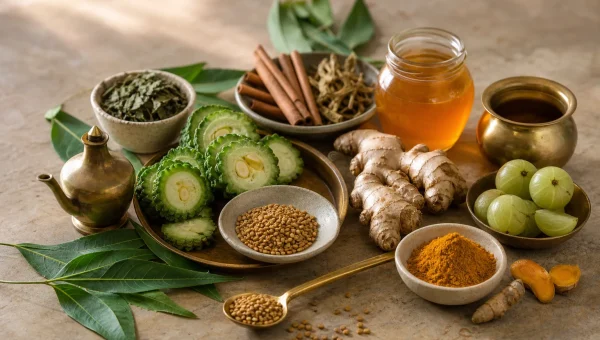
Simple Upanaha paste for a closed-skin Grade I-II sprain after the acute phase:
- Haridra (turmeric) powder: 2 parts. Classically, Haridra is Katu-Tikta in rasa, Ruksha in guna, Ushna in virya, and Katu in vipaka.
- Shunthi (dry ginger) powder or a small amount of fresh ginger paste: 1 part. Shunthi is Katu in rasa, Laghu-Snigdha in guna, Ushna in virya, Madhura in vipaka, and Vata-Kapha pacifying.
- Saindhava lavana (rock salt): a small pinch, optional. Omit it if the ankle is still hot, red, irritated, or the skin is sensitive.
- Warm sesame oil or warm water: enough to bind the powders into a thick, spreadable paste.
- Optional thickener: roasted sesame seed flour or wheat flour, used only to keep the paste from running.
Patch test the paste first. Apply it only over intact skin, never over cuts, blisters, infection, dermatitis, or numb areas. Spread a 3-5 mm layer around the ankle rather than pressing directly into the most painful ligament line. Cover with a clean cotton cloth and keep the application warm, not hot. For home use, begin with 30-45 minutes, then remove, rinse gently, dry the area, elevate the ankle, and reassess swelling and skin comfort. Stop immediately if burning, itching, rash, throbbing, or increased swelling appears.
After the poultice is removed and the ankle feels comfortable, use gentle active movement instead of forceful stretching. Ankle alphabet movements, slow circles, and pain-free dorsiflexion and plantarflexion are preferable to aggressive pulling or deep kneading. Warm plain sesame oil or a practitioner-chosen medicated oil may be used lightly around the calf, sole, and non-tender areas after the acute phase, but massage should not be used over fresh bruising, marked heat, or severe swelling.
Pada Marma Points for Ankle Recovery
Pada Marma work should be gentle, precise, and delayed until the ankle is no longer in the hot acute stage. The goal is not to “break up” swelling or push through pain. Classical Marma descriptions place Gulpha at the ankle joint, Talahridaya at the center of the sole, and Kshipra in the web space between the great toe and the next toe. In a sprain protocol, these points are used as light oil-touch and awareness points alongside functional rehabilitation.
Gulpha Marma: Gulpha is the ankle joint region at the junction of the foot and leg, and it is classed as a Sandhi Marma. Begin only after sharp tenderness and heat have reduced. Place the fingertips lightly around the medial and lateral ankle, avoiding direct pressure on the most painful ligament. Use slow circular touch for 30-60 seconds, then pause and observe whether the ankle feels calmer. Any sharp pain is a signal to stop.
Talahridaya Marma: Talahridaya is located in the center of the sole. This point is useful in the early subacute stage because it allows foot contact without pressing the injured ankle directly. Apply a small amount of warm oil to the center of the sole and use gentle circular touch for 1-2 minutes, keeping the ankle supported and relaxed.
Kshipra Marma: Kshipra lies in the web space between the great toe and the second toe. Use very light contact or small circular movement for 30-60 seconds. This point is away from the torn ligament area and can be included when the forefoot is tense from guarding, but it should never be dug into or used forcefully.
The 3-Week Active Recovery Protocol
The following timeline is for uncomplicated Grade I-II sprains after fracture and complete rupture have been reasonably excluded. Pain, swelling, ability to bear weight, and ankle stability should guide progression. A sprain that is worsening, severely swollen, visibly deformed, numb, or unable to bear weight needs medical assessment rather than home treatment.
Phase 1: Hours 0-48/72, acute protection
- Protect the ankle from further rolling; use support, compression, and elevation.
- Use short periods of icing if it reduces pain and swelling, with cloth protection for the skin.
- Avoid heat, hot baths, alcohol, running, forceful stretching, and massage.
- Move the toes and knee gently to prevent unnecessary stiffness.
- Seek assessment if there is bony tenderness, inability to take four steps, deformity, numbness, or severe swelling.
Phase 2: Days 3-7, early repair and gentle movement
- Begin Upanaha only if heat and rapidly increasing swelling have settled.
- Use the poultice once daily, reassessing skin and swelling each time.
- Begin pain-free ankle alphabet movements and slow active range-of-motion work.
- Use light Talahridaya and Kshipra oil-touch; avoid firm Gulpha pressure if the ankle is still very tender.
- Walk only as tolerated, preferably with support if gait is altered.
Phase 3: Week 2, rebuilding motion and support
- Continue Upanaha only if stiffness and dull soreness remain; shift to light oil care if warmth feels excessive.
- Add gentle Gulpha Marma contact around, not into, the painful ligament line.
- Progress to supported weight-bearing, heel raises, and resistance-band movements under appropriate guidance.
- Restore normal walking before attempting running, jumping, or sport drills.
Phase 4: Week 3 and beyond, remodeling and stability
- Practice single-leg balance for 20-30 seconds at a time, beginning with eyes open and a stable surface.
- Progress gradually to eyes closed, a folded mat, calf raises, side steps, and sport-specific drills only when pain-free.
- Return to sport only after full pain-free range of motion, near-equal strength, stable balance, and comfortable hopping or cutting mechanics.
- Continue physiotherapy or supervised rehabilitation if the ankle gives way, swells after activity, or feels unreliable.
The Proprioception Deficit: Restoring Stability After Pain Improves
A common reason for repeated ankle sprain is not just weak ligament tissue, but poor proprioception: the ankle’s ability to sense position and react quickly. Injury can disturb the mechanoreceptors and reflexive muscle control that normally protect the joint. Ayurveda describes the same recovery need in functional language: the Gulpha region should become mobile, steady, warm, responsive, and trustworthy again, not merely less painful.
Pada Marma and oil work can help bring calm attention back into the foot, but balance training is the practical foundation for preventing repeated sprain. Begin with a supported single-leg stand near a wall or chair. Progress only when there is no sharp pain, no giving-way sensation, and no next-day swelling increase. The goal is smooth control, not heroic endurance.
Internal Herbs and Diet: Keep It Individualized
The core home protocol for ankle sprain is external care plus rehabilitation. Internal herbs are not a universal self-prescription. A qualified Ayurvedic practitioner may choose Haridra, Shunthi, Ashwagandha, Shallaki, or other dravyas depending on prakriti, agni, swelling pattern, medications, digestion, pregnancy status, and overall health. Ashwagandha, for example, is classically Rasayana, Balya, and Vata-Kapha pacifying, but that does not make it automatic for every acute swollen ankle.
During recovery, keep meals warm, simple, and adequate, avoid alcohol during the acute swelling phase, and prioritize sleep. If using any supplement, avoid stacking multiple anti-inflammatory herbs without guidance, especially when taking blood thinners, diabetes medication, blood pressure medication, sedatives, thyroid medication, or when preparing for surgery.
Safety and When to Seek Care
Do not use Upanaha, heat, deep massage, or forceful Marma work for a severely swollen ankle, open wound, suspected fracture, complete rupture, infection, numbness, diabetic neuropathy, poor circulation, or unexplained calf pain. Medical evaluation is needed when there is inability to bear weight, tenderness over the ankle or midfoot bones, deformity, rapidly increasing swelling, persistent instability, or pain that does not improve as expected.
Medical Disclaimer: Grade III ligament tears, fractures, tendon injuries, and vascular or nerve symptoms require medical diagnosis and appropriate care. This Upanaha and Pada Marma protocol is educational support for uncomplicated Grade I-II sprains after serious injury has been excluded. Return to sport should be guided by a qualified physiotherapist, sports medicine clinician, or orthopedic professional when instability, pain, or recurrent sprain is present.
Nothing in this article diagnoses or treats a medical condition. Consult a qualified Ayurvedic practitioner or healthcare provider before starting herbs, supplements, poultices, Marma therapy, or therapeutic protocols, especially if pregnant, managing a medical condition, using prescription medication, or recovering from a significant injury.
References
- Orthoinfo (orthoinfo.aaos.org)
- Ucsfhealth (ucsfhealth.org)
- Healthdirect (healthdirect.gov.au)
- Aci (aci.health.nsw.gov.au)
- Chelwest (chelwest.nhs.uk)
- NHS
- Rehabilitation of the Ankle After Acute Sprain or Chronic Instability (2002), PubMed Central
- An Updated Model of Chronic Ankle Instability (2019), PubMed Central
- Lateral Ankle Sprain and Chronic Ankle Instability (2019), PubMed Central
- Chronic ankle instability is associated with proprioception deficits: A systematic review and meta-analysis (2021), PubMed Central
- Systematic review of postural control and lateral ankle instability, part II: is balance training clinically effective? (2008), PubMed Central
- THE EFFECT OF BRACING AND BALANCE TRAINING ON ANKLE SPRAIN INCIDENCE AMONG ATHLETES: A SYSTEMATIC REVIEW WITH META-ANALYSIS (2018), PubMed Central
- Ayushdhara (ayushdhara.in)
- Pranavaayurveda (pranavaayurveda.co.uk)
- Healingearth (healingearth.co.in)
- Ayurvedic Pharmacopoeia of India
- Ayurvedic Pharmacopoeia of India
- Hjhs (hjhs.co.in)
- Ijrap (ijrap.net)
- Easyayurveda (easyayurveda.com)
- Ayushdhara (ayushdhara.in)
- Blood pressure normalizing effect of Talahridaya marma therapy: A case report (2021), PubMed Central
- Easyayurveda (easyayurveda.com)
- NCCIH
- NCCIH