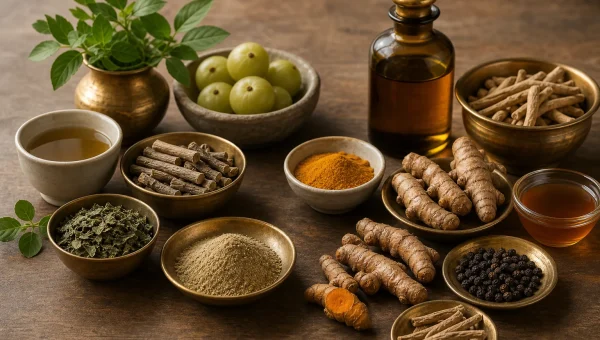
Thyroid Gut Health Ayurveda: The Clinical Connection
Thyroid gut health Ayurveda is best understood as a co-management framework for patients whose thyroid symptoms appear alongside constipation, bloating, low appetite, heaviness after meals, coldness, and fatigue. It does not replace thyroid diagnosis, thyroid function testing, or prescribed levothyroxine. Its value is in reading the digestive pattern that often travels with hypothyroidism: slowed gastrointestinal motility, difficult bowel clearance, weak appetite, and kapha-vata heaviness around the abdomen.
In Ayurvedic assessment, koshtha is the functional digestive chamber and bowel-reactivity pattern. It is traditionally observed as mridu (soft/easy), madhyama (moderate), or krura (hard/slow). Many hypothyroid presentations resemble krura koshtha with mandagni: hard or infrequent stools, delayed urge, bloating, belching, a coated tongue, sleepiness after meals, and incomplete evacuation. This pattern is not a label for the thyroid gland itself; it is the gut expression that must be treated alongside endocrine care.
The Gut-Thyroid Axis: Modern Physiology and Ayurvedic Parallels
The practical connection rests on four links: thyroid hormones influence digestive motility; the gut determines the consistency of levothyroxine absorption; intestinal barrier and microbiota activity shape immune traffic relevant to autoimmune thyroid conditions; and the gut absorbs iodine, selenium, zinc, iron, and other micronutrients needed for thyroid hormone synthesis and metabolism.
T4 is converted to active T3 by human iodothyronine deiodinases, especially D1 and D2, and selenium is required for several selenoproteins involved in thyroid hormone metabolism. The gut microbiota contributes through immune modulation, micronutrient availability, and deconjugation of iodothyronines that supports enterohepatic cycling. This makes the gut a support system for thyroid physiology without making it a substitute for the thyroid gland or thyroid medicine.
Ayurvedically, weak jatharagni leads to incomplete processing of food and the formation of ama. Ama with vata-kapha obstruction can disturb rasa-dhatu flow, create heaviness and swelling tendencies, and make herbal or nutritional support less predictable. Classical thyroid-like neck swelling is discussed under galaganda, while related glandular swelling is discussed under gandamala. Kanchanara Guggulu belongs to this kapha-meda, granthi-like terrain and is traditionally combined with digestive and channel-clearing herbs rather than standing as a single “thyroid stimulant.”
Diagnosing the Pattern: Koshtha Assessment in Hypothyroid Patients
A structured koshtha assessment identifies which part of digestion needs priority attention before stronger thyroid-supportive formulations are introduced. Track the pattern weekly, because bowel rhythm changes with diet, sleep, medication timing, stress, menstrual cycle, travel, and season.
- Bowel frequency and stool quality: Less than one comfortable bowel movement daily, hard stools, pellet-like stools, or repeated straining suggest krura koshtha with vata accumulation in the lower bowel. Sticky, heavy, mucous-coated stools suggest kapha-ama obstruction in addition to vata.
- Appetite and meal response: Low appetite, early fullness, belching, sleepiness after food, and heaviness after moderate meals suggest mandagni. In this state, large meals, cold drinks, and heavy dairy preparations often deepen the sluggish pattern.
- Bloating location: Upper abdominal bloating after meals points toward weak stomach-level digestion, while lower abdominal gas and delayed evacuation point toward pakwashaya vata. Both may be present in hypothyroid constipation.
- Transit observation: A simple food-marker observation with beetroot or sweet corn can roughly show how long food takes to appear in stool. This is not a diagnostic test, but a persistently slow pattern supports the need to restore koshtha function.
- Medication timing: Ask exactly when levothyroxine is taken and whether it is taken near calcium, iron, antacids, high-fiber supplements, coffee, milk, or herbal formulas. Poor timing can mimic treatment failure.
Kanchanara-Centered Protocol for Thyroid-Gut Co-Management
Kanchanara Guggulu is appropriate only when a qualified Ayurvedic physician identifies a kapha-vata, kapha-meda, galaganda-gandamala, or granthi-like pattern. It is not a replacement for levothyroxine and should not be self-started, especially in pregnancy, lactation, hyperthyroid tendencies, autoimmune thyroid disease, liver disease, or when multiple medicines are being used.
A safer sequence is to establish koshtha and agni before escalating glandular formulas. Triphala may be used at night when the main problem is sluggish elimination, while Trikatu may be used in small, individualized amounts when appetite is dull and kapha heaviness dominates. Trikatu is heating and is not suitable for everyone; it should be avoided or modified in marked acidity, burning, loose stools, pregnancy, or high pitta presentations.
Kanchanara Guggulu traditionally contains Kanchanara, Varuna, Triphala, Trikatu, Trijataka, and purified Guggulu. This classical architecture itself shows the combined logic: glandular swelling, kapha-meda clearing, bowel regulation, agni support, and channel movement are addressed together. In hypothyroid patients with constipation, the bowel and agni work should not be treated as optional add-ons.
| Phase | Gut and Agni Focus | Thyroid-Supportive Focus | Dietary Focus |
|---|---|---|---|
| Weeks 1-2 | Correct constipation, meal timing, appetite, bloating, and sleep. Triphala or mild bowel support only when suitable. | Continue prescribed thyroid medicine; do not alter dose without the prescribing physician. | Warm, cooked, light meals; avoid cold drinks, overeating, and heavy late dinners. |
| Weeks 3-6 | Add individualized agni support such as Trikatu only when kapha-mandagni is clear and pitta signs are absent. | Kanchanara Guggulu may be introduced only if prescribed after koshtha assessment. | Use pathya foods such as barley, green gram, bitter gourd, and drumstick when suitable. |
| Weeks 7-12 | Maintain daily bowel clearance, regular meals, warm water, and moderate movement. | Adjust herbs only with practitioner review and thyroid laboratory monitoring. | Ensure adequate dietary iodine and selenium through appropriate foods rather than unsupervised high-dose supplements. |
| Maintenance | Use the minimum support needed to keep appetite, stools, sleep, and energy stable. | Continue thyroid follow-up; review herbs whenever medication dose, symptoms, or lab values change. | Apply seasonal adjustments: lighter in kapha season, warmer and more unctuous in vata season. |
Selenium, Iodine, and Food-Based Thyroid Support
Iodine is an essential structural component of T4 and T3, while selenium is needed for thyroid hormone metabolism through selenoproteins. The Ayurvedic approach should not turn these minerals into aggressive supplementation by default. Food-based support is preferred unless a clinician documents deficiency or a clear therapeutic need.
Sesame seeds, legumes, nuts, whole grains, and regionally appropriate mineral-containing foods may support the broader thyroid diet, but selenium content varies with soil and food source. Seaweed and kelp should not be used casually for hypothyroidism because iodine excess can aggravate thyroid dysfunction in susceptible patients. In India, iodized salt remains the practical public-health iodine source for many households, but patients with thyroid disease should follow their physician’s advice on iodine intake.
Fermented Foods and Microbiome Support
Fermented foods are useful only when agni can receive them. Ayurveda uses preparations such as dhanyamla, kanji, peya, and takra as light sour supports for digestion, seasonal balance, and bowel function. They should be introduced in small amounts and adjusted according to appetite, acidity, stool quality, and kapha-pitta response.
For hypothyroid patients with constipation and heaviness, thin spiced takra after lunch, small amounts of vegetable kanji, or properly prepared dhanyamla may be preferable to heavy, sweet, thick dairy ferments. If there is reflux, burning, loose stool, histamine sensitivity, or pitta aggravation, sour ferments should be reduced or avoided. Microbiome support belongs inside agni assessment, not as a universal probiotic rule.
The agni restoration framework provides the practical foundation: food, herbs, ferments, and thyroid medicine work more predictably when appetite, bowel rhythm, and post-meal comfort are stable.
Levothyroxine Timing and Ayurvedic Preparation Interactions
Patients taking levothyroxine alongside Ayurvedic care require strict timing separation. Levothyroxine is usually taken with plain water on an empty stomach, 30-60 minutes before breakfast, or several hours after the last meal when prescribed that way. Calcium, iron, antacids, some gastric medicines, high-fiber supplements, and many mineral-containing preparations can reduce absorption if taken too close to levothyroxine.
A practical morning schedule is simple: take levothyroxine on waking with plain water, then wait before food, tea, coffee, supplements, or herbs. Ayurvedic medicines, Triphala, Kanchanara Guggulu, mineral preparations, iron, calcium, and high-fiber products should be separated from levothyroxine by several hours unless the prescribing physician gives different instructions. Kanchanara Guggulu, when prescribed, is often easier to place before lunch and dinner, while Triphala is commonly placed at bedtime.
Thyroid labs should be reviewed after medication changes and whenever new thyroid-active herbs are added or symptoms shift. Ashwagandha requires particular caution: it may affect thyroid hormone levels in some patients and has been linked to hyperthyroid-like reactions in susceptible individuals. Any plan that combines levothyroxine, Kanchanara Guggulu, ashwagandha, mineral preparations, or iodine-containing foods should be supervised.
Lifestyle Factors Connecting Gut and Thyroid
Daily rhythm is medicine for both agni and thyroid balance. Irregular meals, late nights, chronic stress, long sedentary periods, and cold food habits aggravate vata and weaken the digestive rhythm. A hypothyroid gut usually responds better to consistency than intensity: regular meal timing, warm cooked food, warm water, and daily bowel routine.
Gentle pranayama, meditation, and yoga may support stress regulation, which matters because stress chemistry can disturb thyroid signaling, gut barrier function, and bowel motility. Anulom vilom, bhramari, or quiet diaphragmatic breathing can be used as supportive practices, not as substitutes for thyroid medication or medical care.
Movement regularity matters as much as workout intensity. A comfortable walk after lunch or dinner supports bowel movement, insulin sensitivity, and post-meal lightness. Exhaustive training is not ideal when fatigue, coldness, low appetite, and constipation are prominent; intensity can be increased gradually as strength, sleep, and thyroid stability improve.
The thyroid-gut connection reframes what many patients experience as two separate problems into one coordinated pattern. When koshtha, agni, bowel rhythm, food timing, levothyroxine absorption, and thyroid monitoring are handled together, thyroid care becomes more complete and more clinically sensible.
Medical Disclaimer: This content is for educational purposes only and does not constitute medical advice. Thyroid conditions require diagnosis and management by a qualified endocrinologist or physician. Do not start, stop, or change thyroid medication without medical supervision. Thyroid function tests such as TSH, free T4, and free T3 should be monitored as advised by your clinician. Consult a qualified Ayurvedic physician before using Kanchanara Guggulu, Triphala, Trikatu, ashwagandha, mineral preparations, iodine-rich foods, or any herbal protocol alongside conventional thyroid care.
References
- Thyroid disorders and gastrointestinal dysmotility: an old association (2024), PubMed Central
- MedlinePlus
- NIDDK
- Jaims (jaims.in)
- Physiological aspects of Agni (2010), PubMed Central
- Ayurved (ayurved.dpu.edu.in)
- Thyroid-Gut-Axis: How Does the Microbiota Influence Thyroid Function? (2020), PubMed Central
- The relationship between thyroid and human-associated microbiota: A systematic review of reviews (2024), PubMed Central
- NCBI
- A Comprehensive Review of Thyroid Hormone Metabolism in the Gut and Its Clinical Implications (2023), PubMed
- NIH Office of Dietary Supplements
- NIH Office of Dietary Supplements
- Ijapr (ijapr.in)
- Easyayurveda (easyayurveda.com)
- Therapeutic Uses of Triphala in Ayurvedic Medicine (2017), PubMed Central
- Ijrap (ijrap.net)
- Asiapharmaceutics (asiapharmaceutics.info)
- Decoding the Microbial Diversity of Indian Fermented Foods: Integrating Ethnobiology, Multi-Omics and Functional Insights (2026), PubMed Central
- NCBI
- Mayoclinic (mayoclinic.org)
- Efficacy and Safety of Ashwagandha Root Extract in Subclinical Hypothyroid Patients: A Double-Blind, Randomized Placebo-Controlled Trial (2018), PubMed
- Ashwagandha as a Unique Cause of Thyrotoxicosis Presenting With Supraventricular Tachycardia (2022), PubMed Central
- NCBI
- Physiological Role and Use of Thyroid Hormone Metabolites – Potential Utility in COVID-19 Patients (2021), PubMed Central
- Psychosocial stress-induced intestinal permeability in healthy humans: What is the evidence? (2023), PubMed Central
- Health Impacts of Yoga and Pranayama: A State-of-the-Art Review (2012), PubMed Central
- Exercise therapy in patients with constipation: a systematic review and meta-analysis of randomized controlled trials (2019), PubMed
- Healthlinkbc (healthlinkbc.ca)
- Nationwidechildrens (nationwidechildrens.org)
- Fdc (fdc.nal.usda.gov)
- NCCIH