
Daruharidra (Berberis aristata): The Yellow Root-and-Stem Herb for Eyes, Gut, Skin, and Liver Support
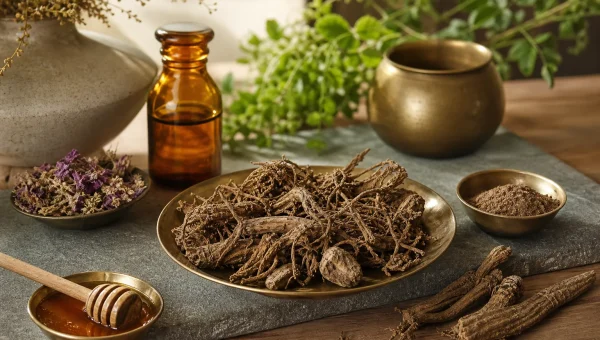
Daruharidra, commonly associated with “tree turmeric” or Indian barberry, is valued in Ayurveda for its bitter taste, drying nature, and striking yellow inner wood. In the Ayurvedic Pharmacopoeia of India, the official single-drug identity is the dried stem of Berberis aristata DC. of the Berberidaceae family. Its yellow xylem, bitter taste, and alkaloid-rich profile make it one of the classical bitter-clearing herbs used where kapha-pitta accumulation appears in the eyes, gut, skin, mouth, wounds, and metabolic channels.
The modern conversation around daruharidra often centers on berberine, a yellow alkaloid found in Berberis species. Berberine is not the whole herb, but it helps explain why daruharidra has remained important in traditional formulas and contemporary herbal practice. Ayurveda looks first at the whole dravya—its rasa, guna, virya, karma, preparation, dose, and patient suitability—while modern pharmacology often studies isolated or standardized berberine preparations.
Classical Profile
The Ayurvedic Pharmacopoeia of India gives a concise official profile for daruharidra stem. In that monograph, rasa, guna, virya, karma, therapeutic uses, and dose are listed; vipaka and a separate dosha-shamana line are not given in the same official stem entry.
| Classical Point | Daruharidra Stem Profile | Practical Ayurvedic Meaning |
|---|---|---|
| Official drug identity | Dried stem of Berberis aristata DC. | The yellow stem wood is the official API drug part for this monograph. |
| Rasa | Tikta (bitter) | Bitter herbs are traditionally used to clear heat, dampness, ama, and pitta-kapha patterns. |
| Guna | Ruksha (dry) | The drying quality suits sticky, moist, oozing, kapha-dominant presentations. |
| Virya | Ushna (hot potency) | The heating potency supports dosha-pachana and helps penetrate sluggish kapha states. |
| Karma | Stanya Shodhana, Stanya Doshahara, Dosha Pachana | The official action language emphasizes cleansing, correcting deranged secretions, and digesting accumulated dosha. |
| Therapeutic uses listed | Kandu, Medoroga, Mukharoga, Vrana, Amatisara, Urustambha, Kapharoga, Karnaroga, Netraroga, Meha | These uses connect daruharidra with itching, metabolic disorders, mouth disease, wounds, mucus-associated diarrhea, stiffness, kapha disorders, ear disease, eye disease, and urinary-metabolic conditions. |
| API dose form | Kvatha, 5–10 ml | Decoction use should be individualized by a qualified practitioner, especially for active disease. |
How This Yellow Herb Works in Ayurvedic Logic
Daruharidra is not simply a “natural antibiotic.” In Ayurveda, its importance comes from the way bitter rasa, dry guna, hot virya, and dosha-pachana karma combine. This makes it useful in patterns where there is sticky secretion, itching, dampness, sluggish metabolism, contaminated discharge, or kapha-pitta obstruction. Its use in the official API indications—especially netraroga, mukharoga, vrana, amatisara, medoroga, meha, and kapharoga—fits this bitter-drying-clearing profile.
In practical terms, daruharidra is often considered when a condition has a yellow, damp, sticky, inflamed, or infected-looking quality, but the herb still needs proper context. A bitter, drying, heating herb can be valuable in the right person and irritating or depleting in the wrong person. This is why classical use depends on formulation, anupana, dose, duration, season, agni, strength, age, and the exact dosha pattern.
The Four Main Pillars: Eyes, Gut, Skin-Mouth-Wounds, and Liver-Metabolic Support
The traditional strength of daruharidra is best understood through four overlapping areas rather than through one isolated compound. Ayurveda places it in eye disease, gut disorders such as amatisara, mouth and wound conditions, kapha disorders, medoroga, and meha; modern literature on Berberis aristata and berberine adds useful pharmacological context without replacing classical diagnosis.
Pillar 1: Eye Care and Rasanjana
Daruharidra’s most distinctive traditional association is with eye care. The API lists netraroga among its therapeutic uses, and traditional concentrated extracts known as rasaut or rasanjana are described in Ayurvedic practice as preparations made from Berberis material for eye-related use. This does not mean that raw powder, homemade decoction, or non-sterile herbal paste should be placed in the eyes.
In classical eye care, rasanjana belongs to specialized ophthalmic practice, not casual home use. The eye is a delicate organ, and redness, pain, discharge, photophobia, corneal injury, blurred vision, contact lens irritation, or suspected infection requires professional examination. If a daruharidra-based eye preparation is used, it should be a properly prepared, sterile, pharmacy-grade product under the supervision of a qualified Ayurvedic ophthalmology practitioner or healthcare provider.
Pillar 2: Gut Health and Amatisara
The API lists amatisara among the therapeutic uses of daruharidra. In Ayurvedic language, amatisara points toward diarrhea associated with ama, kapha, heaviness, mucus, incomplete digestion, and foul or sticky bowel patterns. Daruharidra’s bitter and drying qualities fit this use: it clears, dries, and helps digest accumulated dosha rather than simply soothing the bowel.
Berberine sulfate has been evaluated in adults with acute diarrhea associated with enterotoxigenic Escherichia coli and Vibrio cholerae. In that clinical setting, berberine reduced stool volume in the enterotoxigenic E. coli group after a single oral dose, and earlier experimental work found that berberine inhibited enterotoxin-driven intestinal secretion. This modern antidiarrheal context aligns with the classical placement of daruharidra in amatisara, while still leaving clinical decisions—especially in dehydration, fever, blood in stool, infants, pregnancy, older adults, or chronic bowel disease—to qualified care.
Pillar 3: Skin, Mouth, and Wound Patterns
The API lists kandu, mukharoga, and vrana among daruharidra’s uses. This is a clear classical signal: daruharidra is not limited to the gut. Its bitter, drying, and clearing nature suits itchy, damp, irritated, oozing, or contaminated skin and wound patterns when used in an appropriate formulation.
Traditional rasaut from Berberis aristata has also been described for eye disease, skin disorders, and indolent ulcers. In household language, this is why daruharidra is remembered as a yellow cleansing herb. In clinical practice, external use should still be matched to wound type. Deep wounds, spreading redness, fever, pus, diabetic ulcers, burns, animal bites, and non-healing lesions need medical evaluation rather than home application of herbal paste.
For mukharoga, daruharidra’s role is usually understood through its bitter-astringent, cleansing, and kapha-pitta clearing actions. Gargles, decoctions, and compound formulations may be chosen by practitioners for oral conditions, but persistent mouth ulcers, bleeding gums, loose teeth, oral white patches, or recurrent infections should be assessed by a dentist or physician.
Pillar 4: Liver and Metabolic Support
The API lists medoroga and meha among daruharidra’s therapeutic uses, placing it in the classical field of kapha-medo and urinary-metabolic disorders. Traditional literature and later reviews also associate Berberis aristata with jaundice and liver-spleen conditions. This makes daruharidra relevant to kapha-pitta metabolic patterns, but it should not be treated as a stand-alone cure for fatty liver disease, diabetes, hepatitis, gallbladder disease, or cirrhosis.
Modern clinical literature on berberine includes a randomized trial in non-alcoholic fatty liver disease in which berberine combined with lifestyle intervention produced a larger reduction in hepatic fat content than lifestyle intervention alone. Reviews also discuss berberine’s effects on glucose, lipids, insulin sensitivity, and hepatic fat metabolism. In Ayurvedic practice, this supports daruharidra’s relevance to medoroga-meha patterns, while diet, routine, exercise, sleep, digestive correction, and individualized formulation remain central.
Daruharidra Is Not the Same as Turmeric
Daruharidra and haridra are both yellow and bitter-associated herbs, but they are not interchangeable. Daruharidra is Berberis aristata, with berberine as a key alkaloid, and the official API daruharidra monograph is for the dried stem. Haridra is turmeric, Curcuma longa, a different plant with different classical and phytochemical features. The name “tree turmeric” helps describe daruharidra’s yellow wood, but it should not lead to substituting kitchen turmeric whenever a daruharidra-based formulation is intended.
In practical selection, daruharidra is especially relevant where the picture involves kapha-pitta accumulation, bitter-clearing needs, eye or mouth disorders, damp skin or wound patterns, amatisara, medoroga, meha, and other API-listed indications. Turmeric may be excellent in its own sphere, but yellow color alone is not enough to decide the herb.
Forms and Preparation
Daruharidra appears in several traditional and commercial forms, and the form matters. A decoction, a concentrated rasanjana or rasaut preparation, a powder, a ghana extract, and a standardized berberine capsule are not identical in strength, safety, or intended use.
- Kvatha: The API lists daruharidra stem in kvatha form with a dose of 5–10 ml. This is best understood as a practitioner-guided therapeutic dose, not a casual daily beverage.
- Rasanjana or Rasaut: This is a concentrated extract traditionally associated with eye and skin uses. Ophthalmic use requires sterile, properly prepared product and professional supervision.
- Churna: Powdered daruharidra is used in traditional practice, often as part of a formulation rather than as an isolated long-term supplement. Dose and anupana should be individualized.
- Ghana or tablet extracts: Dry extracts and tablets vary by manufacturer and strength. They should be used according to practitioner direction and product standardization.
- Berberine supplements: Standardized berberine is pharmacologically active and should not be treated as the same thing as mild culinary spice use. It has meaningful drug-interaction potential.
Safety Considerations
Daruharidra and berberine-containing products are potent enough to require caution. Avoid self-prescribing daruharidra for pregnancy, breastfeeding, infants, severe diarrhea, eye infections, liver disease, kidney disease, diabetes, or complex medication use. People taking diabetes medicines, immunosuppressants such as tacrolimus or cyclosporine, cancer medicines, or drugs metabolized through CYP2D6, CYP2C9, or CYP3A4 pathways should consult a qualified healthcare provider before use.
- Pregnancy and breastfeeding: Berberine-containing supplements are generally avoided because of safety concerns, including concerns related to bilirubin displacement and neonatal jaundice risk.
- Diabetes medications: Berberine may lower blood glucose; combining it with glucose-lowering drugs can increase the risk of hypoglycemia.
- Drug interactions: Repeated berberine administration has been associated with inhibition of CYP2D6, CYP2C9, and CYP3A4 activity in humans, which may alter levels of many medicines.
- Digestive side effects: Appetite loss, upset stomach, diarrhea, constipation, or rash can occur in some people.
- Eye safety: Do not place homemade daruharidra preparations, powders, decoctions, or non-sterile extracts in the eyes.
- Duration: Long-term use should be supervised, especially when using standardized berberine extracts or combining daruharidra with other bitter, drying, or glucose-lowering herbs.
Medical Disclaimer: This article is for educational purposes only and does not diagnose, treat, or replace medical care. Daruharidra is a potent Ayurvedic herb, and berberine-containing products can interact with medicines and medical conditions. Consult a qualified Ayurvedic practitioner, physician, ophthalmologist, or other licensed healthcare provider before using daruharidra therapeutically, especially if pregnant, breastfeeding, diabetic, taking prescription medication, treating an eye condition, or managing liver, kidney, gut, or metabolic disease.
References
- Ayurvedic Pharmacopoeia of India
- Quality evaluation of ayurvedic crude drug daruharidra, its allied species, and commercial samples from herbal drug markets of India (2013), PubMed Central
- Mskcc (mskcc.org)
- Berberine: Botanical Occurrence, Traditional Uses, Extraction Methods, and Relevance in Cardiovascular, Metabolic, Hepatic, and Renal Disorders (2018), PubMed Central
- Randomized controlled trial of berberine sulfate therapy for diarrhea due to enterotoxigenic Escherichia coli and Vibrio cholerae (1987), PubMed
- Berberine inhibits intestinal secretory response of Vibrio cholerae and Escherichia coli enterotoxins (1982), PubMed
- Berberine inhibits intestinal secretory response of Vibrio cholerae and Escherichia coli enterotoxins (1982), PubMed Central
- Journals (journals.plos.org)
- Doaj (doaj.org)
- The clinical efficacy and safety of berberine in the treatment of non-alcoholic fatty liver disease: a meta-analysis and systematic review (2024), PubMed
- Berberine in Non-Alcoholic Fatty Liver Disease-A Review (2022), PubMed Central
- Berberine in the treatment of type 2 diabetes mellitus: a systemic review and meta-analysis (2012), PubMed
- Berberine in the treatment of type 2 diabetes mellitus: a systemic review and meta-analysis (2012), PubMed Central
- Repeated administration of berberine inhibits cytochromes P450 in humans (2012), PubMed

the eye drop preparation using Daruharidra decoction for chronic conjunctivitis was something my ophthalmologist was skeptical about. 4 weeks later my chronic redness resolved.
the liver gallbladder support from Daruharidra is clinically relevant. my bilirubin normalized within 8 weeks of adding it to my NAFLD protocol.
That’s really encouraging to hear about the bilirubin normalization. My hepatologist mentioned elevated liver enzymes and I’ve been looking at supportive herbs alongside my protocol. Did you use the whole root decoction or a standardized berberine extract?
for Daruharidra eye drops, how is sterility maintained? this seems like a significant preparation challenge at home.
daruharidra/Berberine has significant drug interactions including with metformin and antibiotics. this is not mentioned adequately.
does the gut antimicrobial effect of Daruharidra cause significant dysbiosis? Berberine can disrupt gut flora at higher doses. 💯
is the Berberine content in Daruharidra comparable to Indian Barberry or Goldenseal? the comparison would help calibrate dosing. नमस्ते
the ‘yellow root antibiotic’ framing is an oversimplification. true antibiotic activity vs antimicrobial activity at biological concentrations is a meaningful distinction.
@Tom for Daruharidra eye drops, how is sterility maintained? this seems like a significant preparation challenge at home.
Noted.
The vivid yellow color of daruharidra really stands out; I can picture how it would stain anything it touches.
Interesting.
does the gut antimicrobial effect of Daruharudra cause significant dysbiosis? Berberine can disrupt gut flora at higher doses.
the ‘yellow root antibiotic’ framing is an oveesimplification. true antibiotic activity vs antimicrobial activity at biological concentrations is a meaningful distinction.
Same here. 🌿
I wonder if the rasanjana preparation is something you can find easily online or if you need to visit an Ayurvedic pharmacy.
@Anand the ‘yellow root antibiotic’ framing is an oversimplification. true antibiotic activity vs antimicrobial activity at biological concentrations is a meaningful distinction. 💯
is the Berberine content in Darujaridra comparable to Indian Barberry or Goldenseal? the comparison would help calibrate dosing.
Thanks!
It’s interesting that the article compares berberine to curcumin and explains when each is better suited.
the liver gallbladder support from Daruharidra is clinically relevant. my bilirubin normslized within 8 weeks of adding it to my NAFLD protocol. tbh
@Geeta daruharidra/Berberine has significant drug interactions including with metformin and antibiotics. this is not mentioned adequately.
Has anyone tried using daruharidra powder for gut issues and noticed a difference in digestion?
Same here.
That’s worth expanding on a bit though, because not everyone’s situation is identical. Were you also taking a probiotic alongside it, or just the Daruharidra on its own?
@Manish daruharidra/Berberine has significant drug interactions including with metformin and antibiotics. this is not mentioned adequately.
Makes sense. 🙌
is the Berberine content in Daruharidra comparable to Indian Barberry or Golsenseal? the comparison would help calibrate dosing. tbh
The bitterness seems strong; adding honey sounds like a practical way to make the decoction more tolerable.
I appreciate the safety notes about pregnancy and drug interactions; it reminds me to check with a doctor before trying new herbs.