
Arjun had been climbing 5.12 routes for three years when a crimp injury on a sharp hold sidelined him entirely. The diagnosis: partial A2 pulley tear, right ring finger. His sports medicine doctor recommended six weeks of rest and physical therapy. Six weeks into it, frustrated and losing strength, he sought out an Ayurvedic practitioner who offered something complementary: a protocol of internal herbs, medicated oil, dietary adjustments, and targeted rehabilitation alongside his conventional care. He reported returning to the wall feeling stronger and more confident in his recovery. For rock climbers, whose sport demands extraordinary precision, strength, and recovery capacity, Ayurveda offers a thoughtful supportive toolkit — best used together with, not instead of, proper medical care.
Why Climbing Creates Unique Ayurvedic Challenges
Rock climbing aggravates multiple doshas in ways that most sports do not. The intense grip demands and sustained isometric loading can aggravate pitta through heat, inflammation, and the competitive intensity that characterizes serious climbers. The dynamic, sometimes explosive movements of bouldering aggravate vata through shock, jarring, and irregular movement patterns. The repetitive strain on finger tendons, forearm flexors, and shoulder stabilizers creates conditions that classical Ayurveda would frame in terms of asthi (bone), snayu (tendon and ligament), and mamsa (muscle) dhatus disturbed by aggravated vata and pitta. This dosha-based reading is an interpretive Ayurvedic framework, not a clinical diagnosis, and it sits alongside — never replaces — an orthopedic assessment.
Understanding Climbing Injuries Through an Ayurvedic Lens
The most common climbing injuries each have plausible Ayurvedic correlates within this traditional model. A2 pulley strain is read as a pitta-vata pattern: pitta’s heating, inflammatory quality combined with vata’s dryness and tendency toward degeneration affecting the fibrous tissue. Forearm tendinitis (golfer’s elbow, climber’s elbow) is read primarily as a pitta inflammatory condition. Shoulder impingement is read as pitta inflammation together with vata-driven instability from overstretching and hypermobility. Framing the root pattern this way helps a practitioner choose herbs and lifestyle measures that match the individual, rather than applying generic “inflammation reduction” — but the underlying tissue diagnosis must still come from imaging and clinical examination.
Herbs for Finger and Tendon Recovery
Several Ayurvedic herbs are traditionally used — and in some cases studied in other conditions — for the inflammation, strength loss, and slow recovery climbers face after finger injuries. None is a proven cure for a torn pulley; each plays a defined supportive role described below.
Shallaki (Boswellia serrata)
Shallaki (शल्लकी) resin is among the better-studied anti-inflammatory herbs used in Ayurveda. Randomized controlled trials in knee osteoarthritis show that standardized boswellic acid extract reduces joint pain and improves function. The proposed mechanism is biochemical: boswellic acids, particularly AKBA, inhibit the 5-lipoxygenase enzyme involved in pro-inflammatory leukotriene synthesis — a laboratory finding, not something clinical trials have demonstrated specifically in tendon or pulley tissue. In classical terms, Shallaki is used for shotha (inflammatory swelling) and sandhigata vata (joint disorders), which is why practitioners apply it to the inflammatory, pitta-driven component of climbing overuse injuries such as tendinitis. For climbers with tendinitis or an inflamed, painful pulley, a typical dose is 350 to 500 mg of standardized boswellic acid extract (containing AKBA) three times daily with meals, taken consistently for 4 to 8 weeks. It supports comfort and reduced inflammation; it does not by itself rebuild torn fibres.
Ashwagandha for Grip Strength Rebuilding
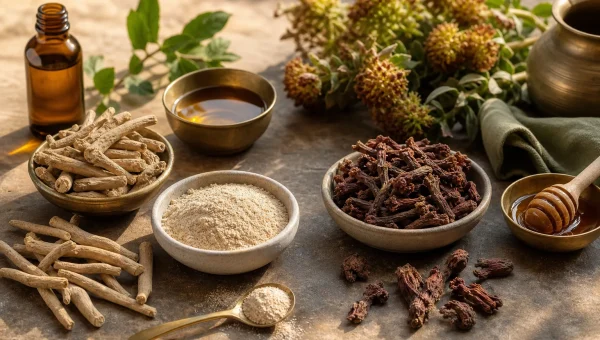
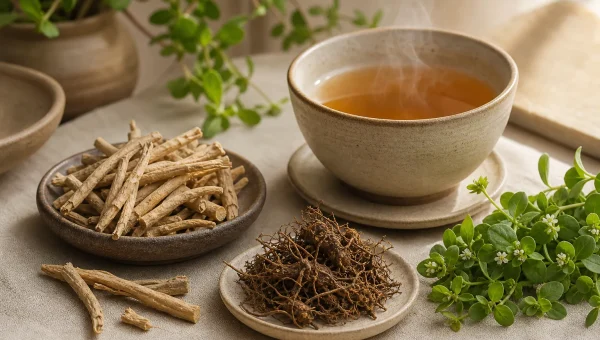
Ashwagandha (अश्वगंधा, Withania somnifera) is the premier Ayurvedic rasayana for rebuilding strength and stamina after injury or a layoff. A randomized controlled trial in men beginning resistance training found that 300 mg of standardized root extract twice daily over 8 weeks produced significantly greater gains in muscle strength and size, and better recovery, than placebo. For climbers rebuilding grip and pulling strength, 300 to 600 mg twice daily of standardized extract is a reasonable range, with strength changes typically assessed over roughly 8 weeks. The classical preparation of ashwagandha milk (about 5 grams of churna simmered in warm milk with a little ghee at bedtime) is the traditional rasayana form and supports recovery and restful sleep.
Guggulu for Musculoskeletal Support
Guggulu (गुग्गुलु, Commiphora mukul) is one of the most important resins in classical Ayurveda, but its documented classical indications are medoroga (disorders of fat metabolism and obesity), amavata (a rheumatoid-arthritis-like condition), sandhivata (joint disease), and kusta (skin disorders) — not a specific snayu (tendon) indication. Its value for climbers is indirect: guggulsterones have recognized anti-inflammatory activity, and classical guggulu formulas are the standard vehicle for vata-aggravated, painful musculoskeletal conditions. Yogaraj guggulu — a classical polyherbal combining guggulu with vata-pacifying spices — is traditionally used for vata disorders affecting the joints, muscles, and locomotor system, and is the form most practitioners reach for in chronic overuse pain. Dose: 500 mg of standardized guggulu extract twice daily with warm water, or Yogaraj guggulu 2 tablets twice daily. There is no classical text or published pharmacological research attributing direct collagen synthesis to guggulu resin, so it is best understood as anti-inflammatory and vata-pacifying support rather than a tendon-rebuilder.
Hadjod (Cissus quadrangularis) for Bone Healing
Hadjod (हड़जोड़, Cissus quadrangularis) is the classical Ayurvedic herb for bhagna (fractures) and asthi-sandhana (bone union) — its Hindi name literally means “bone joiner.” Small human studies, including older clinical reports and more recent trials and biomarker reviews, suggest it can accelerate the healing of bone fractures. Evidence that it heals tendon, pulley, or other soft-tissue injuries specifically is not established. Proposed mechanisms — effects on osteogenesis and bone-related hormones — come mainly from preclinical and biomarker work; descriptions of “anabolic steroid-like” action or direct collagen stimulation are extrapolations, not clinically confirmed. For climbers, hadjod is most justified where bone is actually involved (for example a stress reaction or an avulsion at a tendon insertion); 500 mg to 1 gram twice daily during an active healing phase (weeks 1 to 6) is a common regimen. For a purely soft-tissue pulley tear, its benefit is unproven.
Manjistha for Post-Inflammatory Tissue Clearing
Manjistha (मंजिष्ठा, Rubia cordifolia) is the classical raktaprasadana (blood-purifying) herb of Ayurveda, used for rakta dushti (vitiated blood) and rakta sanga (impaired flow or stagnation of blood in the tissues) — the correct classical terms; there is no classical diagnosis called “raktastasis.” In the Ayurvedic model, repeated microtrauma and lingering inflammation are understood to vitiate rakta and obstruct the channels (srotorodha), and Manjistha is the traditional herb for clearing that state and supporting healthy tissue once the acute phase has passed. It is best understood as classical post-inflammatory and circulatory support rather than a proven treatment for any specific climbing injury. Dose: 500 mg twice daily, or a classical preparation of about 2 grams in warm water. Full details in our manjistha blood purifier guide.
Grip Strength Protocols by Dosha Type
Because climbers differ in constitution, the same injury may call for slightly different emphasis. The table below summarizes how a practitioner might tailor herbs and training approach to a climber’s dominant dosha. Treat it as a starting framework for discussion with a qualified practitioner, not a self-prescription.
| Dosha Type | Injury Pattern | Primary Herbs | Training Approach |
|---|---|---|---|
| Vata dominant climber | Hypermobility, instability, nerve pain, anxiety about injury | Ashwagandha, Bala, sesame oil massage | Slow, controlled movement; avoid explosive sessions; prioritize rest days |
| Pitta dominant climber | Tendinitis, inflammation, overuse from pushing too hard | Shallaki, Manjistha, cooling herbs | Cool training environment; anti-inflammatory diet; avoid midday sessions |
| Kapha dominant climber | Delayed recovery, weight-related joint stress, low motivation | Guggulu, Trikatu, Turmeric | Shorter, more frequent sessions; dynamic movement; fasted morning training |
Medicated Oil for Finger and Forearm Care
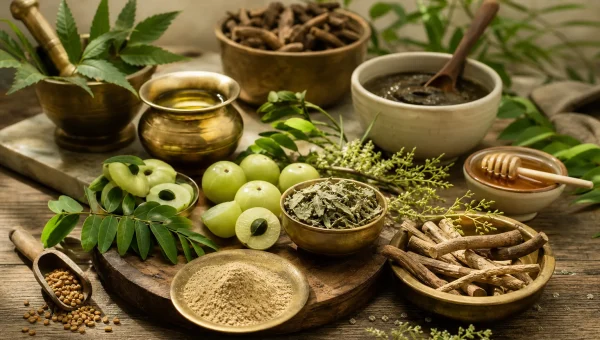
The Ayurvedic practice of abhyanga (oil massage) has traditional applications for climber hand and forearm maintenance. Mahanarayan taila, a classical medicated sesame oil compounded with many herbs, is a standard oil for vata-predominant musculoskeletal complaints. Applied warm to the fingers, hands, and forearms (before training, or 30 minutes before a shower on rest days), it nourishes the local snayu and mamsa, pacifies vata, improves suppleness, and supports local circulation and comfort. This is traditional supportive care: the classical use is for vata musculoskeletal conditions, and claims that daily oiling measurably reduces microinflammation or prevents pulley injury are not established.
A specific application protocol for an injured finger: warm 1 teaspoon of Mahanarayan oil to body temperature, apply to the affected finger with gentle circumferential massage for 5 minutes, then wrap loosely in a warm towel for 10 minutes. This combines the warming, vata-pacifying effect of the medicated oil with the physical benefits of increased local circulation. Avoid massage directly over an acutely swollen or recently torn structure until a clinician confirms it is safe.
Nutritional Support for Tendon and Tissue Recovery
Ayurvedic dietary principles for connective-tissue recovery emphasize nourishing, easily digestible (agni-friendly) foods. These align in spirit with general anti-inflammatory, adequate-protein eating, but they are not a validated sports-nutrition protocol proven to repair tendon collagen — they are traditional dietary guidance. Foods traditionally favored include natural protein and mineral sources (sesame seeds, moringa, well-cooked moong dal, ghee-cooked eggs, well-cooked lentils) and anti-inflammatory spices (turmeric, ginger, cinnamon). A pitta-pacifying approach for inflamed tissue limits chili peppers, fried foods, alcohol, and excessively sour foods, while emphasizing cooling foods such as coconut, coriander, fennel, and cucumber.
Dosage Summary for Climbing Recovery Protocol
The table below consolidates the doses discussed above for quick reference. Doses are typical ranges from traditional practice and the cited studies; confirm specifics and suitability with a qualified Ayurvedic practitioner and your treating physician before starting, especially alongside other medications.
| Herb | Dose | Timing | Duration |
|---|---|---|---|
| Shallaki (AKBA extract) | 350-500 mg | Three times daily with meals | 4-8 weeks |
| Ashwagandha (standardized root extract) | 300-600 mg | Twice daily (morning + bedtime) | 8-12 weeks |
| Hadjod (Cissus) | 500 mg-1 g | Twice daily with meals | 6 weeks, where bone is involved |
| Manjistha | 500 mg | Twice daily with warm water | 4-6 weeks |
| Mahanarayan taila | 1 tsp topically | Daily, pre-training or pre-shower | Ongoing maintenance |
The Mental Game: Vata and Performance Anxiety
Rock climbing is as much mental as physical, and many climbers struggle with fear of falling, performance anxiety, or fear of re-injury after a serious incident. Classical Ayurveda attributes such mental disturbances largely to vata aggravation in the manovaha srotas (the channels of the mind). The traditional herbs for this dimension are brahmi (Bacopa monnieri), classically a medhya rasayana (tonic for mind and intellect) used for focus and calm, and jatamansi (Nardostachys jatamansi), used for grounding and easing fear and restlessness. Brahmi has attracted modern interest for cognition and stress, though evidence specific to athletic performance anxiety is limited. A common dose is brahmi extract 300 mg twice daily for cognitive and calming support. Our detailed guide to brahmi’s benefits for memory and the brain covers its applications comprehensively.
Safety and Disclaimer
Rock climbing injuries, particularly pulley tears and shoulder conditions, require proper diagnosis by a sports medicine physician or orthopedic specialist before beginning any treatment protocol. The Ayurvedic herbs described here may offer supportive benefit but are not substitutes for appropriate medical evaluation, imaging when indicated, and supervised rehabilitation, and they should be used under the guidance of a qualified Ayurvedic practitioner. Guggulu may interact with thyroid medications and blood thinners. Boswellia may affect inflammatory pathways relevant to certain medications. Always disclose all supplement use to your healthcare providers. This article is for educational purposes only and does not constitute medical advice.
Actionable Tip: Once a clinician has cleared you to handle the area, start a daily 5-minute finger maintenance routine: warm 1 teaspoon of sesame oil or Mahanarayan taila, massage each finger from base to tip with gentle circular pressure, then make slow fist-close-open movements 20 times. Do this every evening after climbing or training. This simple practice applies the Ayurvedic principles of daily snehana (oleation) and gentle movement to support snayu (tendon) health.
References
- A double blind, randomized, placebo controlled study of the efficacy and safety of 5-Loxin for treatment of osteoarthritis of the knee (2008), PubMed Central
- Examining the effect of Withania somnifera supplementation on muscle strength and recovery: a randomized controlled trial (2015), PubMed
- The effects of Cissus quadrangularis on bone-related biomarkers in humans: a systematic review and meta-analysis (2025), PubMed Central
- Ayurvedhealing (ayurvedhealing.com)
- Ayurvedhealing (ayurvedhealing.com)
- Ayurvedhealing (ayurvedhealing.com)
I boulder three times a week and the tip about warming the fingers and wrists before crimping using Mahanarayan oil is something I started this week. Even just the circulation improvement before a session feels different. Did the protocol mention anything specific for the wrist flexors, or is it mostly focused on the finger pulleys and tendons?
The article references Ashtanga Hridayam as a source but doesn’t give the specific chapter and verse for the claims made. For a practitioner wanting to verify the original source, more specific citations would be useful.
Rock climber for 9 years, had an A2 pulley injury 3 years ago. Standard sports medicine approach was rest, PT, then gradual return. I was back on the wall in 8 weeks but the finger has never been quite the same. The Ayurvedic angle on tendon care and the marma point therapy is something I wish I had known about at the time.
The beeswax and sesame oil preparation for finger tendons is something my climbing partner has been swearing by for 2 years. I always thought it was placebo. Reading the actual mechanism for how the lipids in sesame oil work on connective tissue has changed my view. Going to try the full protocol for my current strain.
Curious whether this protocol addresses the scar tissue buildup that seems to follow a pulley tear even after the acute pain resolves. My finger healed structurally but the stiffness on cold mornings has lingered for almost a year. Is there an internal herb or topical application in Ayurveda that specifically addresses that kind of residual fibrosis in tendons?
I’m a yoga teacher who also climbs. The overlap between Ayurvedic body care and what climbers need for longevity is much bigger than most people realize. The emphasis on oil, warmth, and circulation in tendons is exactly what prevents the finger injuries that end climbing careers. I work with a lot of 40+ climbers who did none of this in their 20s and are now paying for it.
I related to Arjun’s frustration after six weeks of rest when his strength kept dropping; hearing how he added Ayurvedic herbs alongside his PT gave me hope to try something similar for my own finger strain.
Four weeks into the guggulu and shallaki combination for my flexor tendon strain. The inflammation has reduced meaningfully. I was skeptical going in but the sports physio I see was not dismissive when I brought it up, she said the anti-inflammatory evidence for both herbs is decent. Back on easy routes last week for the first time in 7 weeks.
Useful post on Rock Climbers. The examples make the advice less abstract.
The A2 pulley protocol described here is the most specific thing I have read on tendon injuries from an Ayurvedic angle. Three months into recovery from a similar crimp injury and the conventional physio alone has plateaued. Which of the medicated oil applications would you prioritize if a climber can only do one part of the protocol while traveling?
Wonder if the suggested three hundred fifty to five hundred milligrams of Shallaki taken three times a day would need to be adjusted for someone with a sensitive stomach.
I boulder indoors 4 days a week and the skin and callus care information here is useful beyond the tendon content. The coconut and neem preparation for flappers and cracked skin is something I am going to try. Commercial chalk and aggressive footwear does a lot of damage to skin that I have never had a good protocol for.
I’ve started warming a teaspoon of sesame oil before climbing and massaging my forearms; it feels like it eases the tightness that builds up after long sessions.
Went through exactly this process last year. The recovery made a difference by week 3 and by month 2 I was back to sleeping through the night.
While the article mentions Ashwagandha for grip strength, I’d like to see more data specifically on pulley healing before relying on it for tendon repair.
One thing not addressed here is the interaction between campus boarding and other high-strain training methods and the Ayurvedic recovery requirements. Elite climbers train in ways that are essentially incompatible with the rest and oil massage protocols described. How do you adapt this for athletes who cannot take the recovery time that the protocol assumes?
As a Pitta dominant climber I find that avoiding midday sessions and adding cooling foods like cucumber and coriander helps keep my inflammation lower after intense crimp work.
If Hadjod is mainly for bone healing, would it still be useful for a climber dealing with a stress reaction at the tendon insertion point?
For Rock Climbers, consistency seems like the hard part. Small daily changes are easier to follow than a perfect plan.
I tried brahmi powder in warm milk before bed and noticed less night time anxiety about falling; it’s a small addition but feels supportive.
Following the article’s tip I now do a five minute finger massage each evening with warm Mahanarayan taila and twenty slow fist opens; my fingers feel less stiff the next day.
Is the medicated oil protocol safe to use during the acute inflammatory phase, within the first 48-72 hours, or does it need to wait until the acute phase has subsided? I ask because my instinct is that warming oil on acute inflammation could be counterproductive.
My climbing gym’s trainer said taking 4 weeks off for an A2 pulley with Ayurvedic treatment is too aggressive and risks missing the optimal repair window. Most climbing physios recommend early gentle activity. I don’t understand the evidence basis for the full rest recommendation in this protocol.
Is the sesame oil application safe on skin that has minor abrasions or fresh flappers from climbing? I would not want to apply oil to broken skin without knowing whether it could introduce bacteria.
For Rock Climbers, consistency seems like the hard part. The article avoids making it sound like a quick fix.
just started exploring ayurveda after years of allopathy, this is helpful as an intro but still a lot to absorb
is there a hindi or regional language resource you’d recommend alongside this for my parents
The advice around Rock Climbers is specific enough to be useful. I would like to know how long to try it before judging results.
i have low agni according to my vaidya, does that change which phase to start with
is this suitable for pitta dominant people or mainly vata? i get confused about the cross-dosha applications
Feels like a lot of the advice is very general, my case is quite specific and this didn’t really address it. नमस्ते
The Rock Climbers angle is useful here. Small daily changes are easier to follow than a perfect plan.