Every serious athlete I know has a recovery strategy. Most of them have the same one: ice bath, foam roller, protein shake, sleep. Nothing wrong with any of those. But when I started working with a former national-level sprinter whose persistent hamstring tightness had resisted both physiotherapy and deep tissue massage for 18 months, and a short course of firm Ayurvedic massage with Mahanarayan Taila eased it within a couple of weeks, I became convinced there was something in the Ayurvedic approach to soft tissue that conventional sports care had not fully captured.
Mardana — literally “pressing, kneading, squeezing” — is a vigorous form of therapeutic Ayurvedic massage. It is firmer and deeper than gentle stroking (Samvahana) and distinct from dry-powder massage (Udvartana). It belongs to the broader category of Snehana (oleation) and Abhyanga (medicated-oil massage), whose benefits are set out in the Charaka Samhita (Sutrasthana 5) and the Ashtanga Hridaya (Sutrasthana 2): daily oil massage is said to ward off Vata, fatigue, and the effects of ageing, to nourish the tissues, and to lend firmness and tone to the body. Mardana applies these same principles with greater pressure, which is why it has long been valued by people doing heavy physical work and, in modern practice, by athletes. Note that the classical texts do not enumerate a fixed list of “eight Abhyanga subtypes,” nor do they assign Mardana an athlete-specific protocol; these are later conveniences rather than canonical doctrine.
The Physiology of Mardana
Modern sports-massage research helps explain what firm Ayurvedic massage may accomplish. A 2012 study by Crane and colleagues in Science Translational Medicine found that massage after exercise attenuated exercise-induced inflammation by reducing NF-kB signaling in muscle cells and increasing PGC-1alpha expression — the transcription factor that drives mitochondrial biogenesis and muscle repair. The effect was mechanical: sustained pressure on muscle tissue activates mechanosensing pathways that dampen pro-inflammatory signaling without suppressing the adaptive response to exercise (unlike NSAIDs, which blunt both the inflammatory pain and some of the training benefit). Mardana plausibly engages the same mechanical pathways while adding the pharmacological dimension of a medicated oil.
That oil base is the distinctively Ayurvedic contribution. Through Snehana, the herbs carried in the oil are absorbed transdermally over the skin and superficial tissues, while the warmth and pressure pacify Vata — the dosha governing movement, the nervous system, and, in classical terms, much of musculoskeletal pain and depletion. Attention to marma (vital points) reflects the Ayurvedic emphasis on protecting and supporting these sensitive anatomical sites during bodywork.
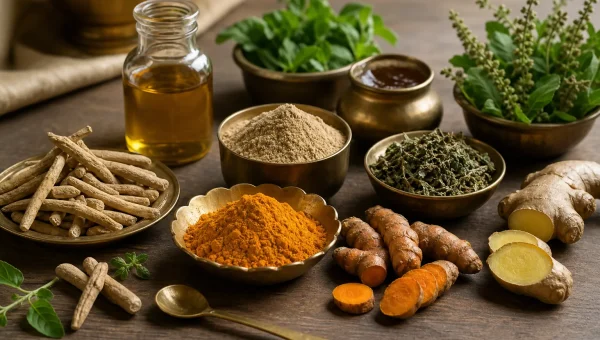
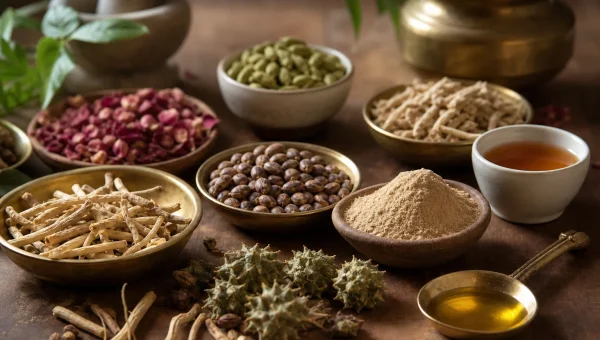
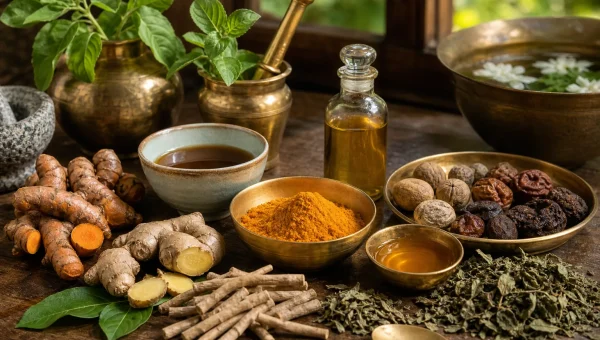
The Medicated Oil Foundation
Oil selection in Mardana is not cosmetic — it is pharmacological. Different classical medicated oils are indicated for different recovery scenarios, and the choice follows the doshic pattern of the complaint rather than the muscle group alone:
| Oil | Primary Indication | Key Ingredients (classical) | Best Applied When |
|---|---|---|---|
| Mahanarayan Taila | Vata disorders, joint and muscle stiffness, general recovery | Bala, Ashwagandha, Bilva and many herbs in a sesame-oil and milk base | Chronic tightness, post-training |
| Dhanwantaram Taila | Vata-type depletion, neuromuscular and post-exertional pain | Bala (chief herb), Dashamoola, sesame oil processed with milk | Overtraining, neuropathic or Vata-predominant pain |
| Murivenna | Sprains, dislocations, soft-tissue injury (Kerala formula) | Coconut-oil base with Allium cepa (onion), Aloe vera (Kumari), Asparagus racemosus (Shatavari), betel leaf | Fresh sprains and contusions, over intact skin |
| Pinda Taila | Vatarakta, burning sensation, Pitta-rakta inflammation | Sariva, Manjishtha, Sarjarasa, Madhuchishta (beeswax), sesame oil | Burning, inflamed, Pitta-type pain |
| Karpooradi Taila | Painful muscles and joints (external analgesic) | Karpura (camphor) with aromatic herbs in an oil base | Localized muscular or joint pain and cramp |
Murivenna: The Kerala Injury Oil
Murivenna is the classical Kerala preparation for fresh injuries; its name refers to a remedy for wounds and traumatic swellings. It is a coconut-oil-based formula prepared with ingredients such as Allium cepa (onion), Aloe vera (Kumari), Asparagus racemosus (Shatavari), and betel leaf, and is traditionally used as an external application for sprains, dislocations, and soft-tissue injuries, often as an adjunct in the management of fractures. Applied over intact skin to fresh sprains, contusions, and muscle strains (never to open wounds), it is used to ease swelling and support recovery of the injured tissue. Reliable human clinical-trial evidence for individual ingredients such as Cissus quadrangularis in fracture healing remains limited and largely preclinical, so the value of Murivenna here rests on classical use and clinical tradition rather than on a settled body of trial data.
The Mardana Technique Sequence for Athletes
The sequence below is a contemporary therapeutic protocol built on Ayurvedic principles of Snehana and Vata-pacification. It is not a verbatim classical prescription, but each step is consistent with traditional practice. A complete session for athletic recovery follows a specific progression.
Phase 1: Oil Application and Warming (5 minutes)
Apply warm medicated oil (heated to roughly 38–40°C, never hot) across the target area and adjacent regions. Initial strokes are broad and gliding — long, oil-distribution strokes — warming the tissue, calming Vata, and beginning transdermal absorption of the oil’s actives.
Phase 2: Kneading and Deep Pressure (10–15 minutes)
This is the core of Mardana: sustained kneading and pressing with the thumbs, knuckles, and heel of the hand along the muscle belly. The pressure is firmer than in gentle Abhyanga, which is the defining feature of Mardana. In modern soft-tissue practice this firm, repeated kneading is applied to areas of chronic tightness around muscle–tendon junctions; the depth and direction are adjusted to the athlete’s tolerance rather than to any fixed classical rule.
Phase 3: Marma Attention (5–8 minutes)
Marma are the 107 vital points enumerated in the Sushruta Samhita (Sharirasthana 6). Sushruta defines a marma as a site where mamsa (muscle), sira (vessels), snayu (ligaments and tendons), asthi (bone), and sandhi (joints) converge, and where prana is concentrated. Classically these are points to be guarded during surgery and trauma; their gentle therapeutic stimulation is a feature of the living Kerala marma-chikitsa tradition rather than a prescribed massage drill. For limb recovery, practitioners in that tradition commonly give attention to:
- Kshipra (hand: between thumb and index finger; foot: between the big and second toe) — a Kalantara-pranahara marma.
- Urvi (mid-thigh and mid-arm) — a sira (vascular) marma; relevant to thigh and arm musculature.
- Indravasti (mid-calf and mid-forearm) — a mamsa (muscle) marma; relevant to calf and forearm.
- Gulpha (ankle) — a sandhi (joint) marma; relevant for runners, jumpers, and court-sport athletes.
- Kurpara (elbow) — a sandhi (joint) marma; relevant for upper-body-dominant athletes.
Because marma are vital points, classical teaching emphasizes care and protection rather than force. Any stimulation should be gentle and sustained, should never provoke sharp pain, and is best performed by a trained therapist. There is no canonical timing or pressure formula in the classical texts; claims of fixed second counts or named pressure grades for marma massage are modern inventions and should be treated as such.
Phase 4: Percussion and Drainage (5 minutes)
Light rhythmic percussion along the muscle bellies, followed by gentle gliding strokes directed toward the body’s center, helps move fluid and supports clearance of metabolic byproducts accumulated during exercise. For lower-limb work the strokes are directed toward the inguinal region, and for upper-limb work toward the axilla.
Post-Mardana Protocol
The 30–60 minutes immediately after Mardana shape how much of the treatment’s benefit is retained:
- Rest for 20–30 minutes: allow the oil to complete its transdermal absorption; moving immediately reduces uptake.
- Warm (not hot) shower: use only mild soap on limited areas. Do not scrub the oiled regions — the residue continues to act for some time after the session.
- Avoid ice immediately after: vasoconstriction from ice opposes the circulatory warming and oil absorption that Mardana promotes. If you use ice, delay it by at least 90 minutes.
- Warm water, not cold: warm fluids support the Vata-pacifying intent of the treatment.
Self-Mardana for Daily Recovery
A full session needs a trained practitioner, but daily self-maintenance uses a simplified version — this is the everyday Abhyanga the classical texts recommend as part of Dinacharya (daily routine):
- 3–5 minutes of warm medicated oil (Mahanarayan or plain sesame) applied to the most worked muscle groups.
- 2 minutes of firm thumb kneading along the belly of each worked muscle.
- Gentle, sustained attention to Indravasti and Gulpha (or Kurpara for upper body), kept light over these vital points.
- Total: about 10–12 minutes, before bed on training days.
For a fuller recovery protocol after high-intensity training, this massage approach complements the herbal support in the Vata workout recovery guide. The joint-protective oil protocol for men over 50 is at strength training after 50.
Firm Ayurvedic massage performed by a trained therapist is generally safe for healthy athletes. Avoid it over active fractures, open wounds, active skin infections, acute thrombophlebitis, or during fever, and keep all work over marma gentle. Always inform your therapist of any medications, particularly blood thinners. Consult a qualified Ayurvedic practitioner for a personalized protocol based on your constitution (Prakriti) and training demands.
One Actionable Step
After your next training session, warm 2 tablespoons of sesame oil and massage it into the muscle groups you just trained using slow, firm strokes directed toward your heart. Do this for about 15 minutes before showering. You need no equipment and no special oil beyond ordinary sesame oil. This is the minimum effective daily Abhyanga for post-exercise recovery. Apply it after every session this week and rate your next-morning soreness from 1 to 10. By week’s end you will have your own direct data on whether the practice is changing your recovery.
The hamstring case with Mahanarayan Taila is interesting to me as a sports physio. Persistent soft tissue restriction that doesn’t respond to deep tissue work often has a neural component. The warm medicated oil approach changes the tissue environment in ways that pure mechanical work doesn’t.
How do you find Mardana practitioners who understand both athletic injury and traditional technique? In my city the split is between sports physiotherapists who don’t know Ayurveda and Ayurvedic therapists who don’t understand loading patterns.
Tried Mahanarayan Taila self-massage after long run days and the DOMS reduction is real. Not just less soreness, the quality of the next day’s training felt different. More supple, less grinding through the first mile.
what’s the shelf life of Mahanarayan Taila once opened? i bought a bottle and using it slowly and not sure if it degrades.
I never realized how much the choice of medicated oil matters for post workout soreness; the breakdown of Mahanarayan Taila versus Murivenna helped me pick the right one for my tight calves.
The Charaka and Sushruta references to Mardana as a recovery tool for warriors is fascinating given that modern sports medicine is essentially rediscovering the same principles two millennia later. High-load athletes need more than structural work.
I’d push back on the 18-month claim for the hamstring restriction. That’s a long time without resolution and in my experience that duration of presentation usually has a contributing factor that’s not just tissue quality. Did you rule out sciatic involvement?
Does the warm oil need to be exactly 38 40°C, or is a little hotter still okay for absorption? Curious about the temperature window.
The direction-specific strokes in Mardana and the muscle fiber orientation question is something I’ve been trying to research. Western massage is usually directionally agnostic. The classical Ayurvedic specification of anuloma (with the grain) versus pratiloma varies by condition, is that being used in sports applications too?
I tried the self Mardana routine after leg day and noticed my morning stiffness dropped a point on my soreness scale; interesting to see the transdermal herb idea in action.
i’ve been training BJJ for five years and the cumulative soft tissue damage from that sport is significant. started adding Abhyanga before sleep and recovery between sessions improved. Hadn’t connected it to the specific Mardana technique until now.
The research cited here is from the 2015-2020 period. Is there more recent work that confirms or updates these findings?
The section on marma points made me wonder if gently working the Gulpha ankle point could help with my recurring shin splints without aggravating them.
It’s helpful that the article clarifies that Mardana isn’t a rigid ancient protocol but a modern adaptation grounded in Snehana principles.
Does this work for tendinopathy? I have chronic Achilles issues that respond to eccentric loading protocols but never fully resolve. Curious whether the oil and technique approach changes anything at the tendon level specifically.
I’m skeptical about claiming the oil alone can replace ice baths entirely; seems like combining both might give the best recovery.
After reading about the mechanical pathways and NF kB reduction, I’m more convinced that firm pressure matters as much as the herbal oil.
For to Sports Massage, consistency seems like the hard part. This would be easier to follow with a one-week sample plan.
The tip to delay ice by at least 90 minutes after Mardana is something I’ll definitely try; I usually ice right away and wonder if that’s blunting the oil uptake.
I appreciate the practical self care version: just 2 minutes of thumb kneading per muscle group before bed sounds doable on busy training days.
The mention of Vata pacifying warm fluids after the session made me switch my post massage tea to ginger instead of cold water.
Case-based evidence is not strong evidence. I’ve worked with athletes who recovered from seemingly similar conditions with nothing but time and progressive loading. Without controls we’re just telling compelling stories.
I wonder if the same Mardana approach works for upper body athletes like swimmers, especially focusing on the Kurpara elbow marma.
The reference to Charaka Samhita sutras is nice, but I’d love to see more modern studies directly on Mahanarayan Taila’s transdermal absorption.
It’s good that the article warns against using Mardana over open wounds or during fever; safety notes like that are often missing in fitness blogs.
Took notes on the part about seasonal adjustments, adding that to my practice now. 💯
@Deepak tried the morning routine from this article and noticed a difference by day 5, not placebo i think
the table in the middle of the article was very clear but i couldn’t figure out the seasonal column
the section on quality sourcing was a surprise, didnt know the extract grade mattered this much
quick question: does the dosage change if someone is also on metformin? asked my doc but he wasn’t sure
reading this after finding it on google, has the recommended dose changed since 2026?
The post-run Abhyanga routine described here is close to what I’ve been doing anyway with sesame oil. hadn’t known there was a classical framework behind it. Did it because it feels good. now i know why it should feel good.
Useful post on to Sports Massage. I would still ask a practitioner before changing medicines.
how do i know if im seeing genuine results vs just placebo? any markers to watch
What would the western equivalent supplement be for someone who can’t get the herb locally.
tried the morning routine for 2 months, gave up. the timing is impossible with a 9 to 5 job and kids
how long before seeing results typically? the article mentions 4 to 6 weeks but is that for everyone
Read this twice and took notes, the distinction between shamana and shodhana applications is really helpful.
Useful post on to Sports Massage. The timing advice is the part I would start with.
@Naveen my constitution is vata-pitta, the article seems to focus on one or the other, any advice ❤️
Can pregnant women follow this or are there modifications? the article doesn’t address that specifically.
followed the dosage table exactly for 10 days and my sleep improved, will continue
does anyone know if this works with the churna form or only the tablet? cant find ksm-66 locally
Finally someone explains the theory behind it and not just the recipe, this made sense to me.
my vaidya recommended something similar last month, good to see the science backing it up here
Is there a Hindi or regional language resource you’d recommend alongside this for my parents.
@Meera where can you source the herbs in india outside of major cities? im in a tier-2 town
Would this protocol work if I travel frequently and can’t maintain a fixed routine.
anyone know if this is okay for kids or only adults? my 14 year old has similar symptoms
the science section feels thin, i’d want to see more than cell studies before calling something proven
Is this suitable for Pitta dominant people or mainly Vata? I get confused about the cross-dosha applications.
the specific morning timing recommendation is practical, most articles skip that detail entirely
late to this but wanted to ask, do these recommendations still hold or has newer research changed anything
would this protocol work if i travel frequently and cant maintain a fixed routine
Doing this
Bookmarked this to share with my mother who has been struggling with the same issue for years.
this helped me understand why my previous attempt at this didnt work, i was doing the timing wrong 🙏
i have low agni according to my vaidya, does that change which phase to start with ठीक है
some of these claims are very strong for what is essentially anecdote-level evidence
just found this post, the section 3 protocol seems intensive for a beginner, any lighter version
how does this compare to the classic ashtanga hridayam recommendation on the same topic
Reading this later and the to Sports Massage advice still feels relevant. A few more examples would still help.
not sure i trust the quality of supplements available online, too many adulterated products out there
off topic but has anyone here tried this approach for hair loss? curious if similar principles apply
what brand of the extract do you personally use or recommend? the market is full of fake products
starting this next week, will come back to report results in about a month
two months in and my symptoms r actually slightly worse, stopping and going back to basics
the recipe proportions seem higher than what i see in other sources, is the difference intentional
Packaging this as science when most of it is tradition makes me skeptical, need more rigorous sourcing.
Helpful 🙏
Reading this later and the to Sports Massage advice still feels relevant. The main idea is clear even if someone is new to Ayurveda.
My functional medicine doctor had mentioned something similar, good to have the Ayurvedic framing too.