
I grew up in Thrissur in a household where hair oiling was as ordinary as brushing one’s teeth. Saturday mornings meant warm coconut oil, my grandmother’s hands moving from scalp to tip in slow circles, and a neem-infused preparation stored in an old glass bottle. Only later did I realise how widely household recipes vary across India. Women from Bengal, Rajasthan, Tamil Nadu, Kerala, and neighbouring regions may all describe a familiar oiling tradition, yet the chosen oil, herbs, frequency, and method can be quite different.
These customs are valuable parts of India’s indigenous hair-care knowledge, but they should not be presented as fixed medical systems designed for the climate of each state. Climate, water, hair texture, ingredient availability, family practice, and personal preference can all influence a routine. Modern research also supports only a limited number of claims. The strongest evidence concerns protection of the hair fibre, particularly coconut oil’s ability to reduce protein loss; evidence for reversing grey hair, blocking dihydrotestosterone, awakening dormant follicles, or treating scalp disease is much weaker or absent.
Regional Traditions: A Map, Not a Medical Rule
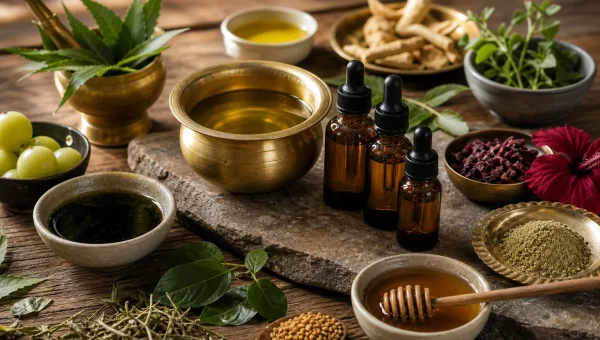
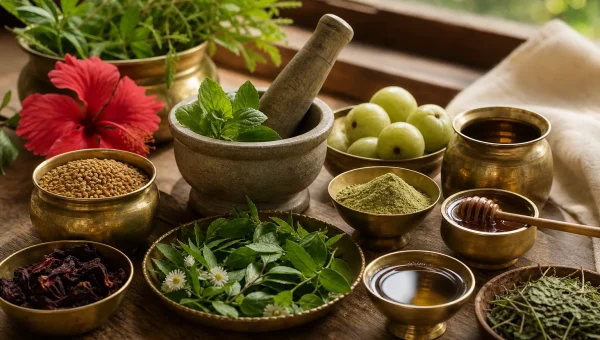
Regional associations can help us understand household practice, but their boundaries overlap. Coconut oil is prominent in many southern and coastal communities, mustard oil is familiar across eastern and northern India, and sesame oil has a long place in Ayurvedic oil preparations. Families may add amla, bhringraj, hibiscus, fenugreek, neem, curry leaves, black seed, flowers, or aromatic herbs, but these additions do not automatically make a recipe a classical Ayurvedic formulation or a clinically validated treatment.
| Regional Association | Commonly Encountered Base | Household or Classical Additions | Evidence-Aware Interpretation |
|---|---|---|---|
| Kerala and the southern coast | Coconut oil or medicated sesame oil | Bhringraj, neeli, amla, liquorice, milk-based ingredients | Coconut oil can reduce hair-shaft protein loss. Classical medicated oils must be identified by their actual formulary composition. |
| Bengal and eastern India | Mustard oil | Fenugreek, neem, black seed | These are established household ingredients, but evidence is insufficient to claim that infused mustard oil treats dandruff, blocks DHT, or prevents patterned hair loss. |
| Rajasthan and western India | Sesame, mustard, or coconut oil | Amla, rose, fenugreek, locally available herbs | Oiling may improve lubrication and reduce friction in dry hair. No standard classical “Rajasthani amla-saffron oil” with fixed quantities was verified. |
| Tamil Nadu and neighbouring regions | Coconut oil | Hibiscus, curry leaves, bhringraj, castor oil | These preparations are familiar cosmetic practices. Human evidence for hair regrowth, anti-androgenic action, or reversal of greying remains inadequate. |
Kerala: Coconut Oil and Classical Medicated Oils
Kerala’s association with coconut oil is unsurprising because coconut has long been readily available along the south-western coast. Plain coconut oil is commonly used before washing or as a small amount on the hair lengths. Kerala Ayurvedic practice also employs formally prepared medicated oils, but these should not be confused with casual herbal infusions. A classical taila is prepared from a specified combination of oil, herbal paste, liquids, and other ingredients according to a defined pharmaceutical process.
Nīlibhṛṅgādi Taila: The Correct Classical Reference
Nīlibhṛṅgādi Taila is often attributed online to the Aṣṭāṅga Hṛdaya, but the Ayurvedic Formulary of India cites Sahasrayoga, Tailaprakaraṇa 38, as its source. The official formula includes juices of nīlī, bhṛṅgarāja, śatakratulatā or karṇasphoṭa, and dhātrī or āmalakī; goat, coconut, buffalo, and cow milk; sesame oil; and a paste of yaṣṭī, guñjā root, and añjana or dāruharidrā extract. The Formulary notes that when coconut oil is used as the oil base, the preparation is called Nīlibhṛṅgādi Kera Taila.
The Formulary describes it as an external oil for śirobhyaṅga, or application and massage of the head, and lists the traditional indications keśapāta and palita, commonly translated as falling hair and premature greying. These are classical indications, not proof that the oil reverses androgenetic alopecia or restores pigment in controlled human trials. Commercial products carrying similar names may also differ, so their labels should be checked against the recognised formulation.
The Ayurvedic Pharmacopoeia of India identifies bhṛṅgarāja as the whole plant of Eclipta alba Hassk. and records its rasa as kaṭu and tikta, guṇa as rūkṣa and tīkṣṇa, vīrya as uṣṇa, and vipāka as kaṭu. Its listed actions include keśya, indicating traditional usefulness for hair. This corrects the widespread description of bhṛṅgarāja itself as an inherently cooling herb. Experimental studies in rodents, cultured follicular cells, and dermal papilla models suggest possible hair-growth activity, but convincing human clinical evidence has not yet been established.
What Coconut Oil Evidence Shows
A frequently cited laboratory study compared coconut, mineral, and sunflower oils on damaged and undamaged hair. Coconut oil was the only one of the three that significantly reduced protein loss when used before or after washing. Its fatty-acid composition and ability to enter the hair fibre help explain its usefulness as a pre-wash conditioner. This evidence concerns the hair shaft; it does not demonstrate treatment of alopecia, stimulation of new follicles, prevention of grey hair, or cure of fungal scalp disease.
Kṣīrabala Taila should also be distinguished from coconut-based hair oils. It is prepared with bala, milk, and sesame oil and is traditionally used in Vāta-oriented external treatments. It was not verified as a standard Kerala summer substitute chosen because it cools the scalp better than coconut oil. Whether it is appropriate for an individual should be decided according to the intended treatment and professional assessment, rather than seasonal marketing claims.
Bengal: Mustard Oil as Household Practice
Mustard oil has a strong place in Bengali household massage and grooming, but claims that it is lighter than coconut oil, penetrates hair more deeply, or specifically prevents humid-weather scalp disease are not supported by good comparative clinical evidence. Mustard oil contains compounds that can produce a warming or pungent sensation, and some users find it too irritating for direct scalp application.
Fenugreek, Neem, and Black Seed
Fenugreek seeds are often steeped in oil in home recipes, yet evidence does not support the specific claim that such an infusion delivers enough trigonelline or diosgenin to inhibit DHT at human hair follicles. Neem has demonstrated antimicrobial activity in laboratory research, but a homemade neem-leaf oil is not an established treatment for seborrhoeic dermatitis, tinea capitis, bacterial folliculitis, or other diagnosed scalp conditions.
A small, preliminary study involving 20 people with telogen effluvium evaluated a scalp lotion containing 0.5% Nigella sativa essential oil for three months. It reported improvement in some measured outcomes, but its size and methodology do not justify broad conclusions. The tested lotion was also not equivalent to black seeds heated in mustard oil, and the study did not establish clinically meaningful 5-alpha-reductase inhibition.
Allyl isothiocyanate, a pungent mustard compound, has shown antimicrobial effects in laboratory systems. It is also an irritant used experimentally to provoke skin responses, and mustard products have caused allergic or irritant contact dermatitis in susceptible individuals. Burning, persistent redness, swelling, blistering, or worsening itch after application is a reason to wash the product off and discontinue it.
Rajasthan: Oiling Dry Hair Without Inventing a Formula
People living in dry environments may prefer richer pre-wash oiling because oil can coat the hair surface, improve slip, and reduce friction during combing and washing. Sesame oil is used in many Ayurvedic preparations and is traditionally described as having an uṣṇa or warming character. However, the claim that it has the greatest penetration depth of all common hair oils or that it has been clinically proven to prevent ultraviolet damage to human hair was not verified.
Amla, Rose, Saffron, and Moringa
A recipe containing exact amounts of amla, saffron, rose petals, and moringa in sesame oil could not be verified as a standard Rajasthani preparation in the Ayurvedic Formulary of India. Saffron has interesting pharmacological constituents, but evidence does not establish that saffron added to hair oil stimulates scalp melanin production or reverses greying. Likewise, describing moringa leaf powder as “biotin-rich” does not prove that its nutrients penetrate the hair follicle or increase keratin synthesis when infused in oil.
A simpler cosmetic approach is to apply a modest amount of a tolerated oil to dry or rough hair lengths before washing. Persistent breakage may also be related to bleaching, straightening, excessive heat, tight hairstyles, nutritional problems, thyroid disease, iron deficiency, or inflammatory scalp disorders. More oil is not necessarily the answer when the underlying cause requires diagnosis.
Tamil Nadu: Coconut, Hibiscus, and Curry Leaf
Coconut oil infused with hibiscus, curry leaves, or other garden ingredients is familiar in many Tamil households. This is best described as a regional domestic practice rather than a single classical formula. Heat and sweating may aggravate itching in some people, but it is inaccurate to label hair loss in Tamil Nadu as uniquely “Pitta-driven” or to assume that a coconut-neem mixture treats DHT-related thinning.
What the Hibiscus Research Found
The commonly repeated claim that a 2012 Journal of Ethnopharmacology study found hibiscus comparable to minoxidil is incorrect. A relevant published study from 2003 evaluated petroleum-ether extracts of Hibiscus rosa-sinensis leaves and flowers in rats and in isolated hair-follicle preparations. The leaf extract showed greater activity than the flower extract. This was preclinical research and does not establish that hibiscus oil performs like minoxidil or regrows hair in humans.
Curry leaves contain antioxidant carbazole alkaloids, but clinical evidence that curry-leaf oil restores natural hair pigment is lacking. Castor oil is a thick emollient that may make coated hair feel fuller and reduce friction, yet no reliable clinical evidence shows that it enlarges follicles or produces new hair growth. Concentrated botanical preparations can also irritate sensitive skin, so “natural” should not be treated as synonymous with risk-free.
A Practical, Evidence-Aware Oiling Routine
A useful routine depends more on scalp condition, hair texture, washing habits, and tolerance than on state of origin. A small pre-wash application can help dry, weathered, or chemically treated hair, while heavy overnight oiling may be uncomfortable or counterproductive for an oily, inflamed, acne-prone, or heavily scaling scalp.
- Patch-test a new oil or herbal preparation on a small area before widespread use.
- Use a modest quantity, concentrating on dry hair lengths unless scalp application has been advised.
- Use oil at room temperature or only mildly warm; it should never feel hot on the skin.
- Massage gently with the finger pads rather than scratching or vigorously rubbing the scalp.
- Wash the oil out when comfortable using a suitable shampoo; there is no universally required two-hour or overnight duration.
- Apply conditioner mainly to the lengths when additional softness or detangling is needed.
No reliable evidence was found for the claim that a warm towel produces clinically important follicular penetration, that hot water permanently “opens” the cuticle, or that a cool final rinse seals moisture and creates measurable improvement within four weeks. Very hot water can feel irritating and may worsen dryness, so comfortably warm water and gentle handling are reasonable practical choices.
Safety note: Hair oiling is supportive grooming, not a substitute for diagnosis or treatment. Consult a qualified Ayurvedic practitioner and an appropriate healthcare provider or dermatologist for sudden or patchy hair loss, visible scalp scarring, painful follicles, pus, persistent redness, severe scaling, eyebrow loss, or progressive thinning. Stop any preparation that causes burning, swelling, rash, or worsening symptoms.
Home infusions should be kept simple and prepared hygienically. A formulation such as Nīlibhṛṅgādi Taila contains several fresh juices, different milks, herbal paste ingredients, and a defined cooking process; it should not be reduced to an improvised mixture merely because the commercial name sounds familiar. When a classical preparation is desired, a properly labelled product from a reputable manufacturer or preparation under professional guidance is preferable.
References
- Dravyaguna notes
- Ia800501 (ia800501.us.archive.org)
- Eclipta alba extract with potential for hair growth promoting activity (2009), PubMed
- Hair growth promoting activity of Eclipta alba in male albino rats (2008), PubMed
- Eclipta prostrata promotes the induction of anagen, sustains the anagen phase through regulation of FGF-7 and FGF-5 (2019), PubMed Central
- Effect of mineral oil, sunflower oil, and coconut oil on prevention of hair damage (2003), PubMed
- Impactfactor (impactfactor.org)
- Release of allyl isothiocyanate from mustard seed meal powder (2014), PubMed
- Dose-response study of topical allyl isothiocyanate (mustard oil) as a human surrogate model of pain, hyperalgesia, and neurogenic inflammation (2017), PubMed
- Contact Hwersensitaity to Mustard Khal and Mustard Oil (1985), PubMed
- Pityriasis rosea-like eruptions due to mustard oil application (2005), PubMed
- Aad (aad.org)
- Scirp (scirp.org)
- In vivo and in vitro evaluation of hair growth potential of Hibiscus rosa-sinensis Linn (2003), PubMed
- Hair Oils: Indigenous Knowledge Revisited (2022), PubMed Central
- Aad (aad.org)
- Aad (aad.org)
- NHS
- Aad (aad.org)
- Ayurvedhealing (ayurvedhealing.com)
- Ayurvedhealing (ayurvedhealing.com)
I am from Thrissur and this article made me feel seen in a way I didn’t expect. Saturday morning oiling was exactly as you describe. My grandmother’s neem bottle was her most protected kitchen item. When she passed we kept it for two years before anyone could bring themselves to empty it.
I have been trying to understand why my hair responds so poorly to coconut oil when every South Indian woman I know swears by it. Reading about the Kapha-heavy effect of pure coconut oil for Pitta types makes sense. I should probably be using sesame or Bhringraj-infused oil instead.
My wife is Bengali and her family uses mustard oil in their hair while mine from Kerala insists on coconut. Both groups insist the other is doing it wrong. Reading this I understand why both have validity in their regional climatic context.
The Tamil Nadu section resonates. My mother-in-law in Madurai uses a specific blend with neem, hibiscus, and fenugreek that she makes herself. She measures nothing, it is all by smell and texture. Watching her make it is like watching someone cook entirely from memory.
I moved from Rajasthan to Toronto 8 years ago and stopped oiling because I thought the practice was just traditional habit. My hair has been consistently worse here. Not just climate, I think I also lost the practice. Going back to amla oil starting this weekend.
The article mentions leaving oil in for 1-2 hours minimum. I find that any oil overnight leaves my pillowcase stained and my scalp breaking out slightly the next morning. Is there guidance on oil-in duration for Kapha-prone scalps?
My mother brought her specific glass bottle from Lucknow when she visited last year and I realized I had no idea what was in it beyond jasmine and something that smelled like fenugreek. I should have asked her to write it down. These oral traditions are fragile.
I enjoyed reading about how Saturday morning oiling felt as routine as brushing teeth in Thrissur households.
I want to push back slightly on the romanticization here. Mustard oil used undiluted on European or African hair types causes significant scalp irritation in many cases. The article presents these traditions as universally applicable when they were developed for specific hair textures and scalp types.
The Rajasthani tradition of amla oil for dryness makes sense given the climate. I grew up in Jaisalmer and hair oiling frequency there is different from what cousins in Mumbai do. The ecological logic of matching oil to local conditions is something I had not consciously articulated before.
As a Western man who started oiling his hair after seeing the results on a South Asian colleague, I want to say the protocol is not intuitive at first. The weight, the application technique, the shampoo-out challenge. A video guide alongside this would help outsiders starting the practice.
It’s interesting to see that mustard oil is common in Bengal but can feel too strong for some scalps.
The Bengal section is accurate but understates how region-specific the mustard oil practice is within Bengal itself. In North Bengal the preparation is different from South 24 Parganas. The tradition is not even uniform within a single state.
I wonder if sesame oil really offers better slip for dry hair compared to coconut oil in Rajasthan.
Tried the Kerala coconut and neem combination after reading this. It took me three washes to fully remove the oil but my scalp feels dramatically less irritated than it has in years. The neem smell is intense but it fades. Worth it.
The article reminded me that adding hibiscus to coconut oil is more a home habit than a proven regrowth method.
Just started exploring Ayurveda after years of allopathy, this is helpful as an intro but still a lot to absorb.
Finally someone explains the theory behind it and not just the recipe, this made sense to me.
Will try
This is the kind of content that makes people delay real medical care, that concern is valid. ✨
the specific morning timing recommendation is practical, most articles skip that detail entirely
@Chris Is this suitable for Pitta dominant people or mainly Vata? I get confused about the cross-dosha applications.
The recipe proportions seem higher than what I see in other sources, is the difference intentional. ✨
Off topic but has anyone here tried this approach for hair loss? curious if similar principles apply.
tried this for 6 weeks and saw no difference, maybe im applying it wrong but nothing changed for me
how do i know if im seeing genuine results vs just placebo? any markers to watch
is this suitable for pitta dominant people or mainly vata? i get confused about the cross-dosha applications
@Jennifer anyone know if this is okay for kids or only adults? my 14 year old has similar symptoms
tried the morning routine for 2 months, gave up. the timing is impossible with a 9 to 5 job and kids
My biggest challenge is getting my teenage son to sit still for oiling. He sees it as embarrassing. My mother oiled my hair every week until I was 15. I feel like a generational link is breaking and I don’t know how to hold it.
I grew up in Bengal and the mustard oil tradition described here is exactly right, though we added methi seeds to ours. Never understood why until I got older. Do you know if the warming properties differ much between the regional oils or is the main difference just what was locally available?
This works in theory but practically very hard to source authentic herbs in most parts of India.
took notes on the part about seasonal adjustments, adding that to my practice now
some of these claims are very strong for what is essentially anecdote-level evidence
I appreciate the caution about patch testing new herbal oils before applying them all over.
Is there a Hindi or regional language resource you’d recommend alongside this for my parents.
tried the morning routine from this article and noticed a difference by day 5, not placebo i think
Off topic but has anyone here tried this approach for hair loss? curious if similar principles apply. 🙏
i have low agni according to my vaidya, does that change which phase to start with
The recipe proportions seem higher than what I see in other sources, is the difference intentional.
reading this after finding it on google, has the recommended dose changed since 2026?
my functional medicine doctor had mentioned something similar, good to have the ayurvedic framing too
this helped me understand why my previous attempt at this didnt work, i was doing the timing wrong 🙏
The Rajasthani tradition section was new to me. I had only ever known the Kerala and Bengali approaches through family. Is the sesame-based preparation used in Rajasthan warm-applied as well, or is that more of a room-temperature application given the climate difference?
where can you source the herbs in india outside of major cities? im in a tier-2 town
how does this compare to the classic ashtanga hridayam recommendation on the same topic
Feels like a lot of the advice is very general, my case is quite specific and this didn’t really address it.
What brand of the extract do you personally use or recommend? the market is full of fake products. नमस्ते
How long before seeing results typically? the article mentions 4 to 6 weeks but is that for everyone.
Some of these claims are very strong for what is essentially anecdote-level evidence. 🙌
Read this twice and took notes, the distinction between shamana and shodhana applications is really helpful.
does anyone know if this works with the churna form or only the tablet? cant find ksm-66 locally
My constitution is Vata-Pitta, the article seems to focus on one or the other, any advice.
what would the western equivalent supplement be for someone who cant get the herb locally
Makes sense
would this protocol work if i travel frequently and cant maintain a fixed routine
the table in the middle of the article was very clear but i couldn’t figure out the seasonal column
@Prakash read this twice and took notes, the distinction between shamana and shodhana applications is really helpful
my vaidya recommended something similar last month, good to see the science backing it up here धन्यवाद
My vaidya recommended something similar last month, good to see the science backing it up here.
This makes sense for Hair Oiling Rituals by Region. Would be useful to see a short checklist next.
It’s useful to know that classical Ayurvedic oils like Nīlibhṛṅgādi Taila follow a specific formula, not just any herb mix.
not sure i trust the quality of supplements available online, too many adulterated products out there
Doing this 🙌
The section on Kerala oiling brought back so many childhood memories. My grandmother also stored her neem preparation in an old glass bottle and refused to ever use a plastic one. She said it changed the smell. I thought that was just superstition but the more I read about oil absorption and storage the more I think she was onto something practical.
late to this but wanted to ask, do these recommendations still hold or has newer research changed anything
starting this next week, will come back to report results in about a month
This makes sense for Hair Oiling Rituals by Region. The timing advice is the part I would start with.
can pregnant women follow this or are there modifications? the article doesn’t address that specifically 🌿
Packaging this as science when most of it is tradition makes me skeptical, need more rigorous sourcing.
noted ✨
How does this compare to the classic Ashtanga Hridayam recommendation on the same topic.
just found this post, the section 3 protocol seems intensive for a beginner, any lighter version 🙏
just started exploring ayurveda after years of allopathy, this is helpful as an intro but still a lot to absorb
I would like more detail on Hair Oiling Rituals by Region. The practical details matter more than people think.
After reading, I think I’ll try a small prewash amount of warm coconut oil on my ends and see how it feels.
the part about adjusting based on prakriti was exactly what i needed to understand, thanks
off topic but has anyone here tried this approach for hair loss? curious if similar principles apply
I would like more detail on Hair Oiling Rituals by Region. The timing advice is the part I would start with.
the science section feels thin, i’d want to see more than cell studies before calling something proven
I would like more detail on Hair Oiling Rituals by Region. The examples make the advice less abstract.
The dosage here seems higher than what my Ayurvedic doctor recommended, a bit concerned.
quick question: does the dosage change if someone is also on metformin? asked my doc but he wasn’t sure
Useful post on Hair Oiling Rituals by Region. A few more examples would still help.
been following this for 3 weeks now and my energy levels are much better, the protocol you described really clicked for me
@Indira is there a hindi or regional language resource you’d recommend alongside this for my parents नमस्ते
where can you source the herbs in india outside of major cities? im in a tier-2 town ठीक है
@Maya shared this with my sister who is a yoga teacher and she said the dosing info was spot on
is there a hindi or regional language resource you’d recommend alongside this for my parents ❤️
Where can you source the herbs in India outside of major cities? I’m in a tier-2 town.
Useful post on Hair Oiling Rituals by Region. The main idea is clear even if someone is new to Ayurveda.
the herb combination u suggested 600mg ksm-66 morning worked well alongside my usual churna
Been using Ayurvedic protocols for 2 years and this is one of the more accurate breakdowns I’ve seen.
tried the morning routine for 2 months, gave up. the timing is impossible with a 9 to 5 job and kids ❤️
what brand of the extract do you personally use or recommend? the market is full of fake products
starting this next week, will come back to report results in about a month 🌿 नमस्ते
Followed the dosage table exactly for 10 days and my sleep improved, will continue.
For Hair Oiling Rituals by Region, consistency seems like the hard part. The article avoids making it sound like a quick fix.
The table in the middle of the article was very clear but i couldn’t figure out the seasonal column.
the pitta protocol in here did not work well for me, caused a lot of heat and skin irritation
Helpful
For Hair Oiling Rituals by Region, consistency seems like the hard part. The safety notes could be expanded a little.
what would the western equivalent supplement be for someone who cant get the herb locally ✨
For Hair Oiling Rituals by Region, consistency seems like the hard part. The examples make the advice less abstract.
this helped me understand why my previous attempt at this didn’t work, i was doing the timing wrong 🙏
is this suitable for pitta dominant people or mainly vata? i get confused about the cross-dosha applications ✨
Reading this later and the Hair Oiling Rituals by Region advice still feels relevant. A few more examples would still help.
the section on quality sourcing was a surprise, didnt know the extract grade mattered this much
Reading this later and the Hair Oiling Rituals by Region advice still feels relevant. I would still ask a practitioner before changing medicines.
Reading this later and the Hair Oiling Rituals by Region advice still feels relevant. This is the kind of detail readers can test slowly.
this is the kind of content that makes people delay real medical care, that concern is valid