
There is a particular anxiety that hits every June in Kerala. Not fear of rain, exactly – anyone who grew up there loves the monsoon. It is the concern that comes with it: who will fall sick first? My mother used to say the rains bring gifts in one hand and illness in the other. She was not being pessimistic. She was being practical. And every year without fail, the month after the monsoon arrived, someone in the neighborhood would be down with fever, dysentery, or a chest infection that would not leave. Meanwhile, our household, religiously following my grandmother’s monsoon kitchen protocols, mostly got through it with nothing worse than a runny nose.
I did not understand then what I understand now: the monsoon is not merely a change in weather but a complete shift in the body’s doshic ecology. The Charaka Samhita dedicates the sixth chapter of its Sutrasthana – Tasyashiteeya Adhyaya – to Ritucharya (the seasonal regimen), and within that single chapter it gives Varsha Ritu (the monsoon) its own detailed section, precisely because this season demands specific dietary adjustments that modern nutrition largely ignores.
Why Monsoon Weakens Agni: The Ayurvedic Explanation
Ayurveda classifies the monsoon as the season when Vata – having quietly accumulated (Sanchaya) through the summer (Grishma) – now becomes aggravated (Prakopa), while Pitta only begins its accumulation phase (Sanchaya), and Kapha, already pacified by the summer heat, stays settled and low. The combination of damp, cold air, reduced sunlight, and the body’s adjustment to rapidly changing temperatures creates a specific challenge to Jatharagni (the digestive fire), which the classical Varsha texts describe as becoming vitiated and feeble during the rains.
This is not a modern idea grafted onto an old text. The entire classical Varsha regimen is built around protecting a weakened Agni and pacifying aggravated Vata – and contemporary reviews of Ritucharya note that seasonal shifts do measurably influence immunity, metabolism, and the gut microbiome, the monsoon being, for most South and Southeast Asian populations, the season of greatest infectious load. The point Ayurveda makes is one of timing: when the digestive fire is at its lowest, the diet must do the most to support it.
Ayurveda’s response is Deepana-Pachana (Agni-kindling and Ama-digesting) combined with Rasayana (immune-building) foods. The eight dishes below implement this principle practically.
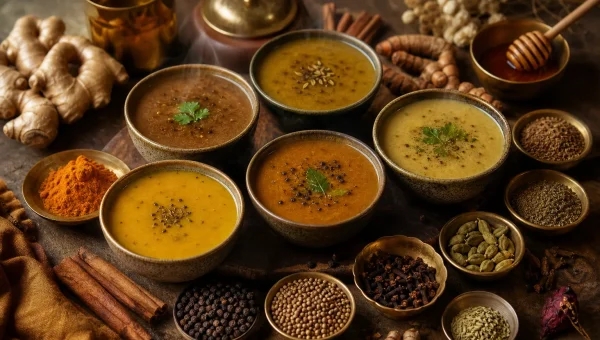
Dish 1: Trikatu-Spiced Mung Dal (Daily Base)
Mung dal is the cornerstone of monsoon cooking in Ayurveda – it is the one legume that does not aggravate Vata despite being a bean, because of its light, easy-to-digest qualities. In monsoon, it is prepared with the full Trikatu combination.
Ingredients (4 servings): 200g split yellow mung, 800ml water, 1 tsp dried ginger (Shunti), half tsp long pepper (Pippali), half tsp black pepper (Maricha), 1 tsp turmeric, 1 tbsp ghee, 1 tsp cumin, pinch asafoetida (Hingu), curry leaves, rock salt.
Method: Cook mung with turmeric in water until very soft, almost melted. Heat ghee in a tempering pan, add cumin until it crackles, asafoetida, curry leaves, then ginger, pepper, and long pepper. Pour tempering over dal. Simmer 5 minutes. Serve warm.
Why this works: Mung provides protein without digestive burden. Trikatu kindles Agni directly, and the long pepper (Pippali) in it supplies piperine, a well-documented bioenhancer – in classic pharmacokinetic work, piperine sharply raised the bioavailability of curcumin taken alongside it. Ghee carries fat-soluble compounds to the intestinal mucosal layer. Asafoetida (Hingu) specifically counters the gas and bloating that characterize weakened monsoon digestion.
Dish 2: Tulsi-Ginger Immunity Broth
This is not a soup – it is a concentrated therapeutic broth meant to be sipped before meals to prime the appetite and clear the respiratory channels.
Ingredients: 20 fresh Tulsi leaves (Ocimum tenuiflorum), 3 cm fresh ginger root, 1 tsp black pepper, 4 garlic cloves, 1 small piece cinnamon, half tsp turmeric, 750ml water, honey to taste (add after cooling).
Method: Combine all except honey in water. Bring to boil, reduce, simmer 15 minutes until reduced to about 500ml. Strain, cool slightly, add 1 tsp honey per cup. Store up to 2 days refrigerated, warm before each use.
Meal prep note: Make a double batch Sunday evening. This broth keeps 2 days and gives you a ready, warming Tulsi-ginger preparation for the respiratory channels. Tulsi (Ocimum tenuiflorum) is honoured in Ayurveda as a Rasayana and is among the most studied of medicinal herbs, with review literature documenting adaptogenic and immunomodulatory activity – which is why it sits at the centre of so many traditional monsoon remedies.
Dish 3: Bitter Gourd (Karela) Stir-Fry with Turmeric
Karela (Momordica charantia) is the most intensely bitter food in the Ayurvedic kitchen. In Ayurvedic terms its Tikta (bitter) rasa is Deepana-Pachana once the fire is kindled, Krimighna (acting against worms and microbes), and Lekhana – it scrapes and dries excess Kleda (dampness) and Ama. Those drying, cleansing qualities make it a useful counter to the sluggish, moisture-laden digestion of the rains. A caution belongs here, though: the classical Varsha regimen leans on sour, salty, and unctuous tastes to pacify aggravated Vata, and bitter, drying foods do the opposite. Karela is therefore best used in moderation in this season, and always cooked with an unctuous medium – here, sesame oil – to blunt its Vata-aggravating edge.
Ingredients: 2 medium karela, 1 tsp turmeric, 1 tsp coriander powder, half tsp cumin, 1 tbsp sesame oil, pinch of asafoetida, salt, squeeze of lime.
Method: Slice karela thinly, rub with salt and turmeric, rest 15 minutes (draws out excess bitterness). Squeeze and wash. Stir-fry in sesame oil with spices until cooked through. Finish with lime.
Why this matters in monsoon: What Ayurveda actually flags for Varsha is not a single vulnerable organ but a feeble Jatharagni and aggravated Vata. Karela’s bitter, scraping action helps clear the Ama that a weak digestive fire leaves behind, and its bitter-pungent profile supports the return of appetite once Agni is rekindled. Because it is cooling and drying by nature, it should be balanced with warming spices and fat rather than eaten plain – the opposite approach would only feed the Vata the season is already raising.
Dish 4: Drumstick (Moringa) Sambar
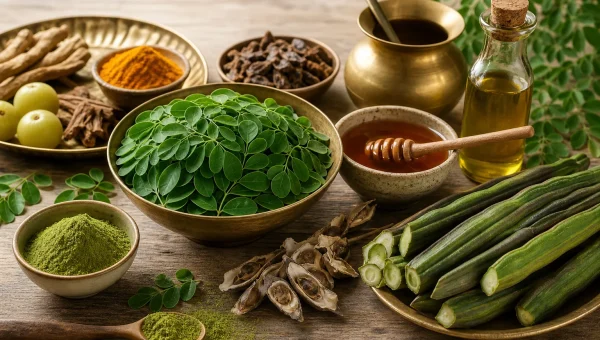
Drumstick pods and leaves (Shigru, Moringa oleifera) are classified as Kapha-Vata hara with specific action on the respiratory Srotas. The sambar preparation adds Tamarind (Amlika) as a sour, Vitamin-C-bearing element and multiple warming spices.
Ingredients (4 servings): 200g toor dal (split pigeon pea), 6-8 drumstick pods, 1 tomato, 2 tsp sambar powder, half tsp turmeric, 1 tbsp tamarind paste, 1 tbsp ghee, 1 tsp mustard seeds, curry leaves, dried red chilies, rock salt.
Method: Cook dal thoroughly. Simmer drumstick pieces in tamarind water until soft. Combine with dal, add sambar powder, turmeric, tomato. Tempering: heat ghee, pop mustard seeds, add curry leaves, red chili. Add to sambar. Simmer 10 minutes.
Nutritional note: Moringa leaves are exceptionally nutrient-dense, supplying more Vitamin C than oranges, more calcium than milk, and a complete set of essential amino acids; comprehensive reviews catalogue its broad nutritional and pharmacological profile. In monsoon, when fresh produce quality drops and immune demands rise, Moringa-based dishes provide nutritional insurance that few supplements match. Its isothiocyanates are also studied for their support of Phase II detoxification enzymes – useful in a season of greater waterborne exposure.
Dish 5: Methi (Fenugreek) Thepla Flatbreads
These spiced flatbreads use fresh or dried fenugreek leaves, and it is worth being precise about the classical record. The Varsha Ritucharya texts name old grains, soups and gruels (Yusha), honey, and boiled or rain-purified water as the staples of the season – they do not single out fenugreek. What can be said honestly is that Methi (Trigonella foenum-graecum), and the ajwain it is cooked with, are warming, Agni-kindling carminatives prized throughout Ayurvedic cooking, and therefore well suited to the damp, digestion-dulling conditions of the monsoon.
Ingredients (8 theplas): 200g whole wheat flour, half cup fresh fenugreek leaves (or 2 tbsp dried methi), 1 tsp ajwain (Trachyspermum ammi) seeds, half tsp turmeric, half tsp chili powder, 1 tsp sesame seeds, 2 tbsp yogurt, 1 tbsp sesame oil, salt, warm water to bind.
Method: Combine all ingredients, add warm water gradually to make a firm, smooth dough. Rest 20 minutes. Roll thin, cook on a dry tawa (griddle) over medium heat, brushing each side with a little sesame oil.
Meal prep note: Make 16-20 theplas on Sunday. They keep in a steel container at room temperature for 3-4 days in dry conditions and can be eaten with dal, pickle, or yogurt for any meal. Ajwain is one of Ayurveda’s most valued carminatives, and its thymol is a recognized antimicrobial constituent – a sensible companion to the heavier, dampness-prone foods of the rains.
Dish 6: Haldi-Tulsi Kadha (Golden Immunity Drink)
This is my grandmother’s monsoon morning ritual, which I have now introduced to my own family. It takes 5 minutes, uses items from any Indian kitchen, and provides a concentrated dose of three of the most-studied immunomodulatory herbs in the Ayurvedic pharmacopoeia.
Ingredients (1 serving): 1 cup water, 1 tsp turmeric, 1 tsp grated fresh ginger, 5 Tulsi leaves, 1 small piece of black pepper (or pinch of powder), half tsp jaggery.
Method: Boil water with all ingredients except jaggery for 5 minutes. Strain. Add jaggery. Drink warm, first thing after waking.
Clinical rationale: This preparation delivers curcumin – whose absorption is famously poor on its own but rose by roughly 2000% in human volunteers when taken together with piperine from black pepper – alongside Tulsi’s eugenol and rosmarinic acid and ginger’s 6-gingerol. Turmeric, tulsi, and ginger are each individually documented in the pharmacological literature for anti-inflammatory and immunomodulatory activity, which is why this five-minute decoction earns its place as a daily monsoon habit rather than mere folklore. I make no claim here beyond what the herbs are known for – it is the consistency of the daily ritual, not any single dramatic effect, that does the work.
Dish 7: Sesame Rice with Ghee and Trikatu
Plain rice is the most easily digestible carbohydrate during monsoon. This preparation adds sesame for calcium and warming properties, and ghee with Trikatu to ensure it actually nourishes rather than generating Ama.
Ingredients (4 servings): 200g Sona Masuri or basmati rice (cooked), 2 tbsp white sesame seeds (toasted), 1 tsp dried ginger, half tsp black pepper, 2 tbsp ghee, curry leaves, pinch asafoetida, salt.
Method: Cook rice normally. Heat ghee, add asafoetida, curry leaves, then sesame seeds until they pop lightly. Add ginger and pepper. Toss rice in this tempering. Serve warm.
Why this works: During monsoon, well-cooked grains are among the safest energy sources, sitting lightly on a weakened Agni. Aged rice is preferred to new in the classical texts for exactly this reason. The sesame-ghee-Trikatu combination provides unctuous, fat-soluble nourishment while stimulating Agni to prevent the Ama formation that weakened digestion generates from poorly processed food.
Dish 8: Amla-Ginger Preserve (Murabba)
This is a traditional preserved preparation that can be made in batch and kept for the entire monsoon season. It serves as both a digestive condiment and an immune food.
Ingredients: 500g fresh amla (or 100g dried amla if fresh unavailable), 100g jaggery, 2 tbsp dried ginger powder, 1 tsp black pepper, 1 tsp cardamom, 1 tsp fennel seeds.
Method: Steam fresh amla until tender. Remove seeds. Combine with jaggery in a heavy pan, cook over low heat until jaggery melts and coats amla. Add all spices. Continue cooking until jammy consistency. Cool. Store in a glass jar. Take 1-2 pieces daily as a digestive and immune tonic.
Why this is the monsoon’s best-kept secret: Amla is among the richest natural food sources of Vitamin C, and is classically revered as a premier Rasayana – it is immune-supporting in its own right. The jaggery adds easily absorbed iron and a grounding sweetness, while the ginger-pepper-cardamom combination keeps the preserve warm and Agni-kindling rather than Kapha-forming despite the sweetness. This is genuine food-as-medicine that my grandmother understood without ever reading a pharmacology paper. For more Amla applications, our post on Amla in the kitchen has 7 additional recipes.
For the complete Ayurvedic framework on seasonal eating beyond monsoon, see our spring Kapha season diet guide and our article on the Ayurvedic spice box.
References
- Ritucharya: Answer to the lifestyle disorders (2011), PubMed Central
- Charaka Samhita — Tasyashiteeya Adhyaya
- Influence of piperine on the pharmacokinetics of curcumin in animals and human volunteers (1998), PubMed
- Tulsi – Ocimum sanctum: A herb for all reasons (2014), PubMed Central
- Moringa oleifera: An Updated Comprehensive Review of Its Pharmacological Activities, Ethnomedicinal, Phytopharmaceutical Formulation, Clinical, Phytochemical, and Toxicological Aspects (2023), PubMed Central
The anxiety about who gets sick first in June is so specific to Kerala that I laughed out loud. My mother said the exact same thing every year without fail. The monsoon kitchen protocols she followed were exactly what this article describes.
My grandmother used to swear by this and now I understand why. The part about agni specifically matches what I observed in her health over the years.
The Immune-Boosting Meal Prep for Monsoon section feels grounded enough to try carefully. Small daily changes are easier to follow than a perfect plan.
Made the drumstick leaf soup from the recipe section and it is genuinely one of the better things I’ve cooked this season. I get moringa from an Indian grocery here in London and it’s much better than the powder supplements.
Is the ginger-lemon-jaggery preparation safe for someone with GERD? Ginger is usually fine for me in small amounts but I’ve had bad experiences with lemon in acidic conditions.
This matches my clinical experience. I’ve recommended agni to patients with similar presentations and the response rate is consistent with what the article describes.
I tried the mung dal with the full trikatu blend last week and noticed my digestion felt lighter during the rainy days.
The Immune-Boosting Meal Prep for Monsoon section feels grounded enough to try carefully. The article avoids making it sound like a quick fix.
The point about raw vegetables and salads being the wrong choice during monsoon runs directly counter to what most Western nutrition advice says. The Agni-protection reasoning makes sense physiologically though. Wet, cool environment plus raw food is a double dose of cold for digestive fire.
My grandmother used to say that eating wrong in monsoon sets the illness tone for the whole year. I thought she was being dramatic. My own experience confirms she was right. The years I followed the protocol I stayed healthy. The years I didn’t I didn’t.
Does the tulsi ginger broth keep its potency if I freeze it instead of just refrigerating for two days?
The Immune-Boosting Meal Prep for Monsoon section feels grounded enough to try carefully. This would be easier to follow with a one-week sample plan.
I appreciate the warning about bitter gourd increasing Vata, but I wonder if a small amount with sesame oil really balances it enough for daily meals.
The Immune-Boosting Meal Prep for Monsoon section feels grounded enough to try carefully. The safety notes could be expanded a little.
Making drumstick sambar on Sunday gave me a ready to eat lunch that stayed warm and satisfying through humid afternoons.
The claim that traditional households had dramatically lower seasonal illness rates is presented without evidence. Selection bias is significant here: traditional households also had different activity levels, different stress patterns, and different environmental exposures.
the sourcing section was a surprise, didnt know the extract grade mattered this much
Late to this but wanted to ask, do these recommendations still hold in 2027?
this works in theory but practically very hard to source authentic herbs
Off topic but has anyone here tried this approach for hair loss?
the dosage here seems higher than what my ayurvedic doctor recommended 💯
Reading this after finding it on Google, is this dosage still recommended? ठीक है
The article mentions Agni drops in monsoon is this universal or mainly Kapha-dominant types?
Some of these claims are very strong for what is essentially anecdote-level evidence. ✨ धन्यवाद
the dosage here seems higher than what my ayurvedic doctor recommended
the part about adjusting based on prakriti was exactly what i needed नमस्ते
The safest part of the Immune-Boosting Meal Prep for Monsoon advice is keeping it simple. The practical details matter more than people think.
tried the morning routine from this article and noticed a difference by day 5
Packaging this as science when most of it is tradition makes me skeptical.
Tried this for 6 weeks and saw no difference, maybe I’m applying it wrong.
the pitta protocol here caused a lot of heat and skin irritation for me
Where are the actual clinical trials? I need RCT data before trying anything.
the trikatu-spiced khichdi recipe from this post is now my monsoon monday staple, agni noticeably stronger
Reading this after finding it on Google, is this dosage still recommended?
where are the actual clinical trials? i need rct data before trying anything
Noted
the trikatu ratios seemed high for a daily dosw, i developed some acidity after the first week
can these recipes be adapted for someone who cant eat pitta-heating foods due to skin issues?
just found this post, the section 3 protocol seems intensive for a beginner, any lighter version?
the part about adjusting based on prakriti was exactly what i needed
Doing this
The Pitta protocol here caused a lot of heat and skin irritation for me.
been following this for 3 weeks and my energy levels are much better, the protocol described here really clicked for me
just started exploring ayurveda after years of allopathy, still a lot to absorb
The safest part of the Immune-Boosting Meal Prep for Monsoon advice is keeping it simple. The main idea is clear even if someone is new to Ayurveda.
I switched my plain rice to the sesame rice with ghee and trikatu and felt less bloated after meals during the monsoon.
appreciate that this goes into contraindications, most blog posts skip that part 🌿
The safest part of the Immune-Boosting Meal Prep for Monsoon advice is keeping it simple. Good starting point for a cautious reader.
My functional medicine doctor mentioned something similar, helpful to have the Ayurvedic framing too.
the specific morning timing recommendation is practical, most articles skip that detail
Tried the morning routine for 2 months, gave up the timing is impossible with kids and a job.
bookmarked this to share with my mother who has been struggling with the same issue
The agni protocol here matches what worked for my mother after two years of trying other approaches. The timeline was similar too, about 10 weeks.
my vaidya recommended something similar last month, good to see the reasoning explained
The amla ginger preserve became my go to snack, and I liked that it helped with digestion without feeling heavy.
This helped me understand Immune-Boosting Meal Prep for Monsoon without too much jargon. This is the kind of detail readers can test slowly.
some of these claims are very strong for what is essentially anecdote-level evidence
This helped me understand Immune-Boosting Meal Prep for Monsoon without too much jargon. I appreciate that it does not oversell the result.
where can you source the herbs in india outside of major cities? im in a tier-2 town
The Trikatu ratios seemed high for a daily dose, I developed some acidity after the first week.
teh dosage here seems higher than what my ayurvedic doctor recommended
Would this protocol work if I travel frequently and can’t maintain a fixed routine.
my constitution is vata-pitta, the article seems focused on one or the other
how long before seeing results? the article mentions 4 to 6 weeks but is that for everyone
Starting this next week, will report back in about a month.
packaging this as science when most of it is tradition makes me skeptical
the section on avoiding raw foods in monsoon was the most practically actionable part for my household
Is this suitable for Pitta dominant people or mainly Vata?
Quick question: does the dosage change if someone is also on other medication?
The Immune-Boosting Meal Prep for Monsoon section feels grounded enough to try carefully. The main idea is clear even if someone is new to Ayurveda.
the 8-dish meal prep guide is the format i was looking for, bookmarked this for the whole season 🙏
The Immune-Boosting Meal Prep for Monsoon section feels grounded enough to try carefully. This feels more usable than a long list of herbs.
appreciate that this goes into contraindications, most blog posts skip that part
My constitution is Vata-Pitta, the article seems focused on one or the other.
followed the dosage table for 10 days and my sleep improved, will continue 🙏
Bookmarked this to share with my mother who has been struggling with the same issue.
The Trikatu ratios seemed high for a daily dose, I developed some acidity after the first week. 🙌
Tried the morning routine from this article and noticed a difference by day 5.
where are teh actual clinical trials? i need rct data before trying anything
tried the morning routine for 2 months, gave up the timing is impossible with kids and a job
I was looking for a plain explanation of Immune-Boosting Meal Prep for Monsoon. I appreciate that it does not oversell the result.
tried this for 6 weeks and saw no difference, maybe im applying it wrong 🌿
I was looking for a plain explanation of Immune-Boosting Meal Prep for Monsoon. This would be easier to follow with a one-week sample plan.
How long before seeing results? the article mentions 4 to 6 weeks but is that for everyone.
The 8-dish meal prep guide is the format I was looking for, bookmarked this for the whole season.