
A 34-year-old woman with unexplained infertility, irregular periods, and chronic fatigue came to an Ayurvedic clinic after three years of trying to conceive. Her fertility specialist had found nothing structurally wrong. Hormone panels were borderline, not diagnosably abnormal, but persistently off. She worked in a corporate office, used plastic containers and a non-stick pan daily, ate predominantly processed food in plastic packaging, and used three synthetic fragrances daily. Her Ayurvedic physician, after taking a detailed history, asked a question her fertility specialist had never raised: “What are you exposed to that might be mimicking your hormones?”
Xenoestrogens are synthetic or natural chemical compounds that mimic estrogen in the body. They bind to estrogen receptors (primarily ERalpha and ERbeta), activate estrogenic signaling cascades, and can produce effects ranging from subtle hormonal disruption to measurable clinical disease. Bisphenol A (BPA) in plastics, phthalates in fragrances, parabens in cosmetics, organochlorine pesticides on conventional produce, and dioxins from industrial sources all qualify as xenoestrogens. These compounds are pervasive in modern life: they are found in food packaging, household dust, personal-care products, and the general food supply, so that low-level, continuous exposure has become an ordinary background condition of urban living rather than the exception. It is this steady, cumulative load, rather than any single large dose, that concerns the clinician.
Ayurveda does not name xenoestrogens specifically, but the classical literature on Agantuja Visha (externally introduced toxins) offers a useful conceptual lens. Of particular relevance is Dushi Visha, described in the Sushruta Samhita as residual, low-potency toxin that is incompletely cleared, lodges quietly in the tissues, and produces slow, chronic, difficult-to-diagnose disturbances that may surface long after the original exposure. This classical picture of a faint cumulative poison that gradually deranges bodily function is a conceptual parallel to chronic low-dose chemical exposure. It is not a literal equivalent of the modern receptor-level mechanism that endocrinology calls endocrine disruption, but it gives the Ayurvedic physician a recognized framework for cumulative environmental toxicity and a coherent rationale for the clearing and tissue-protecting strategies described below, particularly for women with hormone-related conditions and men with declining vitality or fertility concerns.
Understanding Endocrine Disruption Through Ayurvedic Theory
In Ayurvedic pathophysiology, external toxins that enter the body create Ama (unprocessed metabolic waste) when the body’s digestive and detoxification capacity (Agni) cannot fully metabolize them. This Ama accumulates in the Srotas (channels of the body), and when it accumulates specifically in the Artava Vaha Srotas (female reproductive channels) or the Shukra Vaha Srotas (male reproductive channels), it disrupts the production, circulation, and activity of reproductive tissue and its hormones.
In Ayurveda the liver (Yakrit) is principally the seat of Ranjaka Pitta, the subtype of Pitta that imparts color to rasa and forms rakta (blood); the liver and spleen are its classical locations per Sushruta. By contrast, Bhrajaka Pitta resides in the skin (tvak) and governs complexion and the processing of substances applied externally, so attributing the liver to Bhrajaka Pitta is a common but real error. Healthy Ranjaka Pitta together with strong Agni underpins the body’s capacity to transform and clear what circulates in the blood. In modern terms the liver is indeed the central organ of xenoestrogen biotransformation: Phase I cytochrome P450 enzymes modify these compounds, and Phase II conjugation reactions such as glucuronidation and sulfation package them for excretion. When Agni is weak or the liver is overburdened or nutritionally depleted, this clearance falters and unmetabolized toxins linger as Ama.
Ayurvedic Herbs for Xenoestrogen Clearance
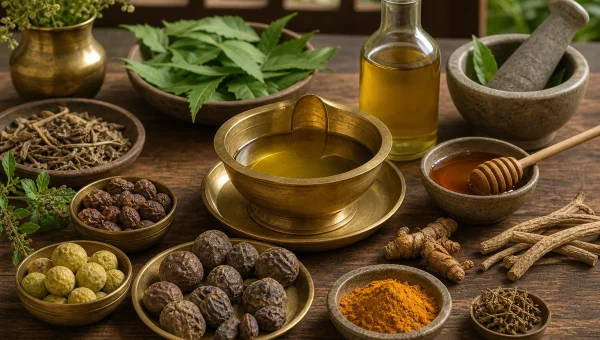
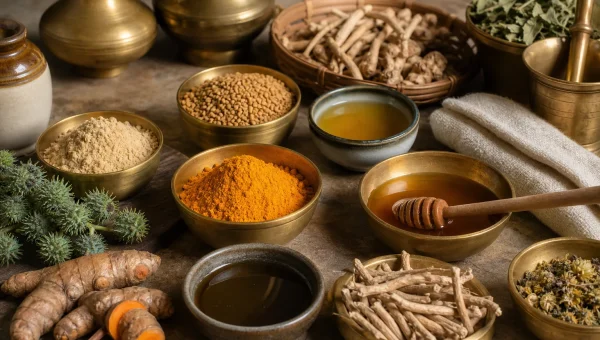
Manjistha (Rubia cordifolia): The premier Rakta Shodhaka and Rakta Prasadana (blood purifier and blood-quality restorative) of the classical materia medica. Its rasa is predominantly tikta (bitter) and kashaya (astringent), with ushna virya and katu vipaka, and its recognized actions include varnya (complexion-improving) and vishaghna (antitoxin). Traditionally it is used to cleanse rasa and rakta dhatu and to clear stagnation from the fine channels, including the lymph-like peripheral pathways, which is the classical rationale for using it where hormone-disrupting toxins are thought to settle in reproductive and connective tissue. See our complete Manjistha blood purifier guide for its full clinical applications.
Neem (Azadirachta indica): Classically Nimba carries tikta and kashaya rasa with sheeta virya and katu vipaka, and is valued as a krimighna (antimicrobial), kushthaghna (skin-disease remover), kandughna, and rakta shodhaka. It is one of the foremost bitter cleansing herbs for the blood and skin rather than a formal “Tikta Rasayana” category. Its strong bitter, cooling action supports the body in clearing heat and impurity from the blood, which is the traditional basis for its use alongside other purifiers in toxin-clearance regimens. Our Neem benefits and skin health guide explores its broader application.
Guduchi (Tinospora cordifolia): Known classically as Amrita (“the nectar of immortality”), Guduchi is a celebrated Rasayana and one of the Medhya Rasayanas, with tikta-kashaya rasa, ushna virya, and madhura vipaka. Its recognized actions are deepana and amapachana (kindling digestion and digesting Ama), jvaraghna, and balya (strengthening). Traditionally it is used to protect and restore the liver and to support the body’s resilience and immune surveillance during periods of toxic load, which is why it is paired with blood purifiers in protocols aimed at strengthening detoxification capacity. Full details at our Giloy and Guduchi immunity guide.
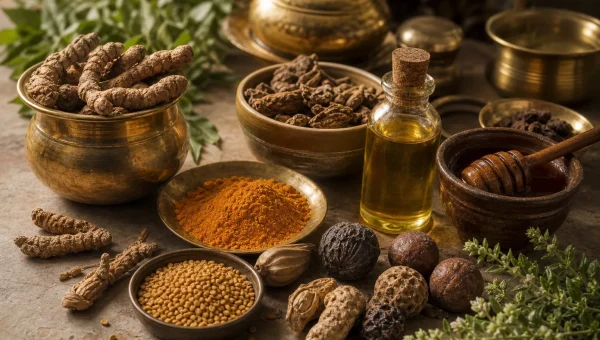
Triphala (Terminalia chebula, T. bellerica, Emblica officinalis): The classical three-fruit combination is tridoshahara, deepana, rasayana, and above all anulomana, meaning it gently regulates downward movement and ensures complete, regular elimination (koshtha shuddhi). This matters for hormone balance because conjugated estrogens and toxins that the liver has prepared for excretion must be carried out promptly; when bowel transit is sluggish, these conjugates linger in the colon and can be reactivated and reabsorbed. By restoring daily, complete evacuation, Triphala supports the timely removal of what the liver has already packaged for disposal, reducing the opportunity for reabsorption. Our complete Triphala benefits guide covers all its mechanisms.
Shatavari (Asparagus racemosus): The foremost Stri Rasayana (female reproductive tonic) of classical Ayurveda, with madhura-tikta rasa, sheeta virya, and madhura vipaka, and actions that are balya, rasayana, and stanyajanana. Rather than clearing toxins, Shatavari plays a nourishing and protective role: it strengthens and soothes the Artava Vaha Srotas and supports the natural function of reproductive tissue. In traditional practice it is given in the consolidation phase to rebuild and steady hormone-sensitive tissue after a course of cleansing, and because it is a phytoestrogen-containing herb it should be used cautiously and under guidance in those with hormone-sensitive conditions.
Xenoestrogen Sources and Exposure Reduction
Reducing ongoing exposure is the foundation of any endocrine-protection strategy; no amount of internal cleansing can keep pace with a continuous inflow of new toxins. The table below maps the most common everyday sources of xenoestrogens, where each tends to concentrate in the body, how it enters, and the most practical substitution for cutting that exposure. Prioritize the routes that touch heat and food, since these dominate daily intake.
| Source | Chemical | Body Site | Exposure Route | Reduction Strategy |
|---|---|---|---|---|
| Plastic containers and bottles | BPA, BPS | Adipose, blood | Leaching into food/drink | Glass and stainless steel only |
| Synthetic fragrances | Phthalates | Reproductive tissue | Inhalation, skin absorption | Unscented or essential oil-based products |
| Conventional produce | Organochlorine pesticides | Liver, adipose | Ingestion | Organic for dirty dozen produce |
| Personal care products | Parabens | Breast tissue, blood | Skin absorption | Paraben-free labeling |
| Non-stick cookware | PFAS compounds | Liver, thyroid | Heating, leaching | Cast iron or stainless steel pans |
| Receipts and printing paper | BPA | Blood | Skin absorption via handling | Minimize skin contact, wash hands after |
The Panchakarma Connection
For individuals with a high suspected toxin burden, Ayurvedic Panchakarma offers a systematic approach to mobilizing and eliminating accumulated impurities. Because most xenoestrogens are lipophilic, they tend to settle in fatty tissue, which in classical terms corresponds to disturbance lodged in Meda Dhatu. The purificatory procedures are chosen accordingly: Virechana (therapeutic purgation) acts through the liver and small intestine, the classical route for clearing aggravated Pitta and bile-bound waste, while Basti (medicated enema) works through the colon, the principal seat of Vata and a major route of elimination. Properly sequenced after oleation (snehana) and sudation (swedana), these therapies aim to draw lodged toxin from the deep tissues back to the gut for removal. It should be stated plainly that rigorous clinical evidence quantifying how much measurable chemical body burden Panchakarma removes remains limited and preliminary; the rationale here is the well-established classical mechanism of mobilization and elimination, not a proven reduction figure. For this reason Panchakarma must be undertaken only under qualified supervision. Our comprehensive Panchakarma detox guide explains these therapies in detail.
Three-Month Protocol for Endocrine Disruption Support
An Ayurvedic endocrine-support protocol should address four simultaneous goals: reducing ongoing exposure, supporting liver and digestive capacity, enhancing intestinal clearance, and nourishing and protecting sensitive reproductive tissue. The staged plan below builds these in sequence and should be adapted to the individual’s constitution by a qualified practitioner.
Month 1, focus on exposure reduction and digestive preparation:
- Replace all plastic food storage with glass; replace non-stick cookware with cast iron or stainless steel
- Triphala churna 3 g at bedtime with warm water to establish regular bowel transit
- Neem leaf tablet 500 mg twice daily with meals
- Reduce or eliminate synthetic fragrances
Month 2, active blood and channel purification:
- Manjistha churna 3 g twice daily with warm water
- Guduchi tablet 500 mg twice daily with meals
- Triphala continued
- Increase Brassica-family vegetables (broccoli, cauliflower, Brussels sprouts) daily; these supply indole-3-carbinol, traditionally regarded as supportive of healthy estrogen metabolism
Month 3, consolidation and tissue protection:
- Shatavari root powder 5 g in warm milk at bedtime
- Continue Manjistha and Triphala at maintenance doses
- Incorporate ground flaxseed (2 tablespoons daily); its lignans support healthy estrogen metabolism and regular elimination
Actionable tip: Start this week by auditing your kitchen for plastic exposure. Remove plastic containers, especially scratched or older ones, that you use for hot food storage or in the microwave, and replace them with glass. Heat markedly accelerates the leaching of BPA and similar compounds from plastic, so the kitchen, where heat and food contact combine, is plausibly among the largest everyday sources of dietary xenoestrogen exposure. While the exact percentage reduction will vary from person to person and has not been precisely quantified, switching heated food contact from plastic to glass is a high-value, low-cost change and a sensible first step before adding any supplement.
The question her Ayurvedic physician asked that the fertility specialist never raised is exactly the gap between conventional and integrative approaches. Xenoestrogen exposure is documented in the research as a fertility disruptor but most fertility workups don’t include any environmental exposure history.
How does the Ayurvedic assessment identify xenoestrogen burden specifically? What signs in the body or tongue or pulse would suggest this as a contributing factor versus a standard hormone panel that might show only borderline results?
I’ve been researching endocrine disruption for years in relation to my own thyroid issues. The Shatavari and Lodhra protocol described here overlaps significantly with the botanical protocols in functional medicine for hormone clearance support. Good to see the classical Ayurvedic basis documented.
Is there any testing recommended alongside the herbal protocol to confirm xenoestrogen reduction? Environmental estrogen panels exist but they’re expensive and not standardly available. How do you track whether the protocol is working without biomarker data?
The dietary piece is equally important but harder. Switching away from plastics and synthetic fragrances is straightforward. Eating predominantly organic and reducing processed food is expensive and not accessible for everyone. The article should acknowledge that the protocol has socioeconomic barriers.
I went through three years of fertility treatment and only found out about xenoestrogen exposure as a potential factor after doing my own research post-treatment. My fertility team never mentioned environmental exposure. This information needs to reach clinicians.
Manjistha for hormone clearance is something my Vaidya prescribed for endometriosis alongside dietary changes. The liver support angle makes sense because estrogen clearance is primarily a hepatic process. The Ayurvedic formulas seem to work upstream.
The claim that three synthetic fragrances daily could contribute to infertility is a serious one that needs more precise quantification. Dose-response matters enormously for endocrine disruption and ‘exposure reduces fertility’ as a general statement doesn’t help people make calibrated decisions.
I never thought about my plastic containers affecting my cycle this article made me check my kitchen
I started the Triphala and liver support protocol after reading about xenoestrogen concerns and my cycles became noticeably more regular within three months. I had been irregular for two years. Correlation not causation but three months of a low-risk intervention producing that result is worth noting.
How does this protocol interact with active fertility treatment? Can someone undergoing IUI or IVF cycles use these herbs simultaneously or is there a risk of interfering with the stimulation protocols?
Can Neem be taken daily without side effects
The point about borderline hormone panels that aren’t diagnosably abnormal is critical. The current medical threshold for ‘normal’ was set based on population averages, not optimal function. Persistent borderline results deserve investigation rather than reassurance.
The explanation of Ama and liver pathways helped me understand why my fatigue persists
Been following this for 3 weeks and my energy levels are much better, the protocol described here really clicked for me. ✨
late to this but wanted to ask, do these recommendations still hold in 2027?
Is there a test to measure xenoestrogen load or only symptom-based assessment?
how long does the detox protocol take to show measurable hormonal changes in bloodwork?
Useful post on Endocrine Disruption. I would still ask a practitioner before changing medicines.
I wonder how realistic it is to switch all food storage to glass for a family on a budget
just started exploring ayurveda after years of allopathy, still a lot to absorb
The article mentions Shatavari for estrogen balance but also mentions avoiding phytoestrogens, is that a contradiction?
Packaging this as science when most of it is tradition makes me skeptical.
my functional medicine doctor mentioned something similar, helpful to have the ayurvedic framing too
The xenoestrogen load issue is something my own practitioner raised with me two years ago and I’ll be honest, I dismissed it initially as fringe thinking. Then I did an elimination of plastics and conventional personal care products for three months and my cycle regulated for the first time in six years. I can’t attribute it to one thing but the correlation was hard to ignore. Does the protocol in this article address cookware specifically, or is the focus primarily on dietary and topical exposure?
Just found this post, the section 3 protocol seems intensive for a beginner, any lighter version?
My vaidya recommended something similar last month, good to see the reasoning explained. धन्यवाद
the sourcing section was a surprise, didnt know the extract grade mattered this much
The Endocrine Disruption section feels grounded enough to try carefully. This is the kind of detail readers can test slowly.
the pitta protocol here caused a lot of heat and skin irritation for me
this works in theory but practically very hard to source authentic herbs धन्यवाद
Just started exploring Ayurveda after years of allopathy, still a lot to absorb.
how long before seeing results? the article mentions 4 to 6 weeks but is that for everyone
the part about adjusting based on prakriti was exactly what i needed
is this suitable for pitta dominant people or mainly vata? 🙌
reading this after finding it on google, is this dosage still recommended? 🙏
the specific morning timing recommendation is practical, most articles skip that detail
Doing this
followed the dosage table for 10 days and my sleep improved, will continue 🙏
Starting this next week, will report back in about a month.
tried this for 6 weeks and saw no difference, maybe im applying it wrong
Shatavari sounds promising but I am cautious because of its phytoestrogen content
as someone with estrogen dominance, the liver support protocol here gave me a structured approach
just found this post, teh section 3 protocol seems intensive for a beginner, any lighter version?
would this protocol work if i travel frequently and cant maintain a fixed routine
where can you source the herbs in india outside of major cities? im in a tier-2 town 🌿
my constitution is vata-pitta, the article seems focused on one or the other
the section on triphala for xenoestrogen clearance was directly relevant to the research i was already doing ❤️
The table linking everyday items to specific toxins was eye opening I will start with unscented soap
Quick question: does the dosage change if someone is also on other medication?
where can you source the herbs in india outside of major cities? im in a tier-2 town
The specific morning timing recommendation is practical, most articles skip that detail.
the dosage here seems higher than what my ayurvedic doctor recommended
some of these claims are very strong for what is essentially anecdote-level evidence
would this protocol work if i travel frequently and cant maintain a fixed routine 💯
the xenoestrogen concept is real but the ayurvedic mechanistic explanation here is speculative at best धन्यवाद
Where are the actual clinical trials? I need RCT data before trying anything.
I was looking for a plain explanation of Endocrine Disruption. Good starting point for a cautious reader.
Tried the morning routine for 2 months, gave up the timing is impossible with kids and a job.
The plastic exposure reduction advice combined with the herbal protocol makes this more actionable than most articles. 🙏
bookmarked this to share with my mother who has been struggling with the same issue
i tried the liver-support herbs for 3 months and my estradiol levels didnt shift significantly
@Nandini Reading this after finding it on Google, is this dosage still recommended?
Tried the morning routine from this article and noticed a difference by day 5.
how long does teh detox protocol take to show measurable hormonal changes in bloodwork?
been following this for 3 weeks and my energy levels are much better, the protocol described here really clicked for me
Is this suitable for Pitta dominant people or mainly Vata?
packaging this as science when most of it is tradition makes me skeptical ✨
Thanks!
where are the actual clinical trials? i need rct data before trying anything
Tried this for 6 weeks and saw no difference, maybe I’m applying it wrong.
The Endocrine Disruption angle is useful here. The practical details matter more than people think.
Starting this next week, will report back in about a month. 🌿
The dosage here seems higher than what my Ayurvedic doctor recommended.
Good info
Helpful
I tried the liver-support herbs for 3 months and my estradiol levels didn’t shift significantly.
Some of these claims are very strong for what is essentially anecdote-level evidence.
this works in theory but practically very hard to source authentic herbs
the plastic exposure reduction advice combined with the herbal protocol makes this more actionable than most articles
the xenoestrogen concept is real but the ayurvedic mechanistic explanation here is speculative at best
tried the morning routine from this article and noticed a difference by day 5
would this protocol work if i travel frequently and can’t maintain a fixed routine