
My father died on a Tuesday in November. I was 34, reasonably healthy by most measures, and completely unprepared for what grief actually does to a body. Within two weeks I had lost weight. I could not sleep past 3am. My digestion, which had always been reliable, became irregular. I was cold all the time, anxious in a way that felt different from anything I had experienced before: a restless, rootless feeling, as if I had been cut loose from something that used to keep me grounded.
I had been practicing Ayurveda for about six years at that point, mostly for performance and physical health. But in those first months of grief, I understood in a direct way why Ayurveda treats emotions as events that involve the mind, prana, digestion, sleep, strength, and tissue nourishment. Grief was not only an idea in my head. It had a pattern in my body, and that meant it could be supported with a clear Ayurvedic framework.
This is what I learned and practiced through that period. I am not presenting this as a cure for grief. There is no reason to erase grief when it is the natural response to love and loss. What Ayurveda offers is a way to grieve without abandoning the body in the process, and a framework for understanding why grief manifests differently in different people.
Grief as a Vata-Led Disturbance of Mind, Heart, and Ojas
Ayurveda describes grief, or shoka, as a state that can affect the mind, the heart, the movement of prana, and the stability of the tissues. In practical terms, grief often behaves like a Vata-aggravating event: it is sudden, destabilizing, drying, depleting, and disruptive to sleep, appetite, elimination, and nervous-system steadiness.
Three Ayurvedic functional principles are especially useful for understanding grief:
- Prana Vata governs the inward movement of breath, sensory intake, and the mind’s interaction with the nervous system. When grief disturbs Prana Vata, a person may experience anxious breathing, racing thoughts, fearfulness, restlessness, insomnia, and difficulty feeling settled.
- Sadhaka Pitta is associated with motivation, determination, accomplishment, intelligence, and the inner capacity to make meaning. In grief, this function can become disturbed as anger, guilt, regret, obsessive reviewing of events, or the painful search for an explanation.
- Tarpaka Kapha is associated with nourishment, emotional stability, memory, satisfaction, and inner steadiness. When grief weighs heavily through Kapha, it may appear as withdrawal, heaviness, excessive sleep, dullness, or a feeling of being unable to move forward.
Classical Ayurveda also links grief with depletion. In the Charaka tradition, shoka is described among factors that can produce wasting or emaciation, and grief is included among influences that disturb ojas, the vital essence associated with strength, vitality, steadiness, and resistance to disease. This does not mean that every grieving person has a disease; it means that prolonged or intense grief can consume strength, disturb sleep, weaken appetite, and leave the body less resilient.
Modern medicine also recognizes bereavement as a whole-body stressor. After the death of a partner, studies have found a higher short-term risk of myocardial infarction and stroke, especially in the first month. Other bereavement research has described changes in inflammatory markers such as interleukin-6 in some grieving populations. Ayurveda’s practical insight is similar in spirit: grief deserves bodily care, not only emotional endurance.
How Different Doshas Grieve Differently
The same loss can produce different patterns depending on a person’s constitution, current imbalance, age, season, digestion, sleep, and available support. The table below is a practical Ayurvedic pattern map, not a fixed diagnostic label. It helps decide what kind of support is most needed.
| Dosha Pattern | Grief Presentation | Physical Signs | Primary Support Focus |
|---|---|---|---|
| Vata | Anxiety, restlessness, fearfulness, dissociation, inability to be present, rapid movement between emotion and numbness | Insomnia, early-morning waking, weight loss, constipation, cold extremities, trembling, variable appetite | Warmth, oiliness, grounding routine, regular meals, touch, rest, nourishment |
| Pitta | Anger, guilt, bitterness, self-blame, irritability, obsessive reviewing of events, need to assign blame | Acidity, heat, loose stools, inflammatory flares, headaches, disturbed sleep with heat or intensity | Cooling, softening, forgiveness work, gentle food, reduced intensity, calming herbs under guidance |
| Kapha | Withdrawal, heaviness, dull sadness, inability to act, clinging to the past, prolonged emotional stagnation | Excessive sleep, heaviness, low appetite, mucus, weight gain, lethargy, chest congestion | Gentle movement, light warmth, companionship, gradual re-engagement, stimulating but kind routine |
My grief was clearly Vata-dominant: insomnia, weight loss, coldness, irregular digestion, and a rootless kind of anxiety. That recognition gave me a direction. I did not need harsh discipline. I needed warmth, oil, routine, food, and repetition.
The Five Core Practices: What I Actually Did
The practices below were the core of my grief-support routine. They did not remove the grief, and they did not replace mourning, prayer, counseling, family support, or time. They simply gave my body enough stability to carry what the heart was carrying.
1. Abhyanga: Daily Oil Massage for Vata Grounding
I started doing full-body warm sesame oil massage every morning at 6am. At first it did not feel luxurious. It felt like work. But in Ayurveda, oil is one of the most direct ways to pacify Vata: it brings warmth, heaviness, softness, steadiness, and contact back into a system that has become dry, cold, mobile, and unsettled.
The home protocol I used was simple: about 60-80 ml of warm sesame oil, long strokes along the limbs, circular movement around the joints, gentle attention to the abdomen, chest, shoulders, ears, and soles of the feet, then 10-15 minutes of quiet sitting before a warm bath or shower. I practiced this daily for three months. Sleep did not transform overnight, but my body began to feel less shocked and less scattered.
Classical Ayurvedic descriptions of abhyanga emphasize Vata pacification, steadiness, nourishment of the body, and support for sound sleep. Padabhyanga, oiling the soles of the feet, is especially valued for pacifying Vata and relieving roughness, dryness, fatigue, and numbness. For related grounding practices, see our guide on grounding practices for anxiety and Vata imbalance.
2. Ashwagandha and Brahmi: Nourishment for Stress, Sleep, and Mental Clarity
Grief can make the body feel depleted and the mind feel foggy. In Ayurveda, this is where deeply nourishing and mind-supportive herbs may be useful, but they should be chosen carefully according to constitution, digestion, medications, and clinical context.
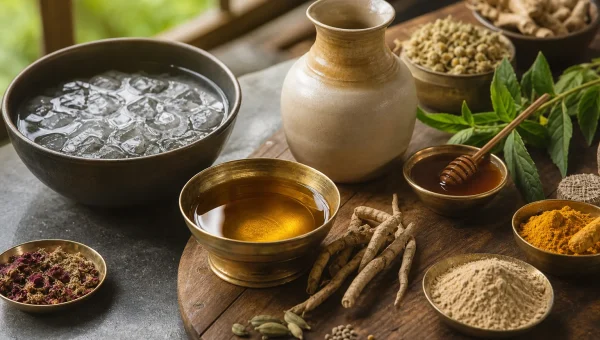
Ashwagandha (Withania somnifera) is a strengthening, nourishing herb widely used in Ayurveda for Vata-type depletion, weakness, stress, and disturbed sleep. My personal bedtime preparation was ashwagandha root powder simmered in warm milk with a small amount of ghee and cardamom. A traditional milk preparation is gentler and more nourishing than taking a dry powder alone, especially when grief has reduced appetite and body weight. People who are pregnant, have thyroid disease, liver disease, autoimmune conditions, hormone-sensitive prostate cancer, or take sedatives, thyroid medicines, or immune-modulating drugs should use ashwagandha only with qualified guidance.
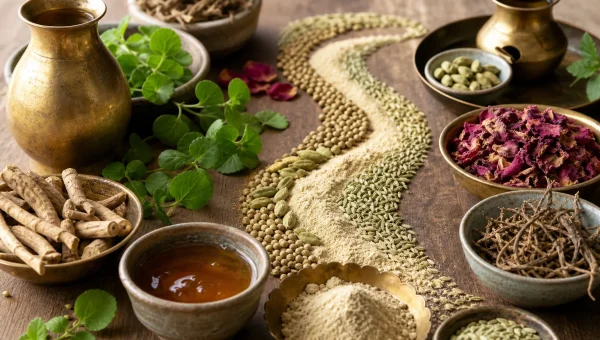
Brahmi is a name used in different traditions for mind-supportive plants, especially Bacopa monnieri and sometimes Centella asiatica. For grief-related brain fog, I used Bacopa monnieri as a morning support for attention and mental steadiness. This is not a numbing herb; it is better understood as a slow, steady support for cognition and emotional steadiness when used appropriately over time.
My practitioner-guided herb routine:
- Ashwagandha root powder in warm milk at bedtime, adjusted to digestion and tolerance
- Brahmi as Bacopa monnieri in the morning, using a reputable preparation
- Ghee and warm milk as nourishing carriers when suitable
- A minimum observation period of several weeks, with changes made according to sleep, digestion, bowel pattern, heat, heaviness, and mental clarity
3. A Nightly Insomnia Protocol
Waking in the early morning was the most difficult symptom for me. The mind would turn on before dawn and immediately begin replaying memories, regrets, and unfinished conversations. From an Ayurvedic perspective, this was a Vata sleep pattern: light, broken, early, and restless.
My nightly routine became intentionally repetitive:
- Warm milk with a small amount of ghee before bed, when digestion allowed
- A tiny pinch of nutmeg only when appropriate, never increased casually or used in large amounts
- Warm sesame oil or Brahmi oil on the soles of the feet before sleep
- Slow breathing with a longer exhale when waking at night
- Nadi Shodhana, alternate nostril breathing, practiced gently in the evening rather than forcefully in bed
The aim was not to force sleep. The aim was to teach the body the same message every night: it is safe to soften. For a broader discussion of sleep patterns and Ayurvedic root-cause care, see our article on the Ayurvedic insomnia protocol beyond Ashwagandha.
4. Diet as Grief Medicine
When grief is Vata-dominant, food needs to be warm, cooked, moist, regular, and easy to digest. Classical Ayurvedic guidance for Vata emphasizes sweet, sour, salty, warm, and unctuous qualities. This does not mean overeating sweets or heavy foods. It means choosing meals that rebuild steadiness instead of increasing dryness, coldness, irregularity, and depletion.
My grief diet for the first three months was built around simple foods:
- Warm rice with ghee, cumin, and rock salt
- Moong dal soup with ginger, cumin, and a little turmeric
- Warm milk with dates when digestion was strong enough
- Cooked root vegetables such as sweet potato, carrot, and beetroot
- Soft khichdi on days when appetite was poor
- Warm water through the day instead of cold drinks
I avoided cold salads, dry snacks, irregular fasting, and alcohol. I also stopped caffeine after noon because the early-morning waking was already strong. This was not a moral rule; it was a Vata rule. A grieving body needs fewer shocks and more rhythm.
5. Routine Anchoring Through Dinacharya and Ritucharya
One of grief’s most destabilizing effects is the collapse of time structure. The person who anchored your day is gone. Meals become irregular, sleep becomes irregular, and the body loses its sense of sequence. In Ayurveda, routine is medicine because it gives Vata a boundary.
The classical ideas of dinacharya, daily routine, and ritucharya, seasonal routine, became a lifeline for me. My grief routine was not complicated: wake at the same time, oil massage, warm water, slow breathing, breakfast by a predictable hour, a walk in daylight, simple warm meals, and lights out by 10pm. The structure did not heal the grief. It gave grief a container.
Seasonal adjustment also mattered. In cold, dry, windy weather, I increased warm oil, soup, ghee, and rest. In hot weather, I softened the routine with cooling foods and less intensity. For the full seasonal framework, our guide on Ritucharya and Ayurvedic seasonal routine is a useful place to begin.
What Ayurveda Does Not Offer, and What It Does
Ayurveda does not offer a shortcut through grief, a way to bypass mourning, or a herb that makes loss painless. Grief is not automatically a disorder. It is a natural response to losing someone or something deeply loved. The Ayurvedic goal is not emotional numbness; it is steadiness, nourishment, and the restoration of enough strength to live with what has happened.
What Ayurveda does offer is support for the body during a process the mind and heart must undergo. It helps reduce the cost of grief on sleep, appetite, digestion, strength, bowel regularity, immunity, and nervous-system stability. It gives symptoms a language: early waking, constipation, coldness, and fearfulness are not signs of weakness; they are signs that Vata needs care.
Classical Ayurvedic care also recognizes the value of reassurance, consolation, supportive surroundings, and appropriate emotional counterweights when the mind is disturbed by loss. That matters. Herbs and oil are not enough if a person is isolated. Grief needs human presence, ritual, conversation, prayer if meaningful, and sometimes professional care.
Safety note: If you are experiencing grief following loss, professional mental health support such as grief therapy, bereavement counseling, or support groups can be an important primary resource. Ayurvedic practices work best as a complementary layer alongside appropriate psychological and medical support. If you experience suicidal thoughts, danger to yourself, severe depression, complete inability to function, or grief that remains intense and disabling over time, seek urgent professional help. In India, the Vandrevala Foundation offers 24/7 mental health support at +91 9999 666 555; outside India, contact your local emergency number or crisis service.
For those whose grief has also disrupted digestion, our article on Agni and digestive fire as Ayurveda’s foundation explains how to rebuild digestive strength after emotional stress.
I am four years past my father’s death now. The grief has not disappeared, and I am not sure it should. But I am healthy. I sleep well. My digestion is strong. The bedtime milk, the oil on the feet, the warm food, and the morning routine have become less like medicine and more like care, which is what grief eventually teaches you to give yourself. Start gently tonight: a warm meal, warm oil on the soles of the feet, a slow exhale, or a practitioner-approved bedtime herb. Let it be the first thing you do for yourself in a long while.
Additional resources:
- Bereavement counseling or grief therapy with a qualified mental health professional
- Local grief support groups, family support, and community care
- Qualified Ayurvedic consultation for individualized herbs, diet, sleep, and daily routine
Nothing in this article diagnoses or treats a medical condition. Use it as educational information and consult a qualified Ayurvedic practitioner, physician, or mental health professional before starting herbs, supplements, detoxes, or therapeutic protocols, especially if pregnant, managing a medical or psychiatric condition, or taking medication.
References
- Psychiatry (psychiatry.org)
- Charaka Samhita — Manas
- Charaka Samhita — Yajjah Purushiya Adhyaya
- Charaka Samhita — Shosha Nidana
- Charaka Samhita — Ojas
- Increased risk of acute cardiovascular events after partner bereavement: a matched cohort study (2014), PubMed
- Risk of acute myocardial infarction after the death of a significant person in one’s life: the Determinants of Myocardial Infarction Onset Study (2012), PubMed Central
- The association between bereavement and biomarkers of inflammation (2015), PubMed
- When grief makes you sick: bereavement induced systemic inflammation is a question of genotype (2012), PubMed Central
- Charaka Samhita — Abhyanga
- Pilot study investigating the effects of Ayurvedic Abhyanga massage on subjective stress experience (2011), PubMed
- NIH Office of Dietary Supplements
- An investigation into the stress-relieving and pharmacological actions of an ashwagandha (Withania somnifera) extract: A randomized, double-blind, placebo-controlled study (2019), PubMed
- Webprod (webprod.hc-sc.gc.ca)
- Msdmanuals (msdmanuals.com)
- NCBI
- Charaka Samhita — Vatavyadhi Chikitsa
- Charaka Samhita — Rasa Vimana
- Charaka Samhita — Ahara vidhi
- Charaka Samhita — Ritucharya
- Ritucharya: Answer to the lifestyle disorders (2011), PubMed Central
- Breathing Practices for Stress and Anxiety Reduction: Conceptual Framework of Implementation Guidelines Based on a Systematic Review of the Published Literature (2023), PubMed Central
- Effects of voluntary slow breathing on heart rate and heart rate variability: A systematic review and a meta-analysis (2022), PubMed
- Influence of alternate nostril breathing on heart rate variability in non-practitioners of yogic breathing (2012), PubMed
- Drugs (drugs.com)
- Vandrevalafoundation (vandrevalafoundation.com)

The 8 pounds in two weeks, the 3am waking, the permanent cold, the rootless anxiety. This is grief described more precisely than anything I’ve read clinically or personally. Thank you for putting language on it.
I lost my mother eighteen months ago and the Vata description of grief as the dosha of movement and loss is the first framework that has made sense to me. The rootlessness is exactly it. Nothing to hold onto after the loss of someone who anchored you.
This makes sense for Approaches to Grief and Loss. The practical details matter more than people think.
This makes sense for Approaches to Grief and Loss. Small daily changes are easier to follow than a perfect plan.
My father died last March and I developed what I now recognize as Ojas depletion grief. The chronic low immunity, the hair loss, the inability to focus. Three months of Ashwagandha, ghee-based food, and Abhyanga and I started to feel physically inhabited again.
Does the dosha protocol change for different prakritis? My assessment came back as Vata-Pitta and I’m not sure if the standard approach applies.
The Nasya with brahmi for the heaviness in the head and the disconnection that characterizes acute grief is something my practitioner prescribed after my brother’s death. I was skeptical of an oil in the nose addressing emotional pain. I was wrong.
The Vata dominant symptoms described insomnia weight loss and constant cold really matched what I felt after losing my mom last year
The six years of Ayurvedic practice for physical performance, and then the grief revealing something about the system’s depth that performance protocols never did, is the kind of experiential truth that’s difficult to dismiss.
The warm sesame oil Abhyanga for Vata grief is the single most effective physical intervention for grief I’ve found. It creates a literal sensation of being held. The pharmacology of why sesame oil pacifies Vata is interesting but the felt experience of it is what matters initially.
I wonder if the ashwagandha milk routine would help with the 3 am waking that comes with grief related anxiety
My therapist and my Ayurvedic practitioner were the two people who helped me through my husband’s death. The therapist addressed the psychological processing. The practitioner kept my body from completely falling apart. Both were necessary.
Lost my mother eighteen months ago and the physical symptoms you describe — the weight loss, the 3am waking, the cold — I thought something was medically wrong with me. No one connected it to grief. The idea that Vata is specifically implicated in the rootless restless quality of that kind of loss is the first framing that has felt accurate to what I actually experienced. Thank you for writing this honestly.
Reading about Sadhaka Pitta disruption made me reconsider why anger shows up so strongly in my own grieving process
The physical symptoms of grief as a diagnostic window into the constitution of the grieving person is a sophisticated clinical approach. Not everyone grieves in the same way physically. The Vata-type restlessness and the Kapha-type heaviness are different physical experiences of the same emotional event.
The idea that grief depletes ojas and shows up as susceptibility to illness lines up with the research cited on inflammatory markers
Do the grounding oil massage steps need to be done exactly at 6 am or can they be shifted to fit a different schedule
I tried a warm sesame oil foot rub before bed and noticed I fell asleep faster though the grief feelings were still there
It is helpful to see grief framed as a physiological event rather than just an emotional one it validates the body’s response
The section on dosha specific grief patterns makes me think my friend’s Kapha type sadness might need different support than my Vata type anxiety
I am skeptical about the claim that avoiding caffeine after noon alone can shift the 3 am waking pattern but I am willing to test it
The nightly protocol with ghee nutmeg and saffron sounds soothing has anyone tried adding a pinch of cinnamon instead
how does the 3am cortisol spike theory align with modern HPA axis research, any citations
After four years the author still finds the ashwagandha milk ritual meaningful as a self care gesture not just a remedy
the lifestyle changes in section 3 about screen time and Vata aggravation saved my sleep. medication-free now
ठीक है। the article mentions Abhyanga before bed but doesnt specify oil. sesame or coconut for Vata type
✨ the article mentions Abhyanga before bed but doesn’t specify oil. sesame or coconut for Vata type
which specific ashwagandha preparation works better for sleep quality, the root powder or the extract
tried the entire protocol for a month. my sleep if anything got worse. I think there’s huge individual variation
brahmi oil on the head before bed leaves a mess on the pillow. not practical for most people, should mention that
brahmi oil on the head before bed leaves a mess on the pillow. not practical for most people, should mention that asked this just now
for those of us with Pitta-Vata combined type is the protocol different from pure Vata
the article mentions Abhyanga before bed but doesn’t specify oil. sesame or coconut for Vata type
the lifestyle changes in section 3 about screen time and Vata aggravation saved my sleep. medication-free now asked this earlier
🙏 how does the 3am cortisol spike theory align with modern HPA axis research, any citations
the lifestyle changes in section 3 about screen time and Vata aggravation saved my sleep. medication-free now 💯
tried the entire protocol for a month. my sleep if anything got worse. I think there’s huge individual variation 🙌
Helpful, thanks
tried the entire protocol for a month. my sleep if anything got worse. I think there’s huge individual variation asked this just now
💯 the article mentions Abhyanga before bed but doesnt specify oil. sesame or coconut for Vata type
the article is very confident about Vata being the cause of 3am waking. but many people wake then due to glucose crashes too
how does the 3am cortisol spike theory align with modern HPA axis research, any citations asked this just now
the article is very confident about Vata being the cause of 3am waking. but many people wake then due to glucose crashes too asked this last week
the article mentions Abhyanga before bed but doesnt specify oil. sesame or coconut for Vata type
brahmi oil on the head before bed leaves a mess on the pillow. not practical for most people, should mention that asked this recently
after reading the sleep architecture section I changed my dinner to 7pm instead of 9pm. my deep sleep percentage on my tracker went up
for those of us with Pitta-Vata combined type is the protocol different from pure Vata asked this just now
the article is very confident about Vata being the cause of 3am waking. but many people wake then due to glucose crashes too asked this just now
which specific ashwagandha preparation works better for sleep quality the root powder or the extract
which specific ashwagandha preparation works better for sleep quality, the root powder or the extract asked this recently
the article is very confident about Vata being the cause of 3am waking. but many people wake then due to glucose crashes too asked this recently
the article mentions Abhyanga before bed but doesn’t specify oil. sesame or coconut for Vata type asked this just now
💯 the article is very confident about Vata being the cause of 3am waking. but many people wake then due to glucose crashes too
💯 the article mentions Abhyanga before bed but doesn’t specify oil. sesame or coconut for Vata type
for those of us with Pitta-Vata combined type is the protocol different from pure Vata asked this earlier
❤️ the article is very confident about Vata being the cause of 3am waking. but many people wake then due to glucose crashes too
the lifestyle changes in section 3 about screen time and Vata aggravation saved my sleep. medication-free now asked this just now