
If you have been taking plain turmeric capsules regularly but not noticing much difference, the issue may be absorption. Curcumin, the best-known curcuminoid in turmeric, is difficult for the body to absorb in its unformulated form because it has poor water solubility, is rapidly metabolised in the intestine and liver, and is quickly eliminated.
The practical answer is not simply “take more turmeric.” In Ayurvedic practice, turmeric is commonly used as part of a prepared food, milk, ghee, oil, or spice combination rather than as an isolated dry powder swallowed with water. Modern pharmacokinetics helps explain why black pepper, long pepper, ginger, ghee, oil, and milk can change how turmeric behaves in the body.
Here is how to make turmeric work more intelligently while staying close to authentic Ayurvedic use.
The Absorption Problem Nobody Talks About
Curcumin is fat-soluble and poorly soluble in water. When a standard curcumin extract is taken orally, only a small fraction reaches the bloodstream unchanged, and much of what is absorbed is converted into metabolites such as glucuronides and sulfates. This is why two capsules with the same “curcumin” amount on the label can perform very differently depending on the delivery system.
In one 2025 open-label human comparison, standard curcumin produced a reported Cmax of 10.94 ng/mL, while BioTurm™ reached 647.97 ng/mL and a Curcuma longa extract containing 10% piperine reached 663.60 ng/mL. These numbers should be read as product-specific pharmacokinetic findings rather than universal values for every turmeric supplement, but they illustrate the basic point: formulation matters.
The Plot Twist: Local Gut Action Matters Too
Low blood levels do not mean turmeric is useless. Oral curcumin can remain concentrated in the gastrointestinal tract, where it may interact with the intestinal lining, local immune activity, oxidative stress pathways, and the gut microbiota. This helps explain why whole turmeric in food can still be meaningful even when it does not create high systemic curcumin levels.
For general digestive and dietary use, turmeric in cooking may be enough. For systemic goals such as joint comfort or inflammatory support, a well-formulated curcumin product or a traditional preparation that includes fat and pungent spices is usually more logical than plain capsules taken with water.
The 2000% Piperine Finding
In the well-known 1998 human pharmacokinetic work by Shoba and colleagues, 20 mg of piperine taken with 2 g of curcumin increased curcumin bioavailability by 2000% in human volunteers. Piperine, the major alkaloid in black pepper, can slow the metabolic processing of curcumin and increase its measurable presence in blood.
This is powerful, but it is not a free pass to add high-dose black pepper extract to everything. Piperine can also affect drug transporters and drug-metabolising enzymes, including P-glycoprotein and CYP3A4. That is useful for curcumin absorption, but it is also why curcumin-piperine supplements need caution when prescription medicines are involved.
Ayurvedic View of Haridra
In the Ayurvedic Pharmacopoeia of India, Haridra is the dried and cured rhizome of Curcuma longa. Its listed rasa are katu and tikta, its guna is ruksha, its virya is ushna, and its vipaka is katu. Its karma include krimighna, kushaghna, varnya, vishaghna, kaphapittanut, and pramehanashaka, and the adult powder dose is listed as 1–3 g.
This classical profile is important because Ayurveda does not view turmeric as “curcumin only.” Haridra is a hot, pungent-bitter, drying rhizome traditionally used with attention to constitution, digestion, season, preparation, and anupana. A person with sluggish Kapha-type digestion may tolerate it differently from someone with hyperacidity, burning sensations, or aggravated Pitta.
Trikatu: The Digestive Formula Behind the Bioenhancer Idea
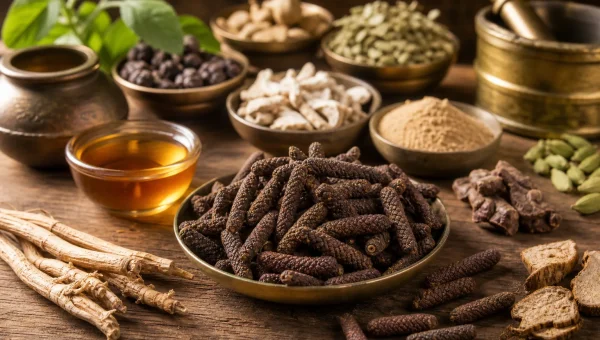
Trikatu is a classical Ayurvedic powder made from three pungent ingredients in equal parts: Maricha, Pippali, and Shunthi. In modern botanical terms, these are black pepper fruit, long pepper fruit, and dried ginger rhizome.
- Maricha — black pepper, Piper nigrum
- Pippali — long pepper, Piper longum
- Shunthi — dried ginger, Zingiber officinale
Ayurveda uses Trikatu as a deepana-pachana formula, meaning it supports appetite, digestive fire, and the proper processing of food. In the context of turmeric, a small pinch of Trikatu provides piperine-containing peppers along with ginger’s warming digestive quality. It is not suitable for everyone in large amounts, especially people prone to acidity, heat, gastritis, ulcers, bleeding disorders, or strong Pitta aggravation.
Modern Bioavailability Solutions: A Comparison
The supplement industry now uses several strategies to solve the same basic problem: curcumin is difficult to absorb on its own. Some methods use piperine, some use lipids or phospholipids, and some use nanoparticle or proprietary delivery systems.
| Formulation Type | What It Does | Practical Notes |
|---|---|---|
| Plain turmeric powder | Provides the whole rhizome matrix, including curcuminoids and volatile oil | Best used in food with oil, ghee, or milk rather than swallowed with water |
| Standard curcumin extract | Concentrates curcuminoids but often has low systemic bioavailability | Absorption is weaker without fat, piperine, or another delivery system |
| Curcumin + piperine | Uses black pepper alkaloids to reduce metabolic breakdown and improve absorption | Affordable and well known, but more interaction-prone with medications |
| Liposomal or phospholipid curcumin | Uses lipid-based carriers to improve dispersion and absorption | Useful for people avoiding piperine, though products vary widely |
| Nanoformulated curcumin | Uses smaller particles or specialised carriers to improve solubility and delivery | Absorption numbers vary by technology, so compare exact products rather than categories |
| Advanced whole-extract systems | Use turmeric fractions such as oils or turmerones with curcuminoids | Promising, but product-specific data should guide expectations |
A large scoping review of curcumin clinical trials found that 45% of trials used enhanced-bioavailability products, and among musculoskeletal trials the figure was about 61.2%. This does not mean every person needs a high-tech formula, but it does show that formulation is central when curcumin is used for targeted purposes.
How to Make Golden Milk for Better Absorption
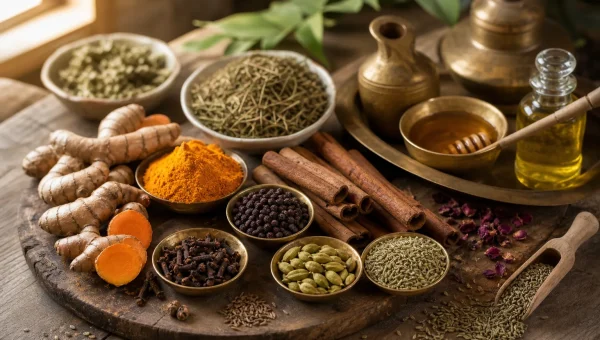
Many online golden milk recipes are pleasant turmeric lattes. A more purposeful turmeric milk should include three things: turmeric, a fat-containing base, and a small amount of black pepper or Trikatu. This keeps the preparation closer to Ayurvedic logic while also addressing curcumin’s fat-soluble nature.
Turmeric Milk
This is a simple household preparation for people who tolerate milk and warming spices well. Use smaller amounts at first if you are sensitive to heat, acidity, or pungent spices.
- 1 cup whole milk or full-fat coconut milk
- 1/2 to 1 teaspoon turmeric powder
- 1/8 teaspoon black pepper powder, or a small pinch of Trikatu
- 1/2 teaspoon ghee or coconut oil
- A small piece of jaggery, or honey added only after the drink cools to warm
- A pinch of cinnamon or cardamom, optional
Method: Warm the milk gently on low heat. Add turmeric, black pepper or Trikatu, and ghee or coconut oil. Stir for 2–3 minutes until the drink turns deep golden. Remove from heat and allow it to cool until warm. If using honey, add it only after cooling, because classical Ayurvedic guidance advises against heating honey.
Turmeric Paste
This paste is a convenient weekly concentrate for people who prefer not to measure spices every time. It should be kept refrigerated in a clean glass jar and used in small amounts.
- 1/4 cup turmeric powder
- 1/2 cup water
- 1 to 2 teaspoons Trikatu powder, or black pepper powder to taste
- 2 tablespoons coconut oil or ghee
Method: Cook the turmeric and water on low heat, stirring until a paste forms. Remove from heat and mix in the fat and pepper or Trikatu. Use about 1/2 to 1 teaspoon of paste in warm milk, adjusting the amount according to tolerance.
Common Mistakes to Avoid
Taking turmeric with plain water: Curcumin is fat-soluble, so plain water is a poor vehicle. Food, milk, ghee, or oil makes more sense than swallowing dry turmeric or curcumin with water alone.
Using too much pepper: A pinch of black pepper in food is very different from concentrated piperine extract. Piperine may improve curcumin absorption, but it can also alter drug metabolism and transport.
Megadosing curcumin: More is not automatically better. Curcumin products commonly cause gastrointestinal symptoms such as nausea, reflux, stomach upset, diarrhoea, constipation, or abdominal discomfort in some people, especially at higher doses.
Ignoring the whole herb: Whole turmeric contains more than isolated curcumin. The Ayurvedic Pharmacopoeia of India lists essential oil and curcumin as constituents of Haridra, and the classical use of turmeric depends on the whole rhizome, its qualities, and its preparation.
Forgetting drug interactions: Curcumin and turmeric supplements require caution with anticoagulant or antiplatelet medicines, surgery, bleeding disorders, gallbladder problems, and medicines affected by drug-metabolising enzymes. Piperine-containing products deserve extra caution.
What Should You Actually Do?
For culinary use, keep using turmeric in dals, sabzis, soups, curries, and rice dishes. Add it during cooking with ghee or oil, and include a little black pepper when appropriate for your constitution and digestion.
For a more traditional household routine, turmeric milk with ghee and a small amount of black pepper or Trikatu is more sensible than plain turmeric in hot water. Start small, observe digestion, and avoid forcing it if it causes burning, reflux, nausea, loose stools, or heat symptoms.
For targeted supplementation, choose a product that clearly states its curcuminoid content and delivery method. Curcumin-piperine products are common and affordable, while liposomal, phospholipid, and nanoformulated products may be suitable for people avoiding piperine. For joint comfort, many clinical trials run for about 8 weeks or longer, so judging a product after only a few days is usually premature.
Frequently Asked Questions
These answers apply to general adult use and do not replace individual advice from an Ayurvedic practitioner, doctor, pharmacist, or other qualified healthcare professional.
Why does plain turmeric have such low absorption?
Curcumin is poorly soluble in water, rapidly metabolised in the intestine and liver, and quickly eliminated. Without fat, piperine, or a specialised formulation, only a small amount reaches systemic circulation unchanged.
Is whole turmeric better than curcumin supplements?
They serve different purposes. Whole turmeric is best suited to food, daily culinary use, and traditional preparations. Curcumin supplements are concentrated products used when a targeted curcuminoid dose and a specific delivery system are desired.
Can turmeric be taken every day?
Turmeric can be used regularly in culinary amounts by many people, but daily supplemental curcumin is not appropriate for everyone. People taking prescription medicines, pregnant or breastfeeding women, those with gallbladder disease or bleeding risk, and anyone preparing for surgery should seek professional guidance first.
How long does turmeric take to work?
For digestive use, tolerance and comfort can often be judged sooner. For joint comfort or inflammatory support, clinical trials commonly evaluate curcumin over several weeks, often around 8 weeks or more, so consistency and the right formulation matter.
Disclaimer: Turmeric, curcumin, Trikatu, black pepper extract, and piperine supplements may not be appropriate for people with gallbladder disease, bleeding disorders, liver disease, active ulcers or reflux, pregnancy, breastfeeding, upcoming surgery, or prescription medication use. Consult a qualified Ayurvedic practitioner, doctor, pharmacist, or healthcare provider before using concentrated turmeric or curcumin supplements.
References
- Improving Curcumin Bioavailability: Current Strategies and Future Perspectives (2021), PubMed Central
- Lpi (lpi.oregonstate.edu)
- Highly Bioavailable Forms of Curcumin and Promising Avenues for Curcumin-Based Research and Application: A Review (2020), PubMed Central
- An Open Label, Randomized, Comparative Bioavailability Study of BioTurm™ Extract Versus Curcuma longa Extract With Piperine in Healthy Adult Volunteers (2025), PubMed
- Cureus (cureus.com)
- Mdpi (mdpi.com)
- Advances and Perspectives in Curcumin Regulation of Systemic Metabolism: A Focus on Multi-Organ Mechanisms (2026), PubMed
- Influence of piperine on the pharmacokinetics of curcumin in animals and human volunteers (1998), PubMed
- Overview of Curcumin and Piperine Effects on Glucose Metabolism: The Case of an Insulinoma Patient’s Loss of Consciousness (2023), PubMed Central
- Piperine, a major constituent of black pepper, inhibits human P-glycoprotein and CYP3A4 (2002), PubMed
- Ayurvedic Pharmacopoeia of India
- Ijrap (ijrap.net)
- Archive (archive.org)
- Mdpi (mdpi.com)
- Dovepress (dovepress.com)
- NCCIH
- Wmic (wmic.wales.nhs.uk)
- Medsafe (medsafe.govt.nz)
- Efficacy of Turmeric Extracts and Curcumin for Alleviating the Symptoms of Joint Arthritis: A Systematic Review and Meta-Analysis of Randomized Clinical Trials (2016), PubMed Central
- An Investigation into the Effects of a Curcumin Extract (Curcugen(®)) on Osteoarthritis Pain of the Knee: A Randomised, Double-Blind, Placebo-Controlled Study (2021), PubMed
- Studies on the physicochemical characteristics of heated honey, honey mixed with ghee and their food consumption pattern by rats (2010), PubMed Central

The fat-soluble point is what got me. I’d always taken my turmeric capsule with a glass of water in the morning, totally fasted. Started stirring it into warm milk with a little ghee instead and the change has been real. Would be curious whether the quality of the fat matters — coconut oil versus ghee, for example.
This is exactly the kind of content that’s missing in the Ayurveda space online, evidence-based but still honoring the traditional context. Bookmarking this entire site.
I’m going to share this comment with my skeptical partner. Exactly what I needed to articulate why this works.
I’m a naturopath and I share quality Ayurvedic content with my clients. This one is going straight into my resources folder. The contraindications section is thorough and honest.
That’s a really important distinction you’ve made. I think a lot of people skip the preparation phase and then wonder why results are inconsistent.
I ordered this from an Ayurvedic supplier after reading this post. Just received it today, wish me luck! I’ll check back in a few weeks with an update
The section on preparation methods is gold. I’d been making it wrong for months. No wonder results were inconsistent. Switching to the decoction method this week.
I’ve been taking this herb for about three months now and the difference is genuinely noticeable. My energy levels have improved and the chronic bloating I used to struggle with has reduced significantly. Thank you for putting this together so clearly.
Ive been taking a curcumin supplement for months and honestly wondered why I wasnt feeling anything. Never knew about the black pepper connection until now. Switched to a formula with piperine three weeks ago and the difference in my joint stiffness is noticeable. Wish the label on my original bottle had mentioned any of this.
Started this about six weeks ago. First two weeks I noticed nothing, then around week three something shifted. Digestion is smoother, less brain fog in the mornings. Cautiously optimistic.
The combination approach you described is exactly what my practitioner recommended too. Validation always feels good
Visiting India next month and planning to consult an Ayurvedic physician there. This article is helping me prepare intelligent questions. Thank you for the depth
The part about preparations really helped me understand why the powder form I was using wasn’t working as well as the decoction my practitioner switched me to. Such an important distinction
Great question, I’ve been wondering the same thing. Following this thread for the answers.
I’ve been researching Ayurvedic herbs for my mother who has kidney issues and this is the most thorough explanation I’ve found online. The dosage section especially is helpful. Sharing this with her doctor.
Grew up in a household where my grandmother used herbal remedies like this and seeing the science now validate what she always believed is so satisfying. This kind of content bridges the gap so well.
the general advice is sound but the claim that this ‘cures’ or ‘fixes’ the condition is irresponsible wording. ‘May help manage’ is more accurate.
I tried this on my own initially without much success. After reading this I realize I was using completely the wrong dose and form. Starting fresh with proper guidance now
your comment prompted me to finally try this. Thank you for the push!
Thank you for the honest feedback. You’re absolutely right that individual responses vary, and we should emphasize that more. We’ll update the article to include stronger caveats about individual variation.
I would like more detail on Why Your Turmeric Isn’t Working. The timing advice is the part I would start with.
So encouraging to hear! Starting my first week and this is motivating me to stick with it.
The information is presented confidently but where are the sample sizes? A study with 20 participants doesn’t prove much
my yoga teacher recommended this site and Ive been reading for hours. This post in particular is incredibly helpful for understanding how to support my constitution.
Really appreciate the mention of quality sourcing. So much of what’s sold online is adulterated. Your guidance on what to look for when buying is genuinely useful.
Been lurking on this site for a while. This is the post that finally made me create an account to comment. Such thorough research. Keep doing what you’re doing
Useful post on Why Your Turmeric Isn’t Working. Small daily changes are easier to follow than a perfect plan.
My integrative medicine doctor actually mentioned this herb last month so finding this detailed write-up feels like perfect timing. The research references at the bottom are really reassuring.
I had a very similar experience! The first few weeks are the adjustment period, it really does get better
I would like more detail on Why Your Turmeric Isn’t Working. I would still ask a practitioner before changing medicines.
three months sounds right from my experience too. Commit to that and then evaluate
does anyone know if the quality differs significantly between brands? I’ve tried two and noticed what seemed like a difference in potency but wasn’t sure if I was imagining it.
I switched from powder to a liposomal curcumin supplement and my joint inflammation markers dropped measurably within 6 weeks. The bioavailability upgrade from powder to proper formulation is not incremental it’s qualitatively different.
The fat-soluble carrier molecule explanation is finally what made the turmeric-in-fat concept click for me. I knew you were supposed to take it with fat but didn’t understand the mechanism. Now I always use a fat-based preparation instead of capsules.
The alkalinity interaction is news to me I’ve been taking turmeric with my alkaline green smoothie. Do antacids have the same effect on curcumin absorption or is this specific to very high-pH beverages?
The root versus supplement debate at the end is the practical question most readers need answered. I’ll try the golden paste method described because the food matrix approach sounds more bioavailable than capsules and more traditional.
The 3% curcumin in standard turmeric powder means you need a lot of turmeric to get a therapeutic dose as powder. Most people who add a teaspoon to their smoothie are getting less curcumin than in a single 500mg supplement capsule.
I work with a researcher who studies curcumin and the bioavailability problem is well known. Even the enhanced forms have inconsistent absorption between individuals. The optimistic claims in some supplement marketing oversell the actual clinical evidence.
Three years of trying to get my digestion right and finally something that addressed the root. The turmeric protocol described here is essentially what turned things around for me.
The Why Your Turmeric Isn’t Working explanation is clearer than most short posts. Good starting point for a cautious reader.
My experience was mixed at best. The dietary changes helped a little but the herbal recommendations did nothing noticeable.
The piperine interaction note is important piperine increases curcumin blood levels but also increases many drug levels. People on blood thinners or immunosuppressants should check with their prescriber before adding black pepper alongside turmeric.
I like this site generally but this particular article feels rushed compared to your usual standard. Some sections need more depth
Adding black pepper to my turmeric tea seemed to ease knee discomfort after a few days.
Does the Trikatu blend work better than plain pepper for boosting curcumin absorption?
The BioTurm formulation showed a huge jump in blood levels compared to standard curcumin.
I’ve taken plain capsules for months without noticing much change in joint pain.
Curcumin lingering in the intestinal wall might help with local inflammation even if blood levels stay low.
Is it necessary to use fat like ghee when making golden milk for better absorption?
Preparing golden milk on low heat preserves the curcuminoids better than boiling.
The 2000% increase from piperine aligns with what traditional Ayurvedic practitioners observed centuries ago.
A teaspoon of turmeric paste mixed into warm milk feels like a simple daily ritual.
I worry about possible drug interactions when combining piperine with my prescription.
Standard supplemental doses of 500 to 1500 mg curcumin per day seem reasonable for most adults.
Found this while researching liver management options. Added a few of the suggested herbs to my morning routine.
My cycle irregularity testing shows measurable improvement at the 3-month mark. The herbal protocol is one of several changes I made but it’s likely contributing.
Tried several brands of vidari kanda before finding one that worked. The CoA (certificate of analysis) is the key quality indicator I look for now.
I’ve tried vidari kanda three separate times over the years. This time with better quality and consistent intake the results are finally what people describe.
What’s the best time of day for trikatu? I’ve been taking it at night but wondering if morning would be better.
Tried turmeric after reading multiple articles like this. My immunity didn’t improve and I wasted 3 months. Maybe it works for others but not me.
The article makes this sound simpler than it is. My Vaidya took 2 hours to assess my Prakriti before recommending anything. Readers shouldn’t self-prescribe from a blog. 🌿
The Why Your Turmeric Isn’t Working angle is useful here. Would be useful to see a short checklist next.
The cost of a quality Ayurvedic protocol adds up. Factoring that in for anyone budgeting: licorice root alone runs me about 800 rupees a month for a good brand.
My neighbour who practices Ayurveda looked at this article and said the information on ginger is solid and matches classical texts.
My gym trainer uses ginger root for recovery and recommended it to me. The 500mg twice a day dose for this purpose is different from the stress-use dose.
I use a combination of brahmi and guduchi as per my Ayurvedic practitioner’s advice. The article aligns with what she told me. ✨
My low energy testing shows measurable improvement at the 3-month mark. The herbal protocol is one of several changes I made but it’s likely contributing.
I came for Why Your Turmeric Isn’t Working and this answered the main question. The article avoids making it sound like a quick fix.
These articles always skip the part about sourcing quality raw material. I’ve bought neem that clearly had nothing active in it based on zero effect.
I came for Why Your Turmeric Isn’t Working and this answered the main question. The examples make the advice less abstract.
Been experimenting with moringa for my immunity for about a month. Still early days but the bloating is slightly less.
I’ve been using triphala for my hair loss for a few months. Still not sure if it’s placebo but something is changing.
Been experimenting with tulsi for my liver for about a month. Still early days but the bloating is slightly less. Just found this via search, still useful info.