
When I was five months pregnant with my daughter, I stood in front of my bathroom mirror staring at my chin like it belonged to someone else. Three inflamed breakouts had appeared overnight along my jawline, and the brown patches on my cheeks had deepened into full bronze-toned splotches. I am a cosmetic chemist by training. I had formulated serums for other people for a living. And yet, standing there with a shelf full of products I suddenly could not use, I felt completely lost.
That moment changed how I practice. The gap between “you can’t use retinoids anymore” and “here is what you can use instead” is enormous, and many pregnant women are left stranded in it. This guide is what I wish someone had handed me at my first prenatal appointment. Please loop in your OB-GYN, midwife, dermatologist, or qualified Ayurvedic practitioner before starting anything new during pregnancy, especially if you have sensitive skin, a high-risk pregnancy, a history of allergies, or a medical condition.
Why Pregnancy Turns Your Skin Upside Down
Pregnancy can affect the skin through hormonal, vascular, immune, and mechanical changes. The visible result may be acne, dark patches, stretch marks, dryness, itching, or a sudden shift in how your skin tolerates products that once felt completely normal.
First Trimester: Reactive, Oily, and Dehydrated
In the first trimester, the skin may feel unsettled: oilier in some areas, drier in others, and more reactive overall. Some women notice acne along the jaw, chin, chest, or back, while nausea and reduced fluid intake can leave the skin dull or flaky. This is the trimester for restraint: gentle cleansing, lightweight hydration, and a simple sunscreen routine are usually better than aggressive exfoliation or multiple new actives.
Second Trimester: Glow, Pigment, and the Start of Stretching
In the second trimester, increased circulation can create the famous pregnancy “glow,” but pigment changes may also become more obvious. Melasma, often called chloasma during pregnancy, commonly appears on the cheeks, forehead, nose, or upper lip and is easily worsened by sun exposure. This is also when many women begin noticing early stretching over the abdomen, breasts, hips, and thighs.
Third Trimester: Stretching, Dryness, and Itch
In the third trimester, the skin over the abdomen is under maximum tension. Mild itching from stretching and dryness is common, but severe itching, itching on the palms or soles, itching with a rash, or itching that feels unusual should be discussed promptly with your pregnancy-care provider. For everyday dryness and tightness, bland oils, fragrance-free moisturizers, and gentle massage are the safest foundation.
The Safety Table: Herbs and Ingredients at a Glance
I keep a version of this table for pregnant clients because “natural” and “Ayurvedic” do not automatically mean pregnancy-safe. In pregnancy, the safest topical choices are simple, fully disclosed, low-irritation, and conservative.
| Herb / Ingredient | Status | Reason |
|---|---|---|
| Coconut Oil (Narikela Taila) | Generally safe for topical body use | Simple emollient oil for dryness and barrier support; may feel too occlusive for acne-prone facial skin |
| Sweet Almond Oil | Generally safe topically if no nut allergy | Useful carrier oil for gentle massage over the belly, hips, thighs, and breasts |
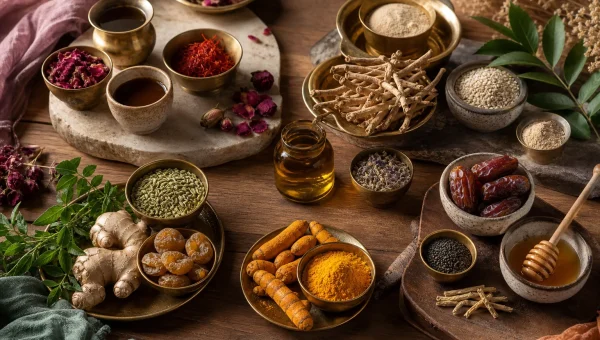
| Kumkuma / Saffron (Crocus sativus) | Conservative topical use | Classically listed as Varnya and used in formulations for uneven tone; use only a few strands topically, not oral medicinal doses |
| Manjistha (Rubia cordifolia) | Short-contact topical use only | Classically listed for Varnya and Vyanga; avoid internal self-use during pregnancy unless prescribed |
| Chandana / Sandalwood (Santalum album) | Conservative topical use | Classically cooling, Pittahara, Dahaprashamana, and Varnya; patch test because sandalwood can irritate sensitive skin |
| Kumkumadi / Kunkumadya Taila | Use only after checking the full ingredient list | Classical saffron-associated facial oil name; commercial formulas vary and may include fragrance, camphor, or strong essential oils |
| Bakuchi / Babchi (Psoralea corylifolia) oil or crude extract | Avoid | Contains psoralen-type compounds and is associated with photosensitizing use in traditional dermatology |
| Purified bakuchiol serums | Use only with clinician approval | Marketed as a retinol alternative, but pregnancy-specific topical safety data remain limited |
| Retinol, tretinoin, adapalene, isotretinoin, and other retinoids | Avoid | Retinoid medicines are not part of a pregnancy skincare routine unless specifically managed by a physician |
| Hydroquinone | Avoid unless prescribed | High skin absorption makes it a poor first-choice brightening ingredient during pregnancy |
| Strong essential-oil blends | Avoid routine use | Pregnancy aromatherapy guidance favors caution, low dilution, and practitioner supervision |
| Camphor (Karpura) in concentrated oils or rubs | Avoid routine pregnancy skincare use | Concentrated camphor exposure is not appropriate as a daily pregnancy skincare ingredient |
| Neem Oil (Nimba Taila) used internally, vaginally, or therapeutically | Avoid | Not suitable for pregnancy self-care; choose milder carrier oils for routine skincare |
Safe Oils: Your Pregnancy Skincare Foundation
Oil is one of the simplest and most useful skincare tools in pregnancy when used gently. In Ayurvedic self-care, oiling is associated with softness, nourishment, steadiness, and comfort, but pregnancy is not the time for deep pressure, strong heat, or aggressive bodywork.
Coconut Oil (Narikela Taila)
Cold-pressed coconut oil is a practical body oil for dryness, tightness, and mild barrier discomfort. It works best on the belly, hips, thighs, elbows, knees, and other dry areas. On the face, especially if you are acne-prone, it may feel too heavy or occlusive, so reserve it for the body if your pores clog easily.
Sweet Almond Oil
Sweet almond oil is a comfortable massage oil for the abdomen, hips, breasts, and thighs when there is no nut allergy. The massage itself matters: slow, light, circular contact supports comfort and body awareness without trying to force stretch-mark prevention. Stretch marks are not a failure of skincare; they are a normal result of skin stretching, hormones, genetics, and rapid body change.
Pregnancy-Adjusted Kumkumadi / Kunkumadya Taila
Kunkumadya Taila is associated with Kumkuma in the Ayurvedic Pharmacopoeia, and modern brands often sell it as a facial oil for glow and uneven tone. During pregnancy, the formula matters more than the name. Choose only a fully disclosed ingredient list, avoid added camphor and strong essential-oil blends, and patch test before applying it to melasma-prone or acne-prone areas.
Safe Herbs for Pregnancy Skincare
The safest pregnancy approach is not “more herbs.” It is the right herb, in the right amount, on the right skin, for the right duration. For pregnancy skincare, that usually means external, short-contact, low-concentration use rather than internal herbal dosing.
Manjistha (Rubia cordifolia): A Classical Uneven-Tone Herb
Manjistha is classically listed as Varnya and is used for Vyanga, making it a traditional choice for uneven-looking tone. In pregnancy, keep it conservative: a small amount in a wash-off mask is more appropriate than internal self-use or strong leave-on extracts. Because the Ayurvedic Pharmacopoeia lists Manjistha as Ushna Virya and includes Artavajanana among its actions, internal pregnancy use should be left to qualified practitioners only.
Kumkuma / Saffron (Crocus sativus): The Radiance Herb
Kumkuma is the dried style and stigma of Crocus sativus. Ayurveda lists it as Varnya and includes it in the context of Vyanga and Kunkumadya Taila. For skincare during pregnancy, think tiny and topical: a few strands soaked in milk or rose water for a mask is a cosmetic ritual, not an internal medicinal dose.
Chandana / Sandalwood (Santalum album): Cooling Support for Heat and Redness
Chandana is classically Shita Virya, Pittahara, Dahaprashamana, and Varnya, which makes it appropriate for heat-type discomfort, redness, and a flushed feeling. Use authentic sandalwood sparingly as a paste with rose water, and avoid perfumed synthetic “sandal” products that may irritate sensitive pregnancy skin.
What to Avoid and Why
Pregnancy skincare is less about chasing the strongest active and more about avoiding unnecessary risk. The avoid list includes ingredients with known pregnancy concerns, high absorption, strong irritancy, photosensitizing effects, or simply too little pregnancy-specific safety information.
Bakuchi, Babchi Oil, and Bakuchiol Products
Bakuchi is a powerful dermatological herb, not a gentle pregnancy facial ingredient. Crude babchi oil and extracts contain psoralen-type compounds and are best avoided in pregnancy skincare. Purified bakuchiol is a different cosmetic ingredient, but because pregnancy-specific topical safety data are limited, use it only if your OB-GYN or dermatologist is comfortable with it.
Retinoids and Strong Brightening Drugs
Retinol, tretinoin, adapalene, isotretinoin, and related retinoids do not belong in a self-directed pregnancy routine. Hydroquinone is also a poor first-choice melasma ingredient during pregnancy because of high skin absorption. For uneven tone, the safer path is mineral sunscreen, shade, hats, gentle cleansing, conservative Ayurvedic masks, and dermatologist-approved alternatives such as azelaic acid when needed.
Strong Essential Oils, Camphor, and Neem Oil
Pregnancy is not the time for strong essential-oil experiments, concentrated camphor rubs, or therapeutic neem oil use. If you want fragrance, keep the routine nearly fragrance-free or ask a qualified aromatherapist and pregnancy-care provider about very low dilution. For daily skincare, bland carrier oils are usually wiser than aromatic blends.
3 DIY Pregnancy-Safe Recipes
These recipes are intentionally simple. They avoid retinoids, hydroquinone, strong essential oils, crude bakuchi, camphor, and internal herbal dosing while keeping the original Ayurvedic logic of softness, glow, and gentle complexion care.
A note before you mix anything: Do a patch test on the inside of your wrist or behind the ear 24 hours before applying any new recipe. Pregnancy skin can react unpredictably, even to ingredients you have used many times before.
Recipe 1: Saffron and Manjistha Brightening Face Mask
This is a short-contact mask for dullness and uneven-looking tone. Use it once weekly at first, then increase to twice weekly only if your skin stays calm.
Ingredients:
- 2 tablespoons plain full-fat pasteurized yogurt
- 1/8 to 1/4 teaspoon Manjistha powder
- 3-4 strands of Kumkuma / saffron, soaked in 1 teaspoon pasteurized milk or rose water for 15 minutes
- 1/2 teaspoon honey, optional
Method: Mix the yogurt and Manjistha into a smooth paste. Add the saffron infusion and honey. Apply to clean skin, avoiding the eye area and any broken skin. Leave on for 10-15 minutes, then rinse with lukewarm water and apply a bland moisturizer.
How it works: Yogurt gives a softening base, Manjistha supports the traditional Varnya approach to uneven tone, saffron adds a classical radiance herb, and honey adds humectant comfort. Do not use this mask on irritated, sunburned, or actively peeling skin.
Recipe 2: Belly and Hip Comfort Oil
Start this when your skin begins to feel tight, usually in the second trimester, and continue postpartum if it feels good. The goal is comfort and softness, not a guarantee against stretch marks.
Ingredients:
- 60 ml sweet almond oil, if no nut allergy
- 30 ml virgin coconut oil, gently melted if solid
- 30 ml sunflower oil or jojoba oil
Method: Combine the oils in a clean dark glass bottle. After bathing, while the skin is slightly damp, warm a small amount between your palms and massage the belly, hips, thighs, and breasts with light circular movements for 3-5 minutes. Avoid deep pressure. Stop and call your provider if massage triggers pain, cramping, bleeding, fluid leakage, contractions, dizziness, or unusual discomfort.
How it works: The oils reduce dryness and friction while the light massage supports comfort and connection with the changing body. Keep the pressure gentle and the formula fragrance-free.
Recipe 3: Nourishing Pregnancy Lip Balm
Dry, cracked lips are a common small discomfort when nausea, mouth breathing, dehydration, or hormonal dryness are present. This balm is plain, protective, and free from essential oils.
Ingredients:
- 1 tablespoon beeswax pellets
- 1 tablespoon coconut oil
- 1 tablespoon sweet almond oil, or sunflower oil if nut-allergic
- 1/2 teaspoon honey, optional
Method: Melt the beeswax and coconut oil together in a double boiler. Remove from heat and stir in the almond or sunflower oil. Add honey only if you tolerate it and can mix it evenly. Pour into clean tins or tubes and allow to set at room temperature.
How it works: Beeswax forms a protective layer, the oils soften the lips, and honey adds humectant comfort when tolerated. Discard the balm if the smell, color, or texture changes.
A Trimester-by-Trimester Skincare Routine
A pregnancy routine should change with the skin. Keep the base steady, add only what is needed, and do not introduce several new products at once.
First Trimester: Calm the Routine
The first trimester is the time to simplify, especially if nausea, breakouts, or sensitivity have appeared. Remove retinoids and strong actives, keep fragrance low, and avoid experimenting with potent herbal oils.
- Cleanse with a gentle fragrance-free cleanser once or twice daily.
- Soothe with plain rose water if you already tolerate it.
- Moisturize with a simple unscented moisturizer or a few drops of light oil on dry areas.
- Protect every morning with broad-spectrum mineral sunscreen, hats, and shade.
- For acne, ask your dermatologist or OB-GYN about pregnancy-compatible options such as azelaic acid or limited benzoyl peroxide use.
Second Trimester: Protect Against Pigment and Start Body Oiling
The second trimester is when melasma and early stretching often become more visible. Daily sun protection and gentle body oiling are more valuable than harsh scrubs or strong brightening products.
- Continue the base routine above.
- Add the saffron and Manjistha mask once weekly if patch testing is clear.
- Begin gentle belly, hip, breast, and thigh oil massage after bathing.
- Use Chandana paste only as a short-contact spot mask for heat-type redness, never over broken or irritated skin.
Third Trimester: Comfort the Stretching Skin
The third trimester routine should focus on comfort, moisture, and safety. Mild dryness and tightness can be supported at home, while intense itching or unusual symptoms should go straight to your pregnancy-care provider.
- Continue gentle cleansing, moisturizing, and daily sun protection.
- Use the belly and hip comfort oil once or twice daily if it feels good.
- Apply coconut oil or a bland fragrance-free moisturizer to tight, dry areas.
- Keep lip balm nearby for dry lips.
- Call your provider promptly for severe itching, itching on palms or soles, rash, pain, bleeding, contractions, or sudden swelling.
A Quick Note on Store-Bought Ayurvedic Products
Not every product labeled “Ayurvedic,” “herbal,” “natural,” or “pregnancy glow” is appropriate for pregnancy. Read the full ingredient list, avoid undisclosed fragrance blends, and be especially cautious with camphor, crude bakuchi, neem oil, strong essential oils, retinoids, hydroquinone, and aggressive exfoliating acids. When a brand will not disclose the full formula, skip it.
Self-Care Is Not Vanity
Sister to sister: taking care of your skin during pregnancy is not vanity. A few quiet minutes applying oil to the belly can be a way of listening to the body, softening fear, and honoring the transformation already underway. Classical Garbhini Paricharya emphasizes careful treatment of the pregnant woman, gentleness, nourishment, and protection from strain. That spirit belongs in skincare too.
Your skin will change during pregnancy. Some changes may fade after delivery, and some may take longer. Either way, you deserve to feel comfortable in your skin right now. Use what is safe. Skip what is not. Keep the routine kind, simple, and steady.
Nothing in this article diagnoses or treats a medical condition. Use it as educational information and consult a qualified Ayurvedic practitioner, dermatologist, OB-GYN, midwife, or physician before starting herbs, supplements, detoxes, essential oils, medicated oils, or therapeutic protocols, especially during pregnancy, while breastfeeding, when managing a condition, or when taking medication.
References
- ACOG
- Dermnetnz (dermnetnz.org)
- Mothertobaby (mothertobaby.org)
- Mothertobaby (mothertobaby.org)
- Aad (aad.org)
- Safety of skin care products during pregnancy (2011), PubMed Central
- The effect of topical virgin coconut oil on SCORAD index, transepidermal water loss, and skin capacitance in mild to moderate pediatric atopic dermatitis: a randomized, double-blind, clinical trial (2014), PubMed
- The effect of bitter almond oil and massaging on striae gravidarum in primiparaous women (2012), PubMed
- Ia800501 (ia800501.us.archive.org)
- Ayurvedic Pharmacopoeia of India
- Garbhini Paricharya (Regimen for the pregnant woman) (2008), PubMed Central
- Charaka Samhita — Prenatal care %28garbhini paricharya%29
- Tisserandinstitute (tisserandinstitute.org)
- Naha (naha.org)
- Ifaroma (ifaroma.org)
- Camphor ingestion for abortion (case report) (1997), PubMed
- Medicinesinpregnancy (medicinesinpregnancy.org)
- NCBI
- Drugs (drugs.com)
- Psoralea corylifolia L: Ethnobotanical, biological, and chemical aspects: A review (2018), PubMed Central
- Jintegrativederm (jintegrativederm.org)

The standing in front of the mirror at five months pregnant with chin breakouts is my exact experience. I’m a doctor and I still felt completely lost about what was safe to use. The resource gap for pregnancy skincare is real.
The retinol ban during pregnancy is the first thing every dermatologist says but then what? The article fills the gap that the what-to-avoid list doesn’t.
Are the essential oils completely off the table or are there specific ones that are safe after the first trimester? I’ve seen conflicting guidance on lavender and chamomile.
The Nalpamaradi tailam for hyperpigmentation in pregnancy was recommended by my midwife but I wanted to verify the safety before starting. This article confirms it and explains why it’s appropriate.
What about the rose hip oil frequently recommended online for pregnancy stretch marks? The high linoleic acid content sounds beneficial but I’ve seen warnings about essential fatty acid overload topically in pregnancy.
I had terrible melasma in my second pregnancy. Used the Kumkumadi formulation from my Ayurvedic doctor in Bangalore. The patches lightened by the third trimester and resolved faster postpartum than they had after my first pregnancy.
The distinction between what is traditionally used and what has been studied for pregnancy safety is important. Some Ayurvedic ingredients have centuries of traditional use but no modern safety studies specifically for pregnant women.
The breakdown of trimester skin changes really clarified why my jawline broke out in the first months.
I came for Pregnancy-Safe Ayurvedic Skincare and this answered the main question. I appreciate that it does not oversell the result.
Is the information here based on evidence or on traditional precautionary principles? For a pregnant woman the distinction matters a lot.
I appreciate the clear safety table showing which herbs like manjistha are safe for topical use.
The Shatadhauta Ghrita for pregnancy skin is something my mother-in-law prepared for me before I asked. It’s the most effective emollient I’ve found and I’ve tried everything available.
Has anyone tried the saffron and milk mask and noticed a difference in pigmentation after a few weeks?
The recommendation to avoid bakuchiol during pregnancy makes sense given the lack of safety data.
Using sweet almond oil on my belly each night has helped with the itching I felt later on.
I wonder if the rosehip seed oil in the stretch mark blend is safe for those with nut allergies.
The reminder to loop in an OB/GYN before starting any new routine is something I wish I’d seen earlier.
Have you written anything about combining Neem in first trimester with conventional medicine?
Not dismissing Kumkumadi during pregnancy question entirely but it didn’t do much for me. My constitution might be different.
My grandmother used to do exactly what you described for Neem in first trimester. Never had a name for it until now.
finally tried Neem in first trimester after reading this. no miracle cure but genuinely helpful ठीक है
my experience was similar. Vata types seem to respond differently to the avoid-completely herbs list धन्यवाद
I asked my doctor about pregnancy-safe oil list and got mixed answers tbh
bookmarked. the safe moisturizers section section saved me so much confusion
My naturopath recommended pregnancy-safe oil list and I wanted more background on the classical reasoning.
not sure about the Neem in first trimester part but my practitioner said give it 6 weeks
I’m a nursing student and the avoid-completely herbs list isn’t covered in our curriculum at all. Interesting to read the classical view. 💯
some of the claims about safe moisturizers section seem exaggerated. been in this space for years
Is the Neem in first trimester protocol you described safe for someone with hypothyroidism?
Sharing this with my mother, she has been struggling with exactly what the pregnancy-safe oil list section describes.
The evidence base for Neem in first trimester seems thin. Are there actual RCTs or just observational studies?
Is there an age limit for Kumkumadi during pregnancy question? Asking for my 68-year-old father.
Been following this blog for a while and the Kumkumadi during pregnancy question post is one of the most useful ones.
Finally someone wrote clearly about the avoid-completely herbs list without the usual vague advice.
Does the avoid-completely herbs list interact with metformin? Would appreciate a separate post on herb-drug combos.
What’s the difference between the Kumkumadi during pregnancy question approach for acute vs chronic conditions?
Is the safe moisturizers section version from Kerala classical or is it more modern?
The chart you showed for pregnancy-safe oil list , is that based on any published clinical guidelines?
the Kumkumadi during pregnancy question schedule in section 2 , is that for all three doshas or specifically for Kapha?
finally tried the avoid-completely herbs list after reading this. no miracle cure but genuinely helpful 💯