
When the Muscle Locks and Won’t Let Go
A trapezius, rhomboid, low-back or calf spasm that feels cold, tight, dry, painful and resistant to movement is a classic setting for a Karpooradi Taila muscle-spasm protocol. In Ayurvedic language, this is treated as a Vata-dominant disturbance in the muscle tissue, often with heaviness or stagnation when the area feels dense and movement is restricted. Karpooradi Taila is most appropriate when the skin is intact and the dominant signs are cramp, stiffness, pain, numbness or restricted motion rather than burning redness, open injury or infection.
The practical protocol is straightforward: warm a small quantity of oil indirectly, apply it directly over the locked muscle, massage for 10-15 minutes, and follow with mild, comfortable fomentation. In persistent spasm, the external work is often paired with Vata-pacifying food, rest, hydration and internal herbs selected by a qualified practitioner. This article explains the formula, why it is chosen, how to apply it deeply enough to matter, when to use it, when to avoid it and how to prepare a cautious home version for external use.
Understanding Karpooradi Taila: Traditional Composition
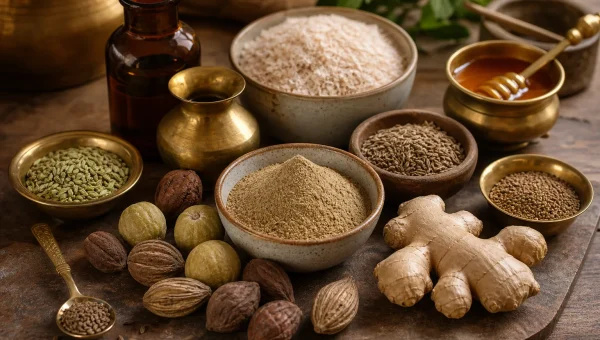
Karpooradi Taila means an oil led by Karpura, or camphor. The Karpooradi Taila used for muscle spasm is a simple camphor-centred medicated oil. In the widely used Kerala and Kottakkal style, the core is Karpura in an oil base, commonly Tila Taila or sesame oil. Some Karpooradi variants include Ajamoda or ajwain with camphor and oil. For cold, dry, Vata-type spasm and stiffness, the sesame-oil version is the usual practical choice.
- Karpura (camphor, Cinnamomum camphora) – the aromatic lead ingredient, used externally as a local pain-relieving counterirritant.
- Ajamoda or Yavani (ajwain, Trachyspermum ammi) – an aromatic seed rich in thymol, used in several Karpooradi-style preparations for its sharp, moving quality.
- Tila Taila (sesame or gingelly oil, Sesamum indicum) – the warming, unctuous carrier preferred for Vata-type pain, dryness and stiffness.
- Coconut oil – used in some Kerala-style preparations, especially when a cooler, gentler base is preferred.
Devadaru and rock salt are not required for the Karpooradi Taila protocol described here. They may appear in other Vata formulas or custom physician preparations, but the standard muscle-spasm approach rests on camphor in an oil base, with ajwain used in broader Karpooradi variants.
Ayurvedically, the therapeutic aim is Vata-shamana, softening of stiffness, local stimulation and release of guarded muscle tissue. In modern terms, camphor acts as a topical counterirritant for temporary muscle and joint aches, while its action on TRPV1 helps explain the familiar cooling-warming sensation followed by reduced pain sensitivity. Ajwain contributes thymol, and thymol has documented effects on calcium and potassium currents in skeletal muscle membranes. Sesame oil adds lubrication, warmth and a stable massage medium, allowing the therapist or patient to work through the muscle without friction.
Conditions Where Karpooradi Taila Is the First Choice
Karpooradi Taila is the first external oil to reach for when the presentation is recent, tight, cold, stiff and movement-limiting. It is not a universal pain oil; it is best chosen when the pattern is Vata-cold stiffness with intact skin and no strong burning inflammatory signs.
Acute muscle spasm: Trapezius, rhomboid, quadratus lumborum, hamstring and calf spasms respond best when the oil is applied warm, worked into the muscle belly with moderate pressure, and followed by mild fomentation. The goal is to interrupt the pain-guarding-pain cycle: first reduce surface sensitivity, then soften the tissue, then restore gentle movement.
Post-exertion soreness: After heavy exercise, travel, long sitting or unaccustomed work, Karpooradi Taila can be used the same day over the sore muscle group. The pressure should be lighter than in a locked spasm, with long gliding strokes over the full muscle belly and only brief deeper work over knots.
Chronic neck and shoulder stiffness: When stiffness is worse with cold weather, air-conditioning, desk posture or lack of movement, daily morning application helps counter the cold-dry quality of aggravated Vata. The oil should be followed by gentle neck mobility rather than forceful stretching.
Cold numbness or nerve-like discomfort: When numbness, tingling or nerve-type discomfort comes with cold stiffness and muscle guarding, Karpooradi Taila may be applied gently along the painful distribution. Pressure should be light, and severe numbness, weakness, radiating pain or loss of function should be assessed by a healthcare provider.
The Karpooradi Taila Muscle-Spasm Protocol
Correct application is the difference between a pleasant smell on the skin and real relief in a locked muscle. Use the following sequence for an adult with intact skin and a clear Vata-cold spasm pattern.
- Screen the area first. Do not apply if the skin is cut, infected, blistered, irritated, burning hot, unusually swollen or red. Do not use over unexplained severe pain after trauma.
- Warm the oil indirectly. Place 5-10 ml oil in a small bowl and place that bowl in warm water. The oil should feel comfortably warm, never hot. Do not microwave camphor oil.
- Begin with broad strokes. Spread the oil over and around the spasm for 1-2 minutes using slow gliding strokes. This prepares the skin and lets the muscle accept touch.
- Work the muscle belly. Use circular pressure over the tightest part for 3-5 minutes, then longitudinal strokes along the direction of the muscle fibres for another 3-5 minutes.
- Release the edges. Most spasms hold at the attachment points as well as the centre. Work gently around the upper shoulder, scapular border, low-back band or calf attachment depending on the site.
- Add mild fomentation. Apply a warm towel or gentle steam for 10-15 minutes. Keep the temperature comfortable. Do not use an electric heating pad, tight bandage or strong heat over camphor oil.
- Move gently after warmth. Use slow, pain-free range-of-motion movements. Avoid aggressive stretching while the muscle is still reactive.
- Repeat as needed. For acute spasm, use once or twice daily for a few days. If pain persists beyond a week, worsens or repeatedly returns, consult a qualified practitioner or healthcare provider.
| Condition | Application Technique | Frequency | Expected Response |
|---|---|---|---|
| Acute muscle spasm | Warm oil, moderate massage over the muscle belly, then mild fomentation | Once or twice daily | Less guarding and better range of motion over the next few days |
| Post-exertion soreness | Light gliding massage over the full muscle belly | Once the same day or before sleep | Reduced tightness and easier next-day movement |
| Cold neck and shoulder stiffness | Warm massage across neck, upper trapezius and shoulder blade margins | Daily morning use for short periods | Gradual mobility improvement with less cold stiffness |
| Cold numbness or nerve-like discomfort | Gentle application along the painful or numb distribution; no deep pressure | Once daily, with assessment if symptoms persist | Comfort and warmth; persistent neurological signs need evaluation |
Conditions Where Karpooradi Taila Should Not Be Used
Karpooradi Taila is for external use on intact skin. It should not be used casually in every painful condition, especially where heat, irritation or toxicity risk is present.
Hot, red, burning or rapidly swollen areas: When the dominant signs are heat, redness, burning pain or rapidly increasing swelling, do not make Karpooradi Taila the first choice. Choose a practitioner-guided cooling or anti-inflammatory approach instead.
Open wounds, broken skin or irritated skin: Camphor can irritate damaged skin and mucous membranes. Do not apply to cuts, abrasions, rashes, burns, ulcers or freshly shaved skin.
Eyes, nose, mouth and genitals: Avoid contact with eyes and all mucous membranes. Wash hands thoroughly after application.
Infants and very young children: Camphor products are especially risky for young children and should not be used on children under 2 years. For older children, use only with appropriate professional guidance and adult supervision.
Pregnancy and breastfeeding: Pregnant or breastfeeding users should consult a qualified practitioner or healthcare provider before using camphor-containing oils.
Internal use: Karpooradi Taila is not for drinking, nasal instillation, nebulisers or humidifiers. Keep it away from children and store it away from heat or flame.
Strong external heat: Mild warm towel fomentation may be used cautiously in the Ayurvedic protocol, but do not combine the oil with electric heating pads, tight bandaging or excessive heat, as this can increase irritation or burn risk.
Preparing Karpooradi Taila at Home
Commercial preparations from reliable manufacturers are appropriate for most users. A small home preparation can be made for adult self-massage when a licensed product is not available, but it should be treated as a mild external massage oil, not as a substitute for clinical care.
Simple home preparation for approximately 200 ml:
- Take 200 ml cold-pressed sesame oil in a clean, heavy-bottomed stainless-steel pan.
- Add 1 tablespoon ajwain seeds. If the skin is sensitive, use half this amount for the first batch.
- Warm on the lowest flame for 15-20 minutes. The oil should become aromatic but should not smoke or boil.
- Switch off the flame and strain out the seeds.
- Allow the oil to cool until it is only mildly warm to the touch.
- Add 6 g medicinal-grade white or natural camphor and stir until fully dissolved. Do not heat camphor directly.
- Bottle in dark glass, label clearly as “external use only”, and store away from children, sunlight, heat and flame.
This home version gives a cautious camphor level suitable for short-term adult massage on intact skin. Do not increase the camphor amount to make the oil “stronger”. If stinging, redness, itching, dizziness, nausea or headache occurs, wash the area with soap and water and discontinue use.
For musculoskeletal conditions that require systematic Panchakarma, oleation, fomentation or basti alongside topical therapy, see our guide to Panchakarma’s five detox therapies. For recurrent stiffness linked with channel obstruction, the broader framework is explained in our article on the srotas system and channel health.
Disclaimer: This article is for educational purposes only and does not replace professional medical advice. Consult a qualified Ayurvedic practitioner or healthcare provider before starting any new health regimen, especially if pain is severe, recurrent, associated with weakness or numbness, or follows injury.
References
- Ayurmedinfo (ayurmedinfo.com)
- Researchgate (researchgate.net)
- Shop (shop.aryavaidyasala.com)
- Vaidyaratnamstore (vaidyaratnamstore.com)
- Ayurtimes (ayurtimes.com)
- Easyayurveda (easyayurveda.com)
- Easyayurveda (easyayurveda.com)
- Webprod (webprod.hc-sc.gc.ca)
- Camphor activates and strongly desensitizes the transient receptor potential vanilloid subtype 1 channel in a vanilloid-independent mechanism (2005), PubMed
- Effect of thymol on kinetic properties of Ca and K currents in rat skeletal muscle (2003), PubMed Central
- The Effects of Topical Sesame (Sesamum indicum) Oil on Pain Severity and Amount of Received Non-Steroid Anti-Inflammatory Drugs in Patients With Upper or Lower Extremities Trauma (2015), PubMed
- Easyayurveda (easyayurveda.com)
- Sdach (sdach.ac.in)
- Nyc (nyc.gov)
- MedlinePlus
- Dailymed (dailymed.nlm.nih.gov)
- Lakshmiayurveda (lakshmiayurveda.com.au)
karpooradi taila helped me more for neck tightness than deep pain. camphor smell is strong though, so not everyone at home will love it.
Will try this. 🙌
Is this safe over broken or abraded skin?
Applied this after a particularly brutal gym session and the DOMS was substantially milder the next day. The Shallaki in the base oil helps I think.
Interesting — I hadn’t even considered the Shallaki base contributing separately. I’ve been using it mainly for a chronic neck spasm and assumed all the relief was from the camphor. Might explain why cheaper camphor balms never worked as well for me. 🙏
Can Karpooradi be applied under a heat wrap or does the camphor volatilize too quickly with added heat?
The formulation mentions Gandhapura (wintergreen) oil is this present in all commercial Karpooradi versions or only some?
camphor is toxic if ingested and absorbed through broken skin. The article needs a stronger warning for use around children and on damaged skin.
is there a maximum frequency for Karpooradi application? im using it twice daily on a knee and wondering if daily camphor exposure has any downside.
The cooling-then-warming sensation from camphor is this actually contraindicated for Kapha-cold type joint pain?
i used Karpooradi on my lower back and got a camphor sensitivity reaction with significant skin redness and burning.
Sorry to hear that — camphor sensitivity seems to be more common than people expect. Did you do a patch test first or go straight to application? The article doesn’t emphasize that step enough for people with reactive skin.
For my frozen shoulder, the combination of Karpooradi local application plus internal Guggulu was the only thing that restored full range after 18 months.
tried that too and found similar results.
same here, if Steve means the quick warmth then yes that part is real. i just wouldnt put karpooradi on irritated skin.
Is there a maximum frequency for Karpooradi application? I’m using it twice daily on a knee and wondering if daily camphor exposure has any downside.
same question here actually.
Good to know.
Same here 🙏 🙏
that’s a good point, the dosage question is something I also asked my vaidya about.
had the same experience with this.