
Many people who color their hair regularly know the pattern: the color looks fresh for a few weeks, then the roots show, the lengths feel drier, and the next appointment begins the cycle again. Permanent oxidative dyes can use alkaline agents, peroxide, dye precursors such as para-phenylenediamine, and couplers such as resorcinol to swell the cuticle and form color inside the hair fiber. That chemistry is effective, but it is very different from a traditional plant-dye approach.
Henna offers a genuinely different method. Pure henna is the powdered leaf of Lawsonia inermis, known in Ayurveda as Madayanti and commonly as mehndi. Its natural coloring molecule, lawsone, gives a red-orange stain and binds with keratin in hair. Henna does not lighten hair, and it does not create black or ash-brown tones by itself; on light or grey hair it gives copper to auburn tones, while on dark hair it usually adds warm red-brown highlights and gloss.
In Ayurvedic language, henna is bitter and astringent in taste, light and dry in quality, cooling in potency, and traditionally described as pacifying Kapha and Pitta. That makes it especially suited to hot, oily, or irritated scalp tendencies, while its dry and astringent nature explains why a good henna recipe should include softening support such as oil, amla, or fenugreek gel for dry hair types.
Choosing the Right Henna
The most important decision in a henna treatment happens before mixing the paste. For an Ayurvedic hair treatment, choose pure leaf powder rather than a boxed “henna color” blend with undisclosed dyes, metallic salts, fragrance, or synthetic additives. Pure henna gives a transparent red-orange stain; any product promising instant black hair from “henna” alone should be avoided.
How to Identify Pure Henna
Good henna should be simple, fresh, and clearly labeled. The safest buying rule is to look for a single botanical ingredient and avoid products that use henna branding while hiding other colorants.
- Ingredient list: It should say Lawsonia inermis leaf powder and nothing else.
- Powder appearance: Pure henna leaf powder is usually greenish, olive, or dull green-brown, not jet black or bright red.
- Smell: It should smell grassy, leafy, and herbal, not strongly perfumed or chemical.
- Freshness: Choose a recently packed, finely sifted powder and store it sealed away from heat, light, and moisture.
- Color promise: Pure henna produces copper, orange-red, auburn, or warm chestnut effects depending on the starting hair color; it does not produce blue-black by itself.
Critical warning: Avoid “black henna” products, especially for skin and also for hair if the ingredients are unclear. Black henna may contain para-phenylenediamine, which can cause severe allergic skin reactions in some people. If you want brown or dark brown hair, use pure henna with pure indigo in a controlled recipe instead of using a product labeled black henna.
The Basic Ayurvedic Henna Treatment
This foundation recipe gives copper to auburn tones on light or grey hair and warm red-brown shine on darker hair. It also uses Ayurvedic hair herbs in a way that respects henna’s cooling but slightly drying nature.
Ingredients
These quantities suit shoulder-length hair of average thickness. Increase the henna proportionally for long, dense, or very curly hair.
- 100 grams pure henna powder
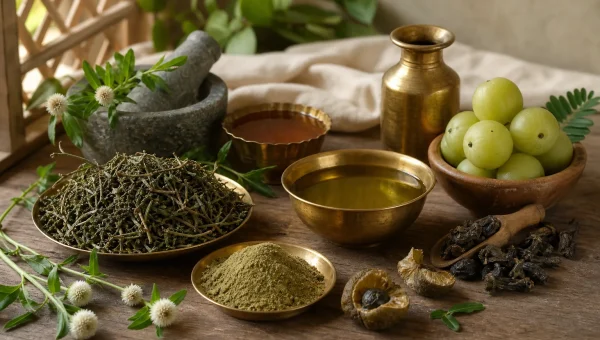
- 1 tablespoon Amla (Amalaki, Phyllanthus emblica / Emblica officinalis) powder
- 1 tablespoon Bhringraj (Bhringaraja, Eclipta alba) powder, optional
- Warm water or cooled black tea, enough to make a thick yogurt-like paste
- 1 to 2 teaspoons lemon juice or amla juice, optional and best skipped if your scalp is sensitive
- 1 tablespoon coconut oil or sesame oil for dry hair, or 1 tablespoon soaked fenugreek gel for extra slip
Preparation
Henna paste needs time for its dye to become available. A slow, covered rest gives a richer stain than mixing and applying immediately.
- Place the henna, amla, and bhringraj powders in a glass, ceramic, or stainless-steel bowl.
- Add warm water gradually and stir until the paste is smooth and thick enough to coat the hair without dripping.
- Cover the bowl and let it rest for about 6 to 12 hours at room temperature. In a warm room, dye release may happen faster; in a cool room, it may take longer.
- Just before application, stir in coconut oil, sesame oil, or fenugreek gel. Add a little more warm water if the paste has thickened too much.
Application
Apply henna patiently and generously. A thin or patchy coating gives uneven color, especially on grey roots.
- Do a strand test first, especially if your hair is grey, bleached, chemically colored, permed, relaxed, or very porous.
- Apply a little oil or balm around the hairline, ears, and neck to reduce skin staining.
- Wear gloves and divide the hair into four sections.
- Apply the paste from roots to ends, pressing it into each section so every strand is coated.
- Pile the coated hair on top of the head and cover it with a shower cap or plastic wrap.
- Leave on for 2 to 4 hours. Two hours gives a lighter copper result; three to four hours gives deeper auburn staining.
- Rinse thoroughly with plain water until the water runs mostly clear. Avoid shampoo for 24 to 48 hours after rinsing.
Expected results: Henna may look bright orange or coppery immediately after rinsing, especially on grey or light hair. Over the next 24 to 72 hours, the color usually settles into a deeper copper, auburn, or warm chestnut tone. The final result depends on your natural color, percentage of grey, hair porosity, paste freshness, and application time.
Customizing Your Henna Mix with Ayurvedic Herbs
Ayurvedic herb additions can make henna more suitable for your scalp and hair texture. Keep additions moderate so they support the treatment without diluting the henna stain too much.
| Herb | Sanskrit/Common Name | Amount per 100g Henna | Role in the Mix |
|---|---|---|---|
| Bhringraj | Bhringaraja, Kesharaja / Eclipta alba | 1 to 2 tablespoons | Classically described as keshya, a hair-supporting herb; useful in strengthening, traditional hair-care blends. |
| Amla | Amalaki / Phyllanthus emblica | 1 to 2 tablespoons | Cooling and rasayana in Ayurveda; often used to soften the brightness of henna and add a firmer, glossier feel. |
| Brahmi | Brahmi / Bacopa monnieri | 1 tablespoon | Cooling in potency; useful when the scalp feels hot or sensitive, though it is not a dye herb. |
| Neem | Nimba / Azadirachta indica | 1/2 to 1 teaspoon | Bitter, cooling, and drying; use sparingly for oily or itchy scalp tendencies. |
| Fenugreek | Methi / Trigonella foenum-graecum | 1 tablespoon soaked seeds, ground to gel | Mucilaginous and softening; improves slip and helps balance henna’s dry, astringent feel. |
| Indigo | Nili / Indigofera tinctoria | Use separately or mix fresh just before application | Used with henna to create brown to dark-brown tones; not the same as unsafe “black henna.” |
Recipe Variation: Brown or Dark Brown Grey Coverage
Pure henna always gives a red-orange base. For brown, dark brown, or near-black effects on grey hair, henna is paired with indigo. Henna lays down the warm base, while indigo adds a cooler blue-green plant pigment that visually turns the result brown or darker.
Two-step process:
- Apply pure henna paste first and leave it on for 2 to 3 hours. Rinse thoroughly with water and let the hair dry or become only slightly damp.
- Mix pure indigo powder with warm water just before use. Do not acid-rest indigo the way you rest henna.
- Apply the indigo paste to the henna-treated hair. Leave it on for 45 to 90 minutes for brown to dark brown, or up to 2 hours for a deeper result.
- Rinse with plain water and avoid shampoo for 24 to 48 hours while the color settles.
Single-step shortcut: For a medium brown, dye-release the henna paste first, then mix indigo powder separately with warm water and combine the two pastes immediately before application. A 2:1 henna-to-indigo ratio gives a warmer brown, a 1:1 ratio gives a deeper brown, and a higher indigo proportion gives a cooler, darker result. Apply promptly because indigo paste does not hold its dye strength for long after mixing.
Post-Treatment Care
The first two days after henna are important because the color continues to settle and the hair fiber adjusts after a heavy herbal paste treatment.
- Avoid shampoo for 24 to 48 hours. Rinse thoroughly with water first, then wait before the first wash when possible.
- Keep the first wash gentle. Use a mild shampoo or a traditional herbal wash such as shikakai paste.
- Use shikakai carefully. Mix 1 to 2 tablespoons of Shikakai (Acacia concinna) powder with warm water into a thin paste, massage briefly into the scalp, and rinse well.
- Oil after the color settles. Two to three days after henna, massage a small amount of warm coconut or sesame oil into the scalp and lengths before washing.
- Avoid harsh clarifying washes at first. Strong detergents, repeated shampooing, and heavy scrubbing can make fresh color look dull sooner.
How Often to Henna
For root maintenance, once every 4 to 6 weeks is a practical rhythm for many people. Full-length applications can be done less often because henna is cumulative: repeated layers make the color deeper and warmer. If your hair is dry, porous, curly, or already damaged, apply mainly to the roots after the first few sessions and refresh the lengths only when needed.
Troubleshooting Common Henna Problems
Most henna problems come from the wrong powder, insufficient strand testing, overly acidic mixes, poor rinsing, or expecting pure henna to behave like synthetic brown or black dye.
“My henna turned my hair orange, not auburn.”
This is common on grey or light hair during the first day. Let the color settle for 48 to 72 hours before judging it. For the next application, add amla, reduce lemon juice, use a longer application time, or follow with indigo if you want brown rather than copper.
“My hair feels dry and straw-like after henna.”
Henna is light, dry, bitter, and astringent in Ayurvedic terms, so dryness can happen if the paste is too acidic, left on too long, or used repeatedly on already dry hair. Add fenugreek gel or a small amount of oil to the paste, rinse patiently, and oil the hair lightly after the color has settled.
“The color faded quickly.”
Check the freshness and purity of the powder, the length of dye release, and the cleansing routine after application. Very old powder, diluted blends, heavy buildup on the hair, and frequent strong shampooing can all reduce the visible result.
“My grey roots are too bright.”
Grey hair takes henna vividly because there is little natural pigment underneath. Use the two-step henna-and-indigo method for brown coverage, or use a henna-indigo blend after a strand test. Repeated applications usually look deeper and less bright than the first application.
Henna for Scalp Comfort: Beyond Color
Henna’s Ayurvedic profile is cooling and Kapha-Pitta pacifying, which makes it useful as a traditional scalp pack for people whose scalp tends to feel hot, oily, or uncomfortable. Because it stains any hair it touches, even a scalp-focused application may tint roots or fine baby hairs.
For a short scalp pack, mix 2 tablespoons henna with 1 teaspoon brahmi, 1 teaspoon amla, and enough water or fenugreek gel to form a paste. Apply mainly to the scalp, leave for 20 to 45 minutes, and rinse well. Use this as a cosmetic scalp-care ritual, not as a treatment for infection, eczema, psoriasis, severe dandruff, open wounds, or unexplained hair loss.
Safety note: Always perform a patch test and strand test before full application. Do not use henna or indigo on broken, inflamed, or actively irritated skin. Avoid black henna and any product with unclear ingredients. If your hair is bleached, permed, relaxed, chemically straightened, or recently dyed, test first because results can be unpredictable. If you are pregnant, nursing, managing a scalp condition, experiencing sudden hair loss, or prone to allergies, consult a qualified Ayurvedic practitioner, dermatologist, or healthcare provider before use.
Henna is not a salon-color duplicate; it is a plant-dye system with its own logic. It colors without the alkali-peroxide process of permanent oxidative dye, adds a warm botanical stain, and can turn a routine coloring session into a cooling Ayurvedic hair ritual. For people who want shine, body, grey blending, and a simpler ingredient list, pure henna used correctly can be a meaningful alternative rather than a compromise.
Nothing in this article diagnoses, treats, or cures a medical condition. Use it as educational information and consult a qualified Ayurvedic practitioner or healthcare provider before starting herbs, supplements, detoxes, or therapeutic protocols, especially if pregnant, managing a condition, or taking medication.
References
- Mdpi (mdpi.com)
- Ec (ec.europa.eu)
- Ayurvedic Pharmacopoeia of India
- Hennacat (hennacat.com)
- FDA
- Hennasooq (hennasooq.com)
- Ancientsunrise (ancientsunrise.blog)
- Allure (allure.com)
- Ayurvedic Pharmacopoeia of India
- Ayurvedic Pharmacopoeia of India
- Hennasooq (hennasooq.com)
- Natural alternatives from your garden for hair care: Revisiting the benefits of tropical herbs (2023), PubMed Central
The ammonia fumes description from every salon visit is so accurate. I switched to henna after reading this and my scalp has stopped being itchy between applications. Chemical sensitivity I’d attributed to general sensitivity was actually a specific response to PPD.
This makes sense for Henna Hair Treatment. This feels more usable than a long list of herbs.
I’ve been looking for exactly this information for weeks. Thank you for being so thorough.
The protein coating mechanism for henna is what explains why my hair feels heavier after treatment. Is there a way to use henna that doesn’t accumulate over time for people who do it monthly?
I’m transitioning from chemical color to henna and the orange phase is difficult. Does the Indigo addition in the article actually produce brown tones reliably or does it require multiple applications?
started out skeptical but 2 weeks in and im genuinely surprised. it works
Thank you for the kind words! It’s readers like you who motivate us to keep producing well-researched content.
been practicing this for about a month now and the difference is noticeable. thanks for breaking it down so clearly
The dosha framework is interesting philosophically, but I think attributing every health issue to dosha imbalance oversimplifies complex medical conditions.
ive been doing this for about a month now and honestly the difference is noticeable. thank you for explaining it so clearly
The section on timing is something I’ve never seen addressed elsewhere. So important.
good stuff overall but the dosha assessment part is too simplified imo. you cant sum that up in one paragraph
I tried henna once years ago and ended up with a weirdly orange result that took months to fade. Reading this I realize I was using body art henna, not hair-grade, and mixing it wrong. The bit about acidic medium and dye release time is new to me entirely. Does the overnight conditioning effect work the same on already-highlighted hair or does bleached hair absorb it differently?
The professional background you bring to this discussion is really valuable. Thank you for reading and contributing.
I liked the practical side of Henna Hair Treatment. This is the kind of detail readers can test slowly.
Your skepticism is healthy and welcome. We never intend for our content to replace medical advice, and we’ll make that clearer going forward.
Thank you for sharing your experience, it’s important that readers see the full range of outcomes, not just success stories. Not every approach works for everyone.
My partner was skeptical but tried it after reading this. Now they’re a convert.
the tips at the end are gold. love the actionable steps not just theory
I liked the practical side of Henna Hair Treatment. The article avoids making it sound like a quick fix.
What about henna on grey hair? I’ve seen very different results on grey from full coverage to patchy orange and don’t understand why the same recipe produces different outcomes.
The tea infusion for mixing henna makes a real difference in the final color depth. I switched from water to black tea two years ago on my grandmother’s instruction and never went back.
The tip about using Rajasthani henna from Sojat made a real difference in color depth.
Are there food interactions with henna that I should be aware of? My Ayurvedic doctor mentioned something about dairy but wasn’t specific.
I’ve seen henna recommended for everything from sleep to immunity to cognition. Something that’s supposed to do everything usually does nothing particularly well.
Question: does the oil addition really prevent dryness if you have naturally coarse hair?
Seeing the warning about black henna’s PPD content made me double check every label.
The two step indigo process sounds like a solid way to get brown shades without the red overtone.
After three applications my hair feels noticeably stronger and the shine lasts longer than any salon dye I’ve used.
how does the henna application work for short hair? the wrapping technique seems designed for longer lengths
not sure about the interaction angle but worth asking a vaidya before mixing
yeah I had the same experience, took about 3 weeks for me to notice though
does the lemon juice amount matter much? I’ve been using more than the recipe specifies
can the iron-pot soaking method you mention affect the color result on already-dyed hair?
how frequently can this be done safely? I want to do it monthly but wasn’t sure if that’s too much
yes that specific thing you mentioned is what made the difference for me too
the bhringraj addition in the mix, does it affect the final color or only the conditioning outcome?
does the lemon juice amount matter much? Ive been using more than the recipe specifies
agreed, that part was confusing for me too. I ended up doing 2 to 3 times per week 🌿
off topic but can these herbs be taken with thyroid medication? my doctor doesnt know
sorry to go off topic but any tips for Ayurvedic approach to knee pain?
same here, though I found the timing made a bigger difference than the dose
can the iron-pot soaking method u mention affect the color result on already-dyed hair?
sorry off-topic but has anyone here used Ayurveda for hair loss? nothing seems to work
unrelated question but does anyone know a good vaidya in Pune?