
I’ve been making medicinal teas since I was old enough to reach the stove, watching my family measure seeds by the pinch and adjust formulations based on who was drinking. A tea for digestion was different from a tea for sleep, and a tea for a cough was different again. This Ayurvedic tea guide keeps that same practical spirit: 15 warm preparations, each tied to a specific wellness goal, with measurements, preparation method, and dosha notes so you can replicate them at home.
For the recipes below, drink the tea warm rather than iced, use clean drinking water, and make only what you will use the same day. Honey should not be boiled; add it only after the tea has cooled to a comfortably warm drinking temperature. These recipes are for household wellness support and are not a substitute for diagnosis or treatment from a qualified Ayurvedic practitioner or healthcare provider.
Digestion and Gut Health
Digestive teas in Ayurveda commonly use aromatic seeds and roots that support Agni, help move Vata downward, and reduce heaviness after meals. The preparations in this section are gentle enough for routine use when taken in moderate quantities.
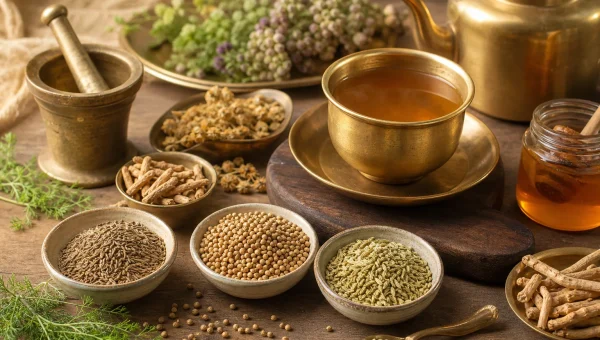
1. CCF Tea (Cumin-Coriander-Fennel)
CCF tea is a simple seed decoction for everyday digestive comfort. In this corrected version, fennel is identified as Mishreya or Madhurika, commonly known as saunf, while cumin is Jiraka or Svetajiraka and coriander is Dhanyaka.
- 1/2 teaspoon Jiraka or Svetajiraka (cumin) seeds
- 1/2 teaspoon Dhanyaka (coriander) seeds
- 1/2 teaspoon Mishreya or Madhurika (fennel/saunf) seeds
- 2 cups water
Method: Lightly crush the seeds with a mortar and pestle. Add them to water, bring to a boil, reduce the heat, and simmer for 5 minutes. Strain and sip warm. Best for: Gas, bloating, post-meal heaviness, and sluggish appetite. Dosha: Useful for Vata-related gas and Kapha-related heaviness; fennel softens the heat of cumin for Pitta-sensitive people.
2. Ginger-Lemon Cold-Season Tea
Fresh ginger, turmeric, black pepper, lemon, and honey make a warming household tea for the first signs of Kapha-type congestion. It is best used in small amounts when the body feels heavy, cold, and blocked.
- 1 inch fresh Ardraka (ginger), thinly sliced
- Juice of 1/2 lemon
- 1 teaspoon raw honey, added after cooling
- 1/4 teaspoon Haridra (turmeric) powder
- Pinch of black pepper
- 2 cups water
Method: Boil the ginger slices in water for 8-10 minutes. Remove from heat. When the liquid is comfortably warm rather than hot, add lemon juice, honey, turmeric, and black pepper. Best for: Cold-season heaviness, scratchy throat, mild sinus stuffiness, and low appetite during a Kapha spell. Dosha: Reduces Kapha and Vata; use less ginger and pepper if Pitta is high.
Immunity and Respiratory Support
Respiratory teas in Ayurveda often combine aromatic, warming, and Kapha-reducing herbs. These preparations are intended for mild seasonal support; persistent cough, breathing difficulty, high fever, chest pain, or wheezing requires medical attention.
3. Tulsi Immunity Tea
Tulsi is a classic household herb for Kapha-type respiratory discomfort. It combines well with black pepper and honey when the chest, throat, or sinuses feel heavy and damp.
- 8-10 fresh Tulsi leaves, or 1 teaspoon dried Tulsi
- 3 whole black peppercorns
- 1/2 teaspoon raw honey, added after cooling
- 2 cups water
Method: Bring water to a boil with Tulsi leaves and peppercorns. Simmer for 7 minutes. Strain, cool slightly, and add honey. Best for: Seasonal respiratory comfort, Kapha heaviness, and stress-heavy days. Dosha: Reduces Kapha and Vata; use moderately if Pitta symptoms such as burning, heat, or acidity are present.
4. Pippali-Honey Respiratory Tea
Pippali and Sunthi are important Ayurvedic herbs for Kapha-type cough and respiratory heaviness. This is a stronger tea than Tulsi tea, so it is best used briefly and in small quantities.
- 1/4 teaspoon Pippali (Piper longum) powder
- 1/4 teaspoon Sunthi (dry ginger) powder
- 1 teaspoon honey, added after cooling
- 1 cup hot water
Method: Stir Pippali and Sunthi into hot water. Cover and steep for 3 minutes. Let it cool to a comfortably warm temperature, then stir in honey. Drink in small sips. Best for: Productive cough, Kapha congestion, and cold-type respiratory heaviness. Dosha: Strongly reduces Kapha and supports Vata movement; use cautiously with high Pitta, acidity, bleeding tendency, pregnancy, or medication use unless supervised.
Brain and Nervous System
Ayurvedic nervous-system teas are typically mild, warm, and steady rather than stimulating. The focus here is on Medhya support, Vata calming, and evening relaxation.
5. Brahmi Brain Tea
Brahmi is classically described as Medhya and Rasayana. This tea keeps the formula simple and adds cardamom to improve flavor and digestibility.
- 1 teaspoon dried Brahmi (Bacopa monnieri) leaves, or 1/2 teaspoon Brahmi powder
- 1/4 teaspoon Shankhapushpi powder
- 2 cups water
- Pinch of cardamom powder
Method: Bring the water to a boil, add Brahmi and Shankhapushpi, and simmer gently for 10 minutes. Strain and add cardamom. Drink 1 cup in the morning. Best for: Focus, learning, memory support, and mental clarity. Dosha: Generally cooling and balancing; reduce the dose if it feels too heavy or dulling.
6. Ashwagandha Milk Tea for Sleep
Ashwagandha is warm, strengthening, and especially useful when Vata shows up as depletion, restlessness, or difficulty settling at night. Milk and ghee make the preparation more nourishing and unctuous.
- 1/2 teaspoon Ashwagandha (Withania somnifera) root powder
- 1 cup whole milk
- 1/4 teaspoon cinnamon powder
- Small pinch of freshly grated nutmeg
- 1/2 teaspoon ghee
- 1 teaspoon jaggery, if desired
Method: Warm the milk on medium-low heat without vigorous boiling. Add Ashwagandha, cinnamon, and nutmeg. Stir for 3-4 minutes. Remove from heat, then add ghee and jaggery. Drink 30 minutes before bed. Best for: Sleep onset, Vata-type fatigue, and an overactive mind at night. Dosha: Strongly pacifies Vata and Kapha; Pitta types can reduce Ashwagandha to 1/4 teaspoon or use it only under guidance.
7. Chamomile-Jatamansi Evening Tea
This evening tea pairs a gentle floral base with Jatamansi and Tagara, two stronger herbs traditionally used in calming formulas. Because both can feel sedating, start with a small dose.
- 1 tablespoon dried chamomile flowers
- 1/8 to 1/4 teaspoon Jatamansi (Nardostachys jatamansi) powder
- 1/8 teaspoon Tagara (Valeriana wallichii) powder
- 2 cups water
Method: Bring water to a boil and remove from heat. Add chamomile, Jatamansi, and Tagara. Cover and steep for 10 minutes. Strain through a fine mesh. Drink 1 cup in the evening. Best for: Racing thoughts, nervous tension, and Vata-type restlessness. Dosha: Pacifies Vata. Caution: Avoid combining with alcohol, sedative medications, or sleep medicines unless a qualified clinician approves.
Warming and Seasonal Teas
Seasonal teas should match the weather, digestion, and constitution. The warming tea below is better for cold, damp, Kapha-Vata weather, while the fennel tea is better for heat, acidity, and summer dryness.
8. Cinnamon-Clove Warming Tea
Twak, Lavanga, Ela, and Sunthi create a fragrant winter tea. Cinnamon and dry ginger provide the main warming quality, while clove and cardamom support taste, throat comfort, and digestion.
- 1 cinnamon stick (Twak, Cinnamomum zeylanicum)
- 3 whole cloves (Lavanga)
- 2 green cardamom pods (Ela), crushed
- 1/4 teaspoon dry ginger powder
- 2 cups water
Method: Add all spices to water. Bring to a boil, then simmer for 10 minutes. Strain. Add honey after cooling if desired. Best for: Cold hands and feet, winter sluggishness, cold-type congestion, and Kapha heaviness. Dosha: Reduces Kapha and Vata; Pitta types should limit quantity and avoid it during acidity, burning, or heat rashes.
9. Fennel-Mint Cooling Tea
Fennel is classically cooling, mildly digestive, and helpful when digestion is uncomfortable but the body already feels hot. Mint keeps the preparation fresh and light.
- 1 tablespoon Mishreya or Madhurika (fennel/saunf) seeds, lightly crushed
- 5 fresh mint leaves
- 2 cups water
Method: Boil the water, add fennel seeds, and simmer for 5 minutes. Remove from heat, add mint leaves, cover, and steep for 2 more minutes. Strain and drink warm or mildly warm, not iced. Best for: Pitta-type heat, post-meal bloating, summer heaviness, and mild acidity after food. Dosha: Especially useful for Pitta and Vata; generally gentle for Kapha when used without sweetener.
Specific Health Targets
The following teas are more targeted than the daily digestive blends. Use them as supportive preparations, not as replacements for prescribed treatment, and stop if they cause discomfort, allergy, loose stools, dizziness, palpitations, or worsening symptoms.
10. Guduchi Fever-Support Tea
Guduchi, also called Amrita, is described in Ayurveda as Rasayana, Jvaraghna, and Tridoshashamaka. This tea is best framed as fever-season and convalescence support, not as a substitute for medical fever care.
- 1 teaspoon Guduchi (Tinospora cordifolia) stem powder
- 1/4 teaspoon turmeric
- Pinch of black pepper
- 2 cups water
Method: Add Guduchi, turmeric, and black pepper to water. Bring to a boil and simmer for 15 minutes. Strain. Sip warm in small portions. Best for: Low-grade fever-season support, post-fever weakness, and recovery after Kapha-Pitta illness. Dosha: Traditionally tridoshic. Caution: Seek medical care for high fever, fever lasting more than three days, dehydration, severe weakness, rash, breathing difficulty, or fever in infants, pregnancy, older adults, or immunocompromised people.
11. Hibiscus-Arjuna Blood Pressure Support Tea
This ruby-colored tea uses food-grade hibiscus or roselle calyces with a small amount of Arjuna. Hibiscus gives a tart, cooling infusion, while Arjuna brings the classical Ayurvedic heart-support angle.
- 2 teaspoons dried food-grade hibiscus or roselle calyces
- 1/4 teaspoon Arjuna (Terminalia arjuna) bark powder
- 2 cups water
Method: Bring water to a boil, add hibiscus and Arjuna, and simmer for 10 minutes. Strain. Drink 1 cup daily if it suits your constitution. Best for: Mild blood-pressure support as part of a clinician-approved diet and lifestyle plan. Dosha: Cooling, best for Pitta. Caution: If you take blood-pressure medication, diuretics, heart medication, kidney medication, or are pregnant, use only with medical guidance and monitor blood pressure.
12. Dashamoola Vata Decoction
Dashamoola means “ten roots” and is a classical group formed from Brihat Panchamoola and Laghu Panchamoola. It is traditionally used when Vata is lodged in deeper tissues, joints, muscles, or the lower body.
- 1 tablespoon Dashamoola powder
- 3 cups water, reduced to 1 cup
Method: Add Dashamoola to water. Boil on medium heat, uncovered, until reduced to about 1 cup, usually 20-25 minutes. Strain through cloth and drink warm. Best for: Vata-type stiffness, joint discomfort, muscle ache, and lower-body heaviness after exertion. Dosha: Strongly Vata-reducing; use carefully if digestion is very weak or stools are loose.
13. Shatavari Women’s Wellness Tea
Shatavari is cooling, nourishing, and classically described as Balya, Rasayana, Pittahara, and Stanyakara. Milk makes the preparation more building and Vata-Pitta pacifying.
- 1/2 teaspoon Shatavari (Asparagus racemosus) powder
- 1 cup warm milk
- 3-4 saffron strands
- 1/2 teaspoon jaggery, if desired
Method: Warm the milk gently. Stir in Shatavari powder, saffron, and jaggery until evenly mixed. Best for: Vata-Pitta dryness, menstrual comfort, lactation support, and perimenopausal depletion when constitutionally appropriate. Dosha: Pacifies Vata and Pitta; may be heavy for Kapha. Caution: Consult a practitioner during pregnancy, fertility treatment, lactation complications, hormone-sensitive conditions, or while using hormonal medication.
14. Arjuna Heart Tea
Arjuna bark is classically described as Hrdya, meaning supportive to the heart. The traditional milk-based preparation is a simple household version of Arjuna Ksheerapaka.
- 1 teaspoon Arjuna (Terminalia arjuna) bark powder
- 1 cup milk or water
- 1/2 teaspoon jaggery, if desired
Method: Simmer Arjuna in milk or water for 5-10 minutes. Strain if gritty, then add jaggery if desired. Drink warm in the morning. Best for: Cardiovascular wellness support under professional guidance, especially when paired with appropriate diet, movement, sleep, and stress management. Dosha: Cooling and generally Pitta-Kapha supportive. Caution: Inform your cardiologist or physician before using Arjuna if you take heart, blood-pressure, cholesterol, anticoagulant, or diabetes medication.
15. Triphala Bedtime Tea
Triphala is the three-fruit formula made from Haritaki, Bibhitaki, and Amalaki. It is traditionally used for gentle bowel regularity, daily cleansing, and broad tridoshic support.
- 1 teaspoon Triphala powder
- 2 cups hot water
Method: Stir Triphala into hot water. Let it sit for 10 minutes so the sediment settles. Drink the liquid warm, including some sediment if tolerated. Best taken 30 minutes before bed. Best for: Gentle bowel regularity, post-meal heaviness, and daily cleansing when suitable. Dosha: Traditionally tridoshic. Caution: Reduce the dose or stop if it causes loose stools, cramps, dehydration, or weakness; consult before use during pregnancy, breastfeeding, active diarrhea, or while taking medications.
Storage and Sourcing Tips
Buy whole seeds and properly identified dried herbs when possible, then crush or grind close to preparation time for better aroma. Store herbs in airtight containers away from sunlight, heat, moisture, insects, and strong odors. Choose reputable suppliers who provide botanical identification and quality testing for contaminants such as heavy metals, pesticides, microbes, and adulterants.
Make teas fresh daily and avoid repeatedly reheating old infusions. Start with one tea that matches your primary need, such as CCF tea for digestion or fennel tea for heat, rather than drinking all 15. The right tea, prepared correctly and taken consistently in the right season and constitution, is more useful than a crowded shelf of random herbs.
Safety note: Herbs can interact with medicines and may be unsuitable during pregnancy, breastfeeding, chronic illness, surgery preparation, liver or kidney disease, autoimmune disease, bleeding disorders, or when symptoms are severe. Consult a qualified Ayurvedic practitioner or healthcare provider before using stronger herbs such as Pippali, Jatamansi, Tagara, Guduchi, Dashamoola, Shatavari, Arjuna, or Triphala therapeutically.
References
- Ayurvedic Pharmacopoeia of India
- Studies on the physicochemical characteristics of heated honey, honey mixed with ghee and their food consumption pattern by rats (2010), PubMed Central
- Ayurvedic Pharmacopoeia of India
- The Clinical Efficacy and Safety of Tulsi in Humans: A Systematic Review of the Literature (2017), PubMed Central
- Natural Ingredient Resource Center
- Meta-analysis of randomized controlled trials on cognitive effects of Bacopa monnieri extract (2014), PubMed
- Easyayurveda (easyayurveda.com)
- NCCIH
- A systematic review and meta-analysis of the effects of Hibiscus sabdariffa on blood pressure and cardiometabolic markers (2022), PubMed Central
- Europepmc (europepmc.org)
- A critical review on two types of Laghupanchamula (2012), PubMed Central
- Therapeutic Uses of Triphala in Ayurvedic Medicine (2017), PubMed Central
The ‘adjust formulations based on who was drinking’ detail is what distinguishes real Ayurvedic herbal knowledge from generic wellness content. A tea for digestion for one person is different from one for another person. This guide gets that.
The exact measurements are the best thing about this article. ‘Add some ginger’ is not a recipe. Having specific gram measurements and steep times makes this replicable.
Reading this later and the The Ayurvedic Tea advice still feels relevant. The examples make the advice less abstract.
Is there a recommended upper limit for how many different herbal teas to have in a day? I’ve been tempted to drink 4-5 different ones for different health goals but wasn’t sure if herb stacking is a concern.
The detox tea with Manjistha and Guduchi how long a course before you expect to see changes? I started it 2 weeks ago but don’t have a clear timeline in mind.
The The Ayurvedic Tea explanation is clearer than most short posts. A few more examples would still help.
The The Ayurvedic Tea explanation is clearer than most short posts. The practical details matter more than people think.
The The Ayurvedic Tea explanation is clearer than most short posts. Small daily changes are easier to follow than a perfect plan.
The anti-anxiety tea with Brahmi and lemon balm the lemon balm is a nice Western addition to a classical combination. Is this an Ayurvedic-Western hybrid formulation or does lemon balm have a classical Ayurvedic equivalent?
Can you share the licorice quantity more precisely? I take licorice tea for adrenal support but am aware that too much can affect blood pressure. The ‘pinch’ measurement in the hormone tea is imprecise for something with that specific safety concern.
The universal rule about leaving 30 minutes between meal and tea is something I’d ignored for years. Changing this timing improved the effectiveness of the digestion tea noticeably. Ayurvedic timing principles matter even for something as simple as tea.
The CCF tea recipe looks straightforward with equal parts cumin coriander and fennel seeds.
I wonder if using fresh tulsi leaves instead of dried changes the flavor noticeably.
Seems important to keep the water filtered and serve the brew warm as the article stresses.
I tried the ginger lemon version last week and felt a gentle soothing effect on my throat.
The brahmi brain tea suggests a longer simmer to extract bacosides which sounds like a useful tip.
Doing this
useful info but hard to find a practitioner who does this type of treatment outside major cities
For someone new to ayurvedic teas the ashwagandha milk tea might be a comforting bedtime option.
same question as above, any substitute for herbs not available outside India?
tried this for 30 days, mixed results. maybe my constitution assessment is wrong
would prefer more citations in the text itself
the seasonal rotation idea is something I had never considered before
Good read
@Catherine good information but the references section would make this much more credible
✨ I wish more doctors knew about this approach
sharing with my mom
useful
Saved this
🙏 does the approach differ for someone with multiple doshas elevated at once?
Reading this later and the The Ayurvedic Tea advice still feels relevant. Would be useful to see a short checklist next.
नमस्ते, this is exactly what I was looking for 🙏
following this from UK, hard to find some of these herbs here ठीक है
My nutritionist sent me this link 🌿
reading this in 2027, has anything changed about the dosage recommendations since this was published?
the translation of Sanskrit terms throughout helps a lot for those of us learning this system
started this protocol 2 weeks ago. nothing notable yet but will report back in a month
Will try
been doing this for 6 months, amazing difference in energy levels
not sure about some of the claims here. would like to see proper citations for the traditional references
I liked the practical side of The Ayurvedic Tea. This is the kind of detail readers can test slowly.
I tried something similar on my own without guidance and had side effects. really recommend consulting a vaidya first
Thanks!
will try and report back. fingers crossed
this is the most detailed breakdown of the topic I’ve found. saving for reference
not sure if its the herbs or the diet changes that made the difference 🙏
the quality of herbs varies so much between brands. really hard to replicate these results
just found this via Google search, is the protocol here still the current recommendation?
The safest part of the The Ayurvedic Tea advice is keeping it simple. Good starting point for a cautious reader.
tried 3 of the suggestions here. 2 worked well, 1 made no difference. good enough ratio for me
been following this blog for 6 months and this is one of the more grounded posts
late to this but wanted to ask if anyone has combined these approaches with conventional treatment
does anyone know if these herbs are safe while on blood thinners? would really appreciate a response
would love a follow-up article on the same topic but for elderly patients
which of these approaches works best for Kapha constitution? the article mixes all three doshas 🌿