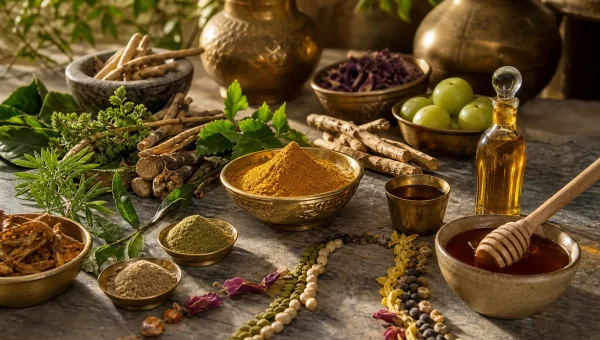
Network Pharmacology of Triphala: How Systems Biology Decodes a 3000-Year Formula
The familiar “one drug, one target” model is useful, but it is not a complete description of pharmacology. Many effective...

April 2, 2026
Where Ayurveda meets modern science — research, mechanisms, and the evidence behind traditional practices.
The familiar “one drug, one target” model is useful, but it is not a complete description of pharmacology. Many effective...
Triphala, Ashwagandha (Withania somnifera), and turmeric-derived curcumin are widely used Ayurvedic or botanical supplements, but their evidence bases are separate...
Can an algorithm learn part of what an experienced vaidya observes during Prakriti assessment? Peer-reviewed studies now show that machine-learning...
Triphala mouthwash vs chlorhexidine is a clinically relevant comparison, but it requires more nuance than declaring one rinse universally superior....
If your joints seem more painful or stiff during spring, the experience may be genuine, but the explanation is not...
Ayurveda describes deha prakriti as an individual constitutional pattern expressed through physical structure, physiological tendencies, and psychological characteristics. Classical descriptions...
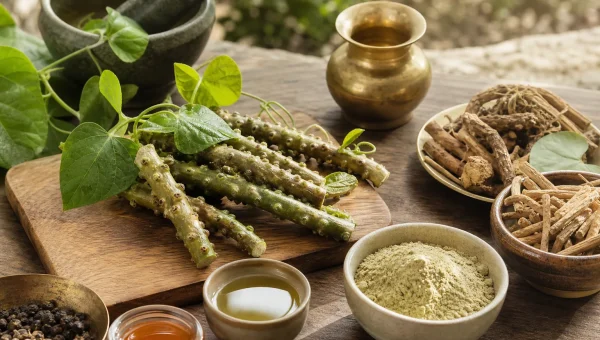
Guduchi (Tinospora cordifolia) is an important Ayurvedic medicinal plant classified as Rasayana, Balya, Dipana and Jvaraghna. Its traditional actions make...
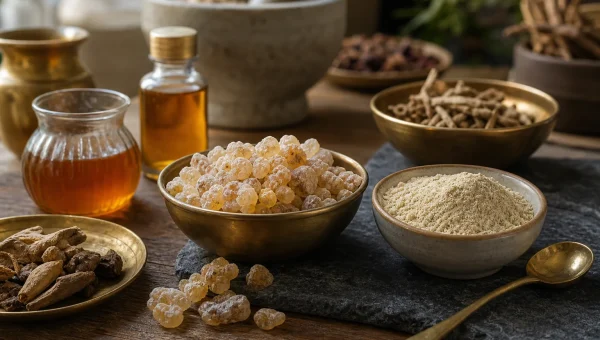
Boswellia for Inflammatory Bowel Disease: A 2026 Evidence Update Boswellia serrata, the source of Indian frankincense, has been examined in...
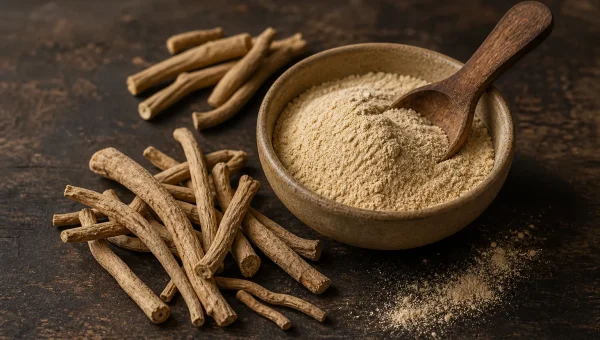
The practical question about Ashwagandha (Withania somnifera) is not simply whether it “works,” but which preparation was studied, at what...
The relationship between the gut microbiome and Ayurvedic constitutional types, or Prakriti, is a legitimate but still exploratory field of...