
Portable food can solve a real problem without needing a dramatic medical story. A commuter who skips the morning meal may find a date-and-nut bite easier to carry than a bowl of porridge, but any change in energy, appetite, anxiety, or sleep is an individual response. It should not be attributed to a “cortisol spike” or to one herb unless it has actually been measured and assessed.
The useful distinction is therefore not “Ayurvedic energy bite versus conventional protein bar.” Commercial bars vary widely, and a homemade bite is not automatically therapeutic. What an Ayurvedic approach can add is attention to ingredient quality, quantity, digestive capacity, season, and the careful use of correctly identified herbs. Ashwagandha, Brahmi, and Shatavari are medicines as well as traditional ingredients; putting them into food does not make them suitable for everyone.
The Ayurvedic View of a Morning Meal
Classical Ayurveda does not prescribe the same breakfast for every person, nor does the Charaka Samhita say that digestive fire must always be “awakened” before any morning food is introduced. In Vimana Sthana 1.24–25, Charaka advises eating warm and unctuous food in a quantity suited to the person, after the previous meal has digested, without incompatible combinations, and neither too quickly nor too slowly. The meal is also to be eaten attentively. The governing idea is suitability, not a universal rule that all cold foods or all substantial breakfasts produce ama.
Agni in this context is the person’s digestive and metabolic capacity. Classical discussions of quantity repeatedly connect the appropriate amount with the strength of digestion, the heaviness or lightness of the food, age, season, and individual adaptation. Date-and-nut balls are compact, sweet, oily, and calorie-dense; that can be useful for portability, but it can also feel heavy. Begin with one small piece, chew it thoroughly, and notice appetite, comfort, belching, bloating, and bowel response before making it a daily habit.
These bites are best understood as a snack or a compact part of breakfast, not a complete meal by definition. Dates chiefly contribute carbohydrate and natural sugars, while nuts and seeds contribute fat, protein, and fibre. That combination may be more filling than sweets alone, but portions still matter. Jaggery, honey, and maple syrup remain concentrated sweeteners and count toward added-sugar intake when used in recipes.
The Herbs: Correct Identity and Classical Properties
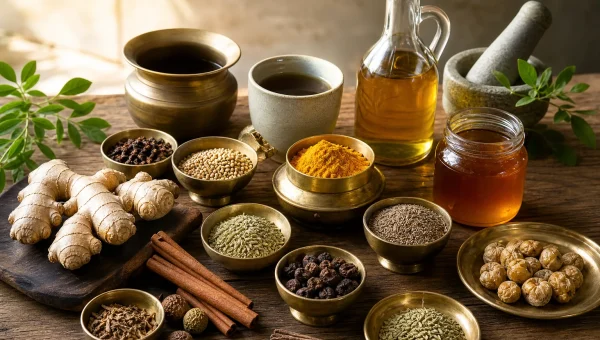
The names on a packet are not enough. “Brahmi,” for example, is used inconsistently in commerce, while the Ayurvedic Pharmacopoeia of India (API) monograph identifies Brahmi here as the dried whole plant of Bacopa monnieri. The table below uses API descriptions rather than simplified internet claims. These properties describe traditional Ayurvedic classification; they do not prove a modern disease-treatment effect or replace an individual prescription.
| Ingredient | Official Plant Part | API Properties and Actions | Practical Correction |
|---|---|---|---|
| Ashwagandha | Dried mature root of Withania somnifera | Tikta and kashaya rasa; laghu guna; ushna virya; madhura vipaka; described as rasayana, balya, and vatakaphapaha | It is not simply “Kapha-reducing.” It is a medicinal root, and research on stress has mostly used specific extracts or measured root preparations rather than homemade balls. |
| Brahmi | Dried whole plant of Bacopa monnieri | Madhura, tikta, and kashaya rasa; laghu and sara guna; shita virya; madhura vipaka; described as medhya, rasayana, vatahara, and kaphahara | “Supports focus” is a traditional and research-informed possibility, not an immediate effect guaranteed by one snack. |
| Shatavari | Tuberous root of Asparagus racemosus | Madhura and tikta rasa; guru and snigdha guna; shita virya; madhura vipaka; described among other actions as balya, medhya, pittahara, and rasayana | The API does not establish the modern marketing claim that Shatavari “balances hormones.” Pregnancy, postpartum, fertility, and lactation use should be individualized by a qualified practitioner. |
| Dates, nuts, and seeds | Foods, not standardized herbal extracts | They form the sweet, binding, and fat-containing base of these recipes | They supply energy but can also make each bite calorie-dense. Dates are not an especially rich source of iron in ordinary serving sizes. |
| Cardamom, ginger, and turmeric | Culinary spices in the recipes below | Used in small amounts for taste and traditional digestive suitability | They should not be presented as guaranteeing absorption, preventing inflammation, or correcting weak digestion in every person. |
Recipe 1: Ashwagandha-Date Nut Balls
This is a portable date-and-nut recipe with Ashwagandha as an optional medicinal addition. The much larger quantity in the original version has been reduced. Even the smaller amount below is not a universal dose: omit the herb unless a qualified Ayurvedic practitioner or healthcare professional has confirmed that Ashwagandha is appropriate for you.
Ingredients (makes about 12 small balls):
- 1 cup soft pitted dates
- 1 cup unsalted almonds, cashews, or a mixture
- 1 teaspoon Ashwagandha root powder, optional
- 1 tablespoon ghee or a neutral nut butter
- 1/2 teaspoon cardamom powder
- 1/8 teaspoon dry ginger powder, optional
- 2 tablespoons sesame seeds or finely chopped nuts for rolling
- A small pinch of salt
Method: Process the dates into a paste. Add the nuts and pulse until the mixture is coarse rather than oily. Add the optional Ashwagandha, ghee, cardamom, ginger, and salt, then process just until the mixture holds when pressed. Shape into 12 small balls and roll in sesame seeds. Chill in a covered container. Freeze part of the batch if it will not be eaten promptly.
Serving: Start with one ball, preferably alongside a balanced breakfast or with a warm drink rather than as a compulsory “empty-stomach dose.” There is no valid way to calculate “300 mg of active withanolides” from ordinary kitchen spoonfuls of unstandardized root powder. Withanolide content varies, and the API monograph does not support that calculation.
Recipe 2: Brahmi-Walnut Oat Squares
This version uses walnuts and oats for texture and includes only a small optional amount of correctly identified Bacopa monnieri. Human trials of Bacopa have generally studied standardized preparations taken consistently for weeks; a single square should not be marketed as an examination aid or an instant cognitive enhancer.
Ingredients (makes 12 small squares):
- 1 cup walnuts
- 1 cup rolled oats or puffed amaranth
- 3/4 cup soft pitted dates
- 1 teaspoon Brahmi whole-plant powder, optional
- 1 tablespoon ghee or almond butter
- 1/2 teaspoon cardamom powder
- 1 to 2 tablespoons warm water, only if needed
Method: Lightly toast the walnuts and oats separately, then cool. Process the dates, add the walnuts and oats, and pulse to a coarse mixture. Add the optional Brahmi, ghee, and cardamom. Press into a lined small tin, chill until firm, and cut into 12 squares.
Classical note: The API lists Brahmi Ghrita among formulations containing Brahmi, so the historical pairing of Brahmi with ghee is verifiable. That fact does not verify the deleted claim that a 2014 Journal of Ethnopharmacology study proved significantly increased Bacopa absorption from dietary fat. No reliable match for that specific citation and claim was found.
Recipe 3: Shatavari-Coconut Nourishing Bites
This is better described as a rich coconut-and-cashew bite than as a “hormone-balance” treatment. Shatavari has important traditional uses and API-listed properties, but those classifications do not establish that this snack treats PMS, perimenopause, infertility, or postpartum symptoms. Anyone considering Shatavari during pregnancy, breastfeeding, fertility treatment, or a hormone-sensitive condition should obtain individualized advice.
Ingredients (makes about 14 small bites):
- 1 cup unsweetened desiccated coconut, divided
- 1/2 cup unsalted cashew butter
- 1/2 cup soft pitted dates, processed to a paste
- 1 teaspoon Shatavari root powder, optional
- 1/2 teaspoon cardamom powder
- A few saffron strands soaked in 1 teaspoon warm water, optional
Method: Mix the cashew butter, date paste, optional Shatavari, cardamom, saffron water, and half the coconut. Chill briefly if soft. Shape into small balls and roll in the remaining coconut. Keep covered and refrigerated. Because coconut, cashew butter, and dates are energy-dense, a small serving is more appropriate than treating them as unlimited “healthy” sweets.
Recipe 4: Turmeric-Ginger Amaranth Bars
Turmeric and ginger work well here as culinary spices. The bars should not be labelled anti-inflammatory treatment for chronic pain, illness recovery, or sports injury. Evidence for turmeric or curcumin in some conditions is promising but not definitive, and studies commonly use preparations and doses very different from a food recipe.
Ingredients (makes 10 to 12 small bars):
- 1 cup puffed amaranth or unsweetened rice crisps
- 1/2 cup almond butter
- 1/3 cup grated jaggery
- 1 tablespoon ghee
- 1 teaspoon turmeric powder
- 1/2 teaspoon dry ginger powder
- A pinch of black pepper, optional for flavour
- 1/2 teaspoon cardamom powder
Method: Warm the jaggery and ghee over low heat just until the jaggery softens. Remove from the heat, stir in the almond butter and spices, then fold in the puffed amaranth. Press into a lined tin, cool, chill, and cut into small bars.
About black pepper: It is not “required.” The widely repeated 2,000% figure comes from a pharmacokinetic study using 2 grams of curcumin with 20 mg of isolated piperine, not from a pinch of pepper in a bar. Piperine can also alter the handling of medicines. In this recipe, pepper is included only as an optional culinary spice.
Recipe 5: Sesame-Date Strength Bites
This food-only version replaces the Shilajit recipe. Shilajit is a mineral exudate used medicinally and is not an appropriate default ingredient for a batch snack shared among adults, athletes, or family members. A cited “2016” sports study was also inaccurate: the relevant trial was published in 2019 and tested a branded purified product at 250 or 500 mg daily, not 200 mg twice daily mixed into food.
Ingredients (makes about 12 bites):
- 1 cup sesame seeds, lightly toasted
- 1/2 cup tahini
- 3/4 cup soft pitted dates
- 1/2 teaspoon cardamom powder
- 1 tablespoon unsweetened cocoa powder, optional
- A small pinch of salt
Method: Process the dates to a paste, then mix with the tahini, cardamom, optional cocoa, and salt. Fold in most of the sesame seeds, reserving a little for coating. Shape into 12 small balls and roll in the remaining seeds. Chill until firm. These are compact foods, not performance supplements; strength and recovery still depend on total energy intake, adequate protein, training, rest, and medical context.
How to Use the Recipes Safely
Choose one base recipe rather than stacking several herbs in the same day. Buy single-herb powders that state the botanical name and plant part, and prefer manufacturers that provide batch testing for identity, microbes, pesticides, and heavy metals. Quality testing matters because contamination and undisclosed metals have been documented in some Ayurvedic products. “Natural,” “classical,” and “food-grade” are not substitutes for traceable manufacturing.
Ashwagandha deserves particular caution. Modern evidence suggests that certain Ashwagandha extracts may reduce perceived stress, anxiety, or cortisol in some adults, but products, doses, and study populations differ. It should be avoided during pregnancy and breastfeeding, and medical advice is important for thyroid or autoimmune disorders, liver disease, upcoming surgery, and use of sedatives, anticonvulsants, thyroid hormone, immunosuppressants, blood-pressure medicines, or diabetes medicines. Rare cases of liver injury have been reported with supplements.
Also consider the food itself. These recipes contain nuts, sesame, coconut, oats, and concentrated sweet ingredients, so they may be unsuitable for people with allergies, swallowing difficulty, or a dietary plan that tightly controls carbohydrate or energy intake. Jaggery and honey count toward added-sugar intake. People with diabetes, reactive hypoglycaemia, gastrointestinal disease, or unexplained fatigue should not use energy bites to postpone assessment of the underlying problem.
For more meal ideas, see Ayurvedic breakfast by dosha. For a fuller discussion of evidence, product forms, and precautions, see the Ashwagandha dosage guide. For traditional uses of fats and oils, see ghee benefits in Ayurveda.
These are recipes, not treatment protocols. The optional herbs are medicines and are not automatically safe because the quantity is spread through food. Do not give herb-containing versions to children, use them during pregnancy or breastfeeding, or combine them with prescription medicines without approval from a qualified Ayurvedic practitioner and healthcare provider. Seek medical evaluation for persistent fatigue, anxiety, sleep disturbance, weight change, pain, or digestive symptoms.
A Practical One-Week Test
Prepare one herb-free batch first. For a week, eat one small bite on mornings when you are genuinely hungry, preferably as part of a meal that also contains an appropriate protein source and fruit or vegetables. Record hunger before eating, comfort one hour later, and energy at late morning and mid-afternoon. Do not expect a predetermined “two- or three-point improvement,” and do not interpret a good or bad week as proof of an adaptogenic effect. If the food suits you and a practitioner later recommends a specific herb, introduce only that one variable so the response is easier to observe.
References
- Charaka Samhita — Rasa Vimana
- Charaka Samhita — Trividhakukshiya Vimana
- Ayurvedic Pharmacopoeia of India
- Ayurvedic Pharmacopoeia of India
- Ayurvedic Pharmacopoeia of India
- NCBI
- NIH Office of Dietary Supplements
- NCCIH
- Fdc (fdc.nal.usda.gov)
- FDA
- NCCIH
- Influence of piperine on the pharmacokinetics of curcumin in animals and human volunteers (1998), PubMed
- Predicting Food-Drug Interactions between Piperine and CYP3A4 Substrate Drugs Using PBPK Modeling (2024), PubMed Central
- Link (link.springer.com)
- FDA
Nothing in this article diagnoses or treats a medical condition. Use it as educational information and consult a qualified Ayurvedic practitioner or physician before starting herbs, supplements, detoxes, or therapeutic protocols, especially if pregnant, managing a condition, or taking medication.

these preparations aren’t regulated. How do we know the label matches what’s inside tbh
bought a well-known brand of this herb and noticed no effect. Quality standardization is inconsistent tbh
the Kapha morning protocol you described is now part of my daily routine. It works.
the Ayurvedic classification of this condition, is it consistent across Charaka and Sushruta texts?
@Greg where is the evidence that the specific sequence matters versus using the herbs individually tbh 🙏
Made a double batch of these for a colleague who was skipping breakfast entirely due to early meetings. She’s been eating two of the Ashwagandha date balls before leaving the house for about ten days and says her focus before noon has noticeably improved. Small thing, real result.
The 3g dosage here is quite different from what my Ayurvedic doctor prescribed. Contradictory.
@Tim Is the protocol appropriate for someone who has just completed chemotherapy?
Thanks!
Anyone here tried this for a family member with Parkinson’s? Any specific considerations? ✨
the IST context you provided (morning vs evening dosing) made more sense than generic timing advice tbh
can this protocol run concurrently with a Panchakarma session or should there be a gap?
My Vaidya confirmed this protocol and it’s been 3 weeks of consistent improvement.
I tried the date-and-nut balls without ashwagandha and they held together well after chilling.
the date-nut base in the second recipe feels like it needs adjustment. I followed the quantities exactly and the mixture was too sticky to roll — ended up adding nearly double the dry ingredients to get a workable texture. might be a moisture issue with Medjool vs regular dates.
I liked the practical side of Breakfast Bars and Energy Bites. Good starting point for a cautious reader.
@Amrita The practical preparation note about ghee quality saved me from using a substandard brand.
Will try.
the comparison between Churna and Kashayam forms here helped me decide which to ask my Vaidya for.
The safest part of the Breakfast Bars and Energy Bites advice is keeping it simple. The practical details matter more than people think.
The article reads like an ad for Ayurveda generally, not a balanced assessment of this specific condition.
@Maria My Vaidya confirmed this protocol and it’s been 3 months of consistent improvement. 🙌
Been making the shatavari-almond bites for about three weeks now and the difference in afternoon energy is real. I eat two with my morning tea instead of a biscuit and the 3 PM slump has mostly gone. Simple change but it actually works.
the Ashwagandha ball recipe lists ‘ashwagandha powder’ without specifying root vs leaf or whether it should be KSM-66 or regular. should I use the standardized root powder or just whatever I find at the health store? would the adaptogenic effect differ much?
@Priya is there a version of the breakfast bar recipe without ghee for vegan participants?
tried all 5 of these. the Ashwagandha date balls are genuinely something I keep making — I swapped the jaggery for dates and added a pinch of cardamom. my commute is only 45 minutes but the mid-morning energy dip has basically stopped. tbh
for the Kanji recipe, can I substitute black carrot with regular carrot? black carrot is hard to find in Chennai.
the triphala energy bar recipe doesn’t say how finely to grind the triphala before mixing — whole powder versus fine-milled changes the texture significantly and coarser powder can be quite bitter. would be helpful to clarify whether any preparation step is needed to mellow the taste.
Does this protocal need to be paused during menstruation or can it continue r u?
is theee a version of the breakfast bar recipe without ghee for vegan participants? tbh
is there a version of the breakfast bar recipe without ghee for vegan participants?
The Ojas-building dietary suggestions here overlap well with what my nutritionist already advised.
Where are the actual peer-reviewed citations? I searched PubMed and found mostly small sample studies.
the diet restrictions here are extensive. Most people can’t maintain this alongside a work schedule tbh
the section on diet modifications, is that specific to this condition or general Ayurvedic eating tbh
i have been asking my Vaidya about this exact approach for years and she disagrees with the sequence.
The safest part of the Breakfast Bars and Energy Bites advice is keeping it simple. This feels more usable than a long list of herbs.
Is there a maintenance dose after the initial 6 months course finishes?
the article assumes readers have a nearby Vaidya for supervision. That’s not always the case tbh
What would be the signs that this protocol isn’t suitable for a particular individual?
Is there specific guidance for the post-menopause phase of life with this protocol?
the preparation method you described, can it be adapted for someone who can’t tolerate ghee?
some of these herb interactions aren’t well studied. Feels like we’re being used as test subjects.
the article assumes readers have a nearby Vaidya for supervision. That’s not always the case.
I have autoimmune issues, are there any herbs in this list I should avoid?
The explanation of Vipaka (post-digestive effect) here is the clearest I’ve seen on any website.
Do you think using ghee instead of nut butter changes the texture noticeably?
For Breakfast Bars and Energy Bites, consistency seems like the hard part. The examples make the advice less abstract.
This helped me understand Breakfast Bars and Energy Bites without too much jargon. The timing advice is the part I would start with.
The theory is interesting but the practical protocol is too vague to actually implement.
Expected more from the genomics section. It’s superficial compared to what the title promises. ❤️
the healing broth for surgical recovery mentions adding Shatavari. is this appropriate for male patients too or primarily for women?
Quick question, is the 5ml dose you mentioned for the extract form or the raw powder?
How does this compare to the Charaka Samhita recommendations for the same condition?
I know two people who tried this approach and neither had the results described here.
my liver function slightly elevated after starting this protocol. Stopped and normalized. Worth warning honestly
my mother is 62 and has been on this for 2 months, her energy levels are much better now.
Good info.
This helped me understand Breakfast Bars and Energy Bites without too much jargon. This feels more usable than a long list of herbs.
I’m Vata-Pitta dominant, does the dosage for this condition change significantly?
how does the frequency of bowel movements factor into this protocol adjustment?
is there a version of the breakfast bar recipe without ghee for vegan participants? ठीक है
not everyone responds the same way to this herb. The article could use more nuance on individual variation. 🙌
I’m not convinced that a teaspoon of brahmi powder in oat squares will actually affect focus but it’s tasty anyway.
Followed the protocol as described and had digestive upset for the first three weeks.
The post specifically answered a question I had about Pitta constitution adjustments.
The Breakfast Bars and Energy Bites section feels grounded enough to try carefully. I would like to know how long to try it before judging results.
I was looking for a plain explanation of Breakfast Bars and Energy Bites. Small daily changes are easier to follow than a perfect plan.
my mother is 62 and has been on this for 2 weeks, her energy levels are much better now tbh
Would appreciate a clearer explanation of why the Vata constitution adjustment is so different.
The Breakfast Bars and Energy Bites explanation is clearer than most short posts. The practical details matter more than people think.
The practical preparation note about ghee quality saved me from using a substandard brand.
Bit off topic but wondering if there’s an Ayurvedic approach to managing high uric acid?
the Tulsi-ginger broth for post-op recovery in the peya recipe article made it for my mother after her hip surgery and she found it genuinely comforting and easy on the stomach.
is there any specific preparation guidance for someone who is fasting during Navratri?
this protocol would be easier to follow with actual product recommendations, not just herb names.
my practitioner suggested this herb but didn’t specify the form. What would you recommend based on this?
good breakdown of which symptoms respond faster and which need the longer 6 months course tbh
is there a maintenance dose after the initial 4 months course finishes?
Remember to store the sesame date bites in the fridge they soften quickly at room temperature.
I was looking for a plain explanation of Breakfast Bars and Energy Bites. The timing advice is the part I would start with.
anyone here tried this for a family member with Parkinson’s? Any specific considerations tbh
is there a specific guidance for those living at high altitude where digestion behaves differently tbh
How many Panchakarma sessions would complement this oral protocal typically r u?
I came for Breakfast Bars and Energy Bites and this answered the main question. The article avoids making it sound like a quick fix.
The claims about cellular repair here need much better sourcing to be credible.
my experience with this approach was expensive and inconclusive after 3 months tbh
does the post-surgical recovery timeframe mentioned here apply to laparoscopic procedures too?
does this protocol require a complete break from coffee and black tea?
I appreciated the warning about jaggery counting as added sugar I’ll keep track of my intake.
can the Trikatu bar recipe be adapted for someone with acid reglux? the ginger and black pepper combination worries me. 💯
is there a version of the breakfast bar recipe without ghee for vegan participants? 🙌
The Breakfast Bars and Energy Bites angle is useful here. The practical details matter more than people think.
the Trikatu-spiced breakfast bar recipe is clever. portable and genuinely warming without being heavy in the stomach.
too optimistic about results. Ayurveda takes months and the article implies weeks tbh
The section on Ayurvedic dosage, is that daily or divided into two doses?
Can someone with Pitta-dominant constitution take the full dose or should it be halved r u?
good to see the contraindication list included. Knew about 3 of them but not the this herb one.
can this be given to children between 8 and 12 years? Any age-adjusted dose guidance?
is there a specific guidance for those living at high altitude where digestion behaves differently honestly
Will try!
Helpful.
i have autoimmune issues, are there any herbs in this list I should avoid tbh
Same here.
The first section mentions a specific quality marker for this herb. Where can I verify this at purchase?
Can this be taken during a juice fast or does it need solid food to absorb properly? 💯
@Nikhil the Brahmi mocktail uses ‘Brahmi extract’ without specifying concentration. should I use 1:10 liquid extract or the powder?
Good reminder on Breakfast Bars and Energy Bites. The main idea is clear even if someone is new to Ayurveda.
@Aman the Brahmi mocktail uses ‘Brahmi extract’ without specifying concentration. should I use 1:10 liquid extract or the powder? नमस्ते
Bought a well-known brand of this herb and noticed no effect. Quality standardization is inconsistent.
Good reminder on Breakfast Bars and Energy Bites. Good starting point for a cautious reader.
tried this herb for 4 months with zero noticeable change. Might just not work for my constitution honestly
for the Kanji rrcipe, can I substitute black carrot with regular carrot? black carrot is hard to find in Chennai.
Does this protocol need to be paused during menstruation or can it continue?
the this herb you recommend, is it available at standard Ayurveda stores or is it specialty sourced tbh
The safest part of the Breakfast Bars and Energy Bites advice is keeping it simple. The article avoids making it sound like a quick fix.
the side effects section is too brief. I had insomnia on this herb that isn’t mentioned here honestly ✨
can someone combine this protocol with a standard multivitamin without interaction honestly
The part about Breakfast Bars and Energy Bites feels realistic. I would still ask a practitioner before changing medicines.
the section on Ayurvedic dosage, is that daily or divided into two doses honestly
The Ojas-building dietary suggestions here overlap well with what my nutritionist already advised r u?
Doing this.
How many Panchakarma sessions would complement this oral protocol typically?
Is there a difference in outcome between using the tablet form versus the churna form?
for the Kanji recipe, can I substitute black carrot with regular caerot? black carrot is hard to find in Chennai.
This helped me understand Breakfast Bars and Energy Bites without too much jargon. I would still ask a practitioner before changing medicines.
what’s the difference between the formulation for acute versus chronic presentations?
The post-surgical recovery protocol here is something I wish I had found 3 months earlier.
Useful info.
The protocol mentions taking this herb with honey, is that flexible or is the timing critical?
what would be the first signs that someone’s constitution is shifting after following this protocol? ठीक है
Would appreciate a clearer explanation of why the Pitta constitution adjustment is so different.
switched from a generic brand to the extract form you recommended, noticeably more effective. ठीक है
Good one.
how long should someone stay on the maintenance dose before considering a full stop?
@Laura for the Kanji recipe, can I substitute black carrot with regular carrot? black carrot is hard to find in Chennai.
Appreciated the part about sourcing quality this herb, not all brands are equivalent.
the article gives a range, is the lower end sufficient for mild presentations tbh
Tried the 3 weeks regimen exactly as described, my Vaidya noted improvement at the follow-up r u?
does the environmental toxin exposure factor mentioned here require additional chelation support? 🌿
how does this compare to the Charaka Samhita recommendations for the same condition tbh 🌿
Makes sense.
is there a maintenance dose after the initial 6 weeks course finishes?
Is there a specific time of day that works best for this herb for sleep versus energy benefits?
my Vaidya in Chennai suggested a slightly different sequence. Regional variation in practice honestly
The homemade preparation method here is simpler than I expected. Made my first batch yesterday.
Can someone combine this protocol with a standard multivitamin without interaction?
The side effects section is too brief. I had insomnia on this herb that isn’t mentioned here.
the dosage range is too wide to be useful. From 10ml to another amount with no explanation of how to choose tbh 🌿
my doctor is skeptical about combining this with my current prescription. Who takes responsibility?
Useful post on Breakfast Bars and Energy Bites. The examples make the advice less abstract.
the body type variation in dosage is something I never found explained properly before this.
The body type variation in dosage is something i never found explained properly before this r u? 🙏
The section on diet modifications, is that specific to this condition or general Ayurvedic eating?
@Naveen the mocktail recipes look interesting but the ingredient quantities feel off. the Amla-rose syrup recipe produced something far too tart at the given proportions.
is the 500mg dose based on body weight or is it uniform for adults?
The specific mention of seasonal Ritucharya adjustments here adds a layer of depth I appreciate.
@Rebecca tried all 5 mocktail recipes. the Brahmi-tulsi cooler with coconut water waa the crowd favorite at our get-together.
The explanation of why Vata types need higher fat anupana clicked for me after reading this.
Following this for 6 months now. my Agni feels stronger, confirmed by my Vaidya at last visit ngl
The protocol mentions taking this herb with warm water, is that flexible or is the timing critical?
the Kanji with mustard and black carrot is actually dekicious. been making it weekly and digestion has been smoother.
The Breakfast Bars and Energy Bites explanation is clearer than most short posts. A few more examples would still help.
what’s the minimum duration before someone can realistically evaluate whether the protocol is working tbh
is the protocol appropriate for someone who has just completed chemotherapy?
is there seasonal guidance for when to start this protocol for best results?
My Vaidya confirmed this protocol and it’s been 4 months of consistent improvement.
the article assumes readers have a nearby Vaidya for supervision. That’s not always the case honestly 🙏
What’s the minimum duration before someone can realistically evaluate whether the protocol is working?
does the protocol change during the summer Pitta season versus the winter Vata season tbh
my Ayurveda teacher pointed me to this article specifically. The dosage chart is useful honestly
Is there a specific guidance for those living at high altitude where digestion behaves differently?
The advice around Breakfast Bars and Energy Bites is specific enough to be useful. Would be useful to see a short checklist next.
i don’t see how this is different from generic Ayurveda advice you can find anywhere tbh
following the 3 weeks course you described, finished last week and planning to continue maintenance.
The safest part of the Breakfast Bars and Energy Bites advice is keeping it simple. Small daily changes are easier to follow than a perfect plan.
The ‘safe for most people’ qualifier is doing a lot of work here without explaining who should avoid it r u?
the Trikatu-spiced breakfast bar recipe us clever. portable and genuinely warming without being heavy in the stomach.
how long should someone stay on the maintenance dose before considering a full stop honestly
Would appreciate a clearer explanation of why the Vata-Kapha constitution adjustment is so different.
Tried this for my husband’s Vata imbalance, 4 months later and his anxiety is more manageable.
What’s the shelf life of the home-prepared version if stored in a cool dry place?
Tried the 6 months regimen exactly as described, my Vaidya noted improvement at the follow-up.
the post specifically answered a question I had about Vata constitution adjustments.
Is this protocol appropriate for someone on Metformin for Type 2 diabetes?
is the protocal appropriate for someone who has just completed chemotherapy ngl 🌿
This helped me understand Breakfast Bars and Energy Bites without too much jargon. This is the kind of detail readers can test slowly.
switched to taking this herb with honey based on this article, digestion noticeably smoother.
Spoke to two Vaidyas and neither confirmed this exact protocol. Where does it come from?
This helped me understand Breakfast Bars and Energy Bites without too much jargon. The main idea is clear even if someone is new to Ayurveda.
This helped me understand Breakfast Bars and Energy Bites without too much jargon. I would like to know how long to try it before judging results.
The third section mentions a specific oil preparation. Is this available commercially or only homemade?
the Tulsi-ginger broth for post-op recovery in the peya recipe article made it for my mother after her hip surgery and she found it genuinely comforting and easy on the stomach. नमस्ते
my mother is 62 and has been on this for 4 months, her energy levels are much better now.
The Breakfast Bars and Energy Bites section feels grounded enough to try carefully. I would still ask a practitioner before changing medicines.
Good to see the contraindication list included. Knew about 3 of them but not the this herb one r u?
is this suitable for someone who is vegetarian and avoids dairy entirely tbh