
The under-eye area is one of the first places the body broadcasts strain, depletion, irregular sleep, and fluid imbalance. Dark circles, persistent puffiness, fine lines, and a hollow, shadowed look are not only cosmetic concerns. In Ayurveda, the eyes are closely connected with Alochaka Pitta, the clarity of perception, the nourishment of blood tissue, and the steadiness of daily rhythm. Understanding what your under-eyes are indicating is the first step toward supporting them with a genuinely holistic routine.
The Ayurvedic Understanding of Under-Eye Changes
Ayurvedic eye care is described in the classical branch of Shalakya Tantra, and the Uttara Sthana of the Ashtanga Hridaya includes chapters on disorders and care of the eyes. The faculty of vision is traditionally associated with Alochaka Pitta, while the brightness and nourishment of the eye area depend on good circulation, balanced digestion, restful sleep, and well-supported tissues. Modern anatomy also helps explain why this area changes early: eyelid skin is among the thinnest skin of the body, with little underlying support, so pigment, visible vessels, swelling, dryness, and tissue hollowing become noticeable quickly.
Different under-eye patterns suggest different imbalances. Blue-purple circles often reflect a Vata-dominant pattern: fatigue, poor sleep, dryness, visible vessels, and depletion. Brown or grey-brown circles often reflect pigmentary tendency, sun exposure, rubbing, dermatitis, or a Pitta-Rakta pattern, especially in people with deeper skin tones. Puffiness and bags suggest a Kapha-fluid pattern, often worsened by salt, allergies, late nights, sleep position, or age-related tissue laxity. Hollowing and fine lines indicate a Vata-depletion pattern, where dryness, stress, ageing, and lack of nourishment make the area appear more sunken. Many people show two or more of these patterns together.
Netra Vitality: The Ayurvedic Eye Wellness System
The Ayurvedic approach to under-eye vitality is layered rather than purely topical. It combines internal support for digestion, elimination, sleep, and fluid balance with gentle topical care, eye rest, and daily rhythm. This is why a single oil, mask, or compress may give temporary improvement, but lasting visible change usually requires correcting the habits that continually disturb the eye area.
Internal Protocol: Sleep, Agni, Rakta, and Fluid Balance
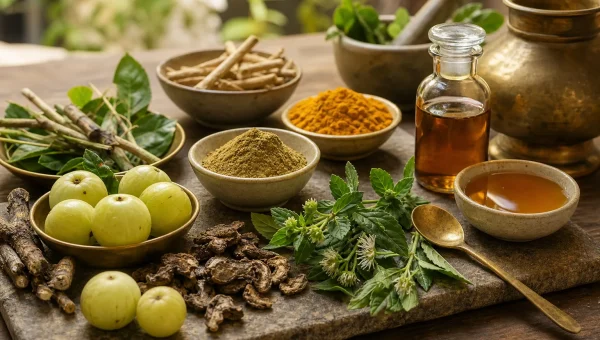
Triphala is one of the most important classical formulas associated with eye support. It combines Amalaki (Phyllanthus emblica), Bibhitaki (Terminalia bellirica), and Haritaki (Terminalia chebula). In classical pharmacopoeial descriptions, these fruits are repeatedly associated with chakshushya action, meaning supportive to the eyes. For under-eye concerns, Triphala is best understood as a digestive and eliminative support that helps maintain regularity and reduces the dull, heavy quality that often appears around the eyes when sleep, digestion, and elimination are irregular.
Punarnava (Boerhaavia diffusa) is another important classical herb for the puffy, fluid-retentive pattern. In Ayurvedic pharmacopoeial descriptions it is listed with shothahara and mutrala actions, traditionally used where swelling and fluid imbalance are prominent. This makes it more relevant for under-eye puffiness than for dry hollowing or purely pigmentary dark circles. Internal herbs should be selected according to constitution, digestion, menstrual status, kidney health, medication use, pregnancy status, and the full clinical picture.
Topical Protocols: Netra Care Principles Applied
Topical under-eye care should be light, precise, and non-irritating. The skin is thin and the eyes are delicate, so the aim is not aggressive exfoliation or heavy application. The safest Ayurvedic principle is to work around the orbital bone, keep preparations out of the eyes, patch-test oils, and use only gentle pressure.
Kumkumadi Taila for Under-Eye Pigmentation and Texture
Kumkumadi Taila is a classical facial oil traditionally used for varnya, the support of complexion and radiance. Its formulations commonly include saffron, Yashtimadhu, and sesame oil, along with other herbs processed into an oil base. For the under-eye area, apply only a tiny amount with the ring finger along the orbital bone, moving from the inner corner outward without pulling the skin. Avoid the lash line, avoid direct eye contact, and stop if burning, watering, rash, or irritation occurs.
Triphala Eye Cleansing and Safe Netra Prakshalana
Netra prakshalana is a classical eye-cleansing practice, and Triphala or Amalaki preparations appear in Ayurvedic eye-care discussions. For home use, the safety rule is strict: do not put kitchen-made herbal decoctions, powders, tap water, or non-sterile liquids into the eyes. If Triphala eye cleansing is prescribed, it should be prepared and handled as a sterile ophthalmic wash under qualified supervision. People with contact lenses, eye pain, redness, discharge, injury, recent eye surgery, glaucoma, or any diagnosed eye condition should seek professional eye-care advice before using any eye wash.
Rose Water and Cool Compresses
Rose water is a cooling, Pitta-soothing cosmetic preparation when used externally on closed lids. A chilled rose-water compress or a clean cool cloth over closed eyes for 5-10 minutes can temporarily calm heat, heaviness, and puffiness. The preparation should be clean, cosmetic-grade, and kept out of the eyes. Cool compresses, cucumber slices, or chilled tea bags may also be used over closed lids for temporary relief of swelling and tiredness.
| Herb or Remedy | Target Concern | Method | Frequency |
|---|---|---|---|
| Triphala (internal) | Digestive regularity, elimination, eye-supportive rasayana tradition | Powder, tablet, or decoction only as advised for constitution | As directed by a practitioner |
| Punarnava (internal) | Puffiness and fluid-retentive Kapha pattern | Classical decoction or tablet only with clinical guidance | Short course as directed |
| Kumkumadi Taila | Pigmentation, dullness, fine-line appearance | Tiny amount on orbital bone after patch testing | Nightly or alternate nights if tolerated |
| Sesame oil massage | Vata dryness and under-eye roughness | Very light massage around the orbital bone, away from lash line | 3-5 times per week |
| Cool compress or rose water compress | Puffiness, heat, eye fatigue | Clean cloth or cotton pads on closed lids for 5-10 minutes | Daily as needed |
| Screen breaks and sleep rhythm | Eye strain, fatigue-related darkness, Vata aggravation | Regular breaks, blinking, dim evening light, earlier sleep | Daily |
Screen Time, Sleep, and the Modern Under-Eye Crisis
Modern under-eye deterioration often includes a lifestyle component: long screen hours, reduced blinking, late-night light exposure, and irregular sleep. Ayurveda’s answer is consistent with its core principle of rhythm: the eyes need rest, darkness, lubrication, and regular sleep. Palming, brief screen breaks, blinking awareness, and reducing bright screens before bedtime are simple practices that protect the eye area from the constant Vata-Pitta strain of digital life.
The strongest under-eye routine is not a single miracle oil. It is a layered system: correct sleep first, support digestion and elimination, reduce salt and allergy triggers when puffiness is present, protect pigment-prone skin from sun exposure, use oils only in tiny amounts, and never drag the delicate skin. When internal rhythm improves, the eyes gradually appear clearer, calmer, and better nourished.
This article is for educational purposes only and does not diagnose, treat, or cure any medical condition. Consult a qualified Ayurvedic practitioner or healthcare provider before starting herbs, supplements, detoxes, eye washes, or therapeutic protocols, especially if pregnant, breastfeeding, taking medication, managing kidney, liver, heart, eye, skin, or hormonal conditions, or experiencing sudden swelling, pain, discharge, vision change, or persistent dark circles.
References
- Conceptual analysis of Physiology of vision in Ayurveda (2014), PubMed Central
- LWW Journals
- Easyayurveda (easyayurveda.com)
- Emedicine (emedicine.medscape.com)
- Thickness of Korean upper eyelid skin at different levels (2006), PubMed
- Periorbital Hyperpigmentation: A Comprehensive Review (2016), PubMed Central
- Periorbital Hyperpigmentation: What Lies Beneath? (2018), PubMed Central
- Mayoclinic (mayoclinic.org)
- Mayoclinic (mayoclinic.org)
- Mayoclinic (mayoclinic.org)
- Triphala Churna-A Traditional Formulation in Ayurveda Mitigates Diabetic Neuropathy in Rats (2021), PubMed Central
- Therapeutic Uses of Triphala in Ayurvedic Medicine (2017), PubMed Central
- Ayurvedic Pharmacopoeia of India
- Natural Ingredient Resource Center
- Ijapr (ijapr.in)
- Jaims (jaims.in)
- FDA
- CDC
- Pharmacological effects of rosa damascena (2011), PubMed Central
- Rosa damascena as holy ancient herb with novel applications (2016), PubMed Central
- Medicalnewstoday (medicalnewstoday.com)
- Aao (aao.org)
- Aao (aao.org)
- The inner clock-Blue light sets the human rhythm (2019), PubMed Central
Finally something that doesnt oversimplify OR go too technical. great balance
I liked the practical side of Under-Eye Care. The practical details matter more than people think.
The Under-Eye Care angle is useful here. Small daily changes are easier to follow than a perfect plan.
The Kapha-dominant dark circle treatment is different from what I’ve been doing for years. I was using Triphala ghee but this suggests the underlying cause determines which herb works. my circles have blue tones, not brown, so maybe the Pitta protocol is more relevant.
I liked the practical side of Under-Eye Care. Small daily changes are easier to follow than a perfect plan.
finally an article that gets the balance right. not too simple not too complex
my whole family has benefited from this site. keep up the amazing work!
The section on timing is something I’ve never seen addressed elsewhere. So important.
You’ve raised a really important point, thank you! I’m actually planning a follow-up post on exactly this aspect, so stay tuned.
I liked the practical side of Under-Eye Care. Would be useful to see a short checklist next.
skeptical at first not gonna lie. but two weeks later and yeah im surprised
Just ordered the herbs mentioned here. Excited to start this protocol.
My mother in Jaipur swears by cold milk pads but the ayurvedic rationale is that milk reduces Pitta-type heat inflammation. Now the mechanism behind her advice actually connects to something.
where was this article 5 years ago lol. would have saved me so much trial and error
Can you address how this changes for different age groups? I’m in my 50s and wondering if the protocol needs modification.
Clear, evidence-based, and practical. Everything a good health article should be.
The sleep debt explanation for dark circles is the most evidence-backed cause and this article correctly identifies it as primary. The Vata aggravation framing of poor sleep is consistent with that.
printing this out and putting it on my fridge lol. such practical advice
interesting, my practitioner recommended basically the same protocol. good to see validation
I respectfully disagree with the characterization of modern medicine as inferior here. Both systems have their place and ideally should complement each other
love the nuance here. most wellness content just tells you what to do not why or when not to
tried the almond oil with turmeric mixture and it stained the pillow yellow. thats not a small problem. Is there an alternative that has the Pitta-cooling property without the color issue?
I’d appreciate a section on contraindications. Not mentioning who should NOT try this is a significant oversight in health content.
I appreciate your thoughtful question. I’ll address this in more detail in an upcoming post, but in the meantime, the key is to listen to your body and adjust accordingly.
Thank you for sharing your experience! Stories like yours help other readers see what’s possible with consistent practice.
So glad this resonated with you! Consistency really is key, give it the full recommended duration and I think you’ll see meaningful changes.
Parts of this are genuinely brilliant, particularly the section on timing. Other parts read like they were copied from every other Ayurveda blog
wish I found this years ago honestly. so much trial and error I could have avoided
tHIS is what i needed to read today, bookmarked it
Would love a follow-up article on how to adapt this for children. Is it safe for kids under 10?
The Vata type dark circles being grayish-blue versus the Pitta type being brownish-red is an interesting differentiation. How reliable is this in practice? Most people I know have mixed presentations.
This is constructive feedback we take seriously. We’ve added a note about consulting with your healthcare provider, especially if you’re on existing medications.
The honesty about limitations and when this approach might not work is really appreciated.
You make an excellent point about individual variation. What works beautifully for one person may need adjustment for another, that’s the beauty of personalized Ayurvedic care.
The Nasya oil application route for addressing eye area problems through the nasal cavity seems indirect. Is there published evidence that Anu Taila administered nasally affects peri-orbital circulation or is this a classical inference?
The explanation of how Alochaka Pitta governs vision really clarified why eye strain shows up as dark circles for me.
Screen exposure late at night is the real cause for most people under 40 and this article at least acknowledges it in the lifestyle section. Nice to see it not buried.
I liked the practical side of Under-Eye Care. The safety notes could be expanded a little.
I tried the Triphala eye wash and noticed less puffiness in the morning.
Started this last July and will report back after 3 months. Results are slow but steady.
6 weeks of consistent early sleep and the dark circles are genuinely lighter. nothing else changed. The Vata-pacifying sleep schedule advice is simple and free and it actually works before spending money on any oils.
The mechanism explanation is clearer than the PubMed abstract I read. Consistency seems to be the key.
Kumkumadi tailam for under-eye saffron and sandalwood combination. Results justify the cost after 8 weeks.
Does Kumkumadi Taila work better when applied with the ring finger as the article suggests, or can any finger be used?
The lymphatic drainage massage technique described here is this the same as the Gua Sha technique for under-eye?
The seasonal variation advice is the part most Ayurveda articles skip. Combined with yoga practice for better results.
The avoidance of cold foods during treatment is something my body confirmed independently. Results are slow but steady.
The avoidance of cold foods during treatment is something my body confirmed independently. The quality of the herb matters a lot.
The recovery experience described in the comments here matches mine closely. Combining with dietary changes.
My practitioner suggested something similar last year. The results were gradual but real. Will update in a few months.
Does anyone know if this applies for a Vata-Pitta dual prakriti? The quality of the herb matters a lot.
The dosage section here is more specific than most sources I’ve seen. The timing of doses matters more than I expected.
Late to this post but it answered a question I’ve had for months. Combining with dietary changes.
Reading about Vata excess causing blue-purple circles made me reconsider my late-night screen habits.
Good reminder on Under-Eye Care. The safety notes could be expanded a little.
I appreciate that the article mentions when to see a doctor rather than only promoting herbs. More research needed but encouraging.
Is this safe with antacids? Combined with yoga practice for better results.
Cold potato slices for 15 minutes daily for 3 weeks. Slight puffiness improvement but color unchanged.
My integrative doctor agrees with this approach, which surprised me. Started with half the dose initially.
The contraindication list should be read first before starting anything here. Combining with dietary changes.
Good reminder on Under-Eye Care. Good starting point for a cautious reader.
The part on Kapha-related puffiness and lymphatic stagnation matches what I’ve seen after salty meals.
Sleep deprivation and Vata aggravation explains why circles worsen with poor sleep.
Been researching this for my father. The practical tips are what he can actually follow. The diet changes helped too.
Is this safe with antacids? Results are slow but steady.
Would love to see a version of this article aimed at practitioners. My practitioner is monitoring.
The safety profile section is the most important part and it’s well done. The diet changes helped too.
I came for Under-Eye Care and this answered the main question. The article avoids making it sound like a quick fix.
Anyone else tried combining this with Shankhpushpi? Will update in a few months.
The diet changes listed here are harder to follow than the herbs but more impactful. Will update in a few months.
I appreciate that the article stresses internal herbs like Punarnava before relying only on topical creams.
Been researching this for my father. The practical tips are what he can actually follow. Took 3 weeks before I noticed anything.
The safety profile section is the most important part and it’s well done. Consistency seems to be the key.
My vaidya prescribed something nearly identical. Good to see the classical basis. Digestive improvement came before other benefits.
My integrative doctor agrees with this approach, which surprised me. My sleep improved first, then energy.
My practitioner suggested something similar last year. The results were gradual but real. The diet changes helped too.
The safety profile section is the most important part and it’s well done. My sleep improved first, then energy.
Tried the recipe/formula mentioned and the results after 6 weeks were encouraging. Digestive improvement came before other benefits.
Bookmarking this. Need to discuss it with my doctor first. The quality of the herb matters a lot.
Would love to see a version of this article aimed at practitioners. Started with half the dose initially.
Anyone else tried combining this with Ashwagandha? Results are slow but steady.
Finding a quality herb source is harder than following the protocol itself. Consistency seems to be the key.
The herb quality issue is real I’ve noticed significant variation across brands. Started with half the dose initially.
Tried this for 3 weeks and noticed more energy. Consistency seems to be the key.
The integration with modern physiology is what makes this article stand out. Combining with dietary changes.
Anyone else tried combining this with Trikatu? Will update in a few months.
My vaidya prescribed something nearly identical. Good to see the classical basis. The quality of the herb matters a lot.
The Rakta Dhatu aspect of dark circles poor Rakta quality (anemia, nutritional deficiency) shows first around the eyes.
The diet changes listed here are harder to follow than the herbs but more impactful. The diet changes helped too.
Reading this on 2026-08-26 has anything changed about the safety profile?
Would love to see a version of this article aimed at practitioners. Combined with yoga practice for better results.
Been using this for 4 months and noticed better sleep. Consistency seems to be the key.
Read this on 2026-09-08 while researching for a family member. Very helpful.
The herb quality issue is real, I’ve noticed significant variation across brands. Still a work in progress.