Last Christmas, I did something that horrified my wife and confused my in-laws. I made the stuffing. Not just any stuffing – a cumin, fennel, and Ashwagandha-infused bread stuffing with ghee-sauteed onions and toasted pumpkin seeds. My father-in-law took one bite, paused, and said, “What IS that? It’s incredible.” He had three servings. Nobody knew they were eating adaptogenic herbs. Nobody cared. They just wanted more.
Holiday meals are the hardest time to eat Ayurvedically. The social pressure, the traditions, the expectation that food tastes a certain way. So instead of fighting it, I’ve spent years learning to infuse Ayurvedic principles directly into classic holiday dishes. These recipes don’t replace your holiday meal – they transform it into medicine that tastes like celebration.
The Ayurvedic Problem with Holiday Meals
From an Ayurvedic perspective, the typical holiday dinner is a digestive disaster:
- Too many tastes combined at once – sweet, salty, sour, pungent all competing on the same plate
- Excessive heaviness – buttery, creamy, starchy foods that overwhelm even winter’s strong Agni
- Poor food combining – fruit desserts immediately after heavy proteins and starches
- No digestive support – the meal is assembled for taste, not for assimilation
The result? Post-meal lethargy, bloating, gas, and that universal holiday complaint: “I ate too much.” But the problem isn’t quantity alone. It’s the absence of digestive spices and proper Agni support in the dishes themselves. The World Journal of Gastroenterology (2014) notes that culinary spices can significantly improve postprandial digestive efficiency when incorporated into meals rather than taken as supplements. My approach bakes digestive intelligence directly into the recipes so you can eat generously without paying for it later.
Recipe 1: Cumin-Fennel Bread Stuffing with Ghee and Herbs
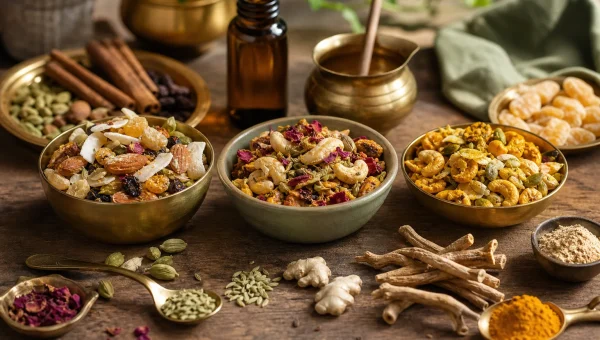
This is the recipe that converted my father-in-law. It uses cumin and fennel as the flavor backbone – both are powerful digestive herbs that happen to taste incredible in a savory bread stuffing.
Ingredients
- 500 grams bread cubes (day-old sourdough or multigrain), toasted until golden
- 3 tablespoons ghee (not butter)
- 1 large onion, finely diced
- 3 stalks celery, diced
- 1 apple (sweet variety), peeled and diced
- 1 tablespoon cumin seeds, toasted and lightly crushed
- 1 teaspoon fennel seeds, toasted and lightly crushed
- 1/2 teaspoon Ashwagandha powder (optional but recommended)
- 1/4 teaspoon hing (asafoetida) – the secret ingredient
- 1/2 cup toasted pumpkin seeds
- 1/4 cup dried cranberries
- 2 tablespoons fresh sage, chopped
- 1 tablespoon fresh thyme leaves
- 400 ml warm vegetable or bone broth
- Salt and black pepper to taste
Method
- Heat ghee in a large pan over medium heat. Add cumin seeds and fennel seeds. Let them sizzle for 30 seconds until fragrant.
- Add onion and celery. Saute 6-7 minutes until soft and translucent.
- Add hing, stir for 10 seconds (hing burns quickly). Add apple, sage, thyme. Cook 2 minutes.
- In a large bowl, combine bread cubes, pumpkin seeds, cranberries, and Ashwagandha powder. Toss.
- Pour the sauteed mixture over bread. Add warm broth gradually, tossing to moisten evenly. The stuffing should be moist but not soggy.
- Transfer to a ghee-greased baking dish. Cover with foil and bake at 180 degrees Celsius for 25 minutes. Remove foil, bake another 15 minutes until the top is crispy.
Why it works: Cumin (Jeeraka) is called “the digestive herb” in Ayurveda. A study in Middle East Journal of Digestive Diseases (2013, n=57) found that cumin extract significantly improved symptoms of IBS, including bloating and abdominal discomfort. Fennel (Shatapushpa) is carminative and anti-spasmodic – its anethole content has been shown in BioMed Research International (2015) to exert smooth muscle relaxation in the GI tract. Hing is the most powerful anti-flatulent in the Ayurvedic pharmacy, with Food Chemistry (2017) documenting its ferulic acid derivatives’ ability to inhibit gas-producing gut bacteria. Together, they ensure the stuffing digests smoothly rather than sitting in your stomach. The 1/2 teaspoon of Ashwagandha per entire dish provides about 100 mg per serving – a micro-dose that contributes to stress reduction during what’s often an emotionally charged holiday gathering.
Recipe 2: Golden Ghee Gravy with Turmeric and Black Pepper
This gravy replaces the heavy, flour-thickened, butter-laden version with something that actually supports digestion. It has a beautiful golden color and a depth of flavor that surprises everyone.
Ingredients
- 2 tablespoons ghee
- 2 tablespoons whole wheat flour (or rice flour for gluten-free)
- 500 ml warm stock (turkey, chicken, or mushroom for vegetarian)
- 1 teaspoon turmeric powder
- 1/2 teaspoon freshly cracked black pepper
- 1/4 teaspoon cinnamon powder
- 1/4 teaspoon ginger powder (Sunthi)
- 1 bay leaf
- 2 tablespoons fresh parsley, finely chopped
- Salt to taste
Method
- Melt ghee in a saucepan over medium-low heat. Add whole wheat flour, whisking constantly for 2-3 minutes until the roux turns a light golden color and smells nutty.
- Whisk in turmeric, cinnamon, ginger, and bay leaf. Stir 30 seconds.
- Slowly pour warm stock in a thin stream, whisking continuously to prevent lumps.
- Bring to a gentle simmer. Cook 8-10 minutes, stirring occasionally, until thickened to desired consistency.
- Remove bay leaf. Add black pepper, salt, and parsley. Stir and serve immediately.
The turmeric-black pepper combination is perhaps the most well-documented synergy in Ayurvedic pharmacology. Piperine from black pepper increases curcumin bioavailability by 2000% (Planta Medica, 1998). At 1 teaspoon of turmeric and 1/2 teaspoon of black pepper per batch, each serving of gravy delivers meaningful anti-inflammatory support alongside the meal.
Using ghee instead of butter provides the added benefit of butyrate – a short-chain fatty acid that supports gut lining health and has anti-inflammatory properties in the intestinal tract. Research in Nutrition Reviews has documented ghee’s superior lipid profile compared to regular butter, including higher conjugated linoleic acid (CLA) content.
Recipe 3: Digestive Chutney for the Holiday Table
This is the dish nobody expects at a holiday meal, and everyone reaches for twice. It’s a fresh chutney that acts as a digestive aid – think of it as your Agni-supporting condiment.
- 1 cup fresh cranberries
- 1/2 cup fresh mint leaves
- 1/4 cup fresh coriander
- 1-inch fresh ginger, peeled
- 1 green chili (adjust to taste)
- 2 tablespoons jaggery or maple syrup
- Juice of 1 lime
- 1/4 teaspoon cumin powder
- Pinch of rock salt
Blend everything in a food processor to a coarse paste. Serve at room temperature. Ginger’s digestive effects are well-established: a systematic review in Food Science & Nutrition (2019, 12 trials) confirmed its prokinetic action on gastric emptying. The combination of ginger, mint, and cumin makes this a potent Deepana-Pachana (appetizer and digestive) preparation that prevents the post-meal heaviness without anyone realizing they’re eating medicine.
Timing Your Holiday Meal: Ayurvedic Principles
| Principle | Practical Application | Why It Matters |
|---|---|---|
| Eat when Agni is strongest | Serve the main meal between 12-2 PM, not 7-9 PM | Pitta time = peak digestion |
| Start with something warm and light | Serve a cup of warm broth or soup first | Primes Agni before heavy food |
| Eat sweet tastes last (not first) | Dessert after the meal, not sweet appetizers | Sweet taste slows Agni |
| Leave 1/3 of the stomach empty | Serve moderate portions, don’t pressure second servings | Space for digestion – supported by gastric physiology research |
| Walk after eating | A 15-minute post-meal stroll, not a couch collapse | Stimulates Samana Vayu, prevents Ama |
The Post-Meal Rescue: If You Do Overeat
Let’s be realistic – at holiday meals, overeating happens. Here’s the damage control protocol:
- Immediately after: Chew 1/2 teaspoon of roasted fennel seeds with a pinch of rock salt. Research in BioMed Research International (2015) confirms fennel’s prokinetic action on the GI tract. This stimulates gastric motility.
- 30 minutes later: Sip warm CCF (Cumin-Coriander-Fennel) tea. Steep 1/2 teaspoon of each seed in 200 ml hot water for 5 minutes.
- Before bed: Take 1 teaspoon Triphala Churna (approximately 3-5 grams) in warm water. This prevents the undigested food from turning into Ama overnight.
- Next morning: Skip breakfast or eat only a light meal of warm khichdi or kanji. Let your Agni catch up.
A study published in Gut (2018) found that post-meal walking (even just 10-15 minutes) significantly improved gastric motility and reduced bloating – validating the Ayurvedic Shatapavali (100 steps after eating) practice. The National Institute of Diabetes and Digestive and Kidney Diseases also recommends slower eating and post-meal activity for reducing digestive discomfort.
Holiday meals should be joyful, not stressful. You don’t need to overhaul your family’s traditions or become the person who brings weird food nobody wants. You just need a few strategic recipes that taste as good as (or better than) the originals, with built-in digestive intelligence that lets everyone enjoy the feast without regretting it later. That’s practical Ayurveda – not purity policing, just smarter cooking.
Medical Disclaimer: These recipes are intended for general wellness and culinary enjoyment. They are not treatments for any medical condition. Individuals with food allergies, diabetes, or digestive disorders should consult their healthcare provider before making dietary changes. If you experience persistent digestive symptoms after holiday meals, seek professional evaluation.
Nothing in this article diagnoses or treats a medical condition. Use it as educational information and consult a qualified Ayurvedic practitioner or physician before starting herbs, supplements, detoxes, or therapeutic protocols, especially if pregnant, managing a condition, or taking medication.