You just finished a 12-kilometer winter hike. Descending the last ridge, your right knee started talking to you – that deep, grinding ache behind the kneecap that gets worse with every downhill step. By the time you reach your car, both knees are stiff, swollen, and angry. You pop two ibuprofen and hope for the best. Sound familiar? I hear this story every December from clients who love the outdoors but dread the aftermath.
Here’s what most hikers don’t realize: cold weather amplifies knee stress in ways that go beyond simple muscle fatigue. And the standard advice – ice, NSAIDs, rest – actually opposes what Ayurveda prescribes for cold-weather joint recovery. Let me walk you through a protocol that’s worked for me and dozens of hiking clients, based on Ayurvedic joint therapy adapted for the active winter hiker.
Why Winter Hiking Destroys Knees Faster
Three factors converge during winter hikes to create the perfect storm for knee damage:
- Cold reduces synovial fluid viscosity. Research published in Osteoarthritis and Cartilage (2014, n=in vitro) showed that synovial fluid becomes thicker and less lubricating at lower temperatures. Your knee cartilage gets less cushioning when it’s cold.
- Vasoconstriction limits blood flow. Cold air causes peripheral blood vessels to constrict, reducing nutrient delivery to tendons and ligaments. Recovery starts slower and finishes later.
- Increased Vata dosha. In Ayurvedic terms, winter’s cold, dry, mobile qualities directly aggravate Vata – the dosha governing all movement, including joint mobility. Elevated Vata in the joints (Sandhigata Vata) produces pain, stiffness, crepitus (cracking sounds), and reduced range of motion.
The downhill component is especially damaging. Eccentric loading during descent puts 3-4 times your bodyweight through the patellofemoral joint. In cold weather, with compromised lubrication, that’s a recipe for inflammation.
The Post-Hike Recovery Protocol
Step 1: Warm Oil Application (Within 30 Minutes of Finishing)
This is the single most important step, and it directly contradicts the conventional RICE (Rest, Ice, Compression, Elevation) protocol. In Ayurveda, applying cold to a Vata-aggravated joint is like pouring water on a flickering fire – it worsens stiffness and delays healing.
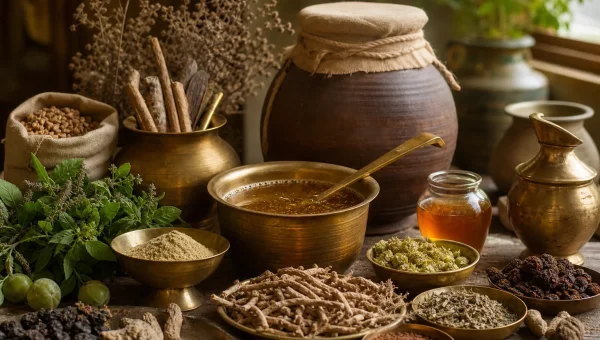
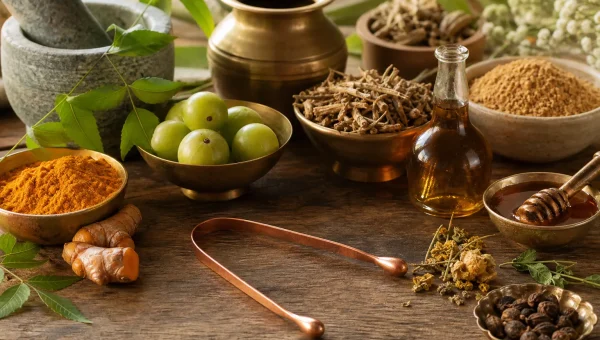
Instead, apply warm Mahanarayan Taila or Dhanvantaram Taila to both knees immediately after your hike. These are classical medicated oils containing dozens of herbs processed in sesame oil base. Mahanarayan Taila specifically contains Ashwagandha, Bala, Shatavari, and Dashamoola – all anti-inflammatory and joint-nourishing.
How to apply:
- Warm the oil to skin temperature (about 38-40 degrees Celsius – test on your wrist)
- Apply generously around the entire knee joint, including the back of the knee (popliteal fossa)
- Massage in circular motions around the kneecap, then longitudinal strokes along the quadriceps and calf
- Spend 5 minutes per knee minimum
- Wrap with a warm flannel or cotton cloth. Leave for 20-30 minutes.
A pilot study in the Journal of Ayurveda and Integrative Medicine (2013, n=30) found that Mahanarayan Taila application reduced knee pain scores by 40% over 4 weeks in osteoarthritis patients. For post-hike acute application, the effect is even more noticeable because the joint hasn’t yet entered chronic inflammation.
Step 2: Janu Basti (Oil Pool Therapy) – Same Evening
Janu Basti is a classical Ayurvedic therapy where warm medicated oil is retained over the knee joint using a ring of dough. It sounds elaborate, but a simplified home version works remarkably well:
- Make a ring of dough using whole wheat flour (atta) and water. About the diameter of your kneecap, 2 inches high.
- Sit with your leg extended. Place the dough ring over the kneecap, pressing the edges into the skin to create a seal.
- Pour warm Mahanarayan Taila into the well until it covers the kneecap.
- Keep the oil warm by periodically removing cooled oil (use a syringe or small cup) and adding fresh warm oil.
- Maintain for 20-30 minutes.
This prolonged contact allows the medicated oil’s herbs to penetrate the joint capsule through transdermal absorption. Localized oil retention therapies like this are among the most effective Panchakarma-derived treatments for joint recovery.
Step 3: Internal Anti-Inflammatory Support
Take the following herbs post-hike and continue for 5-7 days:
| Herb | Dose | Timing | Mechanism |
|---|---|---|---|
| Dashamoola Kwath (decoction of 10 roots) | 30 ml twice daily | Before meals | Anti-inflammatory, Vata pacifying |
| Guggulu (purified) | 250 mg twice daily | After meals | COX-2 inhibition, joint repair |
| Ashwagandha root extract | 300 mg twice daily | With warm milk | Tissue repair, strength recovery |
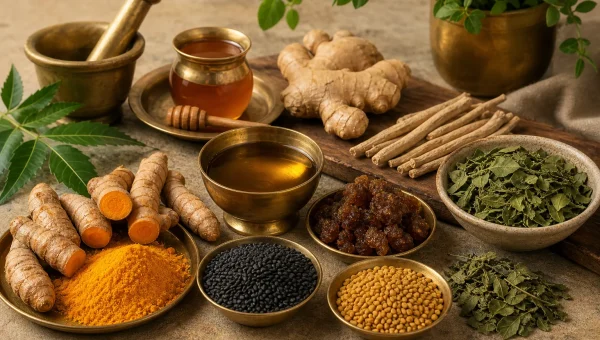
| Turmeric with piperine | 500 mg curcumin + 5 mg piperine | After meals | NF-kB suppression, pain reduction |
| Boswellia serrata | 333 mg three times daily | With meals | 5-LOX inhibition, cartilage protection |
Boswellia (known as Shallaki in Ayurveda) deserves special mention. A meta-analysis in BMC Complementary Medicine and Therapies (2020, n=7 trials, 545 participants total) concluded that Boswellia extracts significantly reduced knee pain and improved function in osteoarthritis, with effects comparable to NSAIDs but with fewer gastrointestinal side effects.
Step 4: Evening Joint Mobility Sequence
According to the Arthritis Foundation, post-activity mobility exercises are essential for preventing stiffness in weight-bearing joints. Don’t just sit on the couch after a hike. Immobilization in cold weather accelerates stiffness. Instead, do this 10-minute joint mobility sequence 2-3 hours after your hike:
- Seated knee flexion-extension: 15 slow repetitions per leg. Full range of motion without load.
- Wall slides: Back against wall, slide down to 45-degree knee bend (not deeper), hold 5 seconds, slide up. 10 reps.
- Ankle circles: 10 each direction. Ankle mobility directly affects knee tracking.
- Supine hamstring stretch: 30-second hold per leg. Tight hamstrings increase patellofemoral pressure.
- Virasana (Hero Pose) modified: Sit on a bolster between your heels. Only go as deep as comfortable. Hold 1-2 minutes. This gently opens the knee joint capsule.
Pre-Hike Prevention Protocol
Recovery is only half the equation. What you do before the hike matters just as much.
Morning of the Hike
- Self-massage (Abhyanga) both knees with warm sesame oil or Bala Taila for 5 minutes. Don’t wipe it off – let it absorb while you prep your gear.
- Take 500 mg Boswellia and 500 mg curcumin 30 minutes before departing.
- Warm up properly. 3 minutes of dynamic leg swings, bodyweight squats, and walking lunges before hitting the trail.
- Carry a thermos with warm ginger-turmeric water (1/2 tsp each in 500 ml hot water). A study in Phytotherapy Research (2016, n=120) confirmed ginger’s ability to reduce delayed-onset muscle soreness after eccentric exercise by 25%. Sip throughout the hike. Cold water on a winter hike increases Vata.
During the Hike
- Use trekking poles for descent. They reduce knee load by 25-30% according to biomechanical research.
- Take shorter steps on descents. Longer strides increase eccentric load exponentially.
- Keep your knees warm. If the temperature drops below 5 degrees Celsius, consider knee-length thermal tights under your hiking pants.
Nutritional Support for Hiking Knees
What you eat in the days surrounding a winter hike directly affects joint inflammation and recovery:
| Food/Nutrient | Why It Helps | How to Include |
|---|---|---|
| Bone broth | Collagen, glycine, proline for cartilage | 200 ml daily in hiking season |
| Sesame seeds (black) | Calcium, magnesium, anti-inflammatory lignans | 1 tbsp in morning porridge |
| Ghee | Lubricates joints (Snehana), fat-soluble nutrient carrier | 2 tsp daily minimum |
| Turmeric in cooking | Continuous low-dose anti-inflammatory effect | 1/2 tsp in every cooked meal |
| Omega-3 rich foods | Resolvin production, inflammation resolution | Walnuts, flax, or fish 3x/week |
When to Stop and See a Professional
This protocol is for post-hike soreness and mild-to-moderate knee strain. Stop hiking and seek evaluation if you experience:
- Knee swelling that doesn’t reduce within 48 hours
- Locking or giving way of the knee
- Pain at rest (not just during or after activity)
- Inability to bear weight
- Numbness or tingling below the knee
These may indicate meniscal damage, ligament injury, or other structural problems that require orthopedic assessment. The American Journal of Sports Medicine (2017) provides guidelines on recognizing red-flag knee symptoms that warrant imaging. Ayurvedic protocols support recovery but don’t replace imaging or surgical intervention when needed.
Research from the Journal of Orthopaedic & Sports Physical Therapy (2018) confirms that pre-activity warm-up and post-activity recovery protocols significantly reduce overuse injury risk in recreational hikers. December is peak hiking season for many of us who love cold, crisp trails. Don’t let knee pain steal that from you. Build the prevention habits, carry the right supplies, and commit to the post-hike recovery protocol. Your knees have to last a lifetime of trails – treat them accordingly.
Medical Disclaimer: This article provides general wellness information and does not constitute medical advice. Consult a qualified healthcare provider before starting any new supplement regimen or therapeutic protocol, especially if you have existing knee injuries, are on blood-thinning medications, or have cardiovascular conditions. Stop any activity that causes sharp pain.