Mucolytic Herbs for Chronic Mucus in Ayurveda: Understanding Kapha Srava
Mucolytic herbs for chronic mucus in Ayurveda begin with pattern recognition rather than a single fixed remedy. In this article, Kapha Srava is used descriptively for excessive Kapha-type discharge: thick, sticky, heavy, cold, or recurring mucus in the nose, throat, sinuses, or chest. Classical Ayurvedic reasoning first asks whether there is excessive flow, obstruction, heat, dryness, digestive sluggishness, or wrong movement of secretions, then chooses herbs and diet according to the dominant dosha and affected srotas.
The two most important channels in chronic respiratory mucus are Pranavaha Srotas and Annavaha Srotas. When mucus is accompanied by poor appetite, heaviness, coating on the tongue, nausea, bloating, or sleepiness after meals, the digestive fire must be corrected along with the respiratory symptoms. The practical line of care is Kapha Shamana, Dipana-Pachana, and careful Srotoshodhana: reducing excess Kapha, supporting digestion, and helping blocked or sticky channels clear without aggravating Pitta or Vata.
Classifying Chronic Mucus by Dosha Pattern
The quality of the mucus matters: colour, thickness, temperature, smell, amount, time of aggravation, and associated symptoms all guide herb selection. Thick white mucus with heaviness is managed differently from yellow mucus with burning, and dry erratic cough is managed differently from wet morning congestion.
| Mucus Pattern | Likely Dosha Pattern | Typical Features | Herbal Direction |
|---|---|---|---|
| Thick white, sticky, copious | Kapha dominant | Heaviness, dull appetite, morning congestion, worse with cold or damp weather | Trikatu when heat is absent; Vasa or Kantakari when cough and chest mucus are present |
| Yellow mucus with heat | Pitta-Kapha | Burning sensation, thirst, bitter taste, feverishness, irritated throat or sinus pain | Vasa and gentle cooling measures; avoid strong heating formulas unless prescribed |
| Scanty, dry, variable, difficult to expel | Vata-Kapha | Dry throat, hoarseness, cough worse with cold air, alternating congestion and dryness | Sitopaladi with suitable vehicle; warm fluids; avoid excessive dry pungent herbs |
| Post-nasal drip and throat clearing | Kapha in the head and throat region | Night cough, coated throat, repeated clearing, rhinitis-like symptoms | Sitopaladi, Kantakari, warm-moist support, and practitioner-guided Nasya when appropriate |
Trikatu: The Central Kapha-Clearing Formula
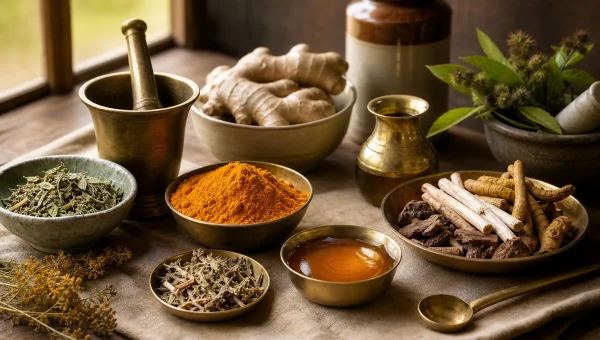
Trikatu means “three pungents” and combines Shunthi (dry ginger), Maricha (black pepper), and Pippali (long pepper). Its best fit is cold, heavy, sticky Kapha with sluggish digestion. It is not the first choice when mucus is accompanied by strong burning, bleeding, severe acidity, high Pitta signs, or marked dehydration.
Shunthi is the dried rhizome of Zingiber officinale. The Ayurvedic Pharmacopoeia of India lists it as Katu Rasa, Laghu and Snigdha Guna, Ushna Virya, and Madhura Vipaka, with actions including Dipana, Pachana, Anulomana, and Vatakaphapaha. In chronic Kapha mucus, this makes dry ginger useful when low digestive fire and cold heaviness are part of the picture.
Maricha is the mature dried fruit of Piper nigrum. Its official Ayurvedic profile includes Katu and Tikta Rasa, Laghu, Ruksha, and Tikshna Guna, Ushna Virya, and Katu Vipaka. It is described with Kapha-clearing actions such as Shleshmahara, Kaphavatajit, and Chedana, making it appropriate for sticky, cold, obstructive Kapha when the patient can tolerate heat and pungency.
Pippali is the dried immature fruit of Piper longum. Its official profile is more nuanced than simply “hot spice”: the pharmacopoeia lists Madhura, Katu, and Tikta Rasa, Laghu and Snigdha Guna, Anushna Virya, and Madhura Vipaka, with actions including Dipana, Kaphahara, Rucya, Vatahara, and Rasayana. Its listed therapeutic uses include Kasa and Svasa, supporting its place in cough-and-breathing formulas.
For practical use, Trikatu should be treated as a concentrated heating formula and taken only in small, practitioner-directed amounts. Honey is often used as a vehicle in cold Kapha patterns, but the formula should be avoided or modified in people with strong acidity, ulcers, burning sensation, bleeding tendency, pregnancy, or medication use unless a qualified practitioner approves it.
Vasa: The Cooling Cough-and-Breathing Herb
Vasa, also called Vasaka, is the fresh or dried mature leaf of Adhatoda vasica. The Ayurvedic Pharmacopoeia of India lists it as Tikta and Kashaya Rasa, Laghu Guna, Shita Virya, and Katu Vipaka, with Kaphapittahara and Kasaghna actions. This makes Vasa especially useful when Kapha mucus is mixed with heat, throat irritation, yellowish sputum, or Pitta-type burning.
The official dose is 10-20 ml of fresh leaf juice or 10-20 g of the dried leaf for decoction. A decoction is generally prepared under practitioner guidance rather than as a casual kitchen tea, because Vasa has a strong bitter-astringent profile and a specific respiratory use. It should not be self-prescribed in pregnancy, for small children, or alongside respiratory, anticoagulant, diabetes, or blood-pressure medicines without professional supervision.
Vasa also has a modern pharmacological connection: bromhexine and ambroxol are semi-synthetic derivatives of vasicine from Adhatoda vasica. This supports the plant’s relevance to mucus-related respiratory care, but the herb, its extracts, and pharmaceutical mucolytics are not interchangeable in dose or safety.
Kantakari: For Kapha-Vata Cough, Rhinitis, and Throat Involvement
Kantakari is the mature dried whole plant of Solanum surattense, synonymous with Solanum xanthocarpum. Its official profile is Katu and Tikta Rasa, Laghu and Ruksha Guna, Ushna Virya, and Katu Vipaka, with actions including Shothahara, Dipana, Pachana, Amadoshanashaka, and Kanthya.
The pharmacopoeia lists Kantakari for Kasa, Svasa, Pinasa, and Svarabheda, making it a useful Kapha-Vata herb when mucus is associated with cough, chronic rhinitis, throat irritation, or hoarseness. The official dose is 20-30 g of the drug for decoction. Because it is drying and warming, it should be used carefully when there is burning, yellow sputum with strong fever, marked dryness, or Pitta aggravation.
Sitopaladi Churna: Classical Upper Respiratory Support
Sitopaladi Churna is a classical powder formulation listed as AFI Part I, 7:34 and in the Ayurvedic Pharmacopoeia of India formulation monograph. Its composition is Sitopala or sugar in 16 parts, Vamshalocana in 8 parts, Pippali in 4 parts, Ela in 2 parts, and Tvak in 1 part. It is sweet-pungent, aromatic, and often used when cough, throat irritation, weak appetite, and upper respiratory Kapha occur together.
The official therapeutic uses include Arocaka, Agnimandya, Pittaja Svasa, Jvara, and Kasa. The official dose is 1-3 g twice or thrice daily, with ghee and honey in unequal quantity as the accompanying vehicle. This is an important correction: equal quantities of honey and ghee should not be presented as the classical vehicle here. Because the formula contains a large proportion of sugar, people with diabetes, insulin resistance, or strict sugar restrictions should use it only with professional advice.
Steam, Warm Moisture, and Nasya
Warm moisture can help loosen thick secretions and soothe upper respiratory dryness, but it should be used safely. A hot shower, warm compress, or controlled warm-moist inhalation is safer than leaning over actively boiling water. If bowl steam is used, the water should be taken off the boil, kept at a safe distance, and avoided for children, frail adults, unsteady patients, and anyone prone to burns or dizziness.
Plain warm moisture is usually enough. Ajwain or Tulsi may be used in mild household steam when tolerated, but strong essential oils are not necessary and may irritate sensitive airways. Stop immediately if steam causes chest tightness, wheezing, eye irritation, dizziness, or worsening cough.
Nasya is a separate Ayurvedic nasal therapy and should not be confused with casual steam inhalation. Medicated nasal oils or powders should be selected by a qualified practitioner, especially in chronic sinus mucus. Classical contraindication lists include states such as acute rhinitis, breathing difficulty, cough, acute fever, pregnancy, extreme age, hunger, thirst, exhaustion, and the period immediately after certain purification procedures.
Dietary Management of Kapha Srava
Diet is not secondary in chronic mucus; it is part of the treatment. Classical descriptions of Kaphaja cough connect excess Kapha with heavy, channel-clogging, sweet, and unctuous foods, excessive sleep, indolence, weak digestion, rhinitis, heaviness, and thick phlegm. When the same pattern appears in chronic mucus, herbs work better when the diet stops feeding the Kapha-Ama cycle.
- Choose warm, light, freshly prepared meals: Soups, thin khichari, cooked vegetables, and warm water are more suitable than cold, heavy, stale, fried, or refrigerated foods.
- Reduce heavy sweet and unctuous foods temporarily: Large amounts of sweets, cold dairy, curd at night, fried foods, and very heavy wheat-based meals can aggravate the Kapha pattern in susceptible people.
- Use pungent spices according to tolerance: Dry ginger, black pepper, and long pepper suit cold Kapha mucus, but they should be reduced or avoided when acidity, burning, bleeding, or strong Pitta signs are present.
- Avoid overeating and irregular meals: Annavaha Srotas is disturbed by excess quantity, untimely food, unsuitable food, and deranged digestive fire.
- Reduce daytime sleep and long sedentary spells: Gentle walking, upright posture after meals, and regular movement help Kapha move instead of stagnating.
Practical Herb Selection Protocol
A simple Ayurvedic protocol begins by choosing the dominant pattern rather than stacking many herbs together. The same person may shift patterns over time, so the formula should change when the mucus changes from cold and white to hot and yellow, or from wet and heavy to dry and irritating.
Cold Kapha pattern: When mucus is white, thick, sticky, and worse in the morning, Trikatu may be chosen in small practitioner-directed doses, especially when appetite is dull. Kantakari is added when cough, rhinitis, or throat involvement is prominent. Vasa may be used when the chest and cough are central, provided the person is not pregnant and has no contraindication.
Pitta-Kapha pattern: When mucus is yellowish and accompanied by burning, thirst, feverishness, bitter taste, or irritated throat, Vasa is generally more suitable than strong Trikatu. Heating spices, alcohol, fried food, and excessive sour or salty foods should be reduced. Green, foul-smelling, blood-tinged, or pus-like sputum requires medical evaluation rather than home herbal treatment.
Vata-Kapha pattern: When cough is dry, hoarse, variable, and difficult to expectorate, overly drying herbs can worsen the condition. Sitopaladi with the correct vehicle, warm fluids, gentle moisture, and Vata-calming diet are preferred. If wheezing, breathlessness, chest pain, or sleep disturbance is present, professional assessment is necessary.
Medical Disclaimer: Chronic mucus production can accompany chronic sinusitis, asthma, allergies, chronic bronchitis, bronchiectasis, GERD, infection, tuberculosis, or other respiratory disease. Seek medical care for blood-stained sputum, green or foul-smelling sputum, chest pain, shortness of breath, wheezing, high or persistent fever, weight loss, severe weakness, symptoms lasting more than three weeks, or worsening symptoms. Ayurvedic herbs may interact with medicines and may be unsuitable during pregnancy, breastfeeding, childhood, bleeding disorders, ulcers, reflux, diabetes, liver or kidney disease, or while using anticoagulants, diabetes medicines, blood-pressure medicines, or respiratory medicines. Consult a qualified Ayurvedic practitioner and healthcare provider before starting herbs, and do not stop prescribed treatment based on this content.
References
- Charaka Samhita — Sroto Vimana
- Easyayurveda (easyayurveda.com)
- An Ayurvedic formulation ‘Trikatu’ and its constituents (1992), PubMed
- Ayurvedic Pharmacopoeia of India
- Ayurvedic Pharmacopoeia of India
- Ayurvedic Pharmacopoeia of India
- Ayurvedic Pharmacopoeia of India
- Ayurvedic Pharmacopoeia of India
- Activity of bromhexine and ambroxol, semi-synthetic derivatives of vasicine from the Indian shrub Adhatoda vasica, against Mycobacterium tuberculosis in vitro (1996), PubMed
- Indianmedicine (indianmedicine.eldoc.ub.rug.nl)
- Ayurvedic Pharmacopoeia of India
- Researchgate (researchgate.net)
- Mayoclinic (mayoclinic.org)
- Healthify (healthify.nz)
- Charaka Samhita — Nasya
- Mayoclinic (mayoclinic.org)
- NHS