Dandruff, Darunaka, and the Ayurvedic Scalp Microbiome
Dandruff ayurvedic scalp microbiome care begins with Darunaka, the classical Ayurvedic description of a flaking, itching disorder of the hair-bearing skin. In Sushruta Samhita, Nidana Sthana 13, Darunaka is included among the Kshudra Rogas and is described as a condition in which the hair-root area becomes hard, dry, and itchy due to deranged Kapha and Vayu. This makes Darunaka a useful Ayurvedic lens for understanding many cases of chronic scalp flaking, especially when dryness, roughness, itching, oiliness, and recurrent scale appear together.
Modern dermatology describes dandruff and mild scalp seborrheic dermatitis through a related but different language: visible scaling arises from the interaction of Malassezia yeasts, sebaceous lipids, scalp-barrier sensitivity, and individual inflammatory response. Ayurveda does not name Malassezia, but the Darunaka framework helps distinguish whether the dominant scalp pattern is dry and rough, oily and sticky, inflamed and burning, or mixed. That distinction matters because the wrong scalp routine can aggravate the same flakes it is meant to calm.
For example, a harsh drying shampoo used repeatedly on a dry Vata-dominant scalp can increase tightness, roughness, and powdery flakes. Heavy overnight oiling on a greasy Kapha-dominant scalp can leave the scalp coated and uncomfortable. A red, burning Pitta-associated scalp may react badly to strong essential oils, camphor, or very heating applications. Darunaka care is therefore best approached by matching the treatment to the visible scalp pattern.
Dosha Classification of Darunaka
The following classification is a practical clinical guide for scalp care. Classical Darunaka is primarily described with Vata and Kapha involvement; Pitta is included here as a useful pattern when redness, burning, heat, or inflammatory scalp sensitivity accompanies the flaking.
| Darunaka Pattern | Scalp Appearance | Oil Approach | Rinse Herbs |
|---|---|---|---|
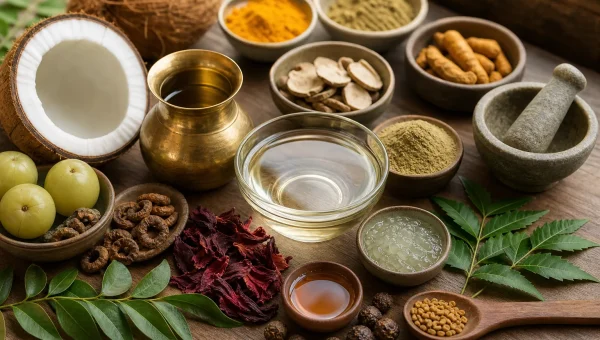
| Vata-dominant Darunaka | Fine white powdery flakes, rough or tight scalp, dryness, itching, possible hair breakage or shedding | Warm sesame-based oil or Bhringaraja taila in a gentle, nourishing routine; avoid harsh drying washes | Hibiscus, aloe vera, amla, mild Triphala rinse |
| Kapha-dominant Darunaka | Greasy or sticky white-yellow scale, oily scalp, heaviness, recurrent itching | Minimal short-contact oil only when needed; avoid heavy overnight oiling on an oily scalp | Neem, Triphala, reetha, fenugreek seed water |
| Pitta-associated Darunaka | Redness, warmth, burning, tenderness, inflamed scale, mixed dry and greasy flakes | Cooling and mild applications; avoid camphor, strong essential oils, and very heating scalp packs | Amla, vetiver water, diluted neem, aloe vera |
| Mixed Darunaka | Fluctuating flakes, seasonal change, dry areas with oily patches, itching that varies with diet, weather, and washing frequency | Choose the approach according to the current scalp state rather than using the same oil every time | Mild Triphala with small amounts of neem, adjusted to tolerance |
The Malassezia-Microbiome Connection in Ayurvedic Language
Malassezia species are part of the normal skin flora and are strongly linked with dandruff and seborrheic dermatitis when scalp oil, lipid breakdown products, barrier disturbance, and individual sensitivity come together. The visible result is accelerated shedding of scalp cells, itching, and recurrent scale. In Ayurvedic language, this is best understood through qualities: Kapha contributes oiliness, heaviness, and sticky accumulation; Vata contributes dryness, roughness, cracking, and fine flaking; Pitta contributes heat, redness, burning, and inflammatory sensitivity.
This is why one universal dandruff oil is not ideal. The same oil that softens a dry Vata scalp may feel heavy and aggravating on a greasy Kapha scalp. The same sharp antimicrobial ingredient that helps an oily, itchy scalp may sting a Pitta-inflamed scalp or overdry a Vata scalp. The goal is not to sterilize the scalp, but to restore a healthier scalp environment by reducing excess scale, supporting the barrier, and choosing herbs according to the scalp’s dominant qualities.
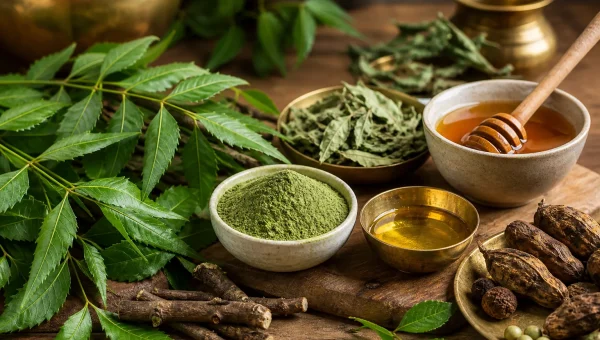
Nimba, or neem, is especially useful in Kapha-Pitta scalp patterns when applied correctly. The Ayurvedic Pharmacopoeia of India lists Nimba leaf as tikta in rasa, ruksha in guna, shita in virya, and katu in vipaka, with classical use in conditions such as Krimiroga, Kushtha, Vrana, and inflammatory disorders. These bitter, drying, cooling qualities make neem more appropriate for oily, itchy, inflamed, or sticky scalp states than for a very dry Vata scalp. Because Nimba leaf is also described as Vatala, strong neem applications should be used carefully when the scalp is already dry, rough, and tight.
The Kapha-Type Anti-Dandruff Protocol
For oily, sticky Kapha-dominant Darunaka, the treatment principle is lightness, cleanliness, and short-contact application. The scalp should be washed often enough to prevent greasy buildup, and medicated dandruff shampoos such as ketoconazole, zinc pyrithione, selenium sulfide, salicylic acid, sulfur, or coal-tar preparations may be used according to the product directions when flakes are persistent.
Short-contact neem scalp rinse or paste, 1-2 times weekly:
- Use 10-15 fresh neem leaves or 1 tablespoon neem leaf powder.
- Simmer in 500-750 ml water for 10 minutes, cool fully, and strain.
- Apply to the scalp after washing, leave for 5-10 minutes if tolerated, and rinse out.
- Avoid the eyes and avoid use on open wounds, intense burning, or highly irritated skin.
Minimal pre-wash oiling when the scalp feels tight but remains oily:
- Use only 1-2 teaspoons of coconut oil or sesame oil as a carrier.
- Add a very small amount of neem oil only if the scalp has tolerated neem before.
- Massage lightly for 3-5 minutes, leave for 20-30 minutes, and wash thoroughly.
- Do not leave heavy oil overnight on a greasy, sticky, or inflamed scalp.
A prepared tea tree oil shampoo may be used as a modern adjunct when tolerated, especially in oily dandruff. Tea tree oil should not be swallowed, should not be applied undiluted, and should be stopped if it causes burning, rash, redness, or worsening dryness.
The Vata-Type Dry Scalp Protocol
For Vata-dominant Darunaka, the scalp is usually dry, tight, rough, and powdery rather than greasy. Here the goal is to soften the scalp, reduce roughness, and protect the barrier without leaving an irritating residue. This pattern usually needs gentler washing and a more nourishing oil routine than Kapha-type dandruff.
Gentle nourishing oil routine, 2-3 times weekly:
- Warm 1-2 tablespoons sesame oil, coconut oil, or a practitioner-selected hair oil.
- Bhringaraja taila may be used when hair fall, dryness, or scalp weakness accompanies flakes; Bhringaraja is classically listed as Keshya and is included in traditional hair-oil formulations.
- Massage slowly for 5-10 minutes using light pressure, then cover with a warm towel for 10-15 minutes.
- Leave for 1-2 hours before washing; overnight oiling is suitable only if the scalp is not greasy, red, infected, or intensely itchy.
Vata-type dry flakes often worsen with very hot water, repeated harsh shampooing, alcohol-heavy styling products, and irregular sleep or meals. A mild cleanser, warm-not-hot water, and steady scalp oiling are usually better than aggressive scrubbing. For a broader oil-selection framework, the comprehensive hair oiling guide by dosha explains how to choose oils according to scalp type.
Herbal Rinses: The Forgotten Step
Herbal rinses are useful because they let the scalp receive a light botanical application without the heaviness of oil. They are best kept mild, strained well, and adjusted according to whether the scalp is dry, oily, or inflamed.
Neem-Triphala rinse for oily or mixed flakes: Simmer 1 teaspoon Triphala powder and 5-10 neem leaves in 500 ml water for 5-10 minutes. Cool completely, strain through a fine cloth, and use after shampooing. Leave briefly if comfortable, then rinse out with plain water if the scalp feels dry or tight.
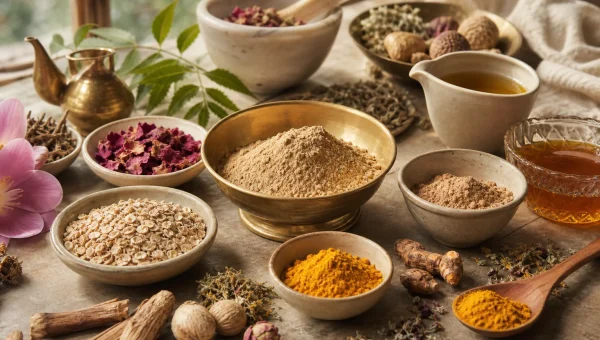
Aloe or hibiscus rinse for dry or Pitta-sensitive scalp: Mix fresh aloe vera gel with water until it becomes a thin liquid, or steep hibiscus petals in warm water until the liquid becomes slightly mucilaginous. Apply to the scalp after washing and rinse gently. This is better suited to dry, hot, or irritated scalps than strong neem or essential-oil applications.
Fenugreek seed water for roughness and mild itching: Soak 1 tablespoon fenugreek seeds overnight in water, strain, and use the slippery water as a pre-wash scalp application for 10-15 minutes. Rinse thoroughly and avoid leaving any paste trapped on the scalp.
Internal Correction: The Missing Link in Recurrent Darunaka
Persistent Darunaka is not always only a local scalp problem. Ayurveda also considers agni, ama, diet, bowel regularity, sleep, stress, season, prakriti, and repeated exposure to aggravating foods or routines. The Agni foundation article explains why digestion and tissue metabolism are central to long-term skin and scalp balance.
For Kapha-dominant recurrence, reduce frequent heavy, very sweet, fried, oily, and excessive dairy-heavy meals, especially when they clearly worsen greasiness or itching. Favor warm, lighter meals and regular washing that prevents scalp buildup. For Pitta-associated recurrence, reduce excess chili, alcohol, very sour foods, excessive fermented foods, and heat exposure when they trigger redness or burning. For Vata-dominant recurrence, avoid fasting, irregular meals, inadequate sleep, excessive dryness, and harsh cleansing; support the body with warm meals, stable routines, and appropriate unctuous care.
Internal herbs such as Triphala, Nimba, or other classical formulations should be chosen by a qualified Ayurvedic practitioner rather than self-prescribed, especially when the dandruff is severe, recurrent, associated with hair loss, or accompanied by digestive, hormonal, immune, or skin conditions.
Medical Disclaimer: This article is for educational purposes only. Persistent or severe dandruff with redness, pain, scalp wounds, pus, patchy hair loss, thick plaques, spreading rash, or lesions beyond the scalp should be evaluated by a dermatologist to rule out psoriasis, tinea capitis, contact dermatitis, or other medical conditions.
Consult a qualified Ayurvedic practitioner or healthcare provider before starting herbs, supplements, medicated oils, detoxes, or therapeutic protocols, especially if pregnant, breastfeeding, immunocompromised, managing a medical condition, or taking medication. Patch test topical herbs and oils, avoid the eyes, and stop any application that causes burning, rash, or worsening irritation.
References
- Easyayurveda (easyayurveda.com)
- Wisdomlib — classical text
- Ijhsr (ijhsr.org)
- NCBI
- Betterhealth (betterhealth.vic.gov.au)
- Sciencedirect (sciencedirect.com)
- Pnas (pnas.org)
- Ayurvedic Pharmacopoeia of India
- Aad (aad.org)
- Treatment of dandruff with 5% tea tree oil shampoo (2002), PubMed
- NCCIH
- NCCIH
- Ayush (ayush.delhi.gov.in)