
Air Pollution Lung Herbs Ayurveda: Daily Protection from What You Cannot Avoid
Air pollution is a daily respiratory stressor for people living in many cities. Fine particles such as PM2.5 can reach the deeper parts of the lungs, while PM10 more commonly affects the upper and larger airways. Nitrogen dioxide and ozone can further irritate the respiratory tract, and repeated exposure is associated with reduced lung function, aggravated asthma, respiratory infection risk, oxidative stress and inflammation. Masks, cleaner indoor air and source reduction remain the first line of protection; Ayurvedic herbs and daily routines are supportive measures for nasal moisture, kapha movement, throat comfort and respiratory resilience.
Ayurveda understands this terrain through pranavaha srotas, the channel system concerned with respiration and the movement of prana. Charaka describes the root of pranavaha srotas as hridaya and mahasrotas, linking breath with the chest, circulation and digestive axis. In practical daily care, polluted air can be understood as aggravating dryness and roughness of vata, irritation and heat of pitta, and heaviness or mucus accumulation of kapha. The purpose of a daily protocol is not dramatic “lung detox,” but steady support for clear channels, protected mucosa, balanced agni and easier removal of accumulated kapha.
Nasal Protection: The First Defense Line
The nasal mucosa is the first contact surface for inhaled pollutants, dust and dry air. Ayurveda places nasal care under nasya, and the gentler daily form, pratimarsha nasya, is traditionally performed with a small quantity of oil. Applying 2 drops of warm sesame oil or practitioner-prescribed Anu Taila to each nostril in the morning can help lubricate dry nasal passages and support the natural barrier function of the nose. This should be done gently, without forceful sniffing, and only when the person is comfortable with oil application.
Anu Taila is a classical sesame-oil-based nasal preparation used for nasya. Modern pharmacognostic work describes Anu Taila as containing more than 25 herbs and goat milk according to the Ayurvedic Formulary of India. For a pollution-support routine, plain sesame oil is often the simplest daily option, while Anu Taila is better used when prescribed or when the person already tolerates medicated nasal oils well. Nasya should be avoided during acute fever, immediately after meals, during active nosebleed, when the nose is severely blocked, or if it causes coughing, choking or irritation.
The Morning Protection Stack: Kitchen Pharmacy
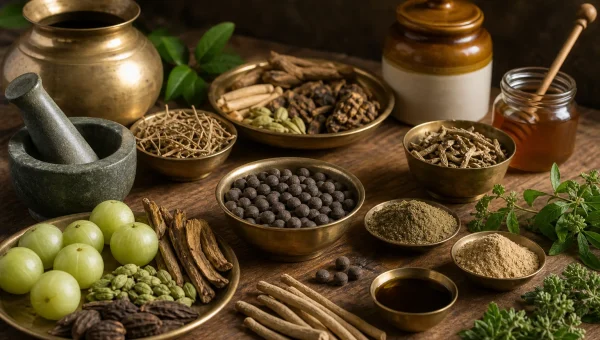
The morning respiratory support stack uses familiar Ayurvedic herbs in small, practical doses. It is designed for people who regularly face dust, smoke, traffic pollution or dry polluted air, especially when the tendency is toward morning congestion, throat irritation or kapha heaviness. Sensitive people, those with asthma or COPD, pregnant people, and anyone taking regular medication should use herbs under qualified guidance.
Tulsi decoction: Steep 8–10 fresh tulsi leaves in about 300 ml hot water for 5–7 minutes and drink warm. Tulsi is an aromatic, kapha-moving herb traditionally used in cough, cold and respiratory discomfort. Its phytochemical profile includes eugenol, rosmarinic acid and other polyphenols, and it is valued as an adaptogenic herb that supports resilience against physical and chemical stress. Honey may be added only after the tea has cooled to a warm, drinkable temperature.
Trikatu with honey: Mix 1/8 to 1/4 teaspoon Trikatu churna with 1 teaspoon honey and lick slowly after the tulsi tea. Trikatu is the classical three-spice combination of dry ginger, black pepper and long pepper. Its main Ayurvedic role here is to kindle agni, reduce kapha heaviness and support the movement of mucus from the throat and chest. Because black pepper and long pepper contain piperine, this combination also has a long-standing role as a bioavailability-supporting adjunct in herbal formulations. People with acidity, gastritis, ulcers, burning sensation, high pitta symptoms or mouth ulcers should avoid or reduce Trikatu.
Vasa when cough or congestion is present: Vasa, also known as Vasaka or Adhatoda vasica, is one of Ayurveda’s important herbs for cough, breathlessness and kapha lodged in the chest. Its alkaloids, especially vasicine and vasicinone, are associated with expectorant and bronchodilator activity. A conservative adult range is 5–10 ml of fresh leaf juice or extract, or about 1–3 g leaf powder, taken only under professional guidance. Vasa is not a casual daily tonic for everyone and should be avoided in pregnancy unless a qualified physician specifically advises otherwise.
| Herb or Practice | Typical Adult Use | Primary Support | Timing |
|---|---|---|---|
| Tulsi decoction | 8–10 leaves in 300 ml water | Aromatic kapha support, antioxidant food-herb support | Morning |
| Trikatu + honey | 1/8–1/4 tsp + 1 tsp honey | Agni kindling, kapha movement, bioavailability support | After tulsi tea |
| Vasa | 5–10 ml juice/extract or 1–3 g powder under guidance | Cough, kapha congestion, bronchial support | When indicated |
| Sesame oil or Anu Taila nasya | 2 drops per nostril | Nasal moisture and mucosal support | Morning before going out |
| Pippali milk | 1/8–1/4 tsp in warm milk with ghee | Kapha-vata cough support, rasayana-style nourishment | Evening when suitable |
Evening Lung Support: Post-Exposure Clearing
The evening routine focuses on softening dryness, loosening kapha and calming irritated passages after a day outside. A mild steam inhalation may be prepared with plain water, tulsi leaves, a pinch of ajwain and a small piece of dry ginger. Keep the face comfortably away from the vessel and inhale gently for 3–5 minutes, not 10 minutes of intense heat. Steam should feel soothing, never suffocating. Avoid steam inhalation in young children, during acute asthma flare, severe breathlessness, dizziness, fever, active nosebleed or when heat worsens symptoms.
Eucalyptus oil should be used with caution. Its main constituent, 1,8-cineole, is known for mucolytic and anti-inflammatory respiratory actions, but concentrated essential oil can irritate airways and is unsafe if swallowed. If used at all, 1–2 drops in a large bowl of hot water is enough for adults who tolerate it. It should be avoided around young children, during pregnancy unless advised, in seizure history, and in people whose asthma or breathing sensitivity worsens with strong aromas.
After steam, pippali milk may be used when the person has a kapha-vata pattern: chronic mild throat mucus, cold-type cough tendency, weak digestion and no burning symptoms. Mix 1/8 to 1/4 teaspoon pippali powder into 250 ml warm milk with 1 teaspoon ghee. Pippali is warming and penetrating, so it is not suitable for everyone. Avoid it in acidity, ulcers, burning sensation, active bleeding disorders, pregnancy unless prescribed, or when pitta symptoms are prominent.
Food as Lung Protection
Food support for pollution exposure should emphasize antioxidant-rich, easy-to-digest meals rather than heavy “detox” claims. Pomegranate is useful as a seasonal fruit because it contains punicalagins, anthocyanins and other polyphenols. These compounds support the body’s antioxidant defenses and help counter the oxidative burden associated with polluted air. It may be taken as whole arils or fresh juice, preferably without added sugar.
Moringa leaves, known as drumstick leaves, are another practical food for urban respiratory support. The leaves provide minerals, carotenoids, vitamin C, phenolics and flavonoids such as quercetin and kaempferol. Use them as a cooked leafy vegetable, in dal, or as 1 teaspoon of good-quality leaf powder added to warm food. Very high doses are unnecessary and may disturb digestion.
Turmeric remains a simple evening food-herb for inflammatory burden when taken in a traditional form. Add 1/4 teaspoon turmeric to warm milk or plant milk with a little ghee, and include a small pinch of black pepper. Piperine from black pepper markedly increases curcumin bioavailability, while fat supports absorption of turmeric’s lipophilic constituents. This preparation should be avoided or modified in gallbladder disease, reflux, active ulcers, anticoagulant use or when turmeric causes heat or loose stools. For the pranayama practices that complement respiratory care, see our detailed guide at pranayama breathing techniques.
When to Seek Medical Care
Ayurvedic respiratory support should never delay medical treatment. Chest pain, wheezing, shortness of breath, blue lips, coughing blood, oxygen drop, persistent fever, severe weakness or worsening asthma symptoms require prompt medical evaluation. People with asthma, COPD, interstitial lung disease, heart disease, pregnancy, kidney or liver disease, or those taking regular medicines should consult a qualified healthcare provider and an Ayurvedic practitioner before using herbs, nasal oils, steam or supplements.
Nothing in this article diagnoses, treats or cures a medical condition. It is general educational information on Ayurvedic respiratory support for pollution exposure. Use herbs and therapeutic routines with professional guidance, especially if pregnant, elderly, managing a diagnosed condition, giving herbs to children, or taking prescription medication.
References
- World Health Organization
- Epa (epa.gov)
- Ww2 (ww2.arb.ca.gov)
- World Health Organization
- Oxidative stress pathways of air pollution mediated toxicity: Recent insights (2020), PubMed Central
- Charaka Samhita — Sroto Vimana
- Easyayurveda (easyayurveda.com)
- Jaims (jaims.in)
- Identification and estimation of bioactive constituents Negundoside, Berberine chloride, and Marmelosin by HPLC and HPTLC for development of quality control protocols for Ayurvedic medicated oil formulation (2021), PubMed Central
- Sciencedirect (sciencedirect.com)
- Tulsi – Ocimum sanctum: A herb for all reasons (2014), PubMed Central
- Ocimum sanctum Linn. A reservoir plant for therapeutic applications: An overview (2010), PubMed Central
- Bioavailability enhancers of herbal origin: an overview (2013), PubMed Central
- Influence of piperine on the pharmacokinetics of curcumin in animals and human volunteers (1998), PubMed
- Exploring the pharmacological and chemical aspects of pyrrolo-quinazoline derivatives in Adhatoda vasica (2024), PubMed Central
- Cellmolbiol (cellmolbiol.org)
- Sciencedirect (sciencedirect.com)
- New Perspectives for Mucolytic, Anti-inflammatory and Adjunctive Therapy with 1,8-Cineole in COPD and Asthma: Review on the New Therapeutic Approach (2020), PubMed Central
- Carum copticum L.: a herbal medicine with various pharmacological effects (2014), PubMed Central
- Poison (poison.org)
- NCCIH
- Anti-inflammatory activity of two varieties of Pippali (Piper longum Linn.) (2012), PubMed Central
- Review of Pharmacological and Medicinal Uses of Punica granatum (2024), PubMed Central
- Europepmc (europepmc.org)
- Moringa oleifera: An Updated Comprehensive Review of Its Pharmacological Activities, Ethnomedicinal, Phytopharmaceutical Formulation, Clinical, Phytochemical, and Toxicological Aspects (2023), PubMed Central
- Mdpi (mdpi.com)
- Curcumin: A Review of Its Effects on Human Health (2017), PubMed Central

this protocol seems designed for Delhi-level pollution. What about moderate pollution city dwellers?