
Metabolic Flexibility and Kapha: Breaking the Fat-Burning Impasse
Kapha-dominant metabolism is built around steadiness, endurance, cohesion, and storage. When these qualities are balanced, they give strength, stamina, patience, and resilience. When kapha becomes excessive, the same pattern may become heaviness, slow initiation, excess meda dhatu, sluggish digestion, and a tendency to store more than the body uses. In classical Ayurvedic language, this territory belongs to sthaulya, atisthula, and medoroga, where meda dhatu and kapha disturb the normal movement of channels and require careful management.
In exercise physiology, metabolic flexibility refers to the body’s ability to shift between fuels according to need: using more glucose when intensity rises and using more fat when intensity is lower, food is absent, or carbohydrate intake is reduced. For kapha management, this becomes a practical training goal: kindle agni without provoking vata, reduce excess kapha-meda without exhausting mamsa dhatu, and build enough muscle and mitochondrial capacity to make fat use easier over time.
The protocol below keeps the Ayurvedic emphasis on lightness, heat, movement, and rhythm while correcting the common mistake of treating kapha fat loss as simple food restriction. Kapha needs stimulation, but not reckless depletion. The goal is to combine fasting-aware aerobic work, brief high-intensity stimulus, fed resistance training, midday-focused carbohydrate timing, and carefully chosen herbs that fit kapha-meda patterns.
Why Kapha Types Struggle with Fat Burning
Kapha is associated with guru (heaviness), manda (slowness), sthira (stability), snigdha (unctuousness), and structural cohesion. These qualities are not defects; they are the reason kapha constitutions often tolerate steady routines well. The difficulty appears when the body becomes too comfortable with heaviness, frequent feeding, low movement variety, and a routine that never asks the system to switch fuel sources.
Ayurveda describes excessive obesity as arising from over-nourishment, heavy and sweet foods, cold and fatty foods, lack of physical exercise, day sleep, and other kapha-promoting habits. Charaka also describes obstruction of channels by increased meda, with disturbed vata and agni becoming important factors in the obese state. In modern training language, this maps well to a pattern where energy intake, low activity, and poor fuel switching reinforce each other.
The practical answer is not extreme fasting, random low-carb dieting, or daily maximum-effort training. Kapha benefits from a progressive pattern: more movement during the kapha-dominant morning, the strongest meal during the pitta-dominant middle of the day, lighter evenings, and resistance training to protect mamsa dhatu. This creates a body that is less dependent on constant glucose availability and more capable of using stored energy without becoming depleted.
Exercise Sequencing for Maximum Fat Oxidation
The sequence matters because each session has a different purpose. Fasted low-to-moderate aerobic work trains calm fuel switching. Brief high-intensity intervals provide a stronger adaptation signal. Fed resistance training protects strength, muscle, and recovery. Active recovery keeps kapha moving without accumulating fatigue.
Session 1 (Monday/Thursday): Fasted Morning Kapha-Stimulus Session
Perform this 20-40 minutes after waking, before caloric intake, if fasted exercise is well tolerated. Begin with 8-10 minutes of brisk walking, mobility, or cycling. Then perform 4-6 rounds of 20-30 seconds hard effort followed by 90-120 seconds of easy movement. Suitable options include hill walking, cycling, rowing, skipping, short sprints, or bodyweight movements. This session should feel sharp and awakening, not crushing. Beginners, people with high stress, and anyone prone to dizziness should start with brisk walking only and add intervals gradually.
Session 2 (Tuesday/Friday): Fasted Steady-State Cardio
Use 40-60 minutes of low-to-moderate effort, ideally in the morning kapha window. A useful target is a pace where breathing is deeper but conversation is still possible. Walking, cycling, swimming, elliptical work, and steady hiking all fit. This session is not about exhaustion; it is about teaching the body to move comfortably without needing constant carbohydrate intake. For kapha patterns, this is often the most sustainable foundation.
Session 3 (Wednesday/Saturday): Fed Resistance Training
Perform this session after a proper meal or snack, preferably 1.5-3 hours after eating. Duration: 45-60 minutes. Focus on compound movements such as squats, hip hinges, presses, rows, lunges, carries, and controlled core work. Use challenging but clean technique for 3-5 sets of 5-10 repetitions per main movement. This session supports mamsa dhatu, strength, posture, glucose disposal, and long-term metabolic rate. Kapha fat loss should never be pursued by sacrificing muscle.
Session 4 (Sunday): Active Recovery and Circulation
Use 45-75 minutes of walking, yoga, mobility, light cycling, or an easy hike. If the body feels fresh, add 5-8 minutes of short accelerations near the end, but avoid turning recovery into another hard session. The purpose is to prevent kapha stagnation while allowing the nervous system, joints, and muscles to reset.
Carbohydrate Timing by Dosha Rhythm
Ayurveda traditionally divides the day into repeating dosha periods: kapha from roughly 6-10 AM and 6-10 PM, pitta from 10 AM-2 PM and 10 PM-2 AM, and vata from 2-6 AM and 2-6 PM. For kapha-meda management, this rhythm is useful because it gives structure to food timing without requiring harsh restriction.
The kapha morning window should be light, warm, and activating. If fasted training suits the person, non-caloric warm fluids and exercise can be used before breakfast. If breakfast is needed, choose a light, protein-forward, warm meal rather than sweet, cold, heavy foods. The pitta midday window is the best place for the main meal and the largest portion of starches, grains, legumes, or root vegetables. The evening kapha window should be lighter, warm, and easier to digest, with fewer heavy sweets, fried foods, cold dairy, and large grain portions.
| Time Window | Dosha Dominant | Recommended Food Focus | Training Recommendation |
|---|---|---|---|
| 6-10 AM | Kapha | Warm fluids; light protein if needed; avoid heavy sweet breakfasts | Fasted walking, steady cardio, or brief intervals if appropriate |
| 10 AM-2 PM | Pitta | Main meal; best window for the day’s largest carbohydrate portion | Fed resistance training or post-meal walk |
| 2-6 PM | Vata | Light snack if genuinely hungry; warm tea; avoid grazing | Mobility, yoga, walking, skill work |
| 6-10 PM | Kapha | Light warm dinner; protein, vegetables, soups, moderate legumes | Easy walk only; avoid late intense training |
Ayurvedic Herbs That Support Kapha-Meda Metabolism
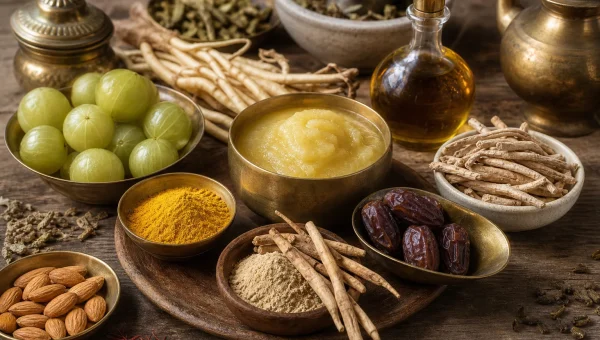
Herbs for kapha-meda metabolism should be chosen for their fit with the person’s digestion, strength, medications, and prakriti. The most useful category is not “fat burner” in the modern marketing sense, but deepana, pachana, lekhana, kaphahara, and medohara support that helps agni, clears heaviness, and reduces kapha-type stagnation.
Guggulu (Commiphora wightii, syn. Commiphora mukul) is one of the clearest classical choices for kapha-meda patterns. The Ayurvedic Pharmacopoeia of India lists guggulu as the exudate of the plant and gives its rasa as katu, tikta, and kashaya; its guna as laghu, sara, and vishada; its virya as ushna; and its vipaka as katu. Its actions include medohara, and its therapeutic uses include medoroga. This makes it appropriate to discuss in a kapha-metabolic article, but it should be used as a proper Ayurvedic medicine under guidance, not as a casual thyroid or weight-loss supplement.
Trikatu is the classical “three pungents” combination: pippali (Piper longum), maricha (Piper nigrum), and shunthi (Zingiber officinale). Its role in this protocol is digestive and kapha-clearing. It is best suited to cold, heavy, sluggish, mucus-prone, or ama-associated patterns where agni needs kindling. Because it is heating and sharp, it is not ideal for people with active acidity, burning sensations, gastritis, ulcers, strong pitta aggravation, or pregnancy unless a qualified practitioner specifically recommends it.
Gandira (Coleus forskohlii, syn. Coleus barbatus) is the more accurate Ayurvedic Pharmacopoeia name for the Coleus forskohlii root discussed in modern supplement contexts. The Ayurvedic Pharmacopoeia of India lists it as katu, kashaya, and tikta in rasa; ruksha, tikshna, and sara in guna; ushna in virya; and katu in vipaka. Its actions include kaphahara, and its uses include mandagni, gulma, udara, and related abdominal conditions. Modern standardized forskolin extracts are a supplement category and should not be treated as identical to classical Gandira use.
Putting the Kapha Flexibility Protocol Together
A useful kapha metabolic block can run for 4-6 weeks. Keep two morning fasted stimulus sessions, two morning steady-state sessions, two fed resistance sessions, and one active recovery day. Place the largest meal at midday, keep dinner lighter, and use herbs only when the digestive picture clearly calls for them. Track energy, sleep, hunger, bowel regularity, training recovery, waist measurement, and strength. If strength collapses, sleep worsens, cravings spike, or anxiety increases, the protocol has become too depleting and should be softened.
The Ayurvedic aim is not to punish kapha but to restore movement, heat, clarity, and intelligent use of stored energy. The body should feel lighter, warmer, steadier, and more responsive. Done correctly, kapha’s natural endurance becomes an advantage: once the system learns to switch fuels more easily, the same constitution that once stored heavily can sustain disciplined training and long-term metabolic change.
Medical Disclaimer: This information is for educational purposes and does not constitute medical advice. People with diabetes, hypoglycemia, thyroid disease, cardiovascular disease, pregnancy, eating disorders, high blood pressure, gastrointestinal inflammation, or those taking thyroid medication, blood sugar medication, blood pressure medication, anticoagulants, or antiplatelet drugs should consult a qualified Ayurvedic practitioner and healthcare provider before beginning fasted training, intense exercise, guggulu, trikatu, Gandira, forskolin, or any supplement protocol.
References
- Charaka Samhita — Ashtauninditiya Adhyaya
- Charaka Samhita — Kapha dosha
- Metabolic Flexibility in Health and Disease (2017), PubMed Central
- Metabolic flexibility in the development of insulin resistance and type 2 diabetes: effects of lifestyle (2009), PubMed
- Effects of aerobic exercise performed in fasted v. fed state on fat and carbohydrate metabolism in adults: a systematic review and meta-analysis (2016), PubMed
- Effects of fasted vs fed-state exercise on performance and post-exercise metabolism: A systematic review and meta-analysis (2018), PubMed
- An acute bout of high-intensity interval training increases the nuclear abundance of PGC-1α and activates mitochondrial biogenesis in human skeletal muscle (2011), PubMed
- Effect of exercise training on weight loss, body composition changes, and weight maintenance in adults with overweight or obesity: An overview of 12 systematic reviews and 149 studies (2021), PubMed Central
- Resistance training effectiveness on body composition and body weight outcomes in individuals with overweight and obesity across the lifespan: A systematic review and meta-analysis (2022), PubMed Central
- Ayurvedacollege (ayurvedacollege.com)
- Mapi (mapi.com)
- Ayurvedic Pharmacopoeia of India
- Dsiij (dsiij.dsvv.ac.in)
- 1mg (1mg.com)
- Dravyaguna notes
- Body composition and hormonal adaptations associated with forskolin consumption in overweight and obese men (2005), PubMed
- Webmd (webmd.com)
- Webmd (webmd.com)
- NCCIH


the article mentions Trikatu for improving Agni in metabolic conditions. is there a risk of aggravating Pitta in menopausal women who already tend toward Pitta excess? 🙏
the Kapha metabolic flexibility article lacks actual nutritional specifics. ‘reduce sweet and heavy foods’ isn’t actionable without quantities.
for metabolic flexibility, how does the training approach change based on whether someone is primarily Kapha dominant versus Kapha-Pitta?
does the Kapha-reducing diet for metabolic flexibility differ significantly from a standard low-carb approach? the similarities are striking.
The Metabolic Flexibility and Kapha explanation is clearer than most short posts. This is the kind of detail readers can test slowly.
The Metabolic Flexibility and Kapha explanation is clearer than most short posts. This feels more usable than a long list of herbs.
The exercise sequencing described makes sense for someone who struggles to tap fat stores during fasting.