
When Grey Hair Appears at 28
The message that comes in most often from readers in their late 20s and 30s sounds like: “I found three more grey hairs this morning. I’m 29. What do I do?” In Ayurveda, early greying is approached as Palitya or Akala Palitya. A practical premature grey hair Ayurveda routine can support the scalp, nourish the hair root, reduce avoidable triggers, and help slow the spread when the pattern is early and linked with diet, stress, sleep, heat, dryness, or correctable deficiencies. It is not a one-week fix. Hair changes are best judged over months, with steady internal care and regular external application.
Classical Ayurvedic discussions of Palitya describe it as a hair and head-related condition in which Pitta is often dominant, with Vata dryness and nourishment of the hair root also considered. Contemporary hair biology describes greying through reduced pigment production in the follicle, changes in melanocytes and melanocyte stem cells, oxidative stress, nutritional status, and systemic factors such as thyroid function. The most useful plan respects both views: treat the scalp locally, correct diet and routine internally, and investigate deficiencies when greying is sudden, widespread, or unusually early.
The recipes below keep the original Ayurvedic aim: support keshya herbs, lubricate dryness, calm excessive scalp heat where present, and use safe, repeatable applications rather than harsh irritants. Grey hairs that have already become fully white may not darken quickly; the realistic goal is healthier scalp conditions, better hair quality, slower progression, and, in some people, improved pigmentation in newly growing hair when the underlying driver is corrected.
The Core Herbs for Palitya Treatment
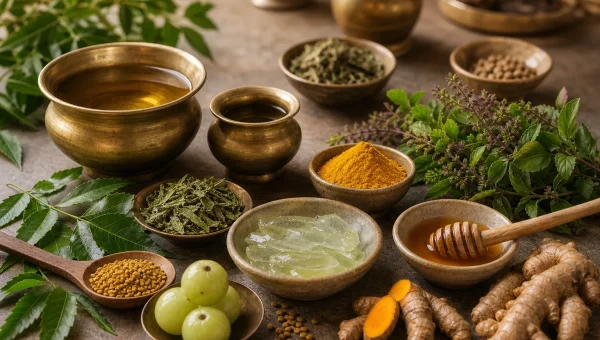
The main herbs in this protocol are chosen because Ayurveda classifies them as hair-supportive, nourishing, rejuvenative, or useful in classical hair oils and pastes. They are not all natural dyes. Nili gives a visible tint, while herbs such as bhringraj, amla, brahmi, sesame, and methi are better understood as scalp and hair-root supports.
Bhringraj (Eclipta alba/Eclipta prostrata): Bhringraj is one of Ayurveda’s central hair herbs and is traditionally known by names such as Kesharaja. The Ayurvedic Pharmacopoeia of India lists it as keshya and rasayana, and classical oil preparations such as Bhringaraja Taila, Bhringamalakadi Taila, and Nili Bhringadi Taila use this plant in hair care. Its listed taste profile is katu and tikta, with ruksha and tikshna qualities and ushna virya, so it is often balanced with amla, brahmi, coconut, yogurt, or other softer carriers for Pitta-prone scalps.
Amla or Amalaki (Emblica officinalis): Amla is the key cooling rasayana in this routine. Ayurveda describes it as tridoshajit, rasayana, and chakshushya, with shita virya and madhura vipaka. It is especially useful in Palitya routines where heat, acidity, irritability, late nights, or inflammatory scalp tendencies are present. Amla fruit also contains ascorbic acid, tannins, gallic acid, ellagic acid, and related polyphenols, which makes it a strong daily food-herb choice for oxidative stress patterns.
Brahmi (Bacopa monnieri): Brahmi is not a direct hair dye, but it is valuable in a Palitya protocol when stress, poor sleep, mental overwork, or heat in the head are part of the picture. The Ayurvedic Pharmacopoeia describes brahmi as medhya and rasayana, with shita virya. In masks, it pairs well with amla and bhringraj to make the application gentler for sensitive or Pitta-dominant scalps.
Tila or sesame (Sesamum indicum): Sesame seed and sesame oil are deeply valued in Ayurvedic hair care. The Ayurvedic Pharmacopoeia lists sesame seed with actions including keshya, kesha krishnakara, and kesha vardhaka, while sesame oil is listed as keshya, snehana, and vatahara. For Palitya, sesame is most useful when the hair is dry, rough, brittle, or undernourished. It should be understood as a nourishing oil and food support, not as a guaranteed way to push minerals through the scalp.
Methi or fenugreek (Trigonella foenum-graecum): Methi seeds become mucilaginous after soaking, which makes them useful in hair masks for slip, softness, and scalp comfort. Ayurveda lists methi as snigdha in quality and vatahara in action. In these recipes, methi helps the paste hold moisture and reduces the drying effect that powdered herbs can sometimes have.
Nili or indigo (Indigofera tinctoria): Nili is the herb in this protocol that can visibly darken light or grey strands. The Ayurvedic Pharmacopoeia lists Indigofera tinctoria leaf as keshya and notes indican among its constituents; Nili Bhringadi Taila is also listed among classical formulations. Use only pure hair-grade indigo leaf powder, not textile dye or black-henna mixtures. Always strand-test first, because indigo can leave a blue-black tint on grey or white hair.
Three Hair Mask Recipes for Palitya
Use these masks on a clean, healthy scalp and patch-test first behind the ear or on the inner arm. Do not apply herbal pastes to broken, infected, inflamed, or severely itchy skin. If a mask burns, stings, causes rash, or triggers headache or irritation, rinse it off immediately and discontinue it.
Recipe 1: The Bhringraj-Amla Base Mask
This is the core weekly mask for early Palitya where the goal is to combine a traditional keshya herb with a cooling rasayana. It is best for people whose scalp tolerates herbal powders well and whose greying is accompanied by heat, stress, dull hair, or thinning hair quality.
Ingredients: 2 tablespoons bhringraj powder or 4 tablespoons fresh bhringraj leaf paste; 2 tablespoons amla powder; 1 teaspoon sesame oil or coconut oil; 2-4 tablespoons plain yogurt, aloe gel, or rose water to make a smooth paste.
Mix the ingredients into a soft green-brown paste. Apply in sections to the scalp first, then spread lightly through the hair lengths. Cover with a shower cap or warm towel. Leave for 45-75 minutes, then rinse thoroughly with cool or lukewarm water. Use a mild shampoo only if needed. Repeat once weekly for at least three months before judging the routine.
Recipe 2: The Sesame-Methi Nourishing Mask
This mask is best when the hair feels dry, coarse, rough, or under-lubricated. Sesame provides the classical snehana and keshya base, while soaked methi gives a soft mucilaginous texture that helps the mask cling to the scalp without becoming harsh.
Ingredients: 2 tablespoons black sesame seeds soaked overnight and ground to a paste; 1 tablespoon methi seeds soaked overnight and ground to a paste; 1 tablespoon amla powder; 1 teaspoon bhringraj oil or sesame oil; enough warm water or aloe gel to adjust consistency.
Blend everything into a smooth paste. Apply to the scalp and dry hair lengths, especially areas that feel rough or brittle. Leave for 40-60 minutes. Rinse patiently, because sesame and methi can cling to the hair. Shampoo gently if residue remains. Use once weekly, or every 10 days if your scalp is oily.
Recipe 3: The Brahmi-Nili Keshya Tint Mask
This mask combines brahmi and amla for scalp support with nili for a temporary darkening effect on pale strands. It is useful when the reader wants both an Ayurvedic hair-care application and a mild cosmetic tint. Because indigo stains, this recipe should be used with gloves and a strand test.
Ingredients: 2 tablespoons brahmi powder; 1 tablespoon amla powder; 1-2 teaspoons pure hair-grade nili/indigo powder for a mild tint, or up to 1 tablespoon for stronger tinting; rose water or aloe gel to make a paste; 1 teaspoon coconut oil if the scalp is dry.
Mix brahmi and amla first with rose water or aloe gel, then add the indigo powder just before application. Apply to grey-prone areas or the full scalp. Leave for 45-75 minutes. Rinse well and avoid white towels, pillowcases, and clothing immediately after use. Repeat every two to three weeks, not daily.
| Mask | Ayurvedic Emphasis | Use Frequency | What to Expect |
|---|---|---|---|
| Bhringraj-Amla Base | Keshya support, rasayana support, Pitta-Vata balance with a suitable carrier | Weekly | Better scalp comfort and hair quality first; slowing of spread is judged over months |
| Sesame-Methi Nourishing | Snehana, Vata dryness support, hair softness and manageability | Weekly or every 10 days | Softness and reduced roughness may appear quickly; nourishment requires consistency |
| Brahmi-Nili Keshya Tint | Medhya-rasayana scalp care with nili-based tinting | Every 2-3 weeks | Immediate blue-black tint on light strands; scalp support depends on ongoing care |
The Internal Protocol: What You Take Matters As Much As What You Apply
Topical masks are only one part of Palitya care. Ayurveda treats premature greying as a deeper pattern involving heat, dryness, tissue nourishment, digestion, sleep, and mental strain. When greying appears early or accelerates suddenly, internal correction matters as much as the paste applied to the scalp.
Use amla consistently: Amla is the most reliable daily herb-food in this plan. Classical dosage ranges vary by form: fresh fruit, fresh juice, and dried powder are not interchangeable. A practical adult routine may use fresh amla in food, amla juice, or dried amla powder within traditional dosage ranges, adjusted for digestion and constitution. People with acidity, loose stools, medication use, pregnancy, or chronic illness should take practitioner guidance before using concentrated preparations.
Check B12, folate, ferritin, and thyroid status: Premature greying can overlap with low vitamin B12, low ferritin, folate issues, thyroid dysfunction, and other nutritional or systemic patterns. If levels are low, correction through food, supplements, or medicines should be done with a healthcare provider rather than guessed through hair masks. When iron deficiency is present, classical formulations such as Dhatri Lauha belong under qualified Ayurvedic supervision, not casual self-prescription.
Do not self-prescribe copper: Copper is relevant to melanin biology because tyrosinase is a copper-containing enzyme, but that does not mean everyone with grey hair needs copper supplements. Excess zinc intake can disturb copper balance, and unnecessary copper can be harmful. Use sesame as a nourishing food and oil within a balanced diet, and use lab-guided supplementation only when a clinician identifies a need.
Reduce the Pitta-Vata pattern around the hair root: The external protocol works better when daily routine supports it. Keep meals regular, avoid repeated late nights, reduce excessive heat exposure where possible, manage anger and overwork, and use gentle oiling rather than frequent harsh washing. For the complete Ayurvedic hair care framework including oil selection and dosha-specific routines, see our guide to Ayurvedic hair oiling by dosha.
Disclaimer: This article is for educational purposes only and does not replace professional medical advice. Consult a qualified Ayurvedic practitioner or healthcare provider before starting herbs, medicated oils, mineral preparations, iron or copper supplements, or any new health regimen, especially if you are pregnant, nursing, taking medication, or have a scalp condition.
References
- Ayushdhara (ayushdhara.in)
- Ayushdhara (ayushdhara.in)
- Age-induced hair greying – the multiple effects of oxidative stress (2013), PubMed
- Three Streams for the Mechanism of Hair Graying (2018), PubMed
- Premature Graying of Hair: Review with Updates (2018), PubMed Central
- Factors Associated with Premature Hair Graying in a Young Indian Population (2016), PubMed Central
- Ia800501 (ia800501.us.archive.org)
- Hair growth promoting activity of Eclipta alba in male albino rats (2008), PubMed
- Functional and Nutraceutical Significance of Amla (Phyllanthus emblica L.): A Review (2022), PubMed Central
- Ayurvedic Pharmacopoeia of India
- Health (health.ec.europa.eu)
- Histidine residues at the copper-binding site in human tyrosinase are essential for its catalytic activities (2020), PubMed Central
- Tyrosinases: a family of copper-containing metalloenzymes (2024), PubMed Central
- NCCIH
- FDA
Your explanation of melanocyte protection via antioxidant pathways finally explains why Amla works it’s not folklore, it’s radical scavenging.
Premature greying has genetic, nutritional, and thyroid components. Topical oil masks address none of the root causes in most cases.
For someone with seborrheic dermatitis, are any of these oil-based masks contraindicated?
the palitya mask recipes are useful but messy. bhringraj stains my towel every time, so a cleanup note would help.
The black sesame paste application is it rinsed off after 30 minutes or left overnight?
I rinse after 45 minutes — leaving sesame-based pastes overnight tends to block the scalp too long and I’d wake up with clogged follicles. Though I’ve seen people say overnight worked fine for them, so maybe skin type matters here.
Good to know.
The Bhringraj and Amalaki oil mask has slowed my premature greying noticeably. At 32 I was getting significant silver streaks but 4 months in the new growth is mostly dark.
I’ve been using Bhringraj oil religiously for 2 years for my greying and while my hair is in better condition I see no reduction in grey growth.
The Bhringraj oil should I prepare it fresh each week or can I store a large batch for a month?
ive been using Bhringraj oil religiously for 2 years for my greying and while my hair is in better condition I see no reduction in grey growth.
The bhringraj-amla mask sounds promising for early greying, especially with the weekly routine.
Can these masks help with stress-induced greying specifically or primarily constitutional greying?
Helpful. 🌿
For someone with seborrheic dermatitis, are any of these oil-based masks contraindicated? 🙌 नमस्ते
can you make a simple weekly hair mask plan? like which day amla, which day sesame oil, and when to skip if scalp is oily.
makes sense given what the article says about the Pitta component. 🌿
I wonder if the black sesame methi mask would be too heavy for fine hair.
once melanocytes in a hair follicle stop functioning, topical application of any herb cant restart melanogenesis. The results some report are likely Bhringraj’s hair conditioning darkening appearance rather than actual repigmentation.
Once melanocytes in a hair follicle stop functioning, topical application of any herb can’t restart melanogenesis. The results some report are likely Bhringraj’s hair conditioning darkening appearance rather than actual repigmentation.
Same here 🙏
For someone with seborrheic dermatitis, are any of these oil-based masks contraindicated? 🙌