
Ayurvedic Hair Color Alternatives: Henna, Indigo, and Herbal Dye Combinations
Herbal hair color works differently from salon dye. Instead of forcing a uniform shade in one sitting, henna and indigo build translucent plant color over the hair shaft. The result is slower, more gradual, and highly dependent on your starting color, the amount of gray, hair porosity, powder freshness, and application method. Used correctly, pure henna, indigo, amla, and supportive Ayurvedic herbs can give a useful range from copper and auburn to brown-black without relying on compound “black henna” products.
The practical key is to stop thinking of henna and indigo as a one-size-fits-all box dye. Henna gives the warm copper-red base. Indigo gives the cool blue-darkening element. Amla and a few supportive herbs can help with tone and hair feel, but they do not replace the main dye action of henna and indigo. A strand test is essential before every new brand, batch, ratio, or major color change.
The Core Three: Henna, Indigo, and Amla
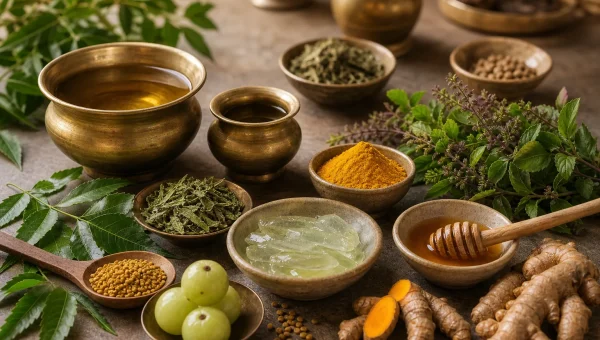
Most Ayurvedic herbal color routines are built around three ingredients: henna for the warm stain, indigo for darker brown-to-black results, and amla as a sour-astringent companion powder used in small amounts. These plant powders should be pure, clearly labeled by botanical name, and free from added PPD, synthetic dyes, metallic salts, or fragrance blends.
Henna (Lawsonia inermis) — Madayanti / Mehndi
Henna is the dried leaf of Lawsonia inermis. In Ayurveda it is known as Madayanti or Mehndi. Its principal coloring molecule is lawsone, which gives a red-orange stain and binds to keratin-rich surfaces such as hair, skin, and nails. In Ayurvedic classification, Madayanti is described as tikta-kashaya in rasa, laghu-ruksha in guna, shita in virya, katu in vipaka, and kapha-pitta shamaka in karma.
On white or gray hair, pure henna usually appears bright orange, copper, or auburn. On dark brown or black hair, it often appears as a warm reflection that is most visible in sunlight. Because henna is ruksha in Ayurvedic language and naturally astringent in feel, some dry or porous hair can feel stiff after application, especially when too much acid is added to the paste.
Indigo (Indigofera tinctoria) — Nili / Neel
Indigo is the dried leaf of Indigofera tinctoria, known in Ayurveda as Nili or Neel. The leaf contains indican, the precursor associated with indigo’s blue color. In Ayurvedic classification, Nili is katu-tikta in rasa, sara in guna, ushna in virya, katu in vipaka, and is counted among keshya herbs.
Indigo is the partner that turns henna from copper into brown, dark brown, black-brown, or soft black. Used by itself on white or gray hair, indigo can look blue, greenish, or ashy because it lacks henna’s warm base. For natural-looking dark shades, apply indigo after henna or mix freshly prepared indigo into a henna paste just before application.
Amla (Emblica officinalis / Phyllanthus emblica) — Amalaki
Amla, or Amalaki, is the fruit of Emblica officinalis, also listed as Phyllanthus emblica. It is not the main hair dye in this routine. The fruit is sour and astringent in taste and contains ascorbic acid and tannins. In herbal color recipes, small amounts of amla powder are commonly used with henna to make a brown recipe feel less sharply coppery and more balanced.
Amla should be used modestly. Too much added powder can dilute the amount of actual henna dye touching the hair. For most home recipes, 1–2 teaspoons of amla per 100 g henna is enough for a strand test. Very dry or brittle hair may prefer little or no added amla.
Shade Guide: Starting Ratios for Herbal Hair Color
The following ratios are starting points, not guaranteed formulas. Herbal color is affected by the natural hair color, percentage of gray, hair porosity, mineral buildup, old chemical dye, powder freshness, and timing. Always test the exact paste on a hidden strand or collected shed hair before applying it to the full head.
| Desired Shade | Henna | Indigo | Supportive Addition | Best Method |
|---|---|---|---|---|
| Copper / Auburn | 100% | None | Warm water or cooled black tea as liquid | Single step, 2–4 hours |
| Warm Chestnut | 70–80% | 20–30% | Optional small amla addition | One-step method, 2–3 hours |
| Light Brown | 60% | 40% | Optional small amla addition | One-step method; two-step if gray is resistant |
| Medium Brown | 50% | 50% | Fresh indigo added just before use | One-step for maintenance; two-step for first coverage |
| Dark Brown | Henna base first | Indigo second, 60–120 minutes | Amla only in the henna paste | Two-step preferred |
| Black-Brown / Soft Black | Henna base first | 100% indigo second, 1.5–3 hours | No acidic liquid in indigo paste | Two-step required |
Method 1: Two-Step Process for Dark Brown to Black-Brown
The two-step process gives the most dependable dark result because it first coats gray hair with henna’s warm copper base, then layers fresh indigo over that base. This is the best method for resistant gray hair, naturally dark hair, and anyone who wants dark brown, black-brown, or soft black rather than auburn.
Step 1: Henna Application
The first step prepares the hair to receive indigo. Do not judge the color after this step alone; gray hair will often look orange or copper before the indigo stage.
- Prepare the henna paste: Mix 100 g pure henna powder with warm water or cooled black tea to a thick yogurt-like consistency. Add 1–2 teaspoons amla powder if desired. Avoid using a large amount of lemon juice, especially if your scalp is sensitive or your hair is already dry.
- Rest the paste: Cover the bowl and let the paste sit for about 4–8 hours at room temperature, or follow the timing recommended for your specific powder. Warmer rooms release dye faster than cool rooms.
- Apply thoroughly: Apply to clean, product-free hair using gloves. Work in thin sections, saturating the roots first and then the lengths. Gray areas need generous paste coverage.
- Cover and wait: Cover the hair with a shower cap or wrap and leave the paste on for 2–4 hours. Longer timing usually gives a stronger henna stain, but very dry hair may not need the longest timing.
- Rinse with water: Rinse thoroughly with water only. The hair may look bright copper or orange at this stage. That is the expected base for the indigo step.
Step 2: Indigo Application
Indigo should be mixed fresh and applied promptly. Unlike henna, it should not be left overnight and should not be mixed with lemon juice or other acidic liquids.
- Prepare fresh indigo paste: Mix indigo powder with warm water until smooth and yogurt-like. Let it sit only briefly while you section the hair, then apply promptly.
- Apply over hennaed hair: Apply to damp hair after rinsing the henna. Cover all gray and orange areas carefully, using enough paste to fully coat the hair.
- Choose timing by shade: Leave on for about 45–90 minutes for brown, 90–120 minutes for dark brown, and up to 3 hours for deeper black-brown results. Strand testing is the safest guide.
- Rinse gently: Rinse with water only. Avoid shampoo for 24–48 hours so the final color can settle. After that, use a gentle cleanser.
Method 2: One-Step Premix for Light to Medium Brown
The one-step method is more convenient, but it is usually less powerful for darkening resistant gray. It works best when you want copper-brown, chestnut, light brown, or medium brown, or when you are maintaining a shade that has already been established with previous applications.
- Prepare henna paste first and let it rest as usual.
- Mix indigo separately with warm water just before application.
- Combine the fresh indigo paste into the rested henna paste according to your chosen ratio.
- Apply immediately to clean, product-free hair, working in thin sections.
- Leave on for 2–3 hours, then rinse thoroughly with water.
Important note: If your gray hair turns too coppery with the one-step method, do not keep adding random darkening powders. Use the two-step process instead: henna first, then fresh indigo.
Helpful Additions and What They Can Really Do
Additional herbs and liquids should support the core dye, not replace it. Henna and indigo provide the main durable hair color. Amla, tea, bhringaraj, and gentle cleansing herbs can influence tone, hair feel, and scalp comfort, but adding too many powders can weaken the dye result by diluting the henna and indigo.
For Warmer Tones
Warmth comes mainly from using more henna and less indigo. If you want copper, auburn, or chestnut, keep the formula henna-dominant and avoid leaving indigo on too long.
- More henna: Increases copper, auburn, and warm chestnut tones.
- Cooled black tea: Can be used as the mixing liquid for henna. It may add a temporary darker cast, but it does not replace henna’s lawsone stain.
- Hibiscus or beetroot: These can tint a paste cosmetically, but they are not dependable permanent gray-coverage dyes. Use only in small amounts after a strand test.
For Cooler or Darker Tones
Darker results come from correct indigo use, not from overloading the paste with many dark-colored herbs. For brown and black-brown shades, focus on fresh indigo, good saturation, and enough processing time.
- Indigo: The main cooling and darkening partner for henna. Increase indigo for darker browns, but use the two-step method when you want black-brown or soft black.
- Amla: Use a small amount in the henna paste when you want a less fiery copper base. Do not add large amounts, because it can dilute the henna.
- Bhringaraj (Eclipta alba): Bhringaraj is classically keshya and appears in traditional hair-oil formulations. It is a supportive hair herb, not a replacement for indigo. Use modestly if you like it, such as 1 teaspoon to 1 tablespoon per 100 g henna, and strand test first.
For Better Hair Feel During and After Coloring
Because henna and amla can feel astringent, dry or porous hair often needs thoughtful aftercare. For the strongest color uptake, keep the dye paste simple and avoid adding heavy oils or conditioners directly before coloring.
- Keep the dye paste clean: Use henna, indigo, water or tea, and small amounts of amla or bhringaraj. Heavy oils, conditioners, and creamy foods can reduce how evenly the plant dye contacts the hair.
- Condition after the color settles: If hair feels stiff, use a simple conditioner or a light oil treatment after 24–48 hours rather than immediately after rinsing.
- Use gentle cleansers: Shikakai and reetha are traditional plant cleansers; reetha is rich in saponins, and shikakai pods are used as a natural hair-cleansing material. Use them gently and avoid scrubbing freshly colored hair.
A Reliable Dark Brown Recipe for Naturally Dark Hair With Scattered Grays
This recipe is a practical starting point for naturally black or dark brown hair with visible gray strands. It aims for dark brown to brown-black rather than a flat artificial black. Adjust quantities based on hair length and thickness, and always strand test before full application.
Night Before
Mix 100 g pure henna powder with warm water or cooled black tea to a thick yogurt-like paste. Add 1–2 teaspoons amla powder if your hair tolerates it. If desired, add 1 teaspoon to 1 tablespoon bhringaraj powder as a supportive hair herb. Cover and rest the paste for 4–8 hours, depending on room temperature and powder instructions.
Application Day
Apply the henna paste to clean, product-free hair in thin sections. Cover and leave for about 3 hours, then rinse thoroughly with water only. After rinsing, mix 100–120 g indigo powder with warm water and apply immediately to the damp hennaed hair. Leave for 90–120 minutes for dark brown, or longer only after a successful strand test.
Expected Result
On naturally dark hair with scattered grays, this process usually gives a rich dark brown to black-brown result. The gray hairs may remain slightly warmer than the rest of the hair, which often creates a natural highlighted effect. Root touch-ups are usually easier than full-head applications once the base color is established.
Common Mistakes and How to Avoid Them
Most disappointing results come from old powder, poor saturation, skipping the henna base, using indigo too late after mixing, or expecting plant dye to behave like chemical dye. These fixes keep the process predictable.
| Mistake | Why It Happens | How to Fix or Avoid It |
|---|---|---|
| Hair looks green, blue, or ashy | Indigo was used without enough henna underneath, or the formula was too indigo-heavy for the hair | Apply henna first to rebuild warmth, then use indigo more carefully in a second step |
| Hair is too orange | Henna worked, but indigo was insufficient, weak, old, or left on too briefly | Repeat only the indigo step on the next day, or switch to the two-step method for future applications |
| Patchy gray coverage | Paste was too thin, sections were too thick, or gray roots were not fully saturated | Use more paste, section hair finely, apply roots first, and press paste into resistant gray areas |
| Dry or stiff hair after coloring | Henna and amla can feel astringent, and too much lemon juice or overly long timing can increase dryness | Use less acid, reduce added amla, rinse gently, and condition after the color has settled for 24–48 hours |
| Color fades or washes out quickly | Hair had buildup, indigo was old, shampoo was used too soon, or the paste did not stay moist long enough | Start with clean product-free hair, use fresh powders, keep paste moist during processing, and wait before shampooing |
| Color becomes darker than expected | Indigo-heavy formulas can continue to deepen as the color settles | Use strand tests, shorten indigo timing, and avoid repeated full-head indigo applications on already-dark lengths |
Ayurvedic Hair Care Between Color Sessions
Between coloring sessions, the goal is to keep the scalp comfortable, the hair flexible, and the color even. Herbal dye does not need to be repeated on the full length every time; root-only touch-ups are often enough once the desired shade is built.
- Wash gently: Use a mild cleanser after the first 24–48 hours. Shikakai and reetha can be used as traditional cleansing herbs, but freshly colored hair should not be scrubbed aggressively.
- Oil before washing, not before dyeing: A light oil treatment before a wash can improve hair feel, but heavy oil immediately before coloring can interfere with even dye contact.
- Refresh roots first: Apply henna and indigo mainly to new gray growth. Repeatedly applying indigo to already-dark lengths can make the ends too dark.
- Use internal herbs only with guidance: If graying or hair fall is sudden, severe, or accompanied by fatigue, scalp disease, illness, or nutritional concerns, consult a qualified Ayurvedic practitioner or healthcare provider before taking internal herbs.
Transitioning from Chemical Dye to Herbal Color
Switching from chemical dye to henna and indigo is possible, but it should be done gradually and carefully. Old chemical color, bleach, relaxers, and heat damage can make the first herbal result uneven, so strand testing is not optional.
- Wait until the scalp is calm: If you recently used chemical dye, bleach, relaxer, or perming products, wait until any irritation has fully settled. When possible, allow 2–4 weeks before the first herbal application.
- Strand test first: Test the exact formula on a hidden section or collected shed hair. Check the result after rinsing and again after 24–48 hours.
- Avoid compound henna: Use only pure plant powders with clear ingredient labels. Avoid “black henna” and any powder that does not disclose its full ingredients.
- Expect buildable color: The first application may look warmer than the final routine. Darker shades often become more even after the method and timing are adjusted.
- Plan before going very dark: Henna and indigo are long-lasting on hair. Going lighter afterward can be difficult and unpredictable.
Safety Notes
Natural does not automatically mean risk-free. Pure henna and indigo are very different from compound “black henna” products, and every new powder should be tested before full application.
- Use pure, clearly labeled powders: Choose henna labeled Lawsonia inermis and indigo labeled Indigofera tinctoria. Avoid “black henna,” “instant henna,” and unlabeled blends.
- Be cautious with PPD: Some black henna products may contain para-phenylenediamine (PPD), a strong allergen associated with serious skin reactions.
- Patch test and strand test: Patch test each herb paste on a small area of skin before first use, and strand test for color before applying to the full head.
- Protect the eyes and skin: Wear gloves, protect clothing and surfaces, and rinse immediately if paste enters the eyes.
- Pregnancy, breastfeeding, allergies, or scalp disease: Consult a qualified healthcare provider, dermatologist, or Ayurvedic practitioner before using herbal hair color if you are pregnant, breastfeeding, allergy-prone, or dealing with scalp inflammation, eczema, psoriasis, wounds, or unexplained hair loss.
Medical Disclaimer: This article provides general guidance on herbal hair coloring based on traditional Ayurvedic usage and practical cosmetic application. It is not a diagnosis or medical treatment plan. Discontinue use if you develop burning, swelling, rash, blistering, breathing difficulty, or any allergic reaction, and seek medical care promptly.
References
- Ayurvedic Pharmacopoeia of India
- Nhm (nhm.ac.uk)
- Ayurvedic Pharmacopoeia of India
- Recent Advancements in Natural Plant Colorants Used for Hair Dye Applications: A Review (2022), PubMed
- Ayurvedic Pharmacopoeia of India
- Jaims (jaims.in)
- Natural alternatives from your garden for hair care: Revisiting the benefits of tropical herbs (2023), PubMed Central
- Healthline (healthline.com)
- FDA
- Dermnetnz (dermnetnz.org)
590885 846707Glad to be 1 of several visitants on this wonderful internet web site : D. 2420
Trying this next week.
Worth trying for a month at least before giving up
thanks for sharing that, useful to know
i think it depends on your constitution tbh
yes but results vary a lot from person to person
i had the same question
does this protocol change during monsoon season? ive heard Ayurvedic timing is seasonal
@Kiran i had the same question
good point
After switching to henna and indigo I noticed my hair felt noticeably thicker over a few months — the chemical dye was doing more damage than I realized. The conditioning effect alone made it worth continuing.
the article would be stronger with a clear ‘when to see a doctor’ section. some of these conditions need medical clearance.
@Anna My practitioner said something similar
is this appropriate for elderly patients above 70 or should the dosages be reduced
same experience here actually
Totally understand the curiosity about fatigue, but if you have gray coverage concerns this post is genuinely useful. The two-step henna-indigo method described here gives much better coverage than I expected without any chemical processing.
what’s the shelf life of the prepared henna paste if kept in fridge ❤️
From what I have found, about 48 hours is the practical limit in the fridge before dye release starts dropping off noticeably. I freeze individual portions in silicone molds now and thaw as needed — holds quality much longer that way. ❤️
does the indigo ratio change if you want lighter brown vs dark black? article doesnt specify
the cold infusion method for hibiscus rinse works better than boiling, preserves more of the anthocyanins.
Good to know about the anthocyanins — I had been boiling mine. Do you steep at room temperature for a set number of hours or go by color? Curious whether overnight in the fridge works or if it needs to be a warm cold infusion.
respectfully, most of these claims need larger RCTs before we can say they’re validated. ✨
shared this with my Ayurveda practitioner and she confirmed the approach is sound.
Thanks!
For the henna specifically, or the indigo as well? I have been using a Rajasthani supplier for the henna and a separate one for indigo — keeping them separate for the two-step process seems to matter a lot for the final color depth.
u mention this is safe but what about drug interactions with common meds like bp tablets
can someone with a strong Pitta constitution follow this or are modifications needed
finally an article that explains the classical text basis rather than just listing herbs.
not disputing Ayurveda has value but articles like this sometimes overstate efficacy.
have u tried adjusting the dose
can someone with a strong Pitta constitution follow this or r modifications needed
Good point, the article doesn’t address that
what’s the shelf life of the prepared henna paste if kept in fridge
tried a similar protocol 6 months back. results were modest at best and I was consistent.
Helpful.
what’s the source text for this recommendation Charaka Samhita or Ashtanga Hridayam
does the indigo ratio change if you want lighter brown vs dark black? article doesn’t specify
@reply Worth trying for a month at least before giving up
the color results with herbal dyes are unpredictable. got green tones first time I tried indigo without enough henna base.
what’s the shelf life of the preprd henna paste if kept in fridge
usually about 2-3 days in the fridge before it starts to lose dye release. some people say up to 5 days if you cover it tightly, but I find the color gets weaker after day 3.
@reply that makes sense for a lot of things but shelf life is more about the dye release oxidizing over time than anything dosha-related — even the freshest paste loses potency once it’s mixed with liquid.
I find the dosage guidance vague. ‘appropriate amount’ is not helpful for someone measuring at home.
very practical protocol. tried a modified version for a week and already feeling a difference.
henna + indigo combo I’ve been using for 2 years. zero damage, hair is actually healthier than when I used chemical dye.
how long do you wait between henna and indigo application? article says 8-12 hours but I’ve read 24h elsewhere
how long do you wait between henna and indigo application? article says 8-12 hours but ive read 24h elsewhere नमस्ते
After years of chemical dye I finally tried henna and indigo on my gray strands and noticed my hair felt softer right after the first rinse.
is there a simplified version for beginners who dont have access to all these herbs
henna makes my scalp itch badly even with amla added. not everyone tolerates it.
can the herbal rinse recipe work for color-treated hair or will it strip the dye
not disputing Ayurveda has value but articles like this sometimes overstate efficacy. ❤️
what’s the shelf life of the prepared henna paste if kept in fridge 🙏
respectfully, most of these claims need larger RCTs before we can say they’re validated.
the bhringraj oil prep you described in the conditioning section transformed my hair texture within a month.
My practitioner said something similar
how long before results become noticeable with this protocol? my patience has limits tbh
is this appropriate for elderly patients above 70 or should the dosages be reduced ✨
does this protocol change during monsoon season? ive heard Ayurvedic timing is seasonal ❤️
henna + indigo combo ive been using for 2 years. zero damage, hair is actually healthier than when I used chemical dye. 🙏
been using henna for about two years now and the one thing I wish someone had warned me about is how differently it grabs on bleached or chemically treated hair vs. virgin hair. the color can go quite brassy. anyone dealt with that?
Henna alone gave me a bright orange tint on my white hairs which faded to a softer copper after a couple of washes.
great to see peer-reviewed studies referenced alongside classical texts. makes it easier to trust.