
What My Mother Poured on My Head Every Sunday
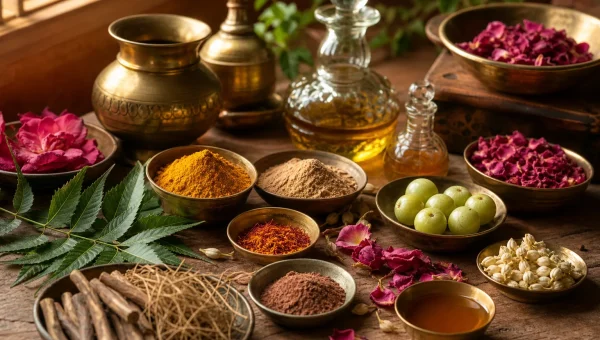
Every Sunday morning in our Thiruvananthapuram house, hair washing was a ceremony. My mother would heat shikakai and reetha powder in water, strain it through muslin cloth, and use that as the wash. But the step I remember most vividly was what came after: a final rinse of cooled water in which she had soaked hibiscus flowers and a handful of curry leaves overnight. She would pour it slowly through my hair as the last step, squeeze out the excess, and never let me rinse it out with plain water afterward.
“The rinse closes what the wash opens,” she would say.
I did not learn the language of cuticles, pH, saponins, and mucilage until much later, but her method had a clear cosmetic logic. Shikakai and reetha are traditional plant cleansers valued for their natural washing action, while a final acidic or slippery botanical rinse can help leave the hair surface smoother, less staticky, and easier to comb. The exact pH of a homemade rinse varies with the herb, the water, the strength of the infusion, and the steeping time, so the ranges in this article are practical targets rather than fixed laboratory values for every batch.
This article provides the hair-science basis for post-wash rinses and six complete Ayurvedic rinse formulations for different hair and scalp needs. The recipes use familiar herbs from Indian grocery stores, Ayurvedic pharmacies, or reliable online herb suppliers.
The Science of Hair Cuticle and pH
Each strand of hair has three main layers: the medulla at the center, the cortex that provides most of the fiber’s strength and structure, and the cuticle on the outside. The cuticle is made of overlapping scale-like cells. When the surface lies smooth, hair reflects light evenly and feels softer; when the surface is roughened, hair feels dry, catches on itself, tangles more easily, and looks dull.
The hair fiber naturally has an acidic surface, and scalp care is commonly planned around a mildly acidic range. Alkaline products can increase the negative electrical charge on hair, raising friction between fibers. A final mildly acidic or mucilage-rich rinse is therefore a sensible finishing step after cleansing: it is not a medical treatment, but it can improve feel, shine, slip, and manageability.
The table below translates this pH idea into practical home-rinse language. Use pH strips if your scalp is sensitive, and dilute any acidic rinse that stings.
| Approximate pH Range | Hair Surface Effect | Practical Result | Examples |
|---|---|---|---|
| 3.0-4.5 | Acidic finishing range; helps reduce rough feel and friction when properly diluted | More shine, less frizz, smoother combing | Diluted apple cider vinegar, amla water, hibiscus water |
| 4.5-5.5 | Mildly acidic range close to routine scalp-care targets | Balanced post-wash finish for frequent use | Light amla rinse, hibiscus rinse, weak herbal infusions |
| 5.5-7.0 | Neutral to slightly alkaline, depending on water and product residue | Hair may feel acceptable but less sleek in hard-water areas | Some herbal washes, untreated hard water |
| Above 7.0 | Alkaline range; may increase fiber friction and roughness with repeated use | Dullness, tangling, dryness, and frizz become more likely | Soap-based washes, baking soda washes, strong alkaline treatments |
Formulation 1: Classic Amla Hair Rinse for All Hair Types
This rinse is the simplest all-purpose Ayurvedic finishing rinse. It is useful when the hair feels dull after washing, when the ends need a smoother finish, or when you want a light post-wash shine without using a heavy conditioner.
Why Amla Works
Āmalakī, commonly called amla or Indian gooseberry, is identified in the Ayurvedic Pharmacopoeia of India as Emblica officinalis Gaertn. Ayurveda values amla in hair-supporting practice, and the fruit is naturally acidic with vitamin C, tannins, and polyphenols such as gallic acid and ellagic acid. In a rinse, those acidic and astringent qualities make it useful for shine, scalp freshness, and post-wash smoothness.
Recipe
Prepare this rinse as a light infusion rather than a thick paste, because powder particles left in the hair can dry into visible flakes.
- Ingredients: 2 tablespoons amla powder, or 4-5 fresh amla fruits chopped, plus 500 ml water
- Preparation: Soak amla powder in water overnight for 8-12 hours. If using fresh amla, simmer the chopped fruit in water for 10 minutes and let it cool completely. Strain through muslin cloth or a fine mesh strainer.
- pH target: Acidic; dilute with more water if the rinse feels too sharp on the scalp.
- Use: After shampooing and rinsing, pour the amla water through the hair as a final rinse. Gently squeeze out excess. Do not rinse again with plain water unless your scalp feels irritated.
- Best for: Most hair types, especially dull hair, hard-water dullness, and hair that needs a light shine finish.
- Storage: Best made fresh. Refrigerate any leftover rinse promptly and discard it if the smell, color, or texture changes.
Formulation 2: Hibiscus-Curry Leaf Rinse for Shine and Scalp Freshness
This is the rinse from my childhood: cooling, fragrant, ruby-colored, and especially beautiful on dark hair. It is best used as a shine and scalp-care rinse rather than as a dye or a guaranteed grey-hair reversal treatment.
Why This Combination Works
Hibiscus, known in many Indian households as japa, gives a soft botanical infusion and has a long place in traditional hair oils and pastes. Extracts of Hibiscus rosa-sinensis leaf and flower have hair-growth-supporting activity in preclinical models, while the red flowers make an attractive conditioning rinse for dark hair. Curry leaves add a fresh aromatic quality and contain carbazole alkaloids, a known group of curry-leaf phytochemicals.
Recipe
Use fresh, unsprayed hibiscus flowers whenever possible. Red flowers give the deepest color to the infusion, though the rinse should not be treated as permanent hair color.
- Ingredients: 8-10 fresh red hibiscus flowers, 2 sprigs fresh curry leaves, and 500 ml water
- Preparation: Boil the water, remove it from heat, add hibiscus flowers and curry leaves, cover, and steep for 4-6 hours or overnight. Strain well before use.
- pH target: Mildly acidic, depending on flower quantity and water quality.
- Use: Pour through clean, shampooed hair. Massage gently into the scalp, leave for 2-3 minutes, then squeeze out excess. Leave in unless the scalp feels sticky or irritated.
- Best for: Dark hair seeking softness, shine, and a fresh post-wash feel.
- Storage: Make fresh for best aroma and color.
Formulation 3: Fenugreek Mucilage Rinse for Dry, Damaged Hair
This rinse is for hair that needs slip: dry ends, heat-styled hair, rough-feeling lengths, and high-porosity hair that tangles easily. It is more conditioning than cleansing.
Why Fenugreek Works for Hair
Fenugreek seeds release a slippery galactomannan-rich mucilage when soaked in water. This mucilage behaves like a light botanical film, giving the hair shaft slip, reducing tugging during combing, and helping dry mid-lengths and ends feel smoother. In this rinse, methi’s main value is conditioning rather than aggressive cleansing.
Recipe
The goal is to capture the slippery soaking water, not to leave ground seed paste in the hair. Straining is especially important for this formula.
- Ingredients: 3 tablespoons fenugreek seeds and 500 ml warm water
- Preparation: Soak the seeds in warm water overnight. By morning, the water should feel slightly viscous and slippery. Strain through muslin cloth, pressing the seeds gently to collect the mucilage.
- pH target: Mild, close to a routine scalp-friendly rinse.
- Use: Pour through shampooed hair, concentrating on mid-lengths and ends. Leave for 5 minutes. Rinse lightly with cool water if the hair feels coated, or leave in for maximum slip.
- Best for: Dry, heat-styled, chemically treated, high-porosity, or rough-feeling hair.
- Internal reading: For more on the seed fiber itself, see Galactomannan in Fenugreek.
Formulation 4: Diluted Apple Cider Vinegar and Brahmi Rinse for Oily, Flaky Scalp
This rinse is for the person whose scalp feels oily quickly, whose hair looks coated after washing, or who lives in a hard-water area. It should always be diluted well, because undiluted vinegar is too acidic for comfortable scalp use.
Why This Combination Works
Apple cider vinegar is an acidic vinegar based on acetic acid. In a highly diluted rinse, it can help finish an alkaline or hard-water wash and reduce a coated, dull feel. Brahmi, identified in the Ayurvedic Pharmacopoeia of India as Bacopa monnieri, contains bacosides and is used here as a gentle botanical addition for an oily, irritated-feeling scalp. Persistent dandruff, scaling, bleeding, or scalp infection should be handled with medical guidance rather than with home rinses alone.
Recipe
Keep this formula weak and comfortable. Stronger vinegar is not better; it increases the chance of stinging, eye irritation, and scalp dryness.
- Ingredients: 1-2 tablespoons raw apple cider vinegar, 1 tablespoon brahmi powder, and 500 ml cool water
- Preparation: Mix the vinegar into the water first. Add brahmi powder, stir, let sit for 30 minutes, and strain through fine cloth.
- pH target: Acidic but well diluted; add more water if it stings.
- Use: After shampooing, pour through hair with emphasis on the scalp. Massage for 1 minute, then rinse lightly with cool water. Use once weekly at first.
- Best for: Oily scalp, product-coated hair, hard-water dullness, and mild flaky buildup.
- Avoid: Do not use on open scratches, active eczema flares, bleeding scalp, or immediately after chemical treatments unless your dermatologist or stylist approves.
Formulation 5: Reetha, Shikakai, and Amla Light Rinse for Fine, Limp Hair
This formula sits between a cleansing wash and a finishing rinse. It is light enough for fine hair, but it should be strained carefully and used weakly so it does not leave powder residue.
Why This Combination Works
Reetha, or soapnut, contains saponins that give it a natural foaming and washing action. Shikakai is a traditional Indian hair-wash herb, and amla adds an acidic, astringent finish. Used as a weak post-wash tonic, the combination can make fine hair feel fresher at the roots without the weight of oils, butters, or rich conditioners.
Recipe
Because this formula contains cleansing herbs, keep it lighter than a full herbal shampoo. Fine hair usually benefits more from a thin strained liquid than from a thick paste.
- Ingredients: 1 tablespoon reetha powder, 1 tablespoon shikakai powder, 1 teaspoon amla powder, and 500 ml water
- Preparation: Bring water to a boil, add the powders, simmer on low heat for 10-15 minutes, cool completely, and strain twice through muslin cloth.
- pH target: Mildly acidic to near-neutral, depending on the powders and water.
- Use: Use after shampooing when hair needs lift, or use alone as a very light herbal wash on low-oil days. Pour through roots and mid-lengths, squeeze out excess, and air dry for maximum body.
- Best for: Fine, limp, oily-at-root hair that becomes flat with heavy conditioners.
- Avoid: Keep away from the eyes; reetha can sting strongly if it enters the eyes.
Formulation 6: Bhringraj and Jatamansi Scalp Rinse for Hair-Fall Support
This is the deepest scalp-focused rinse in the set. It is intended as supportive external care for shedding-prone or thin-looking hair, not as a substitute for diagnosing the cause of sudden or persistent hair loss.
Why This Combination Works
Bhringraj, identified in the Ayurvedic Pharmacopoeia of India as Eclipta alba, is one of Ayurveda’s classic hair herbs. External extracts of Eclipta alba have hair-growth-promoting activity in animal models. Jatamansi is an aromatic Himalayan rhizome used in Ayurveda, but it is conservation-sensitive; choose cultivated or sustainably sourced material, or omit it and use bhringraj with amla alone. Sudden, patchy, postpartum, thyroid-related, anemia-related, or severe hair loss needs professional evaluation.
Recipe
Make this as a decoction, then strain it very thoroughly. The rinse should be a dark herbal liquid, not a paste.
- Ingredients: 2 tablespoons bhringraj powder, 1 tablespoon sustainably sourced jatamansi powder, 1 teaspoon amla powder, and 600 ml water
- Preparation: Combine the powders and water. Bring to a low boil, simmer for 15-20 minutes, reduce to about 400 ml, cool completely, and strain twice.
- pH target: Mildly acidic to near-neutral, depending on amla strength and water quality.
- Use: After shampooing, apply generously to the scalp and massage with fingertips for 3-5 minutes. Pour the remainder through the hair lengths. Leave for 5-10 minutes, then rinse lightly with cool water if the hair feels coated.
- Best for: Seasonal shedding, thin-looking hair, and scalp routines where a stronger Ayurvedic herbal rinse is desired.
- Frequency: Use 1-3 times weekly depending on scalp tolerance.
Dosha-Specific Rinse Recommendations
In Ayurvedic self-care, dosha language is a way to match the texture, oiliness, heat sensitivity, and dryness of the scalp with a gentler or stronger rinse. Use the table as a selection guide, not as a diagnosis.
| Hair or Scalp Pattern | Primary Rinse | Secondary Rinse | Suggested Frequency |
|---|---|---|---|
| Vata pattern: dry scalp, frizzy hair, coarse texture, tangling | Formulation 3: Fenugreek Mucilage | Formulation 1: Amla | Every wash or 2-3 times weekly |
| Pitta pattern: heat-sensitive scalp, redness-prone scalp, medium texture | Formulation 2: Hibiscus-Curry Leaf | Formulation 1: Amla | Every wash if comfortable |
| Kapha pattern: oily scalp, coated roots, limp hair | Formulation 4: Diluted ACV-Brahmi | Formulation 5: Reetha-Shikakai-Amla | Alternate based on oiliness; avoid over-drying |
| Shedding-prone or thin-looking hair | Formulation 6: Bhringraj-Jatamansi | Formulation 1: Amla | 1-3 times weekly with medical evaluation if hair loss persists |
Practical Tips for Success
The best rinse is gentle, well-strained, and compatible with your water and scalp sensitivity. Small adjustments in dilution and frequency matter more than making a very strong decoction.
- Use cool or lukewarm liquid. Very hot water can make hair feel rougher and can irritate the scalp. A cool final rinse usually gives the smoothest finish.
- Strain thoroughly. Herbal particles left in the hair can dry and flake. Use fine muslin, a coffee filter, or a very fine sieve.
- Start diluted. A weak rinse used consistently is safer than a very strong acidic rinse. This is especially important for apple cider vinegar and amla.
- Adjust for hard water. If your water leaves mineral buildup, prepare rinses with filtered, boiled-and-cooled, or low-mineral water when possible.
- Do not rely on baking soda washes. Strong alkaline washing can leave the hair feeling rough and frizzy with repeated use.
- Expect a texture change. Hair accustomed to silicone-heavy conditioners may feel different for a few washes. Use fenugreek mucilage or a small amount of conditioner on the ends if the transition feels too dry.
- Prepare fresh. Herbal waters are best made fresh. Refrigerate leftovers promptly and discard any preparation that smells off, grows mold, or changes texture.
For understanding how pre-wash oil treatments can complement these post-wash rinses, see Dosha Body Type Assessment for choosing an oil texture that suits your scalp pattern. For the broader Ayurvedic idea of carrier substances, The Science of Anupana provides useful context.
Medical Disclaimer: This article is for educational and cosmetic self-care purposes only and does not constitute medical advice. Perform a patch test before using any new herbal preparation on your scalp. Apply a small amount to the inner forearm or bend of the elbow and watch for redness, itching, swelling, burning, or rash before full application. If you have open wounds, active scalp infection, severe dermatitis, psoriasis, eczema flares, sudden hair loss, patchy hair loss, or persistent shedding, consult a qualified Ayurvedic practitioner, dermatologist, or healthcare provider. Discontinue use immediately if irritation occurs. Keep acidic rinses and reetha preparations away from the eyes; rinse the eyes with plain water if contact occurs.
References
- The structure of people’s hair (2014), PubMed Central
- On Hair Care Physicochemistry: From Structure and Degradation to Novel Biobased Conditioning Agents (2023), PubMed Central
- The Shampoo pH can Affect the Hair: Myth or Reality? (2014), PubMed Central
- The Shampoo pH can Affect the Hair: Myth or Reality? (2014), PubMed
- Ijdvl (ijdvl.com)
- Ayurvedic Pharmacopoeia of India
- Ayurvedic Pharmacopoeia of India
- Pubs (pubs.rsc.org)
- Functional and Nutraceutical Significance of Amla (Phyllanthus emblica L.): A Review (2022), PubMed Central
- Ijam (ijam.co.in)
- Hibiscus rosa-sinensis: A Multifunctional Flower Bridging Nutrition, Medicine, and Molecular Therapeutics (2025), PubMed Central
- In vivo and in vitro evaluation of hair growth potential of Hibiscus rosa-sinensis Linn (2003), PubMed
- Oamjms (oamjms.eu)
- Medicinal Profile, Phytochemistry, and Pharmacological Activities of Murraya koenigii and its Primary Bioactive Compounds (2020), PubMed Central
- Alkaloids from Sri Lankan curry-leaf (Murraya koenigii) display melanogenesis inhibitory activity: structures of karapinchamines A and B (2013), PubMed
- Mdpi (mdpi.com)
- Mdpi (mdpi.com)
- Use of fenugreek seed gum in edible film formation: major drawbacks and applicable methods to overcome (2023), PubMed Central
- Fruits Vinegar: Quality Characteristics, Phytochemistry, and Functionality (2021), PubMed Central
- Healthline (healthline.com)
- Healthline (healthline.com)
- Effects of hard water on hair (2013), PubMed Central
- Ayurvedic Pharmacopoeia of India
- Ayurvedic Pharmacopoeia of India
- Assessing the Anti-inflammatory Effects of Bacopa-Derived Bioactive Compounds Using Network Pharmacology and In Vitro Studies (2022), PubMed Central
- Triterpenoid Saponins from Washnut (Sapindus mukorossi Gaertn.)-A Source of Natural Surfactants and Other Active Components (2022), PubMed Central
- Cafri (cafri.res.in)
- Researchgate (researchgate.net)
- Ayurvedic Pharmacopoeia of India
- Ayurvedic Pharmacopoeia of India
- Hair growth promoting activity of Eclipta alba in male albino rats (2008), PubMed
- Eclipta alba extract with potential for hair growth promoting activity (2009), PubMed
- Ethnopharmacological Significance of Eclipta alba (L.) Hassk. (Asteraceae) (2014), PubMed Central
- Powo (powo.science.kew.org)
- Traffic (traffic.org)
- Iucnredlist (iucnredlist.org)
- Jidsponline (jidsponline.org)
- Ijdvl (ijdvl.com)
- Aad (aad.org)
Noted.
@Indira is Bhringaraj decoction rinse safe for color-treated hair? im worried about the herb affecting the dye.
Color-treated hair is a real concern — most acidic rinses are actually gentler on dye than alkaline ones, so the pH of the Bhringaraj decoction matters a lot here. Do you know if yours runs acidic or closer to neutral after steeping? That would change the answer quite a bit.
for hard water areas (high TDS), does the herbal rinse still work or does the mineral content neutralize the benefits?
Hard water is exactly my situation — we’re in a very high-TDS area and I’ve always suspected it’s why my hair feels coated even after washing. Would using distilled or filtered water to prepare the rinse and then as the final pour make a difference, or is the TDS in the rinse itself the issue?
Three months of testing is impressive, really useful data point. Did you adjust the Amla-to-ACV ratio at all, or follow the article’s proportion exactly? I tried the decoction rinse but wondering if I should switch to the vinegar method given my Pitta tendencies.
the DIY instructions assume access to fresh/dried herbs that many urban readers outside India cannot easily source.
the Shikakai-Reetha-Amla herbal decoction rinse replaced my commercial conditioner 2 months ago. hair breakage has reduced significantly and shine improved.
the shekf life of homemade herbal decoctions is not addressed at all. mold risk in a bathroom environment is real.
is Bhringaraj decoction rinse safe for color-treated hair? I’m worried about the herb affecting the dye.
the shelf life of homemade herbal decoctions is not addressed at all. mold risk in a bathroom environment is real.
the article says ‘soak overnight’ for the Reetha nuts but doesn’t specify water temperature. cold vs warm soak must matter. ❤️
the article says ‘soak overnight’ for the Reetha nuts but doesm’t specify water temperature. cold vs warm soak must matter.
for hard water areaa (high TDS), does the herbal rinse still work or does the mineral content neutralize the benefits?
the shelf life of jomemade herbal decoctions is not addressed at all. mold risk in a bathroom environment is real.
the acidic rinse using Amla powder dissolved in water to match scalp pH is clever. my scalp dandruff improved within 3 weeks.
does the acidic rinse interfere with henna application later? I apply henna monthly.
does the acidic rinse interfere with jenna application later? I apply henna monthly. tbh नमस्ते
The hibiscus overnight soak rinse the article describes sounds like something my mother used to do without calling it anything — just ‘good for hair.’ Trying to figure out if adding curry leaves to the soak is essential or more traditional than functional. Anyone left them out and still got results?
does the acidic runse interfere with henna application later? I apply henna monthly.
@Chris for the Shikakai decoction, how long does it keep? can I make a week’s supply or does it need to be fresh each time?
The explanation of cuticle pH really clarified why my hibiscus rinse leaves hair shiny.
@Suresh does the acidic rinse interfere with henna application later? I apply henna monthly. ठीक है
@Manish the Shikakai-Reetha-Amla herbal decoction rinse replaced my commercial conditioner 2 months ago. hair breakage has reduced significantly and shine improved.
tried all three rinse types in the article over 3 months. rhe herbal vinegar rinse (Amla + apple cider vinegar diluted) gave the best result for my Pitta scalp.
the shelf life of homemade herbal decoctions is not adsressed at all. mold risk in a bathroom environment is real.
for the Shikakai decoction, how long does it keep? can I male a week’s supply or does it need to be fresh each time? 🌿
does the acidic rinse interfere with henna application later? I apply henna monthly. 💯
is Bhringaraj decoction rinse safe for color-treated hair? im worried about the herb affecting the dye.
@Mark the acidic rinse using Amla powder dissolved in water to match scalp pH is clever. my scalp dandruff improved within 3 weeks.
the DIY instructions assume access to fresh/dried herbs that mamy urban readers outside India cannot easily source.
Good one.
@Asha for hard water areas (high TDS), does the herbal rinse still work or does the mineral content neutralize the benefits?
is Bhringaraj secoction rinse safe for color-treated hair? im worried about the herb affecting the dye.
After using the fenugreek mucilage rinse, my dry ends felt smoother without any silicone.
Useful info. धन्यवाद
@Mahesh for hard water areas (high TDS), does the herbal rinse still work or does the mineral content neutralize the benefits?
does the acidic rinse interfere with henna application later? I apply henna monthly. 🙏
is Bhringaraj decpction rinse safe for color-treated hair? im worried about the herb affecting the dye.
does the acidic einse interfere with henna application later? I apply henna monthly.
The apple cider vinegar and brahmi mix helped reduce the flakes on my scalp after two uses.