
Dull, Patchy Skin: A Kumkumadi Night Routine for Glow
Kumkumadi Tailam is one of Ayurveda’s most loved facial oils for skin that looks tired, uneven, dry, or lacklustre. Its appeal is not that it acts like an overnight peel or a quick bleaching product; its strength is subtler. Used lightly and consistently at night, it supports a softer, more even-looking complexion while keeping the routine simple.
The traditional promise of Kumkumadi is mukha varna prasadana, the pleasing of facial complexion and radiance. That makes it especially useful as a night ritual for people who want a nourished glow without layering many strong actives. The key is choosing a well-made oil, applying only a few drops, and adapting the routine to your skin type.
What Is Kumkumadi Tailam, Really?
Kumkumadi Tailam takes its name from Kumkuma, saffron (Crocus sativus), but it is not simply “saffron oil.” Classical and formulary references describe Kumkumadi as a medicated oil prepared through Taila Paka or Sneha Kalpana, where an oil base is processed with herbs and suitable liquid media. The formula is not identical in every text: versions are found across Ayurvedic references such as Ashtanga Hridaya, Bhavaprakasha, Yoga Ratnakara, Chakradatta, Bhaishajya Ratnavali, Gadanigraha, and the Ayurvedic Formulary of India.
Traditional indications include facial concerns such as vyanga, neelika, tilaka, mukhadooshika, and complexion support. In Ayurvedic terms, Kumkumadi is generally understood as a complexion-enhancing preparation with a predominance of bitter, astringent, and sweet tastes, light and unctuous qualities, mostly cooling potency, and a Kapha-Pitta balancing emphasis within a broader tridoshahara frame.
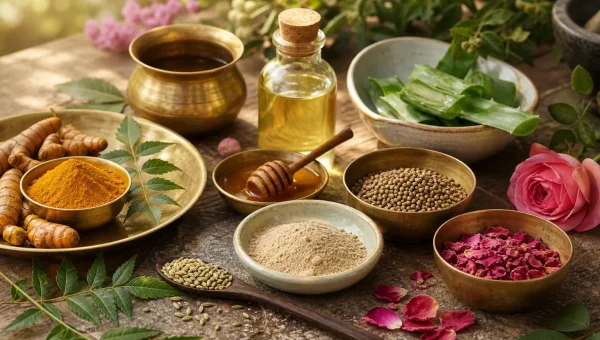
- Kumkuma / Saffron (Crocus sativus): the signature ingredient, valued traditionally for radiance and modernly discussed for crocin, crocetin, and other antioxidant constituents.
- Yashtimadhu / Licorice (Glycyrrhiza spp.): a complexion-supporting herb in Ayurveda, with constituents discussed in relation to pigmentation pathways.
- Manjishtha (Rubia cordifolia): a classical varnya herb associated with a clearer, more even-looking complexion.
- Chandana or Rakta Chandana: sandalwood-family ingredients used in cooling, complexion-supporting preparations.
- Padmaka and Padmakesara: traditional ingredients used in several Kumkumadi references for skin tone and refinement.
- Laksha: lac resin, included in many classical versions of the formulation.
- Tila Taila / Sesame oil: a common base oil in Kumkumadi preparations and a carrier for the processed herbs.
- Ksheera or Ajaksheera: milk or goat milk appears as the liquid medium in some traditional versions.
Because classical versions vary, a good Kumkumadi oil should be judged by its full ingredient list and manufacturing method rather than by the word “Kumkumadi” on the label alone.
The 5-Step Kumkumadi Night Routine
This routine keeps Kumkumadi as the central treatment and avoids overloading the skin. The whole process can be done in about 10 to 15 minutes, with the oil application itself taking only a few minutes. Use it at night, start slowly, and keep the skin slightly damp rather than wet.
Step 1: Cleanse Gently (3 minutes)
Begin with clean skin. Remove sunscreen, makeup, dust, and excess sebum with a gentle cleanser or a small amount of plain sesame oil followed by a soft warm cloth. The goal is not to scrub the skin until it feels tight; the goal is to leave the surface clean while respecting the skin barrier.
Take about 1/2 teaspoon of plain sesame oil only if your skin tolerates oil cleansing. Warm it between your palms, massage gently over the face and neck for 60 to 90 seconds, then remove with a warm, damp muslin cloth. Press the cloth on the face briefly and wipe without dragging. People with acne-prone or very oily skin can use a mild noncomedogenic cleanser instead.
Step 2: Use a Warm Compress, Not Aggressive Steaming (2 minutes)
A gentle warm compress can soften the skin and make the oil application feel more comfortable. Soak a clean cloth in warm water, wring it out, and press it over the face for 30 to 60 seconds. Repeat once if desired. Keep the temperature pleasantly warm, not hot.
Traditional Ayurvedic routines often use warmth before oil application, but facial skin is delicate. Avoid strong steam if you have rosacea, melasma, active inflamed acne, broken capillaries, or heat-triggered redness. Warmth and hydration can influence the outer skin layer, but more heat is not better; irritation can worsen pigmentation and sensitivity.
Step 3: Apply Kumkumadi Tailam with Light Marma-Inspired Massage (3-5 minutes)
Place 3-5 drops of Kumkumadi Tailam on your fingertips. That is usually enough for the entire face and neck. Spread it first between the fingers, then press it gently into the skin. The finish should feel nourished, not greasy.
- Sthapani area: touch the point between the eyebrows and massage outward across the forehead with small, calm circles.
- Apanga area: tap very gently around the outer eye-brow and orbital-bone region, keeping oil away from the lash line and the eyes.
- Phana area: press lightly at the sides of the nostrils and glide outward over the cheeks toward the ears.
- Jaw and neck: use upward strokes from the chin to the jaw and from the collarbone toward the jawline, without pulling the skin downward.
Massage for 3 to 5 minutes. Use the ring finger around the eyes, keep pressure light, and stop if the skin becomes hot, itchy, or red.
Step 4: Adjust for Dark Spots, Acne, or Under-Eyes (1-2 minutes)
Kumkumadi works best when it is adapted to the skin in front of you. Uneven tone, acne, and under-eye dryness do not all need the same handling, so keep this step selective.
For dark spots and uneven tone: apply the oil thinly and consistently at night, then use broad-spectrum sunscreen in the daytime. Pigmentation care depends heavily on sun protection. For a more classical approach, Manjishtha may be used in practitioner-guided routines, but avoid harsh scrubbing powders or strong DIY masks on dark spots.
For active acne: do not layer heavy oil over inflamed pimples. Apply Kumkumadi around the area rather than directly on tender breakouts, or pause the oil until inflammation settles. Acne-prone skin generally does better with noncomedogenic products, and persistent acne should be assessed by a dermatologist. Neem-containing topical products may suit some people, but undiluted neem oil can irritate and should not be treated as a universal acne remedy.
For under-eye dryness: use only the faintest residue of oil around the orbital bone, never inside the eye area. A tiny amount of sweet almond oil can also be used as an emollient if your skin tolerates it. Stop if you notice milia, watering, itching, or puffiness.
Step 5: Finish Lips and Hands (1 minute)
After applying Kumkumadi, rub the remaining trace of oil into the backs of your hands and cuticles. These areas are exposed often and are easy to neglect.
For lips, a tiny amount of plain ghee can be used as a traditional, lipid-rich balm. Apply only a thin film. Do not use ghee or any kitchen ingredient on cracked, bleeding, infected, or allergic skin; in those cases, choose a simple dermatologist-recommended barrier balm.
Choosing the Right Kumkumadi Oil
The word “Kumkumadi” is used broadly in the market, so read the label carefully. A good product should look like a real medicated oil, not just a perfume oil with saffron colour.
- Full ingredient list: look for a complete formula with multiple classical ingredients rather than only saffron and fragrance.
- Sesame oil base: traditional Kumkumadi preparations commonly use tila taila as the oil base.
- Clear manufacturing standard: choose brands that state GMP compliance, licensing, batch number, and expiry date.
- No hidden fragrance load: avoid products where added perfume dominates the ingredient list, especially for sensitive skin.
- Formula transparency: some classical versions may contain animal-derived, mineral, or resin ingredients; read the label if you avoid these.
- Packaging: prefer small dark-glass bottles or well-sealed packaging that protects the oil from light and oxidation.
What to Expect: A Practical Timeline
Kumkumadi is best treated as a steady night-care ritual, not a quick bleaching agent. The results depend on skin type, product quality, sun exposure, acne activity, and how many irritating products are already in your routine.
| Timeframe | What You May Notice |
|---|---|
| First week | Skin may feel softer and less dry if the oil suits you. If you develop itching, burning, or many new pimples, reduce frequency or stop. |
| Weeks 2-3 | The routine may start feeling more settled, with less tightness after cleansing and a smoother morning appearance. |
| Weeks 4-8 | A more even-looking glow may become visible, especially when daytime sunscreen is consistent. |
| Weeks 8-12 | Review progress with photos in the same lighting. Stubborn pigmentation, acne marks, melasma, or scarring may need professional care beyond facial oil. |
Do not treat breakouts as “purging” or impurities being drawn out. If a product repeatedly causes irritation or acne, your skin is telling you it is not the right fit or the frequency is too high.
Common Mistakes to Avoid
Most Kumkumadi disappointments come from using too much oil, applying it over unclean skin, or expecting it to behave like a strong dermatological active. Keep the ritual light and consistent.
- Using a full dropper: 3-5 drops is enough for most faces. Excess oil will sit on the skin and transfer to the pillow.
- Applying over sunscreen or makeup: cleanse first so the oil is not sealing in debris.
- Using it on wet skin: slightly damp skin is fine; dripping-wet skin dilutes the application and makes it messy.
- Combining with too many actives: avoid stacking Kumkumadi on the same night as strong exfoliating acids, retinoids, or harsh scrubs unless guided by a professional.
- Skipping sunscreen: uneven tone and dark spots are difficult to improve without daily sun protection.
- Ignoring your skin type: dry and Vata-type skin may enjoy nightly use, while oily or acne-prone skin may need it only two or three nights per week.
Who Should Be Careful
Kumkumadi is a traditional cosmetic oil, but it is still an active botanical preparation. Patch testing, quality checking, and common sense matter, especially for sensitive skin.
Skin Safety Note: Patch test Kumkumadi Tailam on a small area before using it on the face. Avoid sesame-based formulas if you have a sesame allergy. Do not use the oil on broken, infected, severely inflamed, or freshly treated skin. If you have eczema, rosacea, cystic acne, melasma, pregnancy-related pigmentation, or a history of cosmetic reactions, consult a qualified dermatologist, healthcare provider, or Ayurvedic practitioner before starting. This routine is for general skin care and does not replace medical treatment.
The beauty of Kumkumadi is that it asks for less, not more: cleanse well, warm gently, apply a few drops, massage without force, and protect the skin during the day. Used with patience and the right product, it can become a calm, nourishing night ritual for a brighter-looking complexion.
This article is for informational purposes only and does not replace medical advice. Always consult a qualified healthcare provider or Ayurvedic practitioner for personal skin concerns or before starting any new treatment.
References
- Ijapr (ijapr.in)
- A comparative review study of Sneha Kalpana (Paka) vis-a-vis liposome (2011), PubMed Central
- Mdpi (mdpi.com)
- ROS-scavenging and Anti-tyrosinase Properties of Crocetin on B16F10 Murine Melanoma Cells (2018), PubMed
- Pubs (pubs.acs.org)
- Critical review of Ayurvedic Varṇya herbs and their tyrosinase inhibition effect (2015), PubMed Central
- Easyayurveda (easyayurveda.com)
- Cleansing formulations that respect skin barrier integrity (2012), PubMed Central
- Stacks (stacks.cdc.gov)
- Aad (aad.org)
- The Antimicrobial Potential of the Neem Tree Azadirachta indica (2022), PubMed Central
- The uses and properties of almond oil (2010), PubMed
- Health benefits of ghee: Review of Ayurveda and modern science perspectives (2024), PubMed Central
- Aad (aad.org)
- The Role of Sunscreen in Melasma and Postinflammatory Hyperpigmentation (2020), PubMed Central
- Pib (pib.gov.in)
- Aad (aad.org)
- NCCIH
The ingredient explanations are practical. Ive always read ingredient lists but this gives me a framework for understanding what those ingredients are actually doing.
The stress-skin connection section is so important. My skin always flares during deadlines and understanding the cortisol-Pitta link gives me something actionable to work with.
I appreciate you sharing the skeptical perspective too. It keeps the conversation grounded
I appreciate the inclusion of internal herbs alongside topical treatments. True Ayurvedic skincare addresses both and most mainstream content focuses only on what goes on the skin.
The part about Kumkumadi Night Routine feels realistic. Small daily changes are easier to follow than a perfect plan.
Great question, I’ve been wondering the same thing. Following this thread for the answers.
I’d been spending a fortune on fancy serums. After implementing the Ayurvedic basics here, oil cleansing, herbal toners, the diet changes, my skin looks better than it ever did
Thank you so much for sharing your experience! It’s really encouraging to hear from others on this journey.
I shared this with my book club, we have a wellness focus this month. Everyone immediately wanted to try the face mask recipe. It’s become our next group activity.
The Rasa and tissue nourishment explanation is a really different way of thinking about skin health. Surface-level treatments make more sense when you understand the layers beneath.
The part about Kumkumadi Night Routine feels realistic. I would still ask a practitioner before changing medicines.
Im going to share this comment with my skeptical partner. Exactly what I needed to articulate why this works
I have Pitta skin and the cooling, calming recommendations here resonate exactly with what my skin responds well to. Finally a skincare approach built for my constitution
The emphasis on oil as medicine rather than something to avoid on skin was hard to accept at first. Three months later, my formerly oily skin is actually balanced. Mind blown.
The part about Kumkumadi Night Routine feels realistic. The main idea is clear even if someone is new to Ayurveda.
The Ubtan recipe here works better for my skin than any commercial exfoliant I’ve tried. And it costs a fraction of the price. My whole family has switched.
Thank you for sharing the practical tip about sourcing. That’s something I’ve been confused about
I’ve been using Kumkumadi oil for three months. The improvement in my skin tone is real. Not dramatic overnight change but steady, consistent improvement that’s clearly accumulating.
great question, I’ve been wondering the same thing. Following this thread for the answers
my daughter has been struggling with acne through her teens. The holistic approach here, looking at diet, sleep, stress and skin together, is showing real promise.
I switched to an Ayurvedic skincare routine six months ago and the improvement in my skin texture is genuinely remarkable. My esthetician keeps asking what I’m doing differently
I had the exact same confusion about this. Glad the article cleared it up for both of us.
The explanation of how processed foods affect skin at a systemic level helped me make the dietary changes I’d been resistant to. External changes alone weren’t working
I run a small Ayurvedic beauty brand and content like this educates customers in ways that make my work easier. Well-written educational material raises everyone.
Your persistence through the adjustment period is inspiring. I’m currently in it and your comment helps.
The hair care section in your related article brought me here. Now I’m going down a rabbit hole of Ayurvedic beauty knowledge. Everything connects so logically.
The professional background you bring to this comment is really valuable. Thank you for reading and contributing.
I’ve been on Kumkumadi Tailam for four months and the hyperpigmentation from old acne scars has reduced more than any of the vitamin C serums or niacinamide products I used for two years before this.
The less-is-more protocol that the aunt gives is my experience too. When I stopped my 12-step routine and went to Kumkumadi plus one moisturizer, my skin calmed down within two weeks.
gave this protocol 6 weeks and saw nothing. not saying it doesnt work but didnt work for me
The part about Kumkumadi Night Routine feels realistic. A few more examples would still help.
Your grandmother sounds like an amazing woman! Traditional knowledge passed through families is so precious.
The clarification on why certain popular skincare ingredients can aggravate certain skin types according to this framework explains so much about my personal reactions
Is the commercial Kumkumadi from Forest Essentials or Kama Ayurveda equivalent to classical preparation or are there significant differences in active compound content?
the general advice is sound but the claim that this ‘cures’ or ‘fixes’ the condition is irresponsible wording. ‘May help manage’ is more accurate
The 5-step protocol is manageable but the two-minute massage technique described takes longer than two minutes to do properly. Realistic expectation would be ten minutes for the full routine.
The concept is great but the execution could be better. A lot of ‘do this’ without explaining the why behind each step.
As someone with a science background, I find the mechanism explanations here a bit hand-wavy. Correlation isn’t causation.
The sesame oil cleanse left my skin feeling softer right away.
Does the herbal steam step really make a difference if you only do it twice a week?
The marma point breakdown is helpful though remembering all the taps takes practice.
Kumkumadi Tailam sounds promising but I wonder how it compares to a simple rosehip oil for brightening.
The timeline table is useful; I noticed my own hyperpigmentation faded after about six weeks of consistent use.
Just a heads up, patch testing is essential especially if you have sensitive skin.
I liked the practical side of Kumkumadi Night Routine. I would like to know how long to try it before judging results.
I switched from chemical serums to this protocol 6 weeks ago. The skin barrier feels much calmer. Less sensitivity to environmental changes.
The safest part of the Kumkumadi Night Routine advice is keeping it simple. The safety notes could be expanded a little.
The point about fragrance-heavy commercial versions defeating the purpose of calming Pitta at night was exactly what I needed to hear.
My skin is acne-prone and oily. Is Kumkumadi appropriate or will it clog pores? The article focuses on dry and normal types.
This helped me understand Kumkumadi Night Routine without too much jargon. I would like to know how long to try it before judging results.
Same here
I bought an expensive Kumkumadi oil and it separated after 2 months. Article should mention shelf life and storage.
reading this 14 months after publication. is kumkumadi with saffron still the recommended night routine or has something better come out?
The face steam step before applying the oil, how hot is too hot? I have broken capillaries.
The pitta skin type section was directly relevant. I run hot, prone to redness. The cooling modifications you suggest are practical.
Thanks!
The advice around Kumkumadi Night Routine is specific enough to be useful. The main idea is clear even if someone is new to Ayurveda.
3 steps in now. the first two steps alone improved my skin texture significantly. can’t imagine after all 5.
The Manjistha face pack in step 2 stained my towel pink. Warned my roommates too late. Heads up to others.
Does the order of steps matter if I only have time for 3 of the 5? Which are essential vs optional?
my husband tried to smell the bottle and knocked it over. Rs 2200 gone. store it somewhere safe people
Will try
The clarification about Kumkumadi oil vs Kumkumadi tailam being different products was something I needed. Using wrong type for years.
Does applying oil in the 3rd step interfere with the sheet mask absorbtion in step 4? Seems like it would create a barrier.
the saffron soaking step takes 2 hours which makes this impractical for weeknights. are there shortcuts
The section on layer order, oil before or after the paste, is something every Ayurvedic skincare guide contradicts itself on. Glad you addressed it explicitly.
This makes sense for Kumkumadi Night Routine. A few more examples would still help.
I spent a lot on branded Kumkumadi products. After reading this, making my own at home seems very doable and much cheaper.
I came here from the Instagram post. The article has way more detail than the summary. Bookmarked.
been using these recommendations from the Kumkumadi Night Routine article for about 3 weeks now. seeing some improvement.
I wish the article addressed what to do if you notice no effect after the recommended duration.
Any guidance for people who travel frequently? Hard to maintain a consistent protocol.
The 3-week timeline seems optimistic based on my experience. More like 6 weeks for me.
Just tried this for the first time this week. Too early to say but no adverse effects so far.