
Five Ayurvedic Supports for Migraine: Herbs, Formulas, Nasya, and Safety
A migraine diary often reveals patterns that are easy to miss in day-to-day memory: sleep changes, heat exposure, missed meals, menstrual timing, bright light, digestive heaviness, stress, or seasonal allergy flares. Ayurveda approaches this pattern-based view through Shiroroga (diseases of the head) and Ardhavabhedaka, a classical headache presentation commonly correlated in clinical writing with migraine because of its one-sided, severe, recurrent pain pattern.
The aim of an Ayurvedic migraine plan is not simply to numb pain. It is to identify the dominant doshic pattern, reduce trigger load, support digestion and elimination, calm aggravated Vata, cool aggravated Pitta when heat and burning are prominent, and address Kapha-related heaviness or congestion when present. The five supports below keep that classical intent while using only verifiable formulations, herbs, and safety principles.
Understanding Migraine Through the Ayurvedic Lens
Classical Ayurvedic literature discusses headache disorders under Shiroroga and describes doshic patterns such as Vataja, Pittaja, Kaphaja, and Tridoshaja/Sannipataja presentations. Sushruta’s description of Ardhavabhedaka includes severe pain affecting one half of the head and recurring at intervals, which is why many Ayurvedic clinicians discuss it alongside migraine.
- Vata-dominant headache pattern: piercing, shifting, throbbing, or severe pain, often associated with dryness, irregular routine, sleep disturbance, anxiety, fasting, overexertion, or cold/windy exposure.
- Pitta-dominant headache pattern: burning, sharp, intense pain with heat sensitivity, eye burning, irritability, thirst, sourness, or aggravation from sun, heat, anger, alcohol, or spicy food.
- Kapha-dominant headache pattern: dull, heavy pain with congestion, mucus, sluggishness, facial heaviness, or morning aggravation.
- Tridoshaja/Sannipataja pattern: a mixed presentation in which throbbing, burning, heaviness, nausea, sensory sensitivity, digestive disturbance, and variable triggers overlap.
Modern medicine describes migraine as a neurological disorder that can include throbbing head pain, nausea, vomiting, and sensitivity to light and sound. In migraine with aura, cortical spreading depolarization is an accepted mechanism behind aura, and the trigeminovascular system and CGRP pathway are central to migraine pain biology. Ayurveda and modern neurology use different explanatory languages, but both support careful trigger tracking and individualized treatment planning.
Herb #1: Pathyadi Kwath, the Foundation Formula
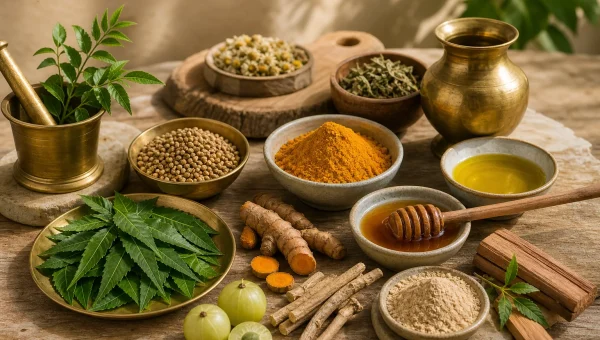
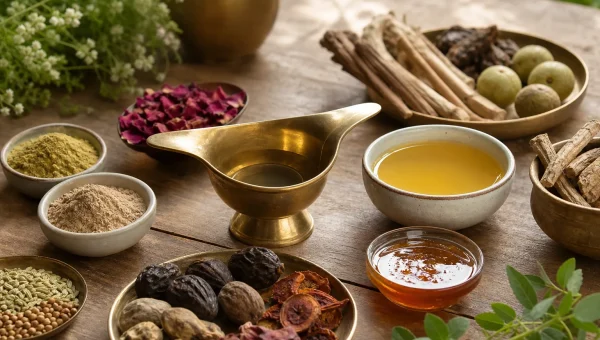
Pathyadi Kwath is a classical Ayurvedic decoction used for Shiroroga and Ardhavabhedaka. It is a polyherbal formulation rather than a single herb. Published clinical descriptions of Pathyadi preparations list ingredients such as Haritaki (Terminalia chebula), Bibhitaki (Terminalia bellirica), Amalaki (Emblica officinalis), Nimba (Azadirachta indica), Bhunimba, Haridra (Curcuma longa), and Guduchi (Tinospora cordifolia), with formula variations depending on the textual and pharmacy tradition used.
In an Ayurvedic migraine plan, Pathyadi Kwath is most useful when the headache pattern includes digestive heaviness, sour belching, constipation, heat in the head or eyes, recurrent one-sided headache, or food-triggered attacks. Its rationale is to support the gut-head axis in Ayurvedic terms: clearing digestive stagnation, reducing Pitta-Kapha load, and helping Vata move in a steadier direction.
Practitioner-supervised use: Liquid kwath products are commonly used in small measured doses diluted with warm water, often before food or as directed by an Ayurvedic physician. Because formulations and concentration vary by manufacturer, the label and practitioner’s prescription matter more than a fixed universal dose.
Herb #2: Godanti Bhasma, the Mineral Support for Heat-Type Headache
Godanti Bhasma is a calcined gypsum preparation used in Ayurveda as a calcium-containing herbo-mineral medicine. Published descriptions identify Godanti with gypsum/calcium sulfate and describe its traditional use in conditions such as fever, burning sensation, pain, cough, gastritis, and calcium deficiency.
For migraine care, Godanti Bhasma belongs only in a carefully supervised plan, especially when the presentation is Pitta-dominant: burning pain, heat intolerance, eye burning, sun aggravation, acidity, or headache with feverish heat. It is sometimes paired with cooling or soothing adjuvants such as ghee, honey, milk, or sugar depending on the patient and the physician’s judgment.
Safety note: Godanti Bhasma and other bhasma preparations should not be self-prescribed. Use only properly manufactured products from reputable pharmacies with quality testing, and take them only under a qualified Ayurvedic practitioner’s supervision. Reports of heavy-metal toxicity from some Ayurvedic products make product quality, correct preparation, and medical supervision essential.
Herb #3: Shirish (Albizia lebbeck), the Allergy-Linked Support
Shirish (Albizia lebbeck) is traditionally valued in Ayurveda for allergic and toxic states. It is especially relevant in migraine plans when attacks cluster around seasonal change, dust exposure, sinus congestion, allergic rhinitis, itching, sneezing, or food sensitivities that produce a histamine-like pattern.
Experimental pharmacology has documented anti-allergic activity of Albizia lebbeck, including mast-cell stabilization and effects on histamine signaling in animal models. In clinical Ayurvedic reasoning, this supports the traditional use of Shirish when Kapha-Pitta reactivity, congestion, and allergen sensitivity appear to amplify headache patterns.
Practitioner-supervised use: Shirish bark powder, decoction, or compound formulations may be selected when allergic triggers are clear. It should be treated as an add-on support, not a replacement for diagnosis, trigger management, or prescribed migraine medicine.
Herb #4: Jatamansi (Nardostachys jatamansi), the Nervous-System Restorative
Jatamansi (Nardostachys jatamansi) is a Himalayan aromatic herb used in Ayurveda for the mind, sleep, and nervous-system calm. It is commonly discussed as a Medhya-type herb in modern Ayurvedic writing and is used when migraine is linked with poor sleep, mental overactivity, anxiety, stress reactivity, or Vata-Pitta aggravation.
Pharmacological literature on Jatamansi describes central nervous system activity, and animal studies report effects on GABA and monoamine neurotransmitters. In an Ayurvedic plan, the value of Jatamansi is not as a quick painkiller but as a stabilizing support when irregular sleep and nervous-system sensitivity keep the migraine cycle active.
Practitioner-supervised use: Jatamansi may be given as powder, tablet, capsule, ghrita, oil, or part of a compound formula. It should be used cautiously in people taking sedatives, psychiatric medicines, anti-seizure medicines, or sleep medicines unless a qualified clinician is supervising the plan.
Herb #5: Dashamoola, the Ten-Root Vata Formula
Dashamoola means “ten roots.” It combines the roots of Bilva, Agnimantha, Shyonaka, Patala, Gambhari, Brihati, Kantakari, Gokshura, Shalaparni, and Prishniparni. It is one of Ayurveda’s central Vata-Kapha formulations and is widely used in conditions involving pain, stiffness, inflammation, respiratory congestion, and musculoskeletal or nerve-related discomfort.
In migraine care, Dashamoola is most appropriate when the headache pattern includes Vata aggravation with neck stiffness, body ache, stress tension, poor sleep, wind/cold sensitivity, or Kapha heaviness. It may be used as kwath, arishta, ghrita, oil, or part of a broader formula depending on constitution, strength, digestion, and the stage of treatment.
Preclinical studies have evaluated Dashamoola preparations for analgesic, anti-inflammatory, and anti-platelet activity. This does not make Dashamoola a direct substitute for modern migraine medicines, but it supports its traditional placement in Vata-related pain and inflammatory patterns.
The Protocol: Putting the Supports Together
A responsible Ayurvedic migraine protocol is individualized after assessing prakriti, vikriti, digestion, bowel pattern, menstrual or hormonal triggers, sleep, stress load, allergy history, medication use, and red-flag symptoms. The structure below is an educational model, not a self-treatment prescription.
| Phase | Clinical Aim | Common Ayurvedic Supports | Additional Measures |
|---|---|---|---|
| Phase 1: Track and reduce triggers | Identify sleep, food, heat, stress, hormonal, allergic, and digestive patterns | Pathyadi Kwath when Shiroroga/Ardhavabhedaka pattern and digestive-Pitta-Kapha load are present | Migraine diary, regular meals, hydration, sleep timing, reduced alcohol, reduced trigger foods |
| Phase 2: Pacify the dominant dosha | Calm Vata, cool Pitta, or lighten Kapha according to symptoms | Jatamansi for Vata-Pitta nervous-system sensitivity; Shirish for allergy-linked patterns; Dashamoola for Vata-Kapha pain and stiffness | Warm oil massage when Vata is high; cooling measures when Pitta is high; steam or light diet when Kapha is high |
| Phase 3: Stabilize recurrence | Reduce recurrence tendency and improve resilience | Jatamansi, Brahmi, Dashamoola, or other practitioner-selected rasayana-style supports | Consistent sleep, gentle pranayama, meditation, neck and shoulder relaxation, trigger review |
| Acute supervised support | Support comfort during a breakthrough headache | Godanti Bhasma only when prescribed; cooling Pitta measures or Vata-calming measures according to presentation | Dark quiet room, cold or warm compress according to dosha pattern, prescribed acute migraine medicine when needed |
Nasya: Nasal Therapy for Head and Neck Patterns
Nasya Karma is the Ayurvedic practice of administering medicated oil, powder, or other preparations through the nasal route. Ayurveda gives special importance to nasal therapy in disorders of the head and neck, and modern drug-delivery literature recognizes that the nasal cavity has anatomical connections to the brain through olfactory and trigeminal pathways.
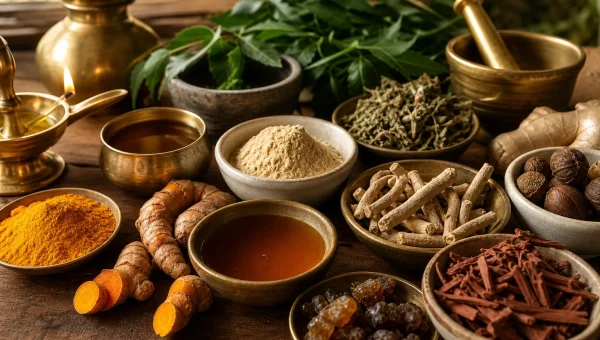
Anu Taila is a classical oil used for Nasya. Ingredient lists commonly include herbs such as Jivanti, Devadaru, Ushira, Tvak, Musta, Sariva, Prishniparni, Shatavari, Brihati, and others processed in an oil base. In migraine care, Nasya is considered when the pattern includes head heaviness, sinus involvement, neck stiffness, dryness, Vata aggravation, disturbed sleep, or recurrent Shiroroga.
Nasya should be taught by a qualified practitioner. It is not suitable during acute cold, fever, immediately after meals, intoxication, pregnancy unless specifically advised, or when there is nasal bleeding or active infection. The oil, dose, timing, and method should match the person’s constitution and condition.
Diet and Lifestyle Anchors
Herbs work best when the daily pattern stops repeatedly provoking the same doshic imbalance. A migraine diary can help identify whether attacks follow missed meals, dehydration, excess screen glare, irregular sleep, sun exposure, alcohol, aged or fermented foods, strong smells, hormonal shifts, or seasonal allergy flares.
For Vata-dominant patterns, favor warm, regular meals, adequate sleep, gentle oil massage, and reduced fasting or overwork. For Pitta-dominant patterns, reduce heat, alcohol, sharp spices, excessive sun, anger-driven overexertion, and late nights. For Kapha-dominant patterns, use a lighter diet, avoid daytime sleep, reduce heavy dairy and cold foods, and address congestion or allergy triggers.
When Migraine Needs Urgent Medical Care
Any new, sudden, severe, or unusual headache should be medically evaluated. Seek urgent care for the worst headache of your life, headache after head injury, headache with fever or stiff neck, weakness, fainting, confusion, vision loss, seizure, new neurological symptoms, headache during pregnancy, or a major change in headache pattern.
Important disclaimer: This article is educational and does not diagnose, treat, or replace medical care. Migraine can require prescription acute and preventive medicines, and sudden or changing headaches may signal serious disease. Do not stop prescribed medicines without your doctor’s guidance. Use herbs, bhasma, Nasya, detoxes, or therapeutic protocols only after consulting a qualified Ayurvedic practitioner and a healthcare provider, especially if pregnant, breastfeeding, managing a medical condition, or taking medication.
Ayurvedic migraine care is strongest when it is individualized: the same headache label may require a Vata-calming, Pitta-cooling, Kapha-clearing, allergy-focused, digestive, sleep-centered, or combined approach. The five supports above are best understood as practitioner-selected tools, not a universal formula for every migraine patient.
References
- My (my.clevelandclinic.org)
- Mayoclinic (mayoclinic.org)
- Wisdomlib — classical text
- Jaims (jaims.in)
- Easyayurveda (easyayurveda.com)
- Medcraveonline (medcraveonline.com)
- Easyayurveda (easyayurveda.com)
- The pathophysiology of migraine: implications for clinical management (2018), PubMed
- Nejm (nejm.org)
- A pilot study on clinical efficacy of Agnikarma and Pathyadi decoction (an Ayurvedic formulation) in the management of Ardhavabhedaka (migraine) (2018), PubMed
- Researchgate (researchgate.net)
- Ijam (ijam.co.in)
- Baidyanath (baidyanath.co)
- Ayurmedinfo (ayurmedinfo.com)
- Wjpr (wjpr.s3.ap-south-1.amazonaws.com)
- Asianpubs (asianpubs.org)
- Toxic metals in ayurvedic preparations from a public health lead poisoning cluster investigation (2017), PubMed Central
- Tga (tga.gov.au)
- Anti-allergic activity of standardized extract of Albizia lebbeck with reference to catechin as a phytomarker (2010), PubMed
- Albizia lebbeck suppresses histamine signaling by the inhibition of histamine H1 receptor and histidine decarboxylase gene transcriptions (2011), PubMed
- Mitochondrial uncoupling protein 2 inhibits mast cell activation and reduces histamine content (2009), PubMed
- An important Indian traditional drug of ayurveda jatamansi and its substitute bhootkeshi: chemical profiling and antioxidant activity (2013), PubMed Central
- Easyayurveda (easyayurveda.com)
- Anxiolytic actions of Nardostachys jatamansi via GABA benzodiazepine channel complex mechanism and its biodistribution studies (2018), PubMed
- Effects of Nardostachys jatamansi on biogenic amines and inhibitory amino acids in the rat brain (1994), PubMed
- Central nervous system depressant activity of Jatamansi (Nardostachys jatamansi DC.) rhizome (2020), PubMed Central
- Americanmigrainefoundation (americanmigrainefoundation.org)
- A compendious review of Chitraka Haritaki Avaleha – A polyherbal Ayurveda formulation for bronchial asthma (2020), PubMed Central
- Experimental evaluation of analgesic, anti-inflammatory and anti-platelet potential of Dashamoola (2015), PubMed Central
- Ayurveda for management of migraine: A narrative review of clinical evidence (2022), PubMed Central
- Hamch (hamch.in)
- Non-Invasive Strategies for Nose-to-Brain Drug Delivery (2020), PubMed Central
- Nose-to-brain drug delivery: from bench to bedside (2025), PubMed Central
- Easyayurveda (easyayurveda.com)
- Ninds (ninds.nih.gov)
I’ve been getting migraines since my teens and the part about the vata-pitta trigger distinction is something no one has ever explained to me. My neurologist talks about serotonin and my Ayurvedic practitioner talks about doshas and I’ve always struggled to connect them. This framing actually helped bridge that gap.
Three months sounds right from my experience too. Commit to that and then evaluate.
The case study format here is what makes this credible. A 47-migraine spreadsheet is hard to argue with. What I’d find helpful is knowing whether the herbs listed here are being used as acute treatment when an attack starts, or as a daily preventive protocol — or both? The article touches on it but I wasn’t sure I understood the distinction.
It’s wonderful to see both believers and skeptics engaging respectfully in the comments. That’s how we all learn
Varun, curious what herbs were actually included in your protocol if you remember. I’ve read three different versions of an Ayurvedic migraine approach and they all list different combinations. The article mentions brahmi and shankhpushpi but I’ve also seen guduchi recommended for the inflammation component.
tried brahmi oil head massage for 2 weeks, frequency dropped from 3 times a week to once. genuinely shocked
The Migraine angle is useful here. Small daily changes are easier to follow than a perfect plan.
I’m recovering from surgery and my integrative medicine team has incorporated some gentle Ayurvedic therapies into my rehabilitation. Seeing real results.
Same here! The practitioner recommendation made all the difference for me. Don’t try to do this without guidance.
Three months on the protocol described here and my migraines went from roughly twice a week to once every ten days. I still get them but the intensity is lower and they respond better when they do hit. The brahmi oil nasya in the morning was the addition I was most skeptical about and honestly might be doing the most work.
The advice around Migraine is specific enough to be useful. The timing advice is the part I would start with.
I’d appreciate a section on contraindications. Not mentioning who should NOT try this is a significant oversight in health content.
The advice around Migraine is specific enough to be useful. I would like to know how long to try it before judging results.
The fact that Topiramate brain fog is mentioned here by name is important. That side effect ended my relationship with preventive medication and I’ve been trying to find something that works without that cost. I’m looking closely at the shatavari and brahmi combination mentioned. Has anyone here actually tried this protocol alongside or after coming off topiramate?
The section on identifying whether it’s a vata or pitta migraine is what I needed. Mine always start with visual aura and then move to intense heat and nausea — I’ve been treating them generically for years. Knowing the type changes which herbs to reach for first is actually useful clinical information.
Your grandmother sounds like an amazing woman! Traditional knowledge passed through families is so precious.
I tried the cold milk with saffron remedy during an actual attack after reading this, mostly out of desperation. It didn’t eliminate the pain but it did reduce the nausea significantly and I was functional within two hours instead of the usual six. Small sample size but I’ll take it.
We appreciate your candid feedback. You’re right that we should distinguish more clearly between traditional knowledge and clinical evidence. We’re working on adding more research citations.
the discussion of how classical and modern approaches to these therapies compare and contrast was particularly interesting from an academic standpoint.
I work in healthcare too and I appreciate you engaging with this from a clinical standpoint
as a massage therapist with interest in Ayurvedic bodywork, this is a fascinating read. The theory behind the techniques is something I’m actively studying to integrate into my practice.
The Migraine angle is useful here. I appreciate that it does not oversell the result.
The integration of traditional explanation with modern physiological understanding is exactly what makes this content valuable. Not either/or but both together
The professional background you bring to this comment is really valuable. Thank you for reading and contributing.
The section on post-treatment care is critical and often missing from other articles. What you do after matters just as much as the treatment itself
The Migraine angle is useful here. This feels more usable than a long list of herbs.
The comparison of different preparation methods here matches what my grandmother described from her experience in India decades ago. This knowledge has clearly been consistent.
My rheumatologist was skeptical when I mentioned Ayurvedic treatment but Im going to share this article with her. The clinical evidence cited might open a conversation
The advice around Migraine is specific enough to be useful. The safety notes could be expanded a little.
Rekha’s spreadsheet approach is exactly how I track mine. Forty-seven in six months is severe but my numbers aren’t far behind. The part about Sumatriptan only buying four hours resonates completely — it treats the pain but I can feel it coming back. Which of the five herbs would you suggest starting with for someone whose migraines are mostly hormonal?
The advice around Migraine is specific enough to be useful. This is the kind of detail readers can test slowly.
Saptamrita Lauha was the game changer for my migraines I’d tried standard Vata protocols without the iron preparation and didn’t get the same result. My Ayurvedic doctor had me on it for 3 months and the frequency dropped from 8/month to 2.
The Nasya application for migraines specifically Anu taila through the nostrils is the most underused treatment in this protocol. It helped me more than any of the oral preparations and my neurologist was skeptical but couldn’t argue with the results.
The lifestyle changes recommended here are excellent. The supplement recommendations, less so. Hard to know what dose actually works
My migraines have a strong hormonal trigger (menstrual cycle) and the Vata protocol helps somewhat but not during the actual hormonal trigger window. Has anyone found the protocol effective for purely hormonal migraines?
The dietary triggers section is consistent with migraine science the Vata-aggravating foods listed overlap significantly with the conventional tyramine/nitrate/caffeine trigger list. Not coincidental.
i appreciate the effort but where are the clinical trials? anecdotal evidence isnt enough tbh
My ayurvedic doctor prescribed Pathyadi Kwath for migraines and it actually shows up in your protocol. Good to see the alignment.
The 4 months to see results mention is important. I tried an Ayurvedic protocol for migraines for 6 weeks, didn’t see the promised improvement, and stopped. Should have had more realistic timeline expectations.
Shirodhara addressed the emotional component of my migraines in a way no pharmaceutical did. I was having what I now understand as Vata-type migraines with significant anxiety and rumination alongside the pain and the shirodhara treated the whole picture.
Are there specific contraindications to the Nasya procedure? I have deviated septum and I’m wondering if the oil application would be safe or could cause problems.
I respectfully disagree with the characterization of modern medicine as inferior here. Both systems have their place and ideally should complement each other.
Valid concerns. Ayurveda works best as a complementary approach, not a replacement for evidence-based medicine. Thank you for highlighting this important distinction.
The nasya oil routine described here sounds like a simple addition to morning habits that could really shift migraine patterns.
I have Pitta-type migraines not Vata burning quality, associated with acidity, worse in summer heat. The article distinguishes these but the Pitta treatment section is shorter. More detail on Pitta migraine protocol would be helpful.
I came for Migraine and this answered the main question. The examples make the advice less abstract.
I wonder how many patients actually try the full 12 week herb schedule before judging results.
Pathyadi Kwath seems to tackle the digestive side, which many overlook when focusing only on head pain.
Tried the Brahmi-based protocol alongside my prescribed topiramate. Discussed with my neurologist first. No interaction concerns identified. Migraine frequency reduced meaningfully over 5 months. Still on topiramate but at lower dose.
Has anyone here used Godanti Bhasma for acute attacks and noticed less fog than with sumatriptan?
The breakdown of vata, pitta, and kapha headache types helped me see why my own migraines feel different each time.
I appreciate the caution about sourcing bhasmas from GMP certified labs; safety matters with mineral prep.
Shirish bark for the histamine link is a fresh angle I hadn’t seen in migraine talks before.
Combining Jatamansi with Brahmi for pitta dominant cases feels like a smart tweak to the base formula.
Dashamoola’s anti inflammatory claim lines up with newer CGRP research, which is encouraging.
Tracking triggers in a spreadsheet, like Rekha did, makes the protocol feel more personal and measurable.
It would be helpful to see a sample daily timetable showing when each herb is taken relative to meals.
The diet correlation section connecting trigger foods to Pitta excess makes intuitive sense. I already avoid fermented foods for this reason.
the title says 5 herbs but you actually mention 7 in the article. inconsistent
The advice around Migraine is specific enough to be useful. I would still ask a practitioner before changing medicines.
Will try
I have Vata migraines, cold, at the back of head, worse with irregular eating. The protocol for Vata type was spot on.
After 15 years of migraines I’m trying everything. Started the Sarpagandha protocol last month. Too early to say but hopeful.
i get aura with my migraines. any different treatment needed? this article doesnt mention aura type specifically
my migraines are hormonal and happen exactly before periods. does this protocol work for menstrual migraines specifically
The Brahmi + Ashwagandha combination for migraine is something my neurologist actually supports. Was surprised when I mentioned it.
The feverfew section is interesting but Ayurveda doesn’t traditionally use it. Feels like it was added to fill a western-herb angle.
reading this in late 2027, has the recommended protocol changed? Asking before I start something that might be outdated.
The butterbur comparison you made, is that the European one or is there an Ayurvedic equivalent? Butterbur has liver toxicity concerns.
The Kapi Kachu mention for serotonin regulation in migraines was a new angle for me. Is there clinical data for this specific use?
I tried the Shiroshasthi treatment you mentioned and it helped within the first session. Not what I expected.
This makes sense for Migraine. Small daily changes are easier to follow than a perfect plan.
Which of the 5 herbs works fastest for acute attacks vs prevention? The article groups them together but they seem different in action.
The Pitta-type migraine section was directly applicable to me. Hot, throbbing, worse in afternoon, that’s exactly mine.
I would like more detail on Migraine. Would be useful to see a short checklist next.
Doing this
Does the Guduchi protocol interfere with sumatriptan? I use both and wondering about combination safety.
Same here
For Migraine, consistency seems like the hard part. Would be useful to see a short checklist next.
Just found this via Google, I’ve been dealing with vestibular migraines. Does this protocol address the dizziness component too?
Can this be combined with standard medication or is it better to do one at a time?
I wish the article addressed what to do if you notice no effect after the recommended duration.
The approach described here is different from what my vaidya recommends. Is there a regional variation in this protocol?
Just tried this for the first time this week. Too early to say but no adverse effects so far.
Skeptical but trying anyway because conventional medicine hasn’t helped. Will report back.
The historical references add credibility. Knowing this has been used for centuries matters to me.
Any guidance for people who travel frequently? Hard to maintain a consistent protocol.