
Ayurvedic face yoga is best understood as a practical combination of gentle facial conditioning, mukha-abhyanga (facial oil massage), and mukhalepa (herbal face application). Classical Ayurveda does not need to be forced into the language of a modern “face-yoga chapter”; its authentic contribution is the careful use of oils, cooling or astringent herbal pastes, complexion-supporting herbs, and dosha-specific skin care to keep the face soft, clear, and responsive.
This routine keeps that Ayurvedic logic intact: the movements are gentle and anatomical, while the herbs provide slip, cooling, astringency, hydration, or cleansing according to the skin’s tendency. The aim is not to pull the skin into a new shape but to reduce habitual tension, improve awareness of facial expression, support muscle tone, and give topical herbs steady contact with the skin.
The Science Behind Face Yoga
Facial exercise has a small but useful modern evidence base when it is practiced consistently and without aggressive pulling. In a 20-week facial-exercise program in middle-aged women, trained assessors noted improvement in upper and lower cheek fullness after regular practice. The program was demanding and small, so the most realistic expectation is gradual, modest improvement in tone and fullness rather than a substitute for dermatologic procedures, sleep, nutrition, or sun protection.
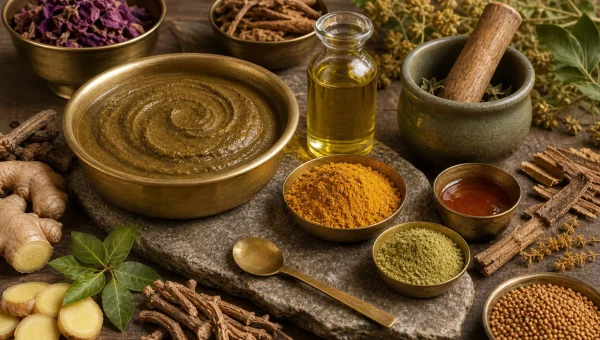
From an Ayurvedic perspective, facial movement works best when paired with appropriate topical care. Oil or gel reduces friction, light massage supports comfort, and herbs such as Chandana, Lodhra, Manjistha, Haridra, rose, and aloe are selected according to dryness, heat, pigmentation, congestion, or sensitivity.
Ayurvedic Herbs for Facial Application
Mukhalepa means applying a prepared paste or pack to the face. In classical and traditional Ayurvedic cosmetic practice, herbs are chosen not only for fragrance or color but for actions such as varnya (supporting complexion), kashaya rasa (astringency), cooling shita virya, or cleansing action in oily and congested skin.
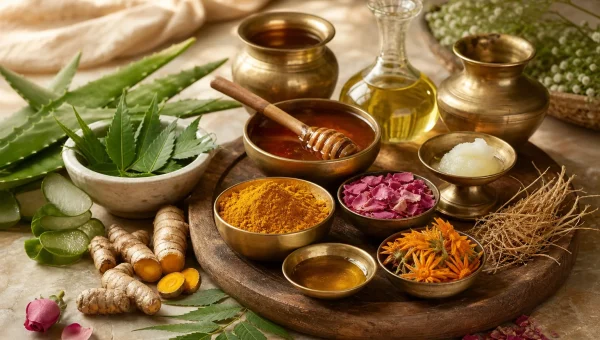
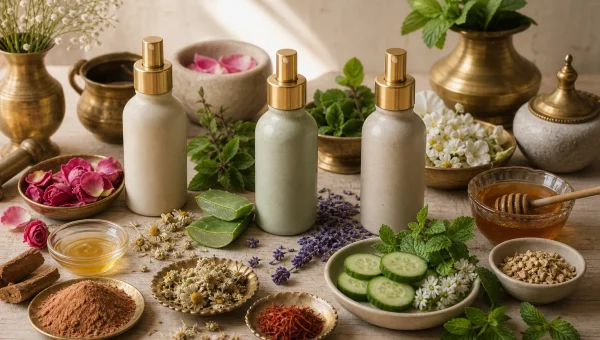
Manjistha (Rubia cordifolia) is traditionally used in complexion formulas and is especially appropriate when uneven tone or post-blemish discoloration is the main concern. Lodhra (Symplocos racemosa) is astringent and cooling, making it useful in face packs for oily or lax-feeling skin. Chandana (Santalum album) is cooling, Pitta-pacifying, and traditionally varnya. Kumari or aloe provides a simple hydrating gel base. Haridra (Curcuma longa) is traditionally varnya, cleansing, and used for skin disorders, but because it is warming and can stain, it should be used sparingly on the face. Kunkuma or saffron is traditionally valued for complexion and is best used in very small amounts in aloe, milk cream, or a neutral gel. Rose water is a cooling finishing mist for sensitive or heat-prone skin.
How to Prepare the Base Herbal Oil for Face Yoga
Prepare the base fresh and simple. For dry or Vata-type skin, use 1 teaspoon of sesame oil or almond oil. For sensitive or Pitta-type skin, use coconut oil, sunflower oil, or aloe gel. For oily or Kapha-type skin, use aloe gel, rose water, or only 2 to 3 drops of a light oil such as sunflower. Do not store aloe gel mixed into oil unless the preparation is properly preserved; instead, blend the oil and gel in your palm immediately before practice.
For a gentle all-purpose face-yoga base, place 3 to 5 drops of the chosen oil in the palm, add a pea-sized amount of aloe gel if desired, warm it between both hands, and press it over clean skin. The face should feel lightly lubricated, not greasy. The purpose is to protect the skin from friction while giving the herbs a clean, comfortable contact surface.
The 12 Exercises: Paired with Herbal Applications
Practice these exercises in front of a mirror with clean hands, trimmed nails, and light pressure. The skin should not be dragged, pinched hard, reddened, or stretched. Stop any movement that causes pain, headache, eye strain, jaw clicking, dizziness, or neck discomfort.
Exercise 1: Forehead Smoothing with Brahmi Oil
Apply 1 to 2 drops of Brahmi-infused oil to the forehead. Place the fingers horizontally across the forehead with gentle downward contact, then raise the eyebrows against that light resistance. Hold for 5 seconds and release. Repeat 8 to 10 times. Brahmi is classically known as a medhya and rasayana herb, and here it is used as a calming oil base while the movement trains awareness of habitual forehead lifting and frowning.
Exercise 2: Eye Circle Draining with Triphala Compress
Prepare a mild Triphala compress by simmering 1/4 teaspoon of Triphala powder in 200 ml water, cooling it completely, and straining it very well. Place soaked cotton pads over closed eyelids for 1 to 2 minutes; do not put the liquid into the eyes. Then use the ring fingers to tap very lightly along the orbital bone from the inner brow, around the outer eye, and under the eye back toward the nose. Complete 3 slow circles on each side. This is a periorbital skin practice, not an eye treatment.
Exercise 3: Cheek Lifting with Saffron Aloe
Soak 1 or 2 strands of saffron in a teaspoon of aloe gel or fresh milk cream for several minutes, then apply a small amount over the cheekbones. Smile by lifting the cheek muscles while keeping the eyes relaxed, and place the fingertips lightly on the cheekbones to sense the movement rather than to push the skin. Hold for 8 to 10 seconds and release. Repeat 8 times. This targets the cheek-lifting muscles while saffron is used in a traditional complexion-supporting role.
Exercise 4: Jawline Definition with Sesame Oil
Apply a thin layer of warm sesame oil along the jawline if the skin is dry; use aloe gel instead if the skin is oily or acne-prone. Glide the fingertips from the center of the chin toward the ears 5 times with very light pressure. Then close the mouth gently, lift the chest, and move the lower jaw forward slightly without clenching. Hold for 5 seconds and release. Repeat 8 to 10 times. This should feel like mild muscular engagement, not strain in the jaw joint.
Exercise 5: Nasolabial Fold Smoothing with Manjistha Honey Paste
Mix a small pinch of Manjistha powder with honey or aloe gel into a thin paste and apply it beside the nose-to-mouth lines. Place the index fingers beside the folds with light stabilizing contact, then smile slowly against that gentle resistance. Hold for 5 seconds and release. Repeat 8 to 10 times, then rinse the paste before it becomes overly dry. This pairs cheek activation with a traditional complexion herb used for uneven tone.
Exercise 6: Lip Fullness with Rose Petal Oil
Apply a drop of rose-infused oil or plain ghee around the lips. Pucker the lips as if giving a kiss, hold for 5 seconds, then widen into a relaxed smile without exposing the teeth aggressively. Alternate these two positions for 10 repetitions. This exercises the orbicularis oris area while rose provides a cooling, softening finish for the delicate skin around the mouth.
Exercise 7: Under-Eye Firming with Aloe Gel
Apply a rice-grain-sized amount of pure aloe gel below each eye, staying outside the lash line and away from the eye itself. Look upward without moving the head, then gently lift the lower eyelids as if making a soft squint. Hold for 2 to 3 seconds and release. Repeat 10 to 15 times. The movement should be subtle; strong squinting can deepen tension lines and should be avoided.
Exercise 8: Neck and Décolleté Toning with Ashwagandha Oil
Apply a thin layer of Ashwagandha-infused sesame oil to the front of the neck and upper chest if the skin is dry. Sit tall, keep the shoulders relaxed, place the tongue on the roof of the mouth, and lift the chin only slightly. Hold for 8 to 10 seconds and release. Repeat 8 times. Avoid this exercise during neck pain, cervical spondylosis flare-ups, dizziness, or recent neck procedures.
Exercise 9: Temple and Scalp Activation with Bhringraj Oil
Apply 1 to 2 drops of Bhringraj oil at the temples and hairline. With the pads of the fingers, massage the temples in small circles for 30 seconds in one direction and 30 seconds in the other direction. Keep the jaw unclenched and the eyes soft. Bhringraj is classically associated with hair and scalp care, making it a suitable oil for the temple-hairline junction.
Exercise 10: Puffiness Reduction with Cooling Chandana Compress
Mix 1/2 teaspoon of sandalwood powder with rose water into a thin paste and apply it to puffiness-prone areas such as the cheeks, jawline, and sinus area, keeping it away from the eyes. Let it sit for about 3 minutes while performing feather-light taps from the center of the face outward toward the ears, then downward along the sides of the neck. Rinse before the paste becomes tight or uncomfortable. Chandana is cooling and especially suited to heat-prone or red skin.
Exercise 11: Full-Face Activation with Neem Leaf Mist
Use a very dilute, cooled neem leaf infusion as a mist for oily or congested skin, or use rose water for dry and sensitive skin. Open the mouth into a relaxed “O” shape for 5 seconds, then gently gather the facial muscles inward toward the nose for 3 seconds, and fully release. Repeat 8 times. Neem is best kept light and diluted on the face; avoid applying undiluted neem oil to facial skin.
Exercise 12: Closing Savasana for the Face with Rose Water
Finish by misting the face with rose water. Lie down or sit quietly, close the eyes, separate the teeth, soften the tongue, and let the forehead, cheeks, lips, jaw, and throat release completely. Rest for 3 to 5 minutes. This closing pause is important because facial beauty in Ayurveda is not only firmness or brightness; it is also the absence of unnecessary strain.
Dosha-Specific Herbal Modifications
Choose the base and herbs according to the skin presentation rather than the body constitution alone. A Vata person can still have oily skin, and a Pitta person can still have dryness, so adjust the routine to what the face is showing that week.
| Skin Tendency | Common Signs | Preferred Base | Helpful Herbs | Avoid or Reduce |
|---|---|---|---|---|
| Vata-type skin | Dryness, roughness, fine lines, dullness | Sesame oil, almond oil, or ghee in very small amounts | Brahmi, Ashwagandha, Shatavari, aloe, rose | Frequent clay masks, harsh exfoliation, long drying packs |
| Pitta-type skin | Redness, warmth, sensitivity, pigmentation tendency | Aloe gel, coconut oil, sunflower oil, rose water | Chandana, Manjistha, Lodhra, rose, small amounts of saffron | Mustard oil, steam, strong turmeric packs, essential oils |
| Kapha-type skin | Oiliness, puffiness, congestion, enlarged-looking pores | Aloe gel, rose water, or a few drops of light sunflower oil | Neem leaf infusion, Lodhra, Haridra in tiny amounts, Manjistha | Heavy cream bases, sleeping with oil on the face, thick occlusive layers |
Dosage and Frequency Recommendations
Consistency matters more than intensity. A realistic routine is better than an ambitious sequence that is done once and abandoned. Begin lightly, watch how the skin responds, and increase only if there is no irritation, soreness, or breakout pattern.
- Daily minimum: 10 to 15 minutes using 4 to 6 exercises with a very light oil, aloe, or rose-water base.
- Full sequence: 25 to 35 minutes, three to four times weekly, with gentle pressure and complete relaxation at the end.
- Mukhalepa: once weekly for dry or sensitive skin and up to twice weekly for oily or congested skin; leave the paste on for 10 to 15 minutes and rinse before it becomes uncomfortable.
- Progress check: take a photo every 4 weeks in the same light. Expect gradual changes in tone, softness, expression awareness, and cheek fullness over 8 to 20 weeks.
Actionable Tip: Start with only Exercise 3 (Cheek Lifting), Exercise 4 (Jawline Definition), and Exercise 12 (Facial Savasana) every morning for 30 days. Use aloe gel if the skin is oily or sensitive, and sesame or almond oil if the skin is dry. Keep the pressure light, take one photo before starting and one photo after 30 days, and expand only if your skin feels calmer and your facial muscles feel less tense.
Nothing in this article diagnoses, treats, or cures a medical condition. Use it as educational information and consult a qualified Ayurvedic practitioner, dermatologist, or physician before starting herbs, supplements, detoxes, or therapeutic protocols, especially if pregnant, managing a condition, using prescription skin treatments, or taking medication.
References
- Wjpr (wjpr.s3.ap-south-1.amazonaws.com)
- Easyayurveda (easyayurveda.com)
- Ayurvedic Pharmacopoeia of India
- Jamanetwork (jamanetwork.com)
- Health (health.harvard.edu)
- The effectiveness of facial exercises for facial rejuvenation: a systematic review (2014), PubMed
- Effect of Intensive Face Yoga on Facial Muscles Tonus, Stiffness, and Elasticity in Middle-Aged Women: A Pre-Experimental Clinical Trial (2025), PubMed Central
- Critical review of Ayurvedic Varṇya herbs and their tyrosinase inhibition effect (2015), PubMed Central
- Hero (hero.epa.gov)
- Ayurvedic Pharmacopoeia of India
- Ayurvedic Pharmacopoeia of India
- Potential of Curcumin in Skin Disorders (2019), PubMed Central
- Moisturizing effect of cosmetic formulations containing Aloe vera extract in different concentrations assessed by skin bioengineering techniques (2006), PubMed
- NCCIH
- Therapeutic Uses of Triphala in Ayurvedic Medicine (2017), PubMed Central
- Protective Effects of Triphala on Dermal Fibroblasts and Human Keratinocytes (2016), PubMed Central
- Neem in Dermatology: Shedding Light on the Traditional Panacea (2021), PubMed Central
- The Antimicrobial Potential of the Neem Tree Azadirachta indica (2022), PubMed Central
- Ayurvedic Pharmacopoeia of India
- Mdpi (mdpi.com)
- Natural Ingredient Resource Center
- Ayurvedic Pharmacopoeia of India
- Dravyaguna notes
- Plant profile, phytochemistry and pharmacology of Asparagus racemosus (Shatavari): A review (2013), PubMed Central
- NCCIH
This helped me understand Face Yoga without too much jargon. This would be easier to follow with a one-week sample plan.
The recommendation to do the exercises in the morning before Abhyanga makes sense for circulation sequencing but would evening practice also work?
My grandmother used to swear by this and now I understand why. The part about ayurvedic specifically matches what I observed in her health over the years.
I am a facial aesthetician and have been offering face yoga alongside facials for 2 years. The Ayurvedic integration described here is something I want to add to my practice. The herbal application protocol is significantly more detailed than what I was doing and the reasoning for which herbs at which points is coherent.
did exercises 1 through 6 for a month, the nasolabial lines look slightly softer. photos side by side confirm it Anyone else tried this? curious to hear others’ experiences Has anything changed since?
The distinction between exercises that are appropriate for Vata skin versus Pitta skin matters more than any face yoga guide has ever told me. The more vigorous, stimulating exercises that are shown in most online face yoga content are exactly the wrong approach for my Pitta-predominant sensitive skin.
Is there evidence that the physical exercises themselves, independent of the oil application, produce measurable skin improvement? Most of the research I have seen on face yoga is small scale and shows modest results. I want to understand whether the improvement described in the case study is driven by the exercises or the Ayurvedic herbal components.
This helped me understand Face Yoga without too much jargon. I would like to know how long to try it before judging results.
Started the cheek lift and temple draining exercises with nasya oil 6 weeks ago. My chronic post-nasal drip has reduced significantly as an unexpected side effect. The connection between facial muscle activation and sinus drainage makes sense anatomically but I had not anticipated that result.
The Face Yoga section feels grounded enough to try carefully. A few more examples would still help.
The step by step guide for the forehead smoothing exercise with Brahmi oil makes it easy to try without buying special equipment.
Protocols involving multiple simultaneous herb changes make it impossible to identify which element is producing any observed effect. Sequential introduction with monitoring would be more informative.
Six months on this protocol. My aesthetician asked what I had changed and when I explained she was skeptical but interested. The lifting and toning are real. The skin texture improvement from the consistent oil application is the more significant change. The exercises maintain and direct the improvement that the oils create.
The Ubtan mask application post-exercise capitalizes on the increased blood flow and open pores. This sequencing is smart and makes the mask more effective.
some exercises look fine but the eye area ones could cause more wrinkles if done wrong. needs clearer demonstration notes
The evidence base for face yoga’s anti-aging effects is thin. The one or two studies cited in similar articles are small and short-term. Enthusiasm should be tempered.
The success story format creates selection bias. We only hear from people who improved. People who tried the protocol and saw no benefit don’t typically post feedback.
The correlation between Pitta skin types and redness after facial exercises is real. The article should more strongly advise Pitta types against vigorous exercises and emphasize gentle circulation only.
the eye brightening exercise with cooling Triphala rinse afterward is the rinse safe for contact lens wearers
month 2 of doing exercises 5-8 daily. puffiness under eyes actually reduced 🌿
The sequencing of Brahmi oil scalp massage before the facial exercises makes good physiological sense. Blood flow to the scalp affects facial muscle tension downstream.
can pregnant women do face yoga? some of the herbs mentioned might be a concern
Is the Ashwagandha paste application between exercises meant to stay on during subsequent exercises or be wiped between each one?
The neck exercises for the platysma muscle integrated with Mahanarayan oil are something I’ve seen recommended by professional aestheticians independently of Ayurvedic practice.
can u do these exercises with glasses on or do u need to take them off
do u need special Ayurvedic oil or can like any sesame oil work to start
The jawline exercises with Triphala oil have made a noticeable difference in my jaw tension over 6 weeks. The massage component alone may be responsible, but the result is real.
the herbal oil costs make this protocol expensive if you’re using different oils for each exercise set
sharing this with my 62-year-old mother. she’s been doing exercises 1, 4, and 7 for 5 weeks and the crow’s feet look softer
did exercises 1 through 6 for a month, the nasolabial lines look slightly softer. photos side by side confirm it
25 min per day is too much for most people. would be useful if u split it into a 10 min version
how many times a week? article says daily but is 5 days enough
the forehead smoothing exercise paired with Brahmi oil actually reduced my tension headaches too. unexpected bonus
Does anyone know if the saffron cream mentioned for cheek lifting works just as well with a regular moisturizer instead of raw cream?
Combining facial Marma point stimulation with the exercises elevates this beyond a purely mechanical approach. The Sthapani marma stimulation before the forehead exercises is a nice addition.
The lip plumping exercise paired with rose water and saffron preparation is the saffron concentration high enough to have any topical effect or is it mostly for ritual and scent?
The jawline exercises with Triphala oil have made a noticeable difference in my jaw tension over 6 weeks. The massage component alone may be responsible, but the result is real. Anyone else tried this?
which oil for oily skin types? Kumkumadi seems too rich
This makes sense for Face Yoga. The safety notes could be expanded a little.
This makes sense for Face Yoga. This feels more usable than a long list of herbs.
the herbal oil costs make this protocol expensive if you’re using different oils for each exercise set Still following this approach.
This makes sense for Face Yoga. I would like to know how long to try it before judging results.
This makes sense for Face Yoga. Good starting point for a cautious reader.
I would like more detail on Face Yoga. A few more examples would still help.
which oil for oily skin types? Kumkumadi seems too rich Has anything changed since?
The correlation between Pitta skin types and redness after facial exercises is real. The article should more strongly advise Pitta types against vigorous exercises and emphasize gentle circulation only. Has anything changed since?
I would like more detail on Face Yoga. Would be useful to see a short checklist next.
do u need special Ayurvedic oil or can like any sesame oil work to start Has anything changed since?
month 2 of doing exercises 5-8 daily. puffiness under eyes actually reduced 🌿 Has anything changed since?
The lip plumping exercise paired with rose water and saffron preparation is the saffron concentration high enough to have any topical effect or is it mostly for ritual and scent? Has anything changed since?
did exercises 1 through 6 for a month, the nasolabial lines look slightly softer. photos side by side confirm it Anyone else tried this?
can u do these exercises with glasses on or do u need to take them off Has anything changed since?
sharing this with my 62-year-old mother. she’s been doing exercises 1, 4, and 7 for 5 weeks and the crow’s feet look softer Has anything changed since?
The recommendation to do the exercises in the morning before Abhyanga makes sense for circulation sequencing but would evening practice also work? Anyone else tried this?
The Ubtan mask application post-exercise capitalizes on the increased blood flow and open pores. This sequencing is smart and makes the mask more effective. Anyone else tried this?
some exercises look fine but the eye area ones could cause more wrinkles if done wrong. needs clearer demonstration notes Anyone else tried this?
I would like more detail on Face Yoga. The article avoids making it sound like a quick fix.
Is the Ashwagandha paste application between exercises meant to stay on during subsequent exercises or be wiped between each one? Has anything changed since?
some exercises look fine but the eye area ones could cause more wrinkles if done wrong. needs clearer demonstration notes Has anything changed since?
can pregnant women do face yoga? some of the herbs mentioned might be a concern curious to hear others’ experiences
Useful post on Face Yoga. Small daily changes are easier to follow than a perfect plan.
how many times a week? article says daily but is 5 days enough Has anything changed since?
the forehead smoothing exercise paired with Brahmi oil actually reduced my tension headaches too. unexpected bonus Has anything changed since?
Useful post on Face Yoga. I appreciate that it does not oversell the result.
Useful post on Face Yoga. The article avoids making it sound like a quick fix.
Useful post on Face Yoga. This is the kind of detail readers can test slowly.
sharing this with my 62-year-old mother. she’s been doing exercises 1, 4, and 7 for 5 weeks and the crow’s feet look softer Anyone tried this in 2027?
I appreciate the dosage advice; starting with just the cheek and jaw moves for two minutes each morning feels manageable.
The explanation of how mechanical movement helps herbal compounds penetrate deeper layers connects the yoga poses to the oil application nicely.
can pregnant women do face yoga? some of the herbs mentioned might be a concern Has anything changed since?
The sequencing of Brahmi oil scalp massage before the facial exercises makes good physiological sense. Blood flow to the scalp affects facial muscle tension downstream. curious to hear others’ experiences
A quick question about the neem toning mist: should it be sprayed on dry skin or after the herbal oil base?
do u need special Ayurvedic oil or can like any sesame oil work to start curious to hear others’ experiences
Useful post on Face Yoga. The main idea is clear even if someone is new to Ayurveda.
Useful post on Face Yoga. This feels more usable than a long list of herbs.
Useful post on Face Yoga. The examples make the advice less abstract.
Useful post on Face Yoga. I would like to know how long to try it before judging results.
The neck exercises for the platysma muscle integrated with Mahanarayan oil are something I’ve seen recommended by professional aestheticians independently of Ayurvedic practice. Has anything changed since?
how many times a week? article says daily but is 5 days enough Anyone else tried this?
did exercises 1 through 6 for a month, the nasolabial lines look slightly softer. photos side by side confirm it Anyone else tried this? curious to hear others’ experiences
Is the Ashwagandha paste application between exercises meant to stay on during subsequent exercises or be wiped between each one? Anyone else tried this?
25 min per day is too much for most people. would be useful if u split it into a 10 min version Anyone else tried this?
I tried the eyebrow lifting exercise 3 times and got a tension headache each time. Is it normal for some face yoga exercises to cause head tension initially and does it resolve with practice?
which oil for oily skin types? Kumkumadi seems too rich Anyone else tried this?
For Face Yoga, consistency seems like the hard part. This is the kind of detail readers can test slowly.
can u do these exercises with glasses on or do u need to take them off Has anything changed since? Anyone else tried this?
The evidence base for face yoga’s anti-aging effects is thin. The one or two studies cited in similar articles are small and short-term. Enthusiasm should be tempered. curious to hear others’ experiences
the eye brightening exercise with cooling Triphala rinse afterward is the rinse safe for contact lens wearers curious to hear others’ experiences
The claim that face yoga produces results comparable to surgical lifting needs to be walked back. The case study describes subjective improvement in how she experienced her face, which is real and valuable, but it is not the same as measurable structural lifting. This conflation is common in face yoga marketing.
For Face Yoga, consistency seems like the hard part. This would be easier to follow with a one-week sample plan.
The jawline exercises with Triphala oil have made a noticeable difference in my jaw tension over 6 weeks. The massage component alone may be responsible, but the result is real. Has anything changed since?
The recommendation to do the exercises in the morning before Abhyanga makes sense for circulation sequencing but would evening practice also work? Six months in and still relevant.
The evidence base for face yoga’s anti-aging effects is thin. The one or two studies cited in similar articles are small and short-term. Enthusiasm should be tempered. curious to hear others’ experiences Anyone else tried this?
25 min per day is too much for most people. would be useful if u split it into a 10 min version Has anything changed since?
sharing this with my 62-year-old mother. she’s been doing exercises 1, 4, and 7 for 5 weeks and the crow’s feet look softer Has anything changed since? Has anything changed since?
the eye brightening exercise with cooling Triphala rinse afterward is the rinse safe for contact lens wearers Anyone else tried this?
do u need special Ayurvedic oil or can like any sesame oil work to start Has anything changed since? curious to hear others’ experiences
Reading this later and the Face Yoga advice still feels relevant. Small daily changes are easier to follow than a perfect plan.
The correlation between Pitta skin types and redness after facial exercises is real. The article should more strongly advise Pitta types against vigorous exercises and emphasize gentle circulation only. Anyone else tried this?
Reading this later and the Face Yoga advice still feels relevant. Would be useful to see a short checklist next.
The Ubtan mask application post-exercise capitalizes on the increased blood flow and open pores. This sequencing is smart and makes the mask more effective. Anyone else tried this? curious to hear others’ experiences
Reading this later and the Face Yoga advice still feels relevant. This is the kind of detail readers can test slowly.
some exercises look fine but the eye area ones could cause more wrinkles if done wrong. needs clearer demonstration notes Anyone else tried this? Has anything changed since?
the herbal oil costs make this protocol expensive if you’re using different oils for each exercise set Anyone else tried this?
The Face Yoga section feels grounded enough to try carefully. I would still ask a practitioner before changing medicines.
Reading this later and the Face Yoga advice still feels relevant. This would be easier to follow with a one-week sample plan.
Reading this later and the Face Yoga advice still feels relevant. The safety notes could be expanded a little.