
A complete warm-up should do more than raise the heart rate. It should bring warmth into the joints, move each major joint through a comfortable range, wake up the breath, and then rehearse the exact movement pattern you are about to load. This five-minute routine keeps that practical goal while using an Ayurvedic frame: warm, oil, mobilize, breathe, then train.
Why a Standard Warm-Up Is Incomplete
Most gym warm-ups follow a familiar formula: a few minutes of light cardio followed by dynamic stretches. That approach is useful because it raises body temperature, increases blood flow, and prepares the neuromuscular system for harder work. The gap is that it can remain too general. A treadmill may warm the body globally, but it does not necessarily prepare the shoulders, wrists, thoracic spine, hips, knees, and ankles for the specific angles and forces of lifting, running, jumping, or loaded carries.
Joints are not just hinges. Synovial joints depend on cartilage, synovial fluid, and repeated movement for smooth mechanics. Synovial fluid contributes lubrication and shock absorption, and its behavior changes with temperature and motion. Warmer, moving joints generally feel less sticky because movement helps distribute fluid through the joint space and gives the nervous system better information about range, balance, and control. A smarter warm-up therefore needs both global heat and local joint preparation.
The Ayurvedic Framework: Warmth, Oil, and Measured Movement
In Ayurveda, movement is governed by Vata dosha. Classical descriptions of Vata include qualities such as ruksha (dry), shita (cold), laghu (light), khara (rough), sukshma (subtle), and chala (mobile). Ayurveda also identifies important Vata sites in the lower body, pelvic region, legs, and bones, while joint and bone regions are repeatedly discussed in relation to Vata disorders. For training, the useful principle is simple: do not load a cold, dry, still system abruptly.
The opposite qualities are the preparation: ushna (warmth), snigdha (unctuousness), steadiness, and gradual movement. Classical daily routine texts recommend Abhyanga, oil massage, for strength, resilience, and protection from strain caused by exertion. They also recommend Vyayama, exercise, in a measured way according to strength, season, age, constitution, and current condition. This warm-up applies those principles in a short, gym-ready format.
The Complete 5-Minute Ayurvedic Warm-Up
This routine is designed for ordinary training days: lifting, running, yoga, mobility work, conditioning, or sports practice. It is not a replacement for rehabilitation, sport-specific coaching, or a longer warm-up before maximal lifts, sprints, heavy Olympic lifting, competition, or training in cold outdoor conditions. Treat it as the minimum intelligent preparation before the real work begins.
Phase 1: Quick Sesame-Oil Joint Massage / Abhyanga Lite (90 seconds)
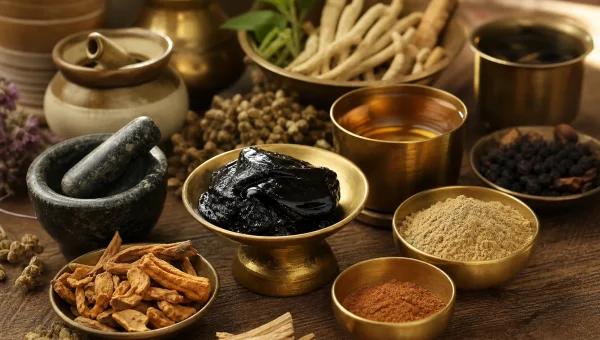
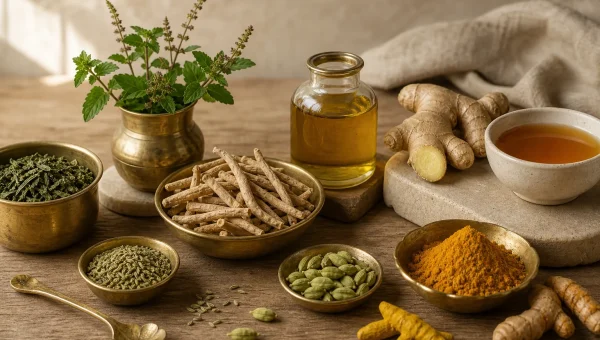
Full Abhyanga is a whole-body oil massage traditionally practiced as part of daily routine. Before training, use a shortened version that targets the joints you are about to load. Plain, untoasted sesame oil, known as Tila Taila, is a traditional Ayurvedic oil base. Warm the bottle in warm water if possible, use only a small amount, and wipe off any excess so your hands, feet, barbell, floor, or equipment do not become slippery.
- Shoulders (20 seconds): Apply a few drops to each shoulder and use firm circular strokes around the deltoid, upper arm, and back of the shoulder. Keep the pressure comfortable.
- Elbows and wrists (20 seconds): Massage around each elbow, then each wrist. Circle the joint, then briefly rub the forearm flexors and extensors.
- Knees (20 seconds): Massage around each kneecap without grinding into the bone. Include the patellar tendon below the kneecap and the quadriceps tendon above it.
- Hips and lower back (20 seconds): Rub the hip creases with the palms, then place both hands on the lower back and rub briskly up and down. The lumbar and pelvic region is especially relevant in Ayurvedic discussions of Vata.
- Wipe excess oil (10 seconds): Use a towel so the skin is lightly oiled but not greasy. Grip and footing must come first.
If oil use is awkward in a gym, apply it at home before leaving, or reserve it for early-morning, cold-weather, heavy lower-body, or high-volume training days. Avoid oil over open wounds, irritated skin, infections, rashes, or areas where tape, chalk, footwear, or a secure grip is required.
Phase 2: Joint Mobilization / Sandhichalan (120 seconds)
Sandhi means joint, and this phase follows the spirit of Sukshma Vyayama, the subtle joint movements used in many yoga traditions to loosen, warm, and awaken the body before deeper practice. Move smoothly rather than aggressively. The goal is not stretching to your limit; the goal is to bring motion, heat, and awareness into every major joint.
- Neck movements (15 seconds): Slowly turn right and left, then nod up and down within a comfortable range. Avoid forceful full neck circles or dropping the head sharply backward.
- Shoulder rolls (20 seconds): Roll both shoulders backward 8 times, then forward 8 times. Let the shoulder blades glide instead of shrugging hard.
- Elbow bends (10 seconds): Extend the arms forward and bend-straighten the elbows 12 to 15 times.
- Wrist circles (10 seconds): Make fists or interlace the fingers and circle the wrists 8 to 10 times each direction.
- Spinal rotations (15 seconds): Stand with feet hip-width apart and rotate the torso gently left and right, letting the arms swing naturally.
- Hip circles (15 seconds): Hands on hips, draw slow circles with the pelvis 6 to 8 times each direction.
- Knee circles (15 seconds): Feet close together, knees slightly bent, hands above the knees. Make small circles 6 to 8 times each direction. Keep the range pain-free.
- Ankle rolls (15 seconds): Balance on one foot or hold a wall. Circle each ankle 8 to 10 times each direction.
- Finger and toe flares (5 seconds): Spread fingers and toes wide, then lightly clench and release.
By the end of this phase, the joints should feel warmer, smoother, and easier to control. If a joint clicks without pain, move gently. If a joint produces sharp pain, instability, catching, swelling, or nerve symptoms, skip that movement and get assessed.
Phase 3: Three-Breath Activation / Pranayama Ignition (30 seconds)
This phase uses breath to shift attention from “arriving at the gym” to “ready to train.” In yogic practice, Kapalabhati and Bhastrika are forceful, heating breath practices, so they should be used carefully. Beginners, pregnant people, and anyone with high blood pressure, heart disease, vertigo, seizure history, panic sensitivity, hernia, recent surgery, or eye-pressure concerns should skip forceful breathing and use three slow nasal breaths instead.
- Breath 1: Gentle Kapalabhati-style exhale pulses (10 seconds): Stand tall. Take a comfortable inhale, then perform 10 to 15 light, short nasal exhales by drawing the lower belly inward. Keep the face and shoulders relaxed.
- Breath 2: Gentle Bhastrika-style bellows breath (10 seconds): Inhale and exhale through the nose with equal effort for 5 to 8 steady cycles. Do not strain or hyperventilate.
- Breath 3: Centering breath (10 seconds): Inhale fully but comfortably, pause only if it feels natural, lightly brace the abdomen, then exhale slowly. Let this be the bridge into movement, not a competition for breath retention.
After this phase, you should feel alert and steady, not dizzy or overstimulated. If breathwork makes you lightheaded, stop immediately, breathe normally, and use a simpler warm-up next time.
Phase 4: Body-Part Specific Warm-Up Finisher (60 seconds)
The first three phases prepare the whole body. The final minute rehearses the actual pattern you are about to train. Choose the option that matches your session and keep the movement crisp, controlled, and submaximal.
- Upper-body day: 10 band pull-aparts, 10 wall slides, and 8 to 10 scapular push-ups. Focus on shoulder blades gliding freely on the ribcage.
- Lower-body day: 8 to 10 bodyweight squats, 8 reverse lunges, and 8 glute bridges. Keep the feet rooted and the knees tracking comfortably.
- Full-body or conditioning day: 3 to 5 inchworms, 8 lateral lunges, and 10 light pogo hops or calf raises if jumping is appropriate for you.
- Running or cardio: 20 high knees, 20 butt kicks, and 10 leg swings per side in front-back and side-to-side directions.
- Yoga or mobility practice: 3 slow cat-cow cycles, 3 half sun-salutation flows, and 5 deep squats or supported malasana pulses.
Now the body has received oil or touch, joint motion, breath activation, and movement-specific rehearsal. Your first working set should still be gradual: begin with lighter loads or lower intensity before reaching training weight or pace.
The Quick-Reference Timing Chart
Use this chart when you already know the routine and want to move through it without thinking. The times are approximate; the principle is more important than the stopwatch.
- 0:00 to 1:30 — Abhyanga Lite: quick sesame-oil massage or dry friction massage on major joints
- 1:30 to 3:30 — Sandhichalan: neck, shoulders, elbows, wrists, spine, hips, knees, ankles, fingers, and toes
- 3:30 to 4:00 — Breath activation: gentle heating breath or three slow nasal breaths
- 4:00 to 5:00 — Session-specific movement finisher
The only equipment required is a small bottle of sesame oil and a towel. A resistance band is useful for upper-body days but not essential.
Adapting for Your Situation
If you train early in the morning, in cold weather, or after long sitting, give extra attention to the oil or friction phase and the joint-mobilization phase. If you are naturally dry, light, cold, restless, under-slept, older, or returning after time away, keep the breathwork gentle and the movement gradual. If you are hot, irritated, inflamed, or training in summer heat, reduce the forceful breathing and use slower nasal breaths instead.
If you are preparing for heavy squats, deadlifts, overhead presses, sprinting, martial arts, or sport, this five-minute sequence should be followed by ramp-up sets or sport-specific drills. Ayurveda favors preparation that matches the person, season, strength, digestion, and condition; modern training reaches the same conclusion through progressive loading.
Stop Warming Up Like It Is an Afterthought
A warm-up is not wasted time before training. It is the first layer of training. In Ayurvedic language, it brings warmth, oiliness, attention, and orderly movement into the places most likely to be disturbed by cold, dryness, rushing, and excessive force. In practical gym language, it makes joints feel better, movement feel cleaner, and the first loaded set less abrupt.
Oil the joints. Move the joints. Breathe into the body. Then load the body.
Five minutes is enough to change the quality of the session when it is done with attention. Keep it simple, repeat it every training day, and adjust it to the weather, your age, your injury history, and the demands of the workout.
Safety and When to Get Guidance
This article is educational and does not diagnose, treat, or prevent any medical condition. Consult a qualified Ayurvedic practitioner, physician, physical therapist, or other qualified healthcare provider before starting a new movement, breathwork, oiling, supplement, detox, or therapeutic protocol, especially if you are pregnant, managing a medical condition, recovering from injury or surgery, taking medication, or experiencing joint pain, swelling, instability, numbness, chest symptoms, dizziness, or shortness of breath.
References
- Revisiting the ‘Whys’ and ‘Hows’ of the Warm-Up: Are We Asking the Right Questions? (2024), PubMed Central
- Effectiveness of Warm-Up Intervention Programs to Prevent Sports Injuries among Children and Adolescents: A Systematic Review and Meta-Analysis (2022), PubMed Central
- NCBI
- Knee synovial fluid flow and heat transfer, a power law model (2023), PubMed Central
- Charaka Samhita — Vata dosha
- Charaka Samhita — Matrashiteeya Adhyaya
- Charaka Samhita — Vyayama
- Dravyaguna notes
- Ayurvedic Pharmacopoeia of India
- The efficacy of topical sesame oil in patients with knee osteoarthritis: A randomized double-blinded active-controlled non-inferiority clinical trial (2019), PubMed
- Yogauonline (yogauonline.com)
- Kamalayaconnect (kamalayaconnect.com)
- Sacred-texts (sacred-texts.com)
- Yogic Bellows, Neural Sparks: Unravelling the Neurophysiological Mechanisms of Kapalbhati-A Systematic Review (2026), PubMed Central
- Therapeutic role of yoga in hypertension (2024), PubMed Central

The labrum tear from a cold shoulder on a regular working weight is exactly the kind of injury that shouldn’t happen but does constantly. Joint temperature and fluid viscosity on cold mornings before warm-up are genuinely different. The 5 minutes wasn’t enough.
My yoga practice always includes specific joint rotation sequences before any loading and I’ve been doing this for ten years injury-free. Seeing the Ayurvedic pharmacological explanation for why moving synovia before loading protects the joint makes the practice more understandable.
How much time should the 5-minute protocol actually take? I’m assuming it should be closer to 10-15 minutes if done properly. The 5-minute framing might encourage people to do it too quickly to be effective.
The wrist and elbow joint attention for people who bench and press is where most warm-up guides fall short. The shoulder gets all the attention while the wrist and elbow, which are under just as much load, are typically ignored.
The Prana management during warm-up is the Ayurvedic concept that maps cleanly onto what sports scientists call proprioceptive activation. You’re not just warming tissues. You’re reestablishing the body’s awareness of where each joint is in space before loading it.
I’ve been lifting for six years and my warm-up was always cardio and a few arm circles. After following this protocol for three months I’ve had zero joint incidents versus the regular minor tweaks I used to expect. Simple investment for significant return.
Is the warm-up described here sufficient on its own or is it intended as a precursor to additional dynamic warm-up work? I want to understand whether this replaces my current warm-up or adds to it.
The synovial fluid viscosity principle you describe is taught in sports medicine and physical therapy training. Cold synovial fluid is more viscous and provides less lubrication. This is basic joint biomechanics that gym culture consistently ignores.
I started the oil application to joints before early morning sessions after reading this and the creaking in my knees on the first set of squats has noticeably reduced. Whether that’s the oil or just the additional attention to warm-up timing, the result is positive.
I’ve had two training partners blow out knees in the last year, both in cold gyms with inadequate warm-ups. The article makes the case for why this is preventable. There are enough injured lifters out there that content like this needs to reach the gym culture broadly.
The story about tearing the labrum on a regular bench press really hits home for anyone who thinks a quick treadmill walk is enough.
the hip joint mobility section is what I’ve been missing. all my warm-up attention goes to the prime movers and I consistently neglect hip capsule mobility. the specific rotation pattern described here has already helped with the deep squat position I’ve been struggling with for months
After reading about synovial fluid getting thicker in cold weather I wonder if adding a quick oil rub before lifts could help my knees feel less stiff.
You mentioned using sesame oil for the self massage does the scent linger on clothing or is it easy to wash out
It seems like the three breath activation is the part most people skip trying Kapalabhati before a workout might feel odd at first
Maybe the real takeaway is that joint preparation needs to be specific not just a generic cardio warm up and that five minutes can actually be enough if done right
Is the the oil massage before workout version from Kerala classical or is it more modern?
@John totally agree on Vata joint prep protocol. i reduced the dose initially too.
same experience here. give it another few weeks.
not convinced by the the oil massage before workout argument. would need to see better evidence
I’m a nursing student and morning movement timing isn’t covered in our curriculum at all. Interesting to read the classical view.
I’m a bit skeptical of the claims around the 5 joint warm-up sequence. The mechanism you describe sounds plausible but where’s the data?
Sharing this.
Can Vata joint prep protocol be done at home or do you need a certified practitioner?
finally tried the oil massage before workout after reading this. no miracle cure but genuinely helpful
Where are the actual studies on the oil massage before workout? A few citations would strengthen this considerably.
The chart you showed for morning movement timing , is that based on any published clinical guidelines? 💯
not sure about the Tadasana variation for knees part but my practitioner said give it 6 weeks 🙏
Sorry off-topic but does anyone have experience with Ayurvedic treatment for hair thinning?
Have been doing Tadasana variation for knees for about 3 months. Saw improvement in month 2, slight plateau now.
At what point should someone stop self-administering Vata joint prep protocol and see a vaidya?
Tried morning movement timing for 6 weeks, honestly didn’t notice much. Maybe my dosage was off.
I’m a nursing student and the oil massage before workout isn’t covered in our curriculum at all. Interesting to read the classical view.
Started Vata joint prep protocol six weeks ago after reading a different article, came here to compare approaches.
Can the oil massage before workout be done at home or do you need a certified practitioner?
The part about the oil massage before workout finally cleared up something I’d been confused about for months. 🌿
Is the Tadasana variation for knees protocol you described safe for someone with hypothyroidism?
magnificent issues altogether, you just won a new reader. What may you suggest in regards to your post that you simply made some days ago? Any positive?
Been following this blog for a while and the Tadasana variation for knees post is one of the most useful ones.
Makes sense.
The Tadasana variation for knees schedule in section 2 , is that for all three doshas or specifically for Kapha?
Is there an age limit for Tadasana variation for knees? Asking for my 68-year-old father.
Picked up the Tadasana variation for knees prep from the section on seasonal variation. Results after 4 weeks: good.
I came for The 5-Minute Ayurvedic Warm-Up and this answered the main question. Small daily changes are easier to follow than a perfect plan.
the article is good but the the 5 joint warm-up sequence part felt rushed. could use more depth
my ayurvedic doctor told me the same thing about morning movement timing last month. glad to see it here