
After 50, vitality depends less on forcing the body and more on rebuilding capacity with rhythm, nourishment, recovery, and carefully chosen rejuvenative support. Classical Ayurveda’s most relevant framework for this stage is Rasayana chikitsa: rejuvenative care for preserving dhatu quality, bala, memory, vitality, complexion, voice, sensory strength, and resistance to illness. Kept in its authentic form, Rasayana is not a quick anti-aging hack. It is a long-course discipline of food, conduct, exercise, sleep, purification when indicated, and individualized herbs or mineral preparations.
What Rasayana Actually Means
Rasayana is traditionally understood as a means of nourishing and refining rasa, the first dhatu and the nutritive foundation from which the later tissues are sustained. Charaka Samhita gives Rasayana an entire opening chapter of Chikitsa Sthana and describes it as a therapy that supports long life, memory, intellect, health, youthfulness, luster, complexion, voice, strength of body, strength of the senses, and excellence of tissues. The same classical framework treats Rasayana broadly: it may include food, lifestyle, conduct, and medicines, not only herbs in capsules.
For men in their 50s, 60s, and beyond, this matters because the classical goals of Rasayana are not cosmetic. They map closely to the practical concerns of aging men: recovery, strength, clarity, digestion, sleep discipline, libido, immune resilience, and the ability to keep training without depletion.
The Physiological Reality After 50
Ageing commonly brings gradual shifts in testosterone, muscle quality, mitochondrial capacity, recovery speed, and training tolerance. Total testosterone tends to decline gradually with age, and skeletal muscle mitochondria also become less efficient unless movement and recovery remain consistent. Ayurveda approaches this stage through bala, agni, ojas, dhatu-poshana, and srotas clarity: build what is depleted, clear what is obstructed, avoid excess strain, and choose Rasayana only when digestion and lifestyle can support it.
The Five Primary Rasayanas for Men Over 50
The following herbs and preparations are not a one-size-fits-all stack. They represent a practical Rasayana framework for male vitality after 50, to be adapted by constitution, digestion, medications, medical history, and the presence or absence of ama.
Ashwagandha (Withania somnifera) for Strength, Sleep Support, and Recovery
Ashwagandha is best used in this context as a balya and strengthening Rasayana for men with fatigue, stress load, poor recovery, or vata-type depletion. Human supplementation protocols have commonly used standardized root extracts in the 300–600 mg daily range. In men aged 40–70 with mild fatigue, an 8-week ashwagandha extract protocol was associated with higher DHEA-S and testosterone than placebo, while symptom outcomes were less consistent. For men over 50, ashwagandha is most appropriate when the goal is rebuilding steadiness, sleep quality, and training recovery rather than forcing stimulation. It is commonly taken with warm milk or food when digestion permits.
Shilajit (Shilajatu) for Stamina, Metabolic Heaviness, and Mineral Support
Classical Ayurveda praises Shilajatu as a powerful Rasayana when used methodically, especially in patterns involving kapha, meda, ama, and obstruction of vata. This makes it more suitable for men with heaviness, sluggish metabolism, poor stamina, and obstructive patterns than for men who are severely depleted, dry, undernourished, or overheated. A purified shilajit protocol of 250 mg twice daily for 90 days has been associated with increased total testosterone, free testosterone, and DHEA-S in healthy men aged 45–55. The practical rule is strict: use only purified, lab-tested shilajit from a reliable source, because poor-quality mineral products can contain unsafe heavy metals.
Amalaki (Emblica officinalis) and Chyawanprash for Cellular Rejuvenation
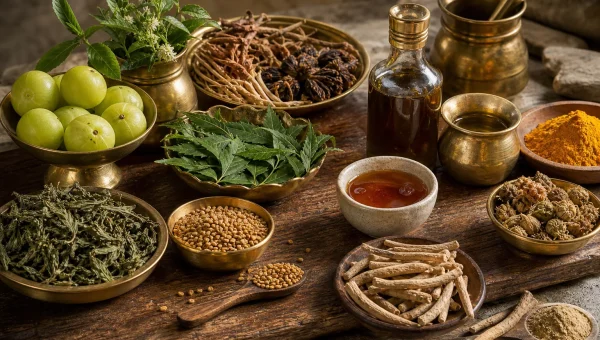
Amalaki is one of Ayurveda’s most important rejuvenative fruits and a central ingredient in classical Rasayana preparations such as Chyawanprash. It is valued for supporting rasa, digestion, complexion, and tissue nourishment without excessive heating. Amalaki contains antioxidant tannins including emblicanin A, emblicanin B, punigluconin, and related compounds. In an Amalaki Rasayana protocol used in adults aged 45–60, telomerase activity increased without a clear short-term change in telomere length. Practically, men over 50 may use Amalaki as a prescribed Rasayana, as Chyawanprash in modest amounts, or as dried fruit powder when sugar intake, digestion, and constitution allow.
Shatavari (Asparagus racemosus) for Nourishment, Dryness, and Ojas Support
Shatavari is often presented as a women’s herb, but classical Rasayana lists include it among nourishing life-promoting substances taken with milk. For men over 50, its best use is not as a testosterone herb but as a cooling, nourishing, tissue-supportive Rasayana when there is dryness, depletion, irritability, heat, low reserve, or poor recovery from overwork. It is especially appropriate when a man needs rebuilding rather than stimulation. It may be less suitable in heavy kapha states, sluggish digestion, thick coating on the tongue, or active ama.
Brahmi, Bacopa, and Medhya Rasayana for Cognitive Longevity
The cognitive Rasayana category is traditionally called Medhya Rasayana. Charaka names Mandukaparni, Yashtimadhu, Guduchi, and Shankhapushpi in this context for promoting intellect and mental steadiness. In contemporary Ayurveda, Bacopa monnieri is also commonly used under the name Brahmi for memory and learning support. Standardized Bacopa extract at 300 mg daily has been associated with improved memory acquisition and retention in healthy older adults. It is best taken consistently with food, and men with sensitive digestion should begin cautiously because gastrointestinal discomfort is a common limiting factor.
The Rasayana Protocol Stack
A Rasayana routine for men over 50 should be simple enough to sustain and gentle enough not to overload digestion. The stack below is a practical template, not a universal prescription. It is strongest when paired with regular meals, moderate training, early sleep, and seasonal adjustment.
Dietary Rasayanas: Ojas-Building Kitchen Support
Food is part of Rasayana when it supports clear digestion, steady energy, and tissue nourishment. The goal is not simply to eat heavier foods; it is to match nourishment with digestive capacity. For men over 50, the most useful Rasayana diet is warm, regular, protein-sufficient, lightly unctuous, and easy to digest.
| Support | Classical Role | Practical Use | Best Fit |
|---|---|---|---|
| Warm milk | Common vehicle for nourishing Rasayana herbs | Used with Ashwagandha or Shatavari when tolerated | Dryness, depletion, poor recovery, vata aggravation |
| Cow’s ghee | Unctuous support and carrier in many Ayurvedic preparations | Small amount with meals when digestion is strong | Dryness, light body, hard training, vata tendency |
| Amalaki or Chyawanprash | Classical Rasayana support centered on Amalaki | Small daily amount, adjusted for sugar tolerance and digestion | General rejuvenation, complexion, tissue support |
| Triphala | Rasayana and digestive-channel support | Used when elimination and digestive clarity need support | Kapha-pitta imbalance, sluggish bowels, coated tongue |
Movement as Rasayana
Ayurveda does not separate longevity from movement. Vyayama is described as exercise that brings lightness, work capacity, firmness, and strength. For men over 50, the Rasayana approach is not reckless intensity; it is ardhashakti, training within an appropriate fraction of one’s capacity while considering age, strength, season, diet, and recovery. In practical terms, this means two to four weekly sessions of resistance training, daily walking or mobility, and brief conditioning work only when sleep, joints, and digestion are stable.
Modern exercise physiology fits this classical caution well. Resistance training preserves muscle and strength, while interval-style aerobic work can support mitochondrial function when introduced progressively. The Rasayana principle is consistency over heroics: the man who trains moderately for decades gains more vitality than the man who alternates between overtraining and collapse.
Safety and Practitioner Guidance
Nothing in this article diagnoses, treats, or cures a medical condition. Consult a qualified Ayurvedic practitioner or healthcare provider before starting Rasayana herbs, mineral preparations, detoxification, or therapeutic protocols, especially if you take medication, have liver disease, thyroid disease, diabetes, hypertension, prostate disease, hormone-sensitive cancer, kidney disease, digestive disease, or a history of heavy metal exposure. Shilajit and other mineral preparations should be purified, lab-tested, and used only under appropriate guidance.
References
- Charaka Samhita — Rasayana Adhyaya
- Testosterone for the aging male; current evidence and recommended practice (2008), PubMed Central
- Nature (nature.com)
- A Randomized, Double-Blind, Placebo-Controlled, Crossover Study Examining the Hormonal and Vitality Effects of Ashwagandha ( Withania somnifera) in Aging, Overweight Males (2019), PubMed
- NIH Office of Dietary Supplements
- Clinical evaluation of purified Shilajit on testosterone levels in healthy volunteers (2016), PubMed
- NCCIH
- FDA
- Antioxidant activity of active tannoid principles of Emblica officinalis (amla) (1999), PubMed
- Influence of Amalaki Rasayana on telomerase activity and telomere length in human blood mononuclear cells (2017), PubMed
- Plant profile, phytochemistry and pharmacology of Asparagus racemosus (Shatavari): A review (2013), PubMed Central
- NCBI
- Does Bacopa monnieri improve memory performance in older persons? Results of a randomized, placebo-controlled, double-blind trial (2010), PubMed
- Charaka Samhita — Vyayama
- Ijmhsjournal (ijmhsjournal.in)
- Enhanced Protein Translation Underlies Improved Metabolic and Physical Adaptations to Different Exercise Training Modes in Young and Old Humans (2017), PubMed
I turned 52 last year and the diminishing returns on my previous approach are real. More training does not produce more results. Reading about Rasayana as a category specifically designed for post-50 regeneration rather than ongoing performance is a useful reframe.
I am 56 and have been on a Chyawanprash-based Rasayana protocol for 8 months. My hematologist noted improved red cell morphology at my last check. He asked what I had changed. I told him. He was skeptical but could not argue with the labs.
The safest part of the Rasayana for Men Over 50 advice is keeping it simple. This feels more usable than a long list of herbs.
I tried Brahma Rasayana for 90 days as my first rasayana protocol. The primary effect I noticed was sleep quality improvement. Not what I was targeting but a significant benefit given that my sleep had been poor for years.
The distinction between Kamya Rasayana (for those seeking specific gains) and Naimittika Rasayana (therapeutic for disease states) is something my practitioner applies but had never explained explicitly. Understanding which category I am in changes how I think about the protocol duration and goals.
I am a cardiologist who hit 55 and started taking my own medicine about lifestyle. The Rasayana framework here overlaps significantly with longevity medicine concepts: mitochondrial support, telomere protection, immune modulation. Not identical but directionally aligned.
The article mentions Ashwagandha as a primary Rasayana but does not address cycling protocols for men over 50. At this age, should we cycle Ashwagandha differently than younger men, given the potential effect on thyroid and hormone levels with extended use?
Are there food interactions with rasayana that I should be aware of? My Ayurvedic doctor mentioned something about dairy but wasn’t specific.
The breakdown of how Rasayana targets testosterone and mitochondrial function makes the ancient approach feel surprisingly modern.
The caveat that Kutipraveshika Rasayana, the indoor isolation protocol, is not practical for modern life is important and honest. I appreciate when traditional approaches are presented without romanticizing the parts that are genuinely impractical.
The research cited is old and small. n=96 for a genomic study in 2015 would not pass peer review today. I’d want to see updated work before drawing strong conclusions.
I wonder if taking ashwagandha with warm milk at night really improves sleep quality for guys over fifty.
The combination of Amalaki with Pippali as a Rasayana pair is something my grandfather used throughout his 80s with robust health. I never questioned why both were used together. The synergistic bioavailability enhancement that Pippali provides for Amalaki’s constituents explains the rationale.
Has anyone tried the full morning stack with Chyawanprash, shilajit, and brahmi together? Curious about taste.
The article’s note on ojas depletion and shatavari’s role caught my attention; I’d like to see more on combining it with ashwagandha.
I’ve read that fulvic acid in shilajit can act like an electron carrier, but does the 300mg dose feel safe long term?
Seeing the reference to Charaka Samhita’s chapter on rasayanas makes me want to look up the original Sanskrit verses.
The protocol’s suggestion to exercise at half max capacity seems like a smart way to avoid injury while still building strength.
Does amalaki’s vitamin C content stay potent when dried into a 500mg extract, or is fresh fruit better for telomere support?
I appreciate that the piece distinguishes rasayana from typical antiaging marketing and grounds it in classical texts.
The mention of mitochondrial density dropping 10% per decade after forty lines up with what I’ve seen in recent aging research.
Trying the nightly ashwagandha in warm milk plus triphala could be a simple first step before adding the whole stack.
I would like more detail on Rasayana for Men Over 50. This feels more usable than a long list of herbs.
Started the testosterone support herbs six weeks ago after reading a different article, came here to compare approaches.
probably best to check with a qualified vaidya on Amalaki Rasayana for men over 50
the anti-aging stack section protocol gave me headaches the first week. had to reduce the dose significantly
yes! Amalaki Rasayana for men over 50 worked similarly for me, thanks for sharing
I notice you don’t mention any contraindications for Amalaki Rasayana for men over 50. That feels like an important omission.
Is there an age limit for the anti-aging stack section? Asking for my 68-year-old father.
The Amalaki Rasayana for men over 50 schedule in section 2 , is that for all three doshas or specifically for Kapha?
Reading this later and the Rasayana for Men Over 50 advice still feels relevant. A few more examples would still help.
interesting but i disagree with the the testosterone support herbs approach. my experience was the opposite
Reading this later and the Rasayana for Men Over 50 advice still feels relevant. The safety notes could be expanded a little.
The chart you showed for Amalaki Rasayana for men over 50 , is that based on any published clinical guidelines? 🌿
Picked up a bottle of Ashwagandha 600mg twice daily for seniors last week but wasn’t sure about timing. Your dosage section helped.
Can Ashwagandha 600mg twice daily for seniors be done at home or do you need a certified practitioner?
Picked up a bottle of the testosterone support herbs last week but wasn’t sure about timing. Your dosage section helped.
The chart you showed for the testosterone support herbs , is that based on any published clinical guidelines?
Finally someone wrote clearly about Amalaki Rasayana for men over 50 without the usual vague advice.
Bit unrelated but has anyone here tried Panchakarma and found it worth the cost?
shared this with my mom, shes been asking about Ashwagandha 600mg twice daily for seniors forever
Not dismissing the testosterone support herbs entirely but it didn’t do much for me. My constitution might be different.
I’m a nursing student and the testosterone support herbs isn’t covered in our curriculum at all. Interesting to read the classical view.
The Rasayana for Men Over 50 section feels grounded enough to try carefully. The article avoids making it sound like a quick fix.
The chart you showed for the anti-aging stack section , is that based on any published clinical guidelines?
My naturopath recommended the anti-aging stack section and I wanted more background on the classical reasoning.
What’s the difference between the the testosterone support herbs approach for acute vs chronic conditions?
Tried the testosterone support herbs twice before with no results. Three months each time. Not everyone responds the same.
The advice around Rasayana for Men Over 50 is specific enough to be useful. Would be useful to see a short checklist next.
The advice around Rasayana for Men Over 50 is specific enough to be useful. This would be easier to follow with a one-week sample plan.
Is the Amalaki Rasayana for men over 50 protocol you described safe for someone with hypothyroidism?
The Rasayana for Men Over 50 angle is useful here. I would still ask a practitioner before changing medicines.