
You want lean muscle. You train hard, plan your protein, and still feel that the body is not converting effort into stable tissue. Ayurveda approaches this through Mamsavaha Srotas, the channel system connected with Mamsa Dhatu (muscle tissue). The practical goal is not simply to add more protein or more herbs; it is to match food, training, recovery, and herbs to your Agni so that nourishment can move through clear channels and support durable strength.
What Is Mamsavaha Srotas?
Mamsavaha Srotas is the Ayurvedic channel system associated with the nourishment and maintenance of Mamsa Dhatu. Classical Ayurvedic physiology describes the sustaining tissues as Rasa, Rakta, Mamsa, Meda, Asthi, Majja, and Shukra; Mamsa is understood after Rasa and Rakta in this dhatu sequence. In this model, muscle building depends on the quality of digestion, the quality of nourishment, and the unobstructed movement of that nourishment through the relevant srotas.
Charaka Samhita describes the roots of Mamsavaha Srotas as snayu and tvak, commonly interpreted as ligamentous/tendinous structures and skin. This is why an Ayurvedic muscle protocol is broader than protein intake alone: it also pays attention to connective support, oiling, recovery, meal timing, and the avoidance of heavy channel-blocking habits that disturb Mamsa-related channels.
The Protein Protocol: Match Intake to Agni
Modern resistance-training nutrition commonly places daily protein for active people in the range of about 1.4–2.0 g/kg/day, with many athletes spreading protein across meals rather than forcing it into one sitting. Ayurveda adds a second question: can your Agni digest the amount and form of protein you are taking? If protein leaves heaviness, belching, coating on the tongue, bloating, dullness, or poor appetite at the next meal, the intake may be too heavy for the current digestive state.
The first step is to make protein digestible: use warm cooked meals, suitable spices, consistent meal timing, and portions that leave lightness after digestion. Protein powder, eggs, dairy, legumes, meat, or fish may all be inappropriate when they exceed digestive capacity. The right protein plan is the one that supports appetite, bowel regularity, sleep, training output, and steady recovery without creating Ama-like heaviness.
Agni Assessment
Vishama Agni tends to feel variable, with irregular appetite, gas, bloating, and inconsistent tolerance of dense foods. Tikshna Agni tends to feel sharp, with strong hunger, heat, acidity, irritability when meals are delayed, and a tendency to overdo pungent or heating foods. Manda Agni tends to feel slow, with low appetite, heaviness, sluggishness after meals, and poor tolerance of oily or dense foods. A muscle-building protocol should first stabilize the digestive pattern, then increase training load and protein gradually.
Key Herbs for Mamsa Support
Herbs are best chosen by constitution, digestive state, sleep quality, training load, and medical history. Classical powders, decoctions, ghrita preparations, and modern extracts are not interchangeable, so dose and form should be decided with a qualified Ayurvedic practitioner.
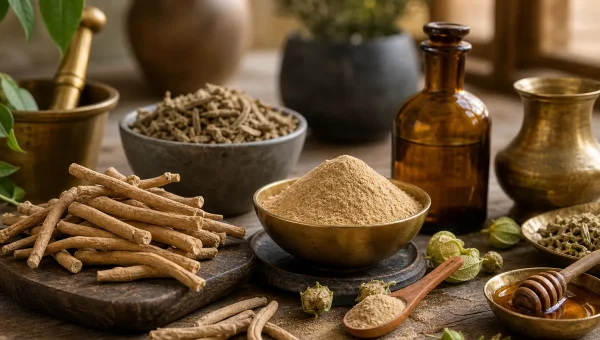
Ashwagandha (Withania somnifera): The Ayurvedic Pharmacopoeia of India lists Ashwagandha root as tikta-kashaya rasa, laghu guna, ushna virya, madhura vipaka, and gives actions including rasayana, balya, vata-kapha-hara, and vajikarana. A practical classical-style dose range for the powder is commonly listed as 3–6 g. For modern extract use in resistance-training adults, 300 mg twice daily has been used; this should not be treated as a universal dose for every person.
Shatavari (Asparagus racemosus): Shatavari root is described in the Ayurvedic Pharmacopoeia with madhura-tikta rasa, guru-snigdha guna, shita virya, madhura vipaka, and actions including balya, rasayana, vrishya, and vatahara. It is more appropriate for dry, depleted, heat-prone, or overtrained patterns than for heavy Kapha-type sluggishness.
Vidari Kanda (Pueraria tuberosa): Vidarikanda is listed in the Ayurvedic Pharmacopoeia as the dried tuber of Pueraria tuberosa. Its properties are given as madhura rasa, guru-snigdha guna, shita virya, madhura vipaka, with actions including brimhana, balya, vrishya, jivaniya, and rasayana. In a muscle protocol, it fits best where the goal is nourishing depleted tissue, not where digestion is already heavy or coated.
Kapikacchu / Atmagupta (Mucuna pruriens): The Ayurvedic Pharmacopoeia lists Atmagupta root as Mucuna prurita / Mucuna pruriens, with actions including brimhana, balya, vrishya, and vajikarana. Because Mucuna is associated with L-DOPA content and can affect the nervous system and medications, it should be used only with professional guidance, especially in people taking psychiatric, neurological, blood pressure, or dopaminergic medicines.
Protein Food Hierarchy by Dosha
This table is a practical starting point for choosing digestible protein patterns. It is not a rigid diet chart. Your actual plan should consider appetite, bowel habits, training time, climate, food ethics, allergies, and whether animal foods are part of your diet.
| Pattern | Better Protein Emphasis | Timing | Use Caution With |
|---|---|---|---|
| Vata / dry-variable digestion | Warm cooked mung dal, well-cooked lentils, milk if tolerated, ghee-supported meals, eggs or meat broth where appropriate | Regular meals every 3–4 hours; avoid long gaps before heavy training | Cold shakes, raw bars, dry roasted snacks, excessive fasting |
| Pitta / sharp-hot digestion | Mung dal, cooling dairy if tolerated, rice-dal meals, moderate eggs or fish where appropriate | Largest meal around the strongest appetite; avoid delaying meals until irritability or acidity appears | Very spicy protein meals, fried meats, excess red meat, overheating supplements |
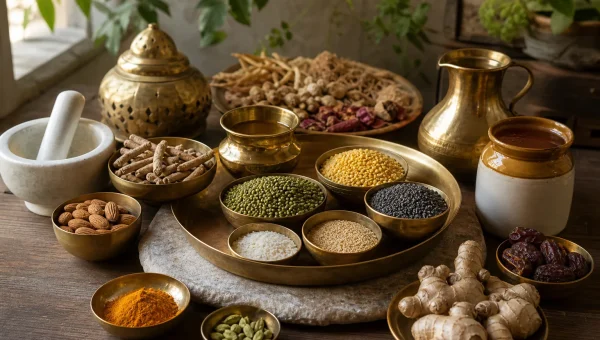
| Kapha / slow-heavy digestion | Lighter legumes, lentils, chickpeas, sprouts only if well tolerated, lean proteins where appropriate, warming spices | Two or three clear meals; lighter evening meal; avoid grazing | Heavy dairy, excess nuts, sweet protein bars, oversized shakes, day sleep after meals |
Training Alignment with Mamsavaha Srotas
Ayurveda classifies exercise as Vyayama. The classical measure is not collapse, exhaustion, or breathless intensity; it is training to an appropriate capacity. Traditional signs of adequate exertion include sweating, lightness, increased warmth, and effort while still maintaining control. For muscle gain, this means progressive resistance training with good form, enough rest between sessions, and stopping before strain turns into depletion.
Train when the previous meal is digested and the body feels clear. Avoid heavy lifting immediately after a large meal, during acute indigestion, during illness, or when sleep debt is high. Charaka specifically connects Mamsavaha Srotas disturbance with heavy, bulky, channel-blocking food and sleeping in the day after eating, so the muscle protocol must include disciplined meal timing and recovery habits, not only gym intensity.
Post-Workout Recovery Protocol
After training, choose warm, digestible nourishment instead of a cold overloaded shake. A simple recovery meal can combine rice or another tolerated grain with mung dal, ghee if suitable, cooked vegetables, and enough protein to match the day’s total requirement. If milk is digested well, warm milk may be used as an anupana for prescribed herbs such as Ashwagandha; if milk causes heaviness, mucus, acne flares, or bloating, use a different practitioner-approved vehicle.
The recovery target is clear: appetite should return naturally, soreness should reduce across the week, sleep should remain steady, and the next morning should feel light rather than coated and dull. Increase protein and herbs only when these signs are stable.
Abhyanga for Muscle Recovery
Abhyanga, or warm oil massage, is useful in a strength-building routine because it helps calm excess Vata, supports relaxation, and prepares the body for better rest. For lifters with dryness, cracking joints, restlessness, or post-training tightness, warm sesame-based oiling before a bath can be helpful. Classical formulations such as Mahanarayana Taila or Bala-Ashwagandha-based oils should be selected according to constitution, season, skin tolerance, and practitioner advice.
Use Abhyanga as recovery support rather than as a substitute for sleep, progressive training, and adequate food. Apply warm oil to major muscle groups, joints, and areas of tightness; allow it to sit briefly; then bathe. Avoid oil massage during fever, acute indigestion, active skin infection, immediately after a heavy meal, or whenever it worsens heaviness.
Ama Clearance: The Non-Negotiable Foundation
No muscle protocol works well when the digestive system is overloaded. In practice, Ama-like signs include a coated tongue, dull appetite, heaviness after meals, sluggish bowels, sticky stools, foul belching, and low morning energy. When these signs are present, reduce the load before increasing it: simplify meals, prefer warm cooked foods, avoid cold shakes and heavy snacks, do not sleep after meals, and use spices only in a way that matches your constitution.
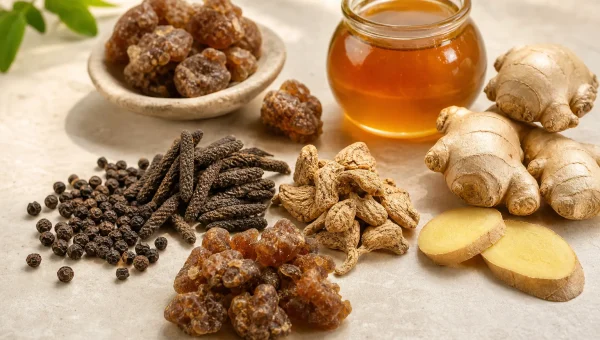
Trikatu is traditionally made from dry ginger, black pepper, and long pepper. It is sharp and heating, so it is not a casual daily supplement for everyone. It may suit some Kapha-type heaviness under supervision, but it can aggravate acidity, burning, ulcers, bleeding tendencies, pregnancy-related sensitivity, and Pitta-dominant heat. Because piperine from black pepper can alter the handling of some medicines, people taking medication should use Trikatu only with professional guidance.
Putting It Together
The complete Mamsavaha Srotas approach is simple but precise: build Agni first, choose protein you can actually digest, train progressively without exhausting yourself, recover with warm nourishment, use herbs according to constitution, and keep the channels clear by avoiding heavy, incompatible, and post-meal sleep habits. When these pieces align, the body has a better foundation for stable Mamsa Dhatu, strength, and recovery.
Nothing in this article diagnoses or treats a medical condition. Use it as educational information and consult a qualified Ayurvedic practitioner or healthcare provider before starting herbs, supplements, detoxes, or therapeutic protocols, especially if pregnant, managing a condition, taking medication, or using hormone, psychiatric, neurological, blood pressure, diabetes, or fertility-related medicines.
References
- Charaka Samhita — Sroto Vimana
- Concepts of Dhatu Siddhanta (theory of tissues formation and differentiation) and Rasayana; probable predecessor of stem cell therapy (2014), PubMed Central
- International Society of Sports Nutrition Position Stand: protein and exercise (2017), PubMed Central
- Easyayurveda (easyayurveda.com)
- Ayurvedic Pharmacopoeia of India
- Examining the effect of Withania somnifera supplementation on muscle strength and recovery: a randomized controlled trial (2015), PubMed Central
- Miracledrinksclinic (miracledrinksclinic.com)
- Dravyaguna notes
- Natural Ingredient Resource Center
- Mucuna pruriens and its major constituent L-DOPA recover spermatogenic loss by combating ROS, loss of mitochondrial membrane potential and apoptosis (2013), PubMed Central
- Charaka Samhita — Vyayama
- Easyayurveda (easyayurveda.com)
- An Ayurvedic formulation ‘Trikatu’ and its constituents (1992), PubMed
- Molecular and pharmacological aspects of piperine as a potential molecule for disease prevention and management: evidence from clinical trials (2022), PubMed Central
- NCCIH
the step by step approach makes this way more approachable than other stuff ive found
This is better than the consultation I paid for. Seriously thorough and well-researched.
This is such encouraging feedback. Keep going with the protocol and feel free to share updates!
Thank you for engaging with this so deeply! Your perspective adds so much value to the conversation here.
tried so many approaches and this is the first one that actually makes sense for my body type
This level of detail is what sets this site apart from the dozens of other Ayurveda blogs.
my ayurvedic doc recommended nearly the same protocol! nice to see it validated
The to Building Lean Muscle section feels grounded enough to try carefully. Good starting point for a cautious reader.
What a wonderful question. The short answer is that individual constitution matters enormously here. I’d recommend starting gently and adjusting based on your body’s response.
This level of detail is what sets this site apart from the dozens of other Ayurveda blogs
I work in healthcare and appreciate the balanced approach here. Not anti-medicine, just complementary.
reading this with my morning chai. couldnt ask for a better start to the day
I’ll be honest, I spent quite a bit on the recommended herbs and supplements with minimal results. Buyer beware.
Thank you for sharing your experience! Stories like yours help other readers see what’s possible with consistent practice.
I think there’s a middle ground being missed here. You don’t have to choose between Ayurveda and conventional medicine, both have value.
ive tried everything and this is honestly the first approach that makes sense for my body
My mother has been doing this her whole life and she’s the healthiest 70-year-old I know.
I was looking for a plain explanation of to Building Lean Muscle. I appreciate that it does not oversell the result.
I came for to Building Lean Muscle and this answered the main question. The practical details matter more than people think.
Been waiting for someone to write about this topic properly. You delivered.
I struggled with this for years before discovering Ayurveda. Six months later, I barely recognize my old self.
Valid concerns. Ayurveda works best as a complementary approach, not a replacement for evidence-based medicine. Thank you for highlighting this important distinction.
I was looking for a plain explanation of to Building Lean Muscle. The safety notes could be expanded a little.
The Agni piece is what I had been missing from every gym-focused muscle protocol. I was eating enough protein but my digestion was clearly not up to processing it efficiently. Adding the digestive preparation before high-protein meals has made a noticeable difference in recovery.
Good reminder on to Building Lean Muscle. I would like to know how long to try it before judging results.
The section on timing is something I’ve never seen addressed elsewhere. So important.
been following this site for a few months now and the quality is consistently great
Your skepticism is healthy and welcome. We never intend for our content to replace medical advice, and we’ll make that clearer going forward.
I came for to Building Lean Muscle and this answered the main question. Would be useful to see a short checklist next.
I came for to Building Lean Muscle and this answered the main question. I would still ask a practitioner before changing medicines.
The explanation of mamsavaha srotas as the micro channel network really clarified why my protein shakes weren’t giving results.
I came for to Building Lean Muscle and this answered the main question. This is the kind of detail readers can test slowly.
I came for to Building Lean Muscle and this answered the main question. The article avoids making it sound like a quick fix.
I came for to Building Lean Muscle and this answered the main question. I appreciate that it does not oversell the result.
Wondering how vidari kanda powder mixes with ghee in the morning, does it clump or dissolve easily?
Shifting my biggest meal to midday as suggested for pitta types made my energy steadier during afternoon lifts.
Noticing that training until light sweat appears on forehead and joints lines up with the 70 80% heart rate zone mentioned.
Recognizing my irregular appetite as vata agni helped me adjust meal timing without feeling deprived.
Pranayama practices involving breath retention are contraindicated in glaucoma, which is not mentioned here. Increased intraocular pressure during Kumbhaka can worsen glaucoma. This omission is a safety concern for a common condition in the older adult population likely reading this.
Adding a pinch of black pepper to the post workout ashwagandha milk seemed to improve the taste and warmth.
The integration with modern physiology is what makes this article stand out. Started with half the dose initially.
Shared this with my mother who has been dealing with this for 5 years. The timing of doses matters more than I expected.
Tried this for 6 weeks and noticed less bloating. Still a work in progress.
The classical Sanskrit terms with explanations are helpful for beginners. Results are slow but steady.
My integrative doctor agrees with this approach, which surprised me. Consistency seems to be the key.
Any recommended books for deeper reading on this topic? Results are slow but steady.
The mechanism explanation is clearer than the PubMed abstract I read. Combined with yoga practice for better results.
The avoidance of cold foods during treatment is something my body confirmed independently. Combined with yoga practice for better results.
Using trikatu before meals cleared my morning tongue coating and reduced bloating after protein.
I appreciate that the article mentions when to see a doctor rather than only promoting herbs. The diet changes helped too.
Does anyone know if this applies for a Vata-Pitta dual prakriti? The diet changes helped too.
Bookmarking this. Need to discuss it with my doctor first. Combined with yoga practice for better results.
Does anyone know if this applies for a Vata-Pitta dual prakriti? Combining with dietary changes.
Is there any published work mapping the 13 Srotas to modern anatomical structures in a peer-reviewed format?
My vaidya prescribed something nearly identical. Good to see the classical basis. Combining with dietary changes.
The classical Sanskrit terms with explanations are helpful for beginners. The quality of the herb matters a lot.
The contraindication list should be read first before starting anything here. Consistency seems to be the key.
Massaging mahanarayan taila on my quads before shower eased the usual post leg day soreness.
Is this safe with antacids? Combined with yoga practice for better results.
The avoidance of cold foods during treatment is something my body confirmed independently. Digestive improvement came before other benefits.
The classical Sanskrit terms with explanations are helpful for beginners. More research needed but encouraging.
The idea that ghee acts as a yogavahi to drive nutrients into mamsa dhatu makes me want to try it with my kitchari tonight.
My vaidya prescribed something nearly identical. Good to see the classical basis. Started with half the dose initially.
The contraindication list should be read first before starting anything here. Still a work in progress.
My practitioner suggested something similar last year. The results were gradual but real. Started with half the dose initially.
Artava vaha srotas (female reproductive) section is the most clinically detailed part here.
The diet changes listed here are harder to follow than the herbs but more impactful. My sleep improved first, then energy.
The diet changes listed here are harder to follow than the herbs but more impactful. Results are slow but steady.
I appreciate that the article mentions when to see a doctor rather than only promoting herbs. Took 3 weeks before I noticed anything.
Three months in and the improvement is steady if slow. My sleep improved first, then energy.
I appreciate that the article mentions when to see a doctor rather than only promoting herbs. Still a work in progress.
Anyone else tried combining this with Ashwagandha? Will update in a few months.
Does anyone know if this applies for a Vata-Pitta dual prakriti? Finding a good source was the challenge.
Bookmarking this. Need to discuss it with my doctor first. Digestive improvement came before other benefits.
Shared this with my mother who has been dealing with this for 5 years. Combining with dietary changes.
Finding a quality herb source is harder than following the protocol itself. Digestive improvement came before other benefits.
The classical Sanskrit terms with explanations are helpful for beginners. The timing of doses matters more than I expected.
Modern lymphatic imaging (ICG lymphography) is the closest we have to visual Srotas mapping.
The Medo Srotas (fat channels) root in kidney and omentum is the classical metabolic syndrome description.
The contraindication list should be read first before starting anything here. The quality of the herb matters a lot.
The herb quality issue is real I’ve noticed significant variation across brands. The quality of the herb matters a lot.
I appreciate that the article mentions when to see a doctor rather than only promoting herbs. Combining with dietary changes.
Finding a quality herb source is harder than following the protocol itself. More research needed but encouraging.
Found this post from search on 2026-08-31 very useful even now.
Anyone else tried combining this with Trikatu? Will update in a few months.