
Dopaminergic Herbs in Ayurveda: Reward, Motivation, and Medhya Support
Dopamine is a catecholamine neurotransmitter involved in movement, reward, motivation, attention, learning, memory, mood, and executive function. Classical Ayurvedic texts do not describe dopamine as a biochemical entity, so a direct one-to-one translation is inappropriate. The more useful bridge is functional: Ayurvedic discussions of medhya action, rasayana support, balya strengthening, vata-shamana in tremor and neuromotor disturbance, and the cultivation of a clear sattvika mind overlap with the clinical domains in which dopamine is now discussed.
The dopaminergic system is especially relevant to Parkinsonian motor dysfunction, reward-linked anhedonia, attention and motivation, and selected aspects of fatigue and stress physiology. In Ayurveda, the herbs most relevant to this discussion are not all “dopamine herbs” in the same sense. Mucuna pruriens is pharmacologically direct because its seeds contain L-DOPA. Brahmi, Ashwagandha, Jatamansi, and Shilajit are better understood as indirect or supportive agents: they influence cognition, stress adaptation, sleep, neuroprotection, monoamine balance, antioxidant tone, or energy metabolism rather than simply “raising dopamine.”
Charaka’s classical Medhya Rasayana group is traditionally described as Mandukaparni, Yashtimadhu, Guduchi, and Shankhapushpi. Later Ayurvedic practice and the Ayurvedic Pharmacopoeia of India also classify Brahmi as Medhya and Rasayana. This article therefore uses “dopaminergic” in a precise modern sense where appropriate, and “dopamine-supportive” where the Ayurvedic herb is better understood through cognition, stress, neuromotor, or rejuvenative pathways.
Dopamine-Related Mechanisms of Selected Ayurvedic Herbs
The following table separates direct dopaminergic action from broader neuroprotective or adaptogenic support. This distinction matters clinically: an L-DOPA-containing seed such as Kapikacchu has drug-like implications, while Brahmi or Ashwagandha generally belongs to the slower medhya-rasayana and stress-adaptive terrain.
| Herb | Dopamine-Relevant Role | Key Constituents | Human / Preclinical Data |
|---|---|---|---|
| Mucuna pruriens / Kapikacchu / Atmagupta | Direct L-DOPA source; traditionally used in Vatavyadhi and Kampavata | L-DOPA, fixed oil, alkaloids | Small Parkinson’s crossover trials; male infertility studies; strong safety need because of L-DOPA |
| Brahmi / Bacopa monnieri | Medhya and Rasayana; supports attention, memory, and cognitive processing; dopamine-linked findings are mainly preclinical | Bacosides, bacopa saponins | Human cognition trials; animal work involving dopamine receptor function and BDNF |
| Ashwagandha / Withania somnifera | Rasayana, Balya, Vajikarana; indirectly relevant through stress-axis regulation, sleep, and neuroprotective terrain | Withanolides, alkaloids | Human stress and cortisol trials; preclinical catecholamine and Parkinsonian-model data |
| Jatamansi / Nardostachys jatamansi | Calming monoamine-GABA herb; useful conceptually where restlessness, sleep disturbance, and mental agitation dominate | Sesquiterpenes including jatamansone-type constituents | Preclinical monoamine, GABA, and MAO-related work; limited direct human data |
| Shilajit | Rasayana-like support for energy metabolism and antioxidant tone; not a direct dopamine precursor | Fulvic acid, humic substances, dibenzo-alpha-pyrones | Procognitive and energy-metabolism rationale; quality-control safety is essential |
Mucuna Pruriens: The Direct L-DOPA Exception
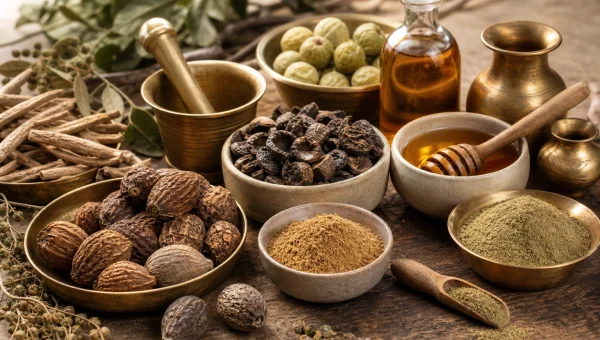
Mucuna pruriens, known in Ayurveda as Kapikacchu or Atmagupta, occupies a separate category because the seed naturally contains L-3,4-dihydroxyphenylalanine, better known as L-DOPA. The Ayurvedic Pharmacopoeia of India lists the seed under Atmagupta and identifies 3,4-dihydroxyphenylalanine among its constituents. Its classical pharmacological profile is madhura and tikta rasa, guru and snigdha guna, shita virya, and madhura vipaka, with actions including Vata-shamana, Vrishya, Balya, and use in Vatavyadhi and Kampavata.
Modern Parkinson’s work has evaluated mucuna seed preparations because Parkinson’s disease involves loss of dopaminergic neurons in the substantia nigra and reduced dopaminergic signaling in motor circuits. A small randomized crossover trial in Parkinson’s patients compared mucuna seed powder with standard levodopa/carbidopa and found rapid motor response with mucuna. A later double-blind crossover study also evaluated single-dose mucuna preparations against dispersible levodopa/benserazide in advanced Parkinson’s disease. These trials make Kapikacchu the clearest example of a genuinely dopaminergic Ayurvedic herb, while also showing why it requires medical supervision.
Outside Parkinsonian contexts, mucuna has also been studied in male infertility, where treatment was associated with changes in semen parameters, testosterone, luteinizing hormone, prolactin, dopamine, adrenaline, and noradrenaline. In Ayurvedic language, this is consistent with its Vrishya and Balya profile, but the presence of L-DOPA means it should not be casually treated as an ordinary tonic.
Kapikacchu products vary widely in L-DOPA content. Traditional seed powder, standardized extracts, and commercial supplements cannot be assumed equivalent. Because levodopa interacts with non-selective MAO inhibitors and dopaminergic medicines, and because dopaminergic therapy can worsen hallucinations or psychosis in susceptible people, mucuna should be avoided without specialist guidance in Parkinson’s medication users, people taking MAO inhibitors, and individuals with psychosis, bipolar disorder, or other dopamine-sensitive psychiatric conditions.
Brahmi: Medhya Rasayana Support for Attention and Learning
Brahmi, identified in the Ayurvedic Pharmacopoeia of India as the whole plant of Bacopa monnieri, is classically described as Medhya, Rasayana, Ayushya, Matiprada, Mohahara, Vatahara, and Kaphahara. Its listed properties include madhura, tikta, and kashaya rasa; laghu and sara guna; shita virya; and madhura vipaka. This makes Brahmi a better fit for sustained cognition, clarity, learning, and mental steadiness than for acute stimulation.
Human trials of standardized Bacopa monnieri extracts commonly use treatment periods of around twelve weeks, with outcomes related to memory, attention, cognitive processing, and learning. This time course fits the Ayurvedic idea of rasayana: gradual strengthening rather than immediate excitation. Brahmi’s dopamine relevance should therefore be framed as indirect. Animal work has examined dopamine D1 receptor function under experimentally induced impairment, and separate preclinical work has linked Bacopa treatment with BDNF changes in hippocampal and frontal regions. These mechanisms sit near dopamine-dependent cognition, but they do not make Brahmi a direct dopamine precursor.
For practical cognitive support, Brahmi is usually chosen when the presentation is forgetfulness, scattered attention, mental fatigue, irritability from overwork, or a need for calmer learning capacity. It is commonly taken with food to improve tolerability. Sensitive individuals may experience digestive discomfort, so gradual introduction and practitioner guidance are preferable, especially when combining it with sedatives, thyroid medication, psychiatric medicines, or other cognitive supplements.
Ashwagandha: Stress Axis and Dopamine-Supportive Terrain
Ashwagandha, the mature root of Withania somnifera, is listed in the Ayurvedic Pharmacopoeia of India as Rasayana, Balya, Vajikarana, and Vata-kapha-apaha. Its pharmacological profile is tikta and kashaya rasa, laghu guna, ushna virya, and madhura vipaka. In the context of dopamine and motivation, Ashwagandha is best understood as an indirect support for the stressed nervous system rather than as a dopaminergic precursor.
A randomized clinical trial using 300 mg of high-concentration Ashwagandha root extract twice daily for 60 days reported reduced perceived stress and a 27.9% reduction in serum cortisol from baseline. Broader clinical summaries also describe Ashwagandha extracts as potentially helpful for stress, anxiety, sleep, and cortisol regulation. This matters for reward and motivation because chronic stress, poor sleep, and anxiety commonly erode drive, pleasure, and executive function even when the primary issue is not a dopamine-producing lesion.
Preclinical Parkinsonian and catecholamine models also place Ashwagandha in the neuroprotective discussion, especially where oxidative stress, mitochondrial strain, and stress physiology intersect. In Ayurvedic selection, it is most suitable when low drive appears with depletion, poor sleep, nervous exhaustion, weakness, or chronic stress. It is less appropriate as a stimulating “dopamine booster,” and it should be used cautiously in pregnancy, autoimmune disease, thyroid disorders, liver disease, and in people using sedatives or psychiatric medication unless supervised.
Jatamansi: A Calming Monoamine-GABA Herb
Jatamansi, from Nardostachys jatamansi, belongs more to the calming and stabilizing side of the dopamine conversation. Preclinical work has reported changes in brain norepinephrine, dopamine, serotonin, 5-HIAA, and GABA after Jatamansi extract administration, and antidepressant-like animal work has discussed MAO and GABA-related mechanisms. This makes Jatamansi relevant where motivation is blocked by agitation, disturbed sleep, emotional overactivation, or an unstable mental field rather than simple under-stimulation.
In practical Ayurvedic reasoning, Jatamansi is not used like Kapikacchu. It is not a direct L-DOPA source and should not be presented as a Parkinson’s substitute. Its value is closer to manas-calming support: easing the restless, overheated, anxious, or sleep-deprived state in which attention and reward naturally become unstable. Because direct human evidence is limited and the plant is ecologically sensitive in parts of its range, Jatamansi should be used conservatively, preferably from verified and responsible sources.
Shilajit: Energy-Metabolism Support, Not a Dopamine Precursor
Shilajit is often included in modern neuro-support formulas, but its relationship to dopamine should be stated carefully. It is a mineral-organic phytocomplex containing fulvic acid, humic substances, and dibenzo-alpha-pyrones. Its best-supported conceptual place is rasayana-like support for energy metabolism, antioxidant balance, and cognitive vitality, not acute dopamine elevation.
This distinction is important because dopaminergic neurons are metabolically demanding, and mitochondrial dysfunction and oxidative stress are important themes in neurodegenerative disorders. Shilajit may therefore be discussed as part of a long-term vitality and neuroprotection framework, especially where fatigue and depletion dominate, but it should not be described as a proven dopamine transporter inhibitor or as a direct Parkinson’s therapy. The quality of Shilajit is central: unpurified or poorly tested material can contain heavy metals and other contaminants. Only purified, tested preparations should be considered.
Building a Coherent Ayurvedic Dopamine-Supportive Protocol
A coherent Ayurvedic approach does not combine these herbs simply because each has a modern neurological keyword attached to it. Kapikacchu is the direct dopaminergic herb and belongs under the strictest supervision. Brahmi suits cognition, learning, attention, and mental clarity. Ashwagandha suits stress-linked depletion, poor sleep, weakness, and low resilience. Jatamansi suits agitation, emotional overactivity, and sleep disturbance. Shilajit suits fatigue, low vitality, and rasayana-style support when quality is assured.
The classical logic is therefore pattern-based rather than neurotransmitter-chasing. A person with tremor and medically diagnosed Parkinson’s disease is not managed the same way as a student with poor recall, a stressed professional with burnout, or a fatigued person with low vitality. Dopamine language can help explain some mechanisms, but Ayurvedic prescription still depends on constitution, agni, dosha, strength, sleep, digestion, age, medications, and disease diagnosis.
Medical Disclaimer: This article is for educational purposes only and is not medical advice. Herbs with dopaminergic or neuroactive effects can interact with prescription medicines and may be unsafe in neurological, psychiatric, endocrine, liver, kidney, pregnancy, or breastfeeding contexts. Kapikacchu / Mucuna pruriens contains L-DOPA and should not be used with Parkinson’s medicines, MAO inhibitors, antipsychotic medicines, or dopamine-sensitive psychiatric conditions unless supervised by a qualified physician. Consult a qualified Ayurvedic practitioner and an appropriate healthcare provider before using these herbs for any diagnosed neurological, psychiatric, hormonal, fertility, or chronic fatigue condition.
References
- My (my.clevelandclinic.org)
- NCBI
- Dopamine System Dysregulation in Major Depressive Disorders (2017), PubMed Central
- Evaluating dopamine reward pathway in ADHD: clinical implications (2009), PubMed Central
- Nootropic herbs (Medhya Rasayana) in Ayurveda: An update (2012), PubMed Central
- Charaka Samhita — Rasayana Adhyaya
- Ayurvedic Pharmacopoeia of India
- Ayurvedic Pharmacopoeia of India
- P01.36. Assessment of commercial formulations of mucuna pruriens seeds for Levodopa (L-DOPA) content (2012), PubMed Central
- Mucuna pruriens in Parkinson’s disease: a double blind clinical and pharmacological study (2004), PubMed
- Mucuna pruriens in Parkinson disease: A double-blind, randomized, controlled, crossover study (2017), PubMed Central
- Levodopa Content of Mucuna pruriens Supplements in the NIH Dietary Supplement Label Database (2022), PubMed Central
- Mucuna pruriens improves male fertility by its action on the hypothalamus-pituitary-gonadal axis (2009), PubMed
- Effect of Mucuna pruriens on semen profile and biochemical parameters in seminal plasma of infertile men (2008), PubMed
- NCBI
- Dhivy (dhivy.com)
- RIVM (Netherlands)
- Frontiersin (frontiersin.org)
- Effects of a standardized Bacopa monnieri extract on cognitive performance, anxiety, and depression in the elderly: a randomized, double-blind, placebo-controlled trial (2008), PubMed Central
- Neuroprotective potential of Bacopa monnieri and Bacoside A against dopamine receptor dysfunction in the cerebral cortex of neonatal hypoglycaemic rats (2013), PubMed
- Chronic administration of bacopa monniera increases BDNF protein and mRNA expressions: a study in chronic unpredictable stress induced animal model of depression (2014), PubMed Central
- Ayurvedic Pharmacopoeia of India
- A prospective, randomized double-blind, placebo-controlled study of safety and efficacy of a high-concentration full-spectrum extract of ashwagandha root in reducing stress and anxiety in adults (2012), PubMed Central
- NIH Office of Dietary Supplements
- Withania somnifera root extract improves catecholamines and physiological abnormalities seen in a Parkinson’s disease model mouse (2009), PubMed
- Effects of Nardostachys jatamansi on biogenic amines and inhibitory amino acids in the rat brain (1994), PubMed
- Inhibition of MAO and GABA: probable mechanisms for antidepressant-like activity of Nardostachys jatamansi DC. in mice (2008), PubMed
- Anxiolytic actions of Nardostachys jatamansi via GABA benzodiazepine channel complex mechanism and its biodistribution studies (2018), PubMed
- Powo (powo.science.kew.org)
- Shilajit: a natural phytocomplex with potential procognitive activity (2012), PubMed Central
- Determinants of dopaminergic neuron loss in Parkinson’s disease (2018), PubMed Central
- Hazardous or Advantageous: Uncovering the Roles of Heavy Metals and Humic Substances in Shilajit (Phyto-mineral) with Emphasis on Heavy Metals Toxicity and Their Detoxification Mechanisms (2024), PubMed
Is Mucuna recommended alongside SSRIs given the dopamine-serotonin interaction potential?