
Why Plain Turmeric Falls Short for Skin Allergies
Many people use turmeric for itching, hives, rashes, or recurring skin sensitivity and feel disappointed when plain turmeric powder in water gives little change. In Ayurveda, that is not surprising. Plain haridra is a respected single herb, but Haridra Khanda is a complete classical formulation: turmeric is processed with ghee, milk, sugar, digestive spices, Triphala, aromatic herbs, cleansing herbs, and Lauha Bhasma. The difference is not only the presence of turmeric; it is the full pharmaceutical design of the formula.
Haridra Khanda is traditionally used for Śītapitta, Udarda, Kotha, Kandu, Visphota, and Dadru—Ayurvedic skin presentations that include itchy wheals, eruptions, pruritus, and allergic-looking skin reactions. It is best understood as a targeted Ayurvedic skin-allergy formula, not as a high-dose curcumin shortcut.
Classical Composition: What Makes Haridra Khanda Different
The Ayurvedic Formulary of India lists Haridra Khanda with its source in Bhaishajya Ratnavali, Śītapitta-Udarda-Kotha Adhikara. The formula includes Haridra with Go-ghrita, Go-dugdha, Khanda, and a group of powdered companion ingredients. This makes it a cooked, sweet, ghee-and-milk processed khanda preparation rather than a simple dry powder.
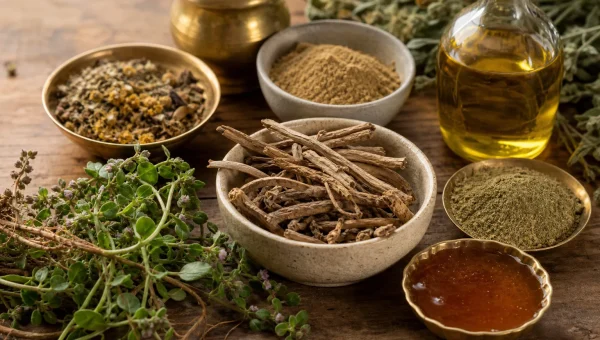
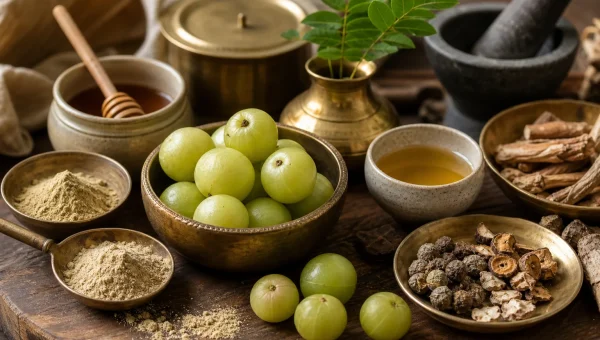
- Haridra (Curcuma longa) – the main herb, classically valued for skin disorders, itching, wounds, swelling, and Kapha-Pitta involvement.
- Go-ghrita and Go-dugdha – the classical fat and milk media used in the preparation, important because curcumin is lipophilic and poorly absorbed when taken alone in water.
- Khanda – the sugar base that gives the preparation its granule/confection form and palatability.
- Trikatu – Sunthi, Maricha, and Pippali, supporting digestion and adding the black-pepper component associated with improved curcumin bioavailability.
- Twak, Ela, and Patra – aromatic spices that support digestibility and balance the heavier milk-ghee-sugar base.
- Vidanga, Trivrit, Musta, and Nagakesara – classical companion ingredients included in the formulation’s skin-allergy context.
- Triphala – Haritaki, Bibhitaka, and Amalaki, giving the formula a broader digestive and cleansing profile than turmeric alone.
- Lauha Bhasma – the classical iron preparation included in the official formula, which is one reason Haridra Khanda should be used as a proper classical product rather than casually improvised at home.
Why the Complete Formula Works Differently from Turmeric Water
Plain turmeric in room-temperature water is limited by curcumin’s poor water solubility and low oral bioavailability. Haridra Khanda addresses that problem in a classical way: turmeric is combined with ghee and milk, administered with water or milk, and supported by Maricha, which contains piperine. This does not turn Haridra Khanda into a modern standardized piperine supplement, but it does explain why the complete formula is very different from raw turmeric powder swallowed in water.
| Plain Turmeric | Haridra Khanda |
|---|---|
| Single-herb use of Haridra | Classical multi-ingredient formulation centered on Haridra |
| Often taken in water, where curcumin dissolves poorly | Prepared with ghee and milk; traditionally taken with water or milk |
| No built-in digestive spice support | Includes Trikatu and aromatic herbs to support digestion and assimilation |
| Useful as a food herb and simple household support | Used classically for Śītapitta, Udarda, Kotha, Kandu, Visphota, and Dadru |
Classical Uses in Skin Allergy Patterns
Haridra Khanda is most relevant when the skin presentation resembles the classical cluster of itching, wheals, redness, eruptions, and recurring allergic-looking skin irritation. In modern language, people often discuss it around urticaria-like hives, pruritus, and inflamed skin eruptions, but an Ayurvedic practitioner should still assess the person’s constitution, digestion, triggers, bowel pattern, medication history, and whether the condition is acute, chronic, infectious, autoimmune, or allergy-related.
| Classical Term | Practical Skin Pattern | Use Note |
|---|---|---|
| Śītapitta | Hives or urticaria-like wheals with itching and sensitivity | Use only with proper assessment, especially if swelling or breathing symptoms occur. |
| Udarda | Raised, itchy, allergic-looking eruptions | Best combined with trigger review, diet correction, and digestive care. |
| Kotha | Wheals, eruptions, or sudden skin reactivity | Recurring cases require evaluation rather than repeated self-dosing. |
| Kandu, Visphota, Dadru | Itching, eruptions, blisters, or ring-like skin disorders | Visible infection, spreading lesions, pus, fever, or severe inflammation needs medical diagnosis. |
Dosage and Anupana
The Ayurvedic Formulary of India lists the dose of Haridra Khanda as 6 g, with water or milk as the anupana. In practice, the exact amount, timing, and duration should be decided by a qualified Ayurvedic practitioner, especially for children, pregnant or breastfeeding women, diabetic patients, people on prescription medicines, and anyone with chronic hives or recurrent skin disease.
Warm milk is often preferred when the person tolerates dairy and the practitioner wants a nourishing, fat-containing carrier. Warm water is also a classical option and may be more suitable when milk is not tolerated. Haridra Khanda should not be used as a substitute for urgent treatment when hives are associated with lip, tongue, throat, or facial swelling, dizziness, wheezing, difficulty breathing, vomiting, faintness, or suspected anaphylaxis.
Can Haridra Khanda Be Prepared at Home?
A casual kitchen mixture of turmeric, amla, black pepper, cardamom, cinnamon, and sugar is not classical Haridra Khanda. The official formula includes ghee, milk, sugar, Trikatu, Triphala, Vidanga, Trivrit, Musta, Nagakesara, and Lauha Bhasma, and it is prepared as a processed khanda. Because it includes a bhasma and cleansing herbs, it is safer to use a properly manufactured classical product or have it prepared under professional supervision.
For ordinary household use, turmeric can still be added to food with ghee or oil and a small amount of black pepper. That is a dietary turmeric practice, not a substitute for Haridra Khanda and not a treatment plan for chronic urticaria, eczema, food allergy, or unexplained rashes.
Where Haridra Khanda Outperforms Plain Turmeric
Haridra Khanda is most useful when the goal is not simply “more turmeric,” but a classical Ayurvedic approach to itchy, reactive, recurrent skin presentations. It combines turmeric with digestion-supporting spices, Triphala, a ghee-milk-sugar processing base, and additional ingredients selected in the classical skin-allergy context. Plain turmeric remains valuable as a food herb, but Haridra Khanda is the more complete traditional formulation for the specific indications listed in Ayurveda.
The practical takeaway is simple: use turmeric in cooking for general dietary support; consider Haridra Khanda only when the skin pattern fits and a qualified practitioner confirms it is appropriate. For chronic hives, recurrent swelling, eczema-like rashes, suspected infection, or food-triggered reactions, a medical diagnosis and safety plan are essential.
Safety and Contraindications
Haridra Khanda contains sugar, milk, ghee, black pepper, and Lauha Bhasma, so it is not suitable for everyone. People with diabetes, dairy intolerance, iron-related disorders, liver or gallbladder concerns, bleeding disorders, upcoming surgery, pregnancy, breastfeeding, or ongoing prescription medicines should consult a qualified Ayurvedic practitioner or healthcare provider before use.
Extra caution is needed with anticoagulant or antiplatelet medicines, diabetes medicines, antiepileptics, narrow-therapeutic-index drugs, and high-bioavailability turmeric or curcumin supplements. Piperine from black pepper can affect drug transport and metabolism, while concentrated turmeric or curcumin products may cause digestive side effects and have been associated with liver injury in some users. Do not use Haridra Khanda to replace prescribed antihistamines, epinephrine, asthma medicines, steroid treatment, or emergency care.
Disclaimer: This article is for educational purposes only and does not replace professional medical advice. Consult a qualified Ayurvedic practitioner or healthcare provider before starting Haridra Khanda or any new health regimen.
References
- Archive (archive.org)
- Davpharmacy (davpharmacy.com)
- Improving Curcumin Bioavailability: Current Strategies and Future Perspectives (2021), PubMed Central
- Highly Bioavailable Forms of Curcumin and Promising Avenues for Curcumin-Based Research and Application: A Review (2020), PubMed Central
- Influence of piperine on the pharmacokinetics of curcumin in animals and human volunteers (1998), PubMed
- Recent developments in delivery, bioavailability, absorption and metabolism of curcumin: the golden pigment from golden spice (2014), PubMed Central
- Curcumin inhibits the activation of immunoglobulin e-mediated mast cells and passive systemic anaphylaxis in mice by reducing serum eicosanoid and histamine levels (2014), PubMed Central
- In vitro anti-inflammatory effects of curcumin on mast cell-mediated allergic responses via inhibiting FcεRI protein expression and protein kinase C delta translocation (2020), PubMed
- Piperine, a major constituent of black pepper, inhibits human P-glycoprotein and CYP3A4 (2002), PubMed
- Operculina turpethum (Linn.) Silva Manso as a Medicinal Plant Species: A Review on Bioactive Components and Pharmacological Properties (2017), PubMed Central
- NCCIH
- Wmic (wmic.wales.nhs.uk)
- Mayoclinic (mayoclinic.org)
You mention 3-6g dose range. For chronic urticaria is the upper dose needed or does the lower dose work for maintenance?
The Khand (sugar) base makes Haridra Khand unsuitable for patients with diabetes or metabolic syndrome a group that often has higher inflammatory/skin conditions. The article doesn’t address this adequately. ❤️
That’s a genuinely important gap in the article. My father is diabetic and also deals with chronic urticaria — the Khand base makes Haridra Khand a non-starter for him as written. Has anyone come across a modified version that substitutes the sugar base, or is the Khand considered functionally necessary for absorption in the classical formula? ❤️
can Haridra Khand be combined with Nimba (Neem) capsules for stubborn skin allergies or is it sufficient alone?
haridra khand timing with food is the part i was looking for. turmeric formulas can upset stomach if taken randomly.
is there a difference between classical Haridra Khand (with Khand = raw cane sugar) and modern versions with alternatives for diabetics?
My mother’s eczema flares in spring every year. Started her on Haridra Khand last March and this year’s spring was significantly milder.
makes sense given what the article says about the Pitta component.
Chronic urticaria has multiple triggers and patterns. Recommending a single herbal formula without identifying the trigger mechanism is clinically incomplete. नमस्ते
For a child with food-allergic eczema, is the formulation appropriate or are there modifications?
i used Haridra Khand for 2 months for my allergic urticaria with no meaningful improvement. My allergist found a dietary trigger that a simple elimination diet resolved. 🙏
had the same experience with this.
Good to know.
Classical Haridra Khand tastes better than I expected. The sugar base makes compliance easy and the result for my seasonal allergies has been meaningful.
Helpful.
that’s a good point, the dosage question is something I also asked my vaidya about.
My vaidya actually had me start at 3g twice daily for the first month and then drop to once daily as maintenance once the hives were under control. The initial loading approach seemed to matter — I tried jumping straight to maintenance dosing on a previous attempt and didn’t get the same response.
The explanation about mishri acting as a carrier for skin tissue makes a lot of sense.