
The Problem Ayurveda Takes Seriously
For adults, a BMI below 18.5 is generally categorized as underweight. For many men, the real problem is not laziness or lack of discipline; it is that appetite, digestion, absorption, sleep, training load, stress, and constitution are not working together to support steady tissue nourishment.
Ayurveda treats persistent leanness as a serious clinical pattern, not as a cosmetic issue. Charaka discusses the excessively lean person under karshya and atikarshya, describing causes such as inadequate food, dry food, fasting, excessive exertion, grief, anger, poor sleep, chronic disease, old age, and constitutional tendency. The central nourishing approach is Brimhana Chikitsa, a therapy intended to increase healthy body bulk and strength through appropriate food, rest, oiling, sleep, and selected herbs.
Diagnosing the Type of Underweight
Not all underweight men need the same plan. Before increasing heavy foods, first identify why the body is not holding nourishment. The table below keeps the classical Ayurvedic logic while translating it into practical patterns.
| Pattern | Common Clues | Ayurvedic Reading | First Priority |
|---|---|---|---|
| Constitutional leanness | Thin since youth, light frame, low fat storage, variable appetite, restless energy | Vata-dominant constitution with a tendency toward dryness, lightness, and depletion | Regular routine, warm cooked food, unctuous nourishment, sleep, and gradual Brimhana |
| Stress and sleep-loss depletion | Weight loss during pressure, poor sleep, low appetite, worry, tension, irritability | Classical causes of leanness include grief, anger, and disturbed sleep; nourishment improves when the nervous system settles | Restore sleep, reduce excess stimulation, use calming nourishment before aggressive weight-gain loading |
| Weak assimilation | Eats enough but has bloating, loose stool, heaviness, irregular bowel habits, or undigested food | Agni and grahani need correction before heavy Brimhana foods are increased | Light warm meals, digestive correction, and practitioner-guided deepana-pachana before calorie loading |
| Overactivity and overtraining | Gym, cardio, work, walking, or restlessness burns more energy than food supplies | Excess exercise is not well tolerated by the excessively lean and can worsen depletion | Temporarily reduce training volume, stop training to exhaustion, and increase nourishing foods |
| Post-illness depletion | Weight loss after illness, chronic disease, long travel, surgery, medication, or prolonged weakness | Depleted tissues require gentle rebuilding, not sudden overeating | Medical evaluation, gradual Brimhana, Rasayana support, rest, and supervised recovery |
The 90-Day Brimhana Protocol
This protocol is designed for otherwise healthy underweight men who want to gain weight in a steady, tissue-supportive way. It should be personalized by constitution, appetite, stool pattern, training load, climate, and medical history.
Phase 1: Make Food Digestible (Days 1-21)
The first phase prepares the body to receive nourishment. Heavy food added to unstable digestion often produces bloating, coating, heaviness, loose stool, or poor appetite, so the first goal is regular meals, warm digestion, and comfortable elimination.
- Eat at fixed times: Keep breakfast, lunch, dinner, and one or two snacks consistent. Vata-type thinness responds well to rhythm.
- Keep food warm and cooked: Favor rice, wheat preparations, dal, soups, stews, cooked vegetables, ghee, and warm milk if tolerated. Avoid making raw salads, cold drinks, and irregular snacking the foundation of the diet.
- Use heaviness gradually: Begin with 1-2 teaspoons of ghee per meal, then increase only when stool and appetite remain comfortable.
- For sharp appetite with heat or acidity: Favor cooling, unctuous nourishment such as milk, ghee, Shatavari, or Vidari under guidance, while reducing excessive pungent, sour, fried, and stimulant-heavy foods.
- For bloating or loose stool: Do not force milk, curd, large ghee doses, or heavy shakes. Stabilize digestion first with simple warm meals and practitioner-guided digestive measures.
- For sluggish appetite: Keep meals lighter for a few days, use warm spices in food, and increase Brimhana foods only after hunger becomes clear and post-meal heaviness reduces.
Phase 2: Brimhana Loading (Days 22-60)
Once appetite, stool, sleep, and post-meal comfort are steadier, begin a deliberate nourishing phase. In Ayurvedic terms, Brimhana foods are generally sweet, unctuous, cooling, stable, and strength-supporting; in practical terms, they help raise intake without relying on junk food.
- Ghee: Use with rice, chapati, dal, porridge, or warm milk. Start modestly and increase gradually. Ghee is classically included among nourishing supports for the lean.
- Milk: Warm whole milk can be useful when digestion tolerates it. It works especially well as an anupana for Brimhana herbs such as Ashwagandha, Shatavari, or Vidari.
- Rice and wheat: Use generous portions of well-cooked rice, wheat chapati, paratha with ghee, wheat porridge, or suji preparations. Charaka includes shali rice and wheat among foods used for nourishing the lean.
- Masha and dal: Black gram is classically nourishing but can be heavy, so use it only if digestion is strong. Mung dal is lighter and can be used when the gut is more sensitive.
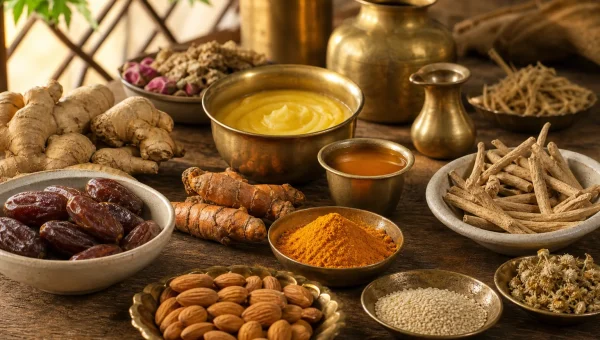
- Dates: Dates are sweet, heavy, unctuous, cooling, strength-supporting, and Vata-pacifying in the Ayurvedic Pharmacopoeia of India. They can be used in warm milk, laddus, or as a snack with ghee.
- Curd: Curd is included in classical nourishment for the lean, but it should be used carefully: daytime, fresh, in small amounts, and avoided when there is mucus, heaviness, skin flare, acidity, or poor digestion.
- Meat soup or vegetarian alternatives: Classical Brimhana includes meat soup for suitable patients. Vegetarian men can use milk, ghee, paneer, dal, rice, wheat, masha when tolerated, nuts, dates, and physician-guided Rasayana support.
- Oil massage: Warm oil massage supports the unctuous, grounding quality needed in Vata-type thinness. Sesame oil is commonly used when there is dryness and coldness; coconut oil may suit heat-dominant individuals better.
Phase 3: Consolidation and Muscle Building (Days 61-90)
After digestion and intake are stable, training can be used to direct the extra nourishment toward strength and muscle. The key is progressive resistance without exhausting the already-lean body.
- Train three days per week: Focus on squats, presses, rows, hip hinges, loaded carries, and pull movements. Keep sessions around 45-60 minutes.
- Stop before collapse: Avoid training to failure in every set. Leave some reserve, especially if appetite drops or sleep worsens after training.
- Limit cardio: Walking is fine, but long cardio sessions can work against weight gain in men who already burn through food quickly.
- Eat after training: Use a warm post-workout meal or drink such as milk with ghee and a prescribed Brimhana herb, followed by a full meal when hunger returns.
- Protect sleep: Sleep is a classical pillar of nourishment and strength. Keep a fixed bedtime, avoid late-night screens and stimulants, and use warm milk at night if it digests well.
Core Brimhana Foods and Practices
A Brimhana diet is not just “more calories.” It is nourishment selected for digestibility, tissue support, and stability. These foods and practices should be adjusted to appetite and bowel response.
| Food or Practice | How to Use | Ayurvedic Purpose |
|---|---|---|
| Ghee | Begin with small amounts on rice, dal, chapati, porridge, or milk; increase slowly | Unctuous nourishment, Vata grounding, classical Brimhana support |
| Warm whole milk | Use morning or night if tolerated; combine with prescribed herbs when appropriate | Sweet, nourishing, strength-supporting carrier for Brimhana herbs |
| Rice and wheat | Use as staple meals with ghee, dal, vegetables, and suitable protein | Stable carbohydrate base for daily nourishment |
| Masha, dal, paneer, or meat soup | Select according to digestion, diet preference, and practitioner advice | Supports strength and tissue rebuilding when properly digested |
| Dates | Use 2-5 soaked dates, date-milk, or date-ghee preparations if blood sugar and digestion allow | Sweet, heavy, unctuous, strength-supporting, Vata-pacifying nourishment |
| Oil massage | Apply warm oil before bath several times weekly | Reduces dryness and supports the unctuous quality needed in Vata depletion |
| Sleep and calm rest | Keep a steady sleep window; use restorative rest when exhausted | Classically linked with nourishment, strength, and recovery |
Herbs and Rasayana Support
Herbs are adjuncts, not substitutes for food, sleep, and proper digestion. The doses below reflect classical adult powder ranges where available in the Ayurvedic Pharmacopoeia of India; extracts, tablets, and proprietary preparations should be used according to practitioner guidance and product standardization.
| Herb | Classical Adult Powder Range | How It Is Commonly Taken | Best Fit |
|---|---|---|---|
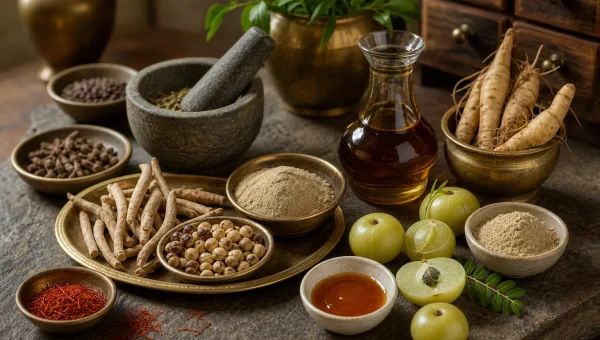
| Ashwagandha (Withania somnifera) | 3-6 g root powder | With warm milk and ghee when suitable | Vata-type weakness, low strength, stress-related depletion, resistance-training support |
| Shatavari (Asparagus racemosus) | 3-6 g root powder | With warm milk, often morning or evening | Dryness with heat, sharp appetite, Pitta-Vata depletion, need for cooling nourishment |
| Vidari (Pueraria tuberosa) | 3-6 g tuber powder | With warm milk and ghee | Weakness, dryness, Vata aggravation, tissue depletion, and Brimhana support |
| Chyawanprash or other Rasayana | Use product-specific or practitioner-directed dose | Usually taken with warm milk or warm water depending on digestion | Recovery, seasonal weakness, and long-term nourishment when digestion is stable |
Ashwagandha has a modern resistance-training trial relevant to this protocol: young men taking 300 mg of root extract twice daily with resistance training for eight weeks had greater improvements in muscle strength and muscle size measures than placebo. This does not make Ashwagandha a shortcut; it works best when food, training, and sleep are already aligned.
A Sample Brimhana Day
This sample day shows the structure of a nourishing routine. Portions should be adjusted upward or downward according to hunger, digestion, weight trend, training load, and medical needs.
| Time | Meal | Purpose |
|---|---|---|
| 7:00 AM | Warm milk with prescribed Brimhana herb, or soaked dates with warm milk if tolerated | Gentle morning nourishment without shocking digestion |
| 8:30 AM | Wheat chapati or paratha with ghee, paneer or dal, and cooked vegetables | Stable carbohydrate, fat, protein, and warmth |
| 11:00 AM | Date-almond milk or a small bowl of wheat porridge with ghee | Calorie-dense snack that is easier than forcing another large meal |
| 1:00 PM | Rice with ghee, dal, cooked vegetables, and a small amount of fresh curd if suitable | Main nourishing meal when digestion is strongest |
| 4:30 PM | Sweet potato with ghee, or a small bowl of khichdi, or milk with dates | Warm afternoon nourishment that prevents long gaps |
| 7:30 PM | Rice or chapati with ghee, dal, paneer, egg, or meat soup according to diet and digestion | Evening nourishment without excessive dryness or raw food |
| 9:30 PM | Warm milk with ghee, or plain warm milk, if it digests comfortably | Supports night nourishment and a grounded routine |
Signs the Protocol Is Working
Proper Brimhana should produce steadier appetite, comfortable stool, better sleep, improved strength, fuller tissues, and gradual weight gain without heaviness or dullness. The aim is not rapid bloating or fat accumulation, but stable nourishment that the body can hold.
- Good signs: Clear hunger, comfortable digestion, more stable energy, better sleep, increased training strength, and slow upward movement in body weight.
- Warning signs: Coated tongue, nausea, heaviness, loose stool, constipation, acne flare, excessive sleepiness, breathlessness, or sudden belly fat gain.
- When to pause loading: If heavy foods reduce appetite or make the stool unstable, return to simpler warm meals for several days and rebuild gradually.
- When to seek evaluation: If weight drops despite adequate intake, or if there is fever, night sweats, chronic diarrhea, vomiting, blood in stool, palpitations, tremor, severe fatigue, or persistent loss of appetite.
Common Mistakes Underweight Men Make
Most failures happen because men try to gain weight by force instead of creating the conditions for nourishment. Brimhana works best when digestion, rest, and training are coordinated.
- Forcing heavy food before digestion is ready: Milk, ghee, masha, curd, and Rasayana preparations are helpful only when they are digested well.
- Using junk food as Brimhana: Brimhana is not random calorie excess. It uses nourishing, digestible, unctuous foods that build strength without overwhelming the gut.
- Overtraining: A lean body that already struggles to hold nourishment should not be pushed with long cardio and failure-based lifting every day.
- Ignoring sleep: Classical Ayurveda places sleep directly in the nourishment and strength conversation. Poor sleep can undo good food and herbs.
- Self-prescribing herbs: Ashwagandha, Shatavari, Vidari, Chyawanprash, digestive formulas, and medicated ghees should be matched to constitution, digestion, disease state, and medication use.
- Expecting a 7-day transformation: Healthy tissue rebuilding is gradual. A practical review point is every 2-4 weeks, based on weight trend, appetite, stool, sleep, and training strength.
Medical Disclaimer: This article is for educational purposes only and does not constitute medical advice. Unexplained weight loss or inability to gain weight can be associated with medical conditions such as thyroid disease, diabetes, gastrointestinal disease, chronic infection, cancer, medication effects, depression, anxiety, or eating disorders. See a qualified healthcare provider for evaluation before beginning a weight-gain protocol, especially if weight loss is recent, rapid, or unexplained. Use Ayurvedic herbs and formulations only under the guidance of a qualified Ayurvedic practitioner or healthcare provider, particularly if you take medication, have thyroid disease, autoimmune disease, liver disease, kidney disease, digestive disease, hormone-sensitive conditions, or any chronic illness.
References
- CDC
- Charaka Samhita — Ashtauninditiya Adhyaya
- Charaka Samhita — Langhanabrimhaniya Adhyaya
- Ayurvedic Pharmacopoeia of India
- Ayurvedic Pharmacopoeia of India
- Examining the effect of Withania somnifera supplementation on muscle strength and recovery: a randomized controlled trial (2015), PubMed
- NCCIH
- Ayurvedic Pharmacopoeia of India
- Ayurvedic Pharmacopoeia of India
- Ayush (ayush.delhi.gov.in)
- Mayoclinic (mayoclinic.org)
- NHS
- Mayoclinic (mayoclinic.org)
- Mayoclinic (mayoclinic.org)
The to Healthy Weight Gain for Underweight Men explanation is clearer than most short posts. Small daily changes are easier to follow than a perfect plan.
How long before seeing results with this protocol? My practitioner said 4 weeks but I’m seeing other timelines mentioned online.
The Vata-dominant constitutional framing explained something I couldn’t understand about my own attempts to gain weight. High-calorie diets just seemed to pass through me, and trainers kept telling me to eat more as if the problem was volume. The Agni piece — that weak digestive fire means nutrients aren’t being absorbed regardless of intake — is the missing explanation nobody in the gym context ever gave me.
The to Healthy Weight Gain for Underweight Men explanation is clearer than most short posts. This is the kind of detail readers can test slowly.
The seasonal weight gain pattern described for Kapha types matches what I observe in myself every year. Consistent weight gain between November and February that doesn’t respond to the same effort that works in summer. The Kapha season accumulation principle explains a pattern I’ve observed but never had a framework for.
The Kapha-reducing spice protocol, dry ginger, black pepper, long pepper, trikatu, does have some evidence for thermogenic and metabolic effects. The intervention isn’t purely theoretical. If the metabolic activation mechanism is real the culinary delivery system may be adequate to produce measurable effects.
The to Healthy Weight Gain for Underweight Men explanation is clearer than most short posts. The timing advice is the part I would start with.
The breakdown of Vata Prakopa and its effect on tissue nourishment really clarified why extra calories alone weren’t working for me.
Are there food interactions with weight that I should be aware of? My Ayurvedic doctor mentioned something about dairy but wasn’t specific.
I’ve always struggled with the skinny label, so learning about Sahaja Karshya felt like a personal explanation.
The to Healthy Weight Gain for Underweight Men explanation is clearer than most short posts. The safety notes could be expanded a little.
Does anyone know if Shatavari can be taken with cold milk, or does it lose its cooling potency?
The to Healthy Weight Gain for Underweight Men explanation is clearer than most short posts. The main idea is clear even if someone is new to Ayurveda.
Adding ghee to every meal seems simple, but I wonder how many tablespoons actually count as too much for digestion.
The idea of regulating Agni before loading calories makes sense, especially for those with Tikshna Agni.
I tried the warm milk with Ashwagandha before bed and noticed I fell asleep faster.
It’s interesting that the article links testosterone synthesis to cholesterol and fat intake, something rarely mentioned in fitness circles.
For stress related weight loss, the suggestion to manage anxiety first before herbs feels practical.
The sample meal plan hits around 3,200 calories, which is a lot more than the usual 2,000 calorie recommendations I see.
I’m skeptical about relying solely on herbal powders without checking with a doctor, especially if you’re on medication.
The caution about excessive protein shakes creating Ama resonates with my own bloating issues after whey.
Reducing gym time to three focused sessions while increasing caloric density seems like a smarter approach for hard gainers.
Reading about Vishama Agni made me realize my irregular eating schedule might be sabotaging my weight goals.
The distinction between building Meda Dhatu and Mamsa Dhatu helped me understand why I was gaining fat but not muscle.
the morning versus evening split for herbs is something I always get confused about. Clear here.
The classical text quotes are helpful context but I’d like to understand the modern interpretation better.
Trying this
could you address the quality certification issue in a future article? Third-party tested herbs are hard to find.
So much misinformation out there. Good to find something grounded.
I liked the practical side of to Healthy Weight Gain for Underweight Men. The main idea is clear even if someone is new to Ayurveda.
I appreciate that the article reminds readers to rule out medical causes like hyperthyroidism before attributing thinness to constitution.
my grandma was right about all of this. just didn’t have the explanation.
The safest part of the to Healthy Weight Gain for Underweight Men advice is keeping it simple. I would like to know how long to try it before judging results.
my practitioner mentioned this approach last week. Nice to find a detailed written explanation.
Finally something that explains the why, not just the what.
As someone who does both allopathy and Ayurveda I appreciate that this article doesn’t demonize either.
The sourcing of quality herbs in my city is impossible. Makes these protocols academic for many readers.
practical + scientific = rr combo in Ayurveda content. Good work.
my western trained MD friend looked at this and said the pharmacology section was reasonable.
the dose specificity here is what makes this actionable. Vague ‘take regularly’ instructions are useless.
Going to share this at my wellness group meeting next week. Very useful.
the Hindi terms alongside English make this usable in both languages.
the morning versus evening split for herbs is something I always get confused about. Clear here. ✨
i was prescribed this by a practitioner 2 years back but never understood why. now i do.
the writing assumes India-based readers. Temperature/herb availability differs greatly outside India.
Helpful
The advice around to Healthy Weight Gain for Underweight Men is specific enough to be useful. This feels more usable than a long list of herbs.
reading this in 2027 are the herb sourcing recommendations still valid?
Does anyone know a practitioner in Hyderabad who works with this kind of protocol?
can this be done alongside an allopathic treatment or should there be a gap?
what’s the cycling recommendation? Should you take a break after 3 months?
for an old post this is still very relevant. good information doesnt expire.
Same here
is there a children’s version of this protocol? My daughter has a similar issue.
Is the Safed Musli dosage here for standardized extract or raw powder? Makes a big difference in amount.
the comments section here is almost as useful as the article itself
I came for to Healthy Weight Gain for Underweight Men and this answered the main question. Would be useful to see a short checklist next.
Quality content. Keep writing like this.
three herbs three outcomes surprisingly simple when laid out like this
been following this blog for six months and the quality is consistently high.
real information. Not fluff. Rare.
I appreciate that the dosages are given in actual mg not just ‘a pinch’ or ‘as needed’.
no mention of the potential testosterone-related effects for men with hormone-sensitive conditions.
the integration of modern evidence with traditional practice is the right approach.
this site is different from other ayurveda blogs. feels researched not just copied. ✨
will try for a month and report back here.
Found this article after searching for 3 days. Exactly what I needed.
how long does a typical protocol like this take to show results?
Any recommendation for online vaidya consultations for those of us not near an Ayurvedic clinic?
People should know this. Sharing everywhere. 💯
For to Healthy Weight Gain for Underweight Men, consistency seems like the hard part. The article avoids making it sound like a quick fix.
will try for a month and report back here. 🌿
just found this through Google. Is this still the current recommendation?
For to Healthy Weight Gain for Underweight Men, consistency seems like the hard part. The main idea is clear even if someone is new to Ayurveda.
the classical text quotes r helpful context but I’d like to understand the modern interpretation better.
The reference to Ashtanga Hridayam which Sutrasthana chapter? Would like to read the original.
My doctor actively discouraged this after I mentioned it. Getting conflicting guidance is difficult to navigate.
the timing protocol assumes a morning training schedule. Doesn’t address evening trainers.
this is the clearest explanation of this topic Ive found. Bookmarked for reference.
What brand of triphala do you recommend? So many options and quality varies greatly.
u said it better than my 45-min consult with the vaidya tbh 🌿
do the ratios change if you are doing this as preventive care versus active treatment?
no mention of the potential testosterone-related effects for men with hormone-sensitive conditions. नमस्ते
My Ayurvedic practitioner of 12 years said this is one of the better online resources she’s seen on the topic.
tried this for 6 weeks without the results described. Maybe the protocol needs personalizing.
this site is different from other ayurveda blogs. feels researched not just copied.
some of the preparation methods r too time-intensive for working adults. Needs a quick-version alternative.
the Q&A format at the end would make this even more useful. Would love a FAQ section.
first comment here. been lurking for months. this is the one that made me want to say thank u
The practical implementation section is what separates this from other Ayurveda sites.
tried the protocol. Week 2 no change yet but following through to the full period.
Some of the preparation methods are too time-intensive for working adults. Needs a quick-version alternative.
Starting today. Fingers crossed.
will try 🙏
shared with my family group and three people are already trying it.
forwarded to my whole family WhatsApp group. Three replies already asking for more details.
i dont comment usually but this was actually helpful
is there a children’s version of this protocol? My daughter has a similar issue. नमस्ते
is the guidance here applicable for elderly patients or is it designed for younger adults?
the IST timings in the practical section are a nice touch. Feels like its written for us.
coming from a conventional medicine background this article impressed me with its rigor. 🌿
tried. Liked. Continuing.
does this protocol need modification for someone who is fasting during Navratri?
u said it better than my 45-min consult with the vaidya tbh
Found this searching for answers, i took notes from this and created a personal protocol. Three weeks in, positive changes.
Been meaning to try this for two years. This article finally pushed me to start.
found this searching for answers, nani used to say the same things in different words. There’s real wisdom here.
late to this discussion but the question in the first comment is still unanswered anyone have more info?
Nani used to say the same things in different words. There’s real wisdom here.
this site is different from other ayurveda blogs. feels researched not just copied. धन्यवाद
for an old post this is still very relevant. good information doesn’t expire.
my yoga teacher recommended this site and now I see why.
Good reminder on to Healthy Weight Gain for Underweight Men. The article avoids making it sound like a quick fix.
Good reminder on to Healthy Weight Gain for Underweight Men. The timing advice is the part I would start with.
I came for to Healthy Weight Gain for Underweight Men and this answered the main question. I would still ask a practitioner before changing medicines.
old post but still helpful. first comment here. been lurking for months. this is the one that made me want to say thank u
just found this via Google, six weeks into the Bala-Ashwagandha stack and strength is up. Hard to attribute fully but the timing lines up.
just found this via Google, first comment here. been lurking for months. this is the one that made me want to say thank u
the Q&A format at the end would make this even more useful. Would love a FAQ section. ❤️
the seasonal protocl is smart. Most people try to use the same routine all year.
The dosage for children per kg bodyweight would be useful to add.
just found this via Google, can someone here who has tried this protocol confirm the timeline? Two weeks vs six weeks? 🙌
have been searching for this explanation for years. Saved. Sharing.
my yoga teacher recommended this site and now I see why. 🌿 धन्यवाद
This makes sense for to Healthy Weight Gain for Underweight Men. The main idea is clear even if someone is new to Ayurveda.
Brilliant breakdown. Forwarding this.
how does weather and season affect the protocol? Im in a hot humid climate.
this article connected the dots between things my vaidya told me over several years.
I would like more detail on to Healthy Weight Gain for Underweight Men. This is the kind of detail readers can test slowly.
i took notes from this and created a personal protocol. Three weeks in, positive changes.
Old post but still helpful. some of the preparation methods are too time-intensive for working adults. Needs a quick-version alternative.
The timing protocol assumes a morning training schedule. Doesn’t address evening trainers. 💯
the language is accessible which is rare for classical Ayurveda writing
this is now my reference article for explaining this topic to friends.
the balance between Sanskrit terminology and plain English is really well done. ❤️
can these adaptogens be stacked with whey protein or does it affect absorption?
i appreciate the acknowledgment that this isnt a substitute for professional consultation.
For to Healthy Weight Gain for Underweight Men, consistency seems like the hard part. The timing advice is the part I would start with.
For to Healthy Weight Gain for Underweight Men, consistency seems like the hard part. This feels more usable than a long list of herbs.
can someone here who has tried this protocol confirm the timeline? Two weeks vs six weeks?
Finally!
the question about brand quality is important. not all suppliers are equal.
just found this via Google, just found this through Google. Is this still the current recommendation?
Late to this but the combination of classical reasoning and practical steps is exactly what I was looking for. धन्यवाद
my training partner started Shilajit based on this article. His recovery metrics improved.
The combination of theory and practical steps is what I appreciate most about this blog.
Late to this but the sourcing of quality herbs in my city is impossible. Makes these protocols academic for many readers.
Old post but still helpful. does this protocol need modification for someone who is fasting during Navratri?
Three months later: the results held. Happy to report.
The before-and-after in my experience matches what the article predicts. That’s meaningful.
practical + scientific = rare combo in Ayurveda content. Good work.
pitta burning its way through this article and finding useful info 🔥 just kidding but yes helpful.
Can this be done alongside an allopathic treatment or should there be a gap? 💯
The safest part of the to Healthy Weight Gain for Underweight Men advice is keeping it simple. A few more examples would still help.
Too theoretical without enough concrete steps. The ‘what’ is clear but the ‘how exactly’ is missing.
Just found this through Google. Is this still the current recommendation? नमस्ते
skeptical about Ayurveda in general but this is presented honestly enough that I’ll try it.
shared with my family group and three people are already trying it. 🙌
does this work for people over 60? The age range in the examples skews younger.
Pitta burning its way through this article and finding useful info 🔥 just kidding but yes helpful. 🌿
the classical text quotes are helpful context but I’d like to understand the modern interpretation better. नमस्ते
Doing this
just found this via Google, six weeks into the Bala-Ashwagandha stack and strength is up. Hard to attribute fully but the timing lines up. 🙏
late to this but the before-and-after in my experience matches what the article predicts. That’s meaningful.
the combination of classical reasoning and practical steps is exactly what I was looking for. 🌿
For Pitta-Kapha dual constitution which aspects of the protocol take priority?
ashwagandha 600mg KSM-66 is that morning or post-workout? Timing isn’t clear in the article.
Found this searching for answers, starting today. Fingers crossed.
Found this searching for answers, does this protocol need modification for someone who is fasting during Navratri?
my constitution is Vata-Pitta so some of this applies and some doesn’t. A chart for dual types would help.
i wish there were more clinical studies cited here. Traditional use is valuable but not sufficient evidence alone.
the Hindi terms alongside English make this usable in both languages. 💯
Would like to see the contraindications section expanded. Too brief for something being suggested for health issues.
just found this via Google, late to this discussion but the question in the first comment is still unanswered anyone have more info?
found this searching for answers, for an old post this is still very relevant. good information doesnt expire. 🌿
Good reminder on to Healthy Weight Gain for Underweight Men. I would still ask a practitioner before changing medicines.
old post but still helpful. been following this blog for six months and the quality is consistently high.
Just found this via Google, this site is different from other ayurveda blogs. feels researched not just copied.
I came for to Healthy Weight Gain for Underweight Men and this answered the main question. A few more examples would still help.
Old post but still helpful. this is now my reference article for explaining this topic to friends.
found this searching for answers, have been searching for this explanation for years. Saved. Sharing.
Thanks for the clear writing. This isn’t easy material to explain simply.
the integration of modern evidence with traditional practice is the right approach. ❤️
Late to this but no mention of the potential testosterone-related effects for men with hormone-sensitive conditions.