
The Afternoon Bloat That Started My Spice Blend Journey
For years, I dealt with what I called “the 3 PM balloon.” Every afternoon, regardless of what I ate for lunch, my abdomen would swell, harden, and produce uncomfortable gurgling sensations. I experimented with eliminating gluten, dairy, and various other dietary triggers. Some adjustments helped slightly, but the bloating never fully resolved.
During a month-long stay in Coimbatore, I observed a different approach in my aunt’s kitchen. She kept small containers of traditional Ayurvedic spice blends and used them regularly with meals—sprinkled over rice, stirred into buttermilk, or taken in small pinches after eating. Within weeks of following a similar pattern, my post-meal heaviness and bloating reduced significantly.
That experience led me into Ayurvedic dietary therapy focused on carminative spice combinations. In Ayurveda, bloating is commonly associated with aggravated vata in the digestive tract and impaired digestive fire (agni). The approach is not merely restriction of foods but restoration of digestive balance using deepana (appetite-kindling) and pachana (digestive-supporting) herbs and spices.
Why Bloating Happens: The Ayurvedic Explanation
In Ayurvedic physiology, bloating is described under conditions such as adhmana, where vata becomes obstructed or imbalanced in the gastrointestinal tract. When samana vayu, responsible for digestive movement and assimilation, is disturbed, food is not processed efficiently, leading to fermentation, gas formation, and abdominal distension.
The therapeutic approach focuses on restoring agni and normalizing vata movement (vatanulomana). Carminative spices support digestion by enhancing digestive secretions, reducing intestinal spasm, and helping prevent excessive gas formation. Rather than addressing symptoms in isolation, Ayurveda emphasizes improving the digestive environment as a whole.
Traditional spice blends (churnas) are designed on the principle of synergistic action, where multiple ingredients work together to support digestion, reduce heaviness, and improve post-meal comfort.
Churna #1: The Universal Carminative (Hingvashtaka Churna)
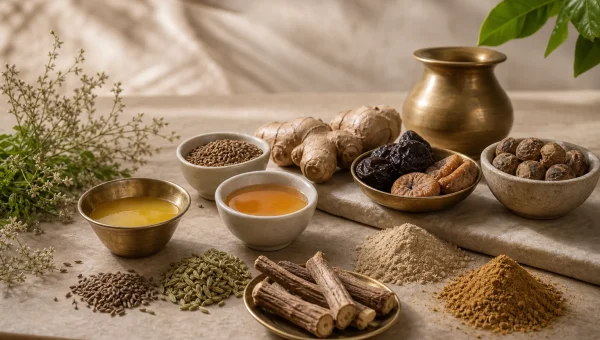
Hingvashtaka Churna is a classical Ayurvedic formulation traditionally used to support digestion and reduce gas formation. It combines warming spices and salts to enhance digestive fire and relieve abdominal discomfort associated with vata imbalance.
| Ingredient | Sanskrit Name | Amount | Function |
|---|---|---|---|
| Asafoetida | Hingu | 1 part | Supports reduction of intestinal gas and spasm |
| Dry ginger | Shunthi | 1 part | Enhances digestive fire |
| Black pepper | Maricha | 1 part | Stimulates digestion |
| Long pepper | Pippali | 1 part | Supports nutrient absorption |
| Cumin seeds | Jeeraka | 1 part | Carminative support |
| Black cumin | Krishna Jeeraka | 1 part | Supports lower digestive tract comfort |
| Ajwain | Yavani | 1 part | Supports relief from abdominal spasms |
| Rock salt | Saindhava Lavana | 1 part | Supports digestion and taste enhancement |
Preparation: Lightly dry roast the spices separately (except asafoetida and salt), cool completely, and grind into a fine powder. Mix all ingredients thoroughly and store in an airtight container.
Dose: Approximately half a teaspoon with warm water, ghee, or sprinkled on food before or during meals.
Best for: General post-meal bloating, gas formation, heaviness after eating, and irregular digestion patterns.
Churna #2: The Cold-Constitution Bloater (Shunthi-Ajwain Blend)
This formulation is traditionally suited for individuals whose bloating worsens with cold foods, irregular meal timing, or vata-predominant digestion. It emphasizes warming spices to support digestive stability.
Ingredients:
- Dry ginger (Shunthi): 3 parts
- Ajwain (Yavani): 2 parts
- Cinnamon (Twak): 1 part
- Cardamom (Ela): 1 part
- Nutmeg (Jatiphala): 1/2 part
- Rock salt (Saindhava): 1/2 part
Preparation: Lightly roast ajwain and dry spices separately, cool, and grind into a uniform powder.
Dose: One-quarter to half a teaspoon with warm water before meals.
Best for: Bloating triggered by cold, raw, or heavy foods and digestive sluggishness in colder conditions.
Nutmeg is traditionally used in very small quantities in Ayurvedic preparations for its digestive-supporting properties. It should always be used in controlled amounts due to its potency.
Churna #3: The Hot-Constitution Bloater (Fennel-Coriander Cooling Blend)
This blend is designed for pitta-dominant digestion, where bloating is associated with heat, acidity, or irritation in the digestive tract. It uses cooling aromatic spices to support comfort and balance.
Ingredients:
- Fennel seeds: 3 parts
- Coriander seeds: 3 parts
- Cumin seeds: 2 parts
- Mint (dried): 1 part
- Cardamom: 1 part
- Rose petal powder: 1/2 part
Preparation: Lightly dry roast seeds, cool, and grind together with herbs into a fine powder.
Dose: One teaspoon steeped in warm water after meals or chewed in small amounts.
Best for: Bloating with acidity, heat sensitivity, or discomfort after spicy foods.
Churna #4: The Post-Heavy-Meal Rescue Blend
This blend is traditionally used after heavy or rich meals to support digestion and reduce post-meal heaviness. It combines warming spices and salts to assist digestive processing.
Ingredients:
- Rock salt: 2 parts
- Black salt: 1 part
- Dry ginger: 2 parts
- Long pepper: 1 part
- Black pepper: 1 part
- Cumin: 1 part
- Pomegranate seed powder: 1 part
- Cinnamon: 1/2 part
- Cardamom: 1/2 part
Preparation: Roast spices lightly, grind finely, and mix with salts and powdered ingredients.
Dose: Half a teaspoon with warm water after heavy meals as needed.
Best for: Occasional overeating, rich meals, or post-festival digestive heaviness.
Churna #5: The Chronic Bloater’s Daily Companion
This gentle formulation is traditionally used for long-term digestive support in individuals experiencing persistent bloating or weak digestive capacity. It aims to gradually strengthen agni and support regular bowel function.
Ingredients:
- Cumin: 4 parts
- Fennel: 2 parts
- Dry ginger: 2 parts
- Vidanga: 1 part
- Chitrak (optional for strong digestion): 1 part
- Musta: 1 part
Preparation: Dry roast ingredients individually, cool, and grind into fine powder.
Dose: Half a teaspoon with warm water or mixed into meals once or twice daily.
Best for: Chronic digestive discomfort, irregular appetite, and long-standing bloating tendencies.
Vidanga is traditionally valued in Ayurveda for supporting intestinal health and maintaining digestive clarity as part of long-term gut balance practices.
General Tips for Getting the Most from Anti-Bloating Churnas
Effective use of Ayurvedic spice blends depends not only on ingredients but also on preparation, timing, and dietary habits that support digestion as a whole system.
- Fresh preparation: Small batches preserve potency and aroma, which are essential for digestive effectiveness.
- Proper roasting: Light dry roasting enhances digestibility and activates aromatic compounds.
- Timing: Use before meals for prevention or after meals for digestive support depending on need.
- Eating habits: Slow eating, proper chewing, and avoiding excessive cold beverages support digestion.
- Individual response: Adjust blends according to personal tolerance and digestive response.
Traditional kitchen wisdom in Ayurveda emphasizes that digestion is influenced by both food and behavior. Spice blends act as supportive tools within a broader lifestyle that includes mindful eating and regular meal patterns.
Medical Disclaimer: This article is for educational purposes only. Persistent, severe, or unexplained bloating should be evaluated by a qualified healthcare professional. Pregnant or medically sensitive individuals should consult an Ayurvedic practitioner before using strong heating spices or mineral salts in therapeutic quantities.
would have liked a clearer explanation of what ‘Sama Agni’ means practically and how to measure if my Agni is balanced.
would have liked a clearrr explanation of what ‘Sama Agni’ means practically and how to measure if my Agni is balanced. tbh
the article doesn’t address IBS-M (mixed) which is extremely common. I dont fit cleanly intp Vata or Pitta type. tbh
the low-FODMAP Ayurvedic adaptation in the article is clever. removing garlic and onion but keeping asafoetida in ghee is something I hadn’t tried.
gave Triphala a 3-month trial and my IBS-D actually got worse initially. some people with Pitta excess seem to react badly to Haritaki.
the article doesn’t address IBS-M (mixed) which is extremely common. I dont fit cleanly into Vata or Pitta type.
my gastro prescribed Rifaximin and I’m also taking Kutaj. is there a known herb-drug interaction concern here?
That’s actually worth asking your prescribing doctor directly — Kutaj has antimicrobial activity and Rifaximin targets gut bacteria, so there could be overlap in mechanism if not outright interaction. Not aware of a documented contraindication but the combination seems worth flagging at your next appointment.
the FODMAP overlap with Ayurvedic restricted foods is interesting. Is there any formal research comparing both protocols head to head? 🙏
for the Pitta-type atisara, does Kutajarishta work differently than plain Kutaja churna? both are available near me but I don’t know which is better.
the article doesn’t address IBS-M (mixed) which is extremely common. I don’t fit cleanly into Vata or Pitta type.
The description of the 3 PM balloon really resonated with my own midday slump.
I have SIBO confirmed on breath test. does the article’s protocol apply or is SIBO a different issue in Ayurvedic classification?
SIBO is a bit different since the issue is bacterial overgrowth in the small intestine rather than just impaired digestion in the colon — in Ayurvedic terms it might be classified under a different imbalance than typical vata-type bloating. The churnas here are carminative but may not address the root cause of SIBO the same way. Worth asking a vaidya who also understands your breath test results.
the Kapha-type diarrhea protocol here is different from what my Ayurvedic doctor recommended and interestingly my symptoms match the Kapha description better.
Triphala 5g before bed changed my life. had chronic IBS-C for 8 years, been 3 months now and motility is so much better.
what does ‘Vata-type diarrhea’ look like in terms of stool characteristics? the article describes the dosha but not the stool pattern specifically. धन्यवाद
Did anyone try the Hingvashtaka churna with ghee before lunch and notice a difference?
frustrated that every Ayurvedic IBS article recommends the same 4 herbs without addressing the dosage variability between churna vs liquid extract.
tried the Musta and Kutaj combination for IBS-D. significant improvement in consistency and frequency within 10 days.
@Greg the low-FODMAP Ayurvedic adaptation in the article is clever. removing garlic and onion but keeping asafoetida in ghee is something I hadn’t tried.
can children take the Bilva (bael fruit) preparation mentioned? my 8-year-old has chronic loose stools.
the fermented kanji recipe mentions leaving it for 2-3 days. in summer with room temp at 38C, does the fermentation time change?
@Brian gave Triphala a 3-month trial and my IBS-D actually got worse initially. some people with Pitta excess seem to react badly to Haritaki. 🙌
I wonder if the effects are due to the spices themselves or just the routine of taking a pause before eating.
the CCF (cumin coriander fennel) tea protocol genuinely reduced my bloating within 2 weeks. I drink it after every meal now. ✨
tried the Musta and Kutaj combination for IBS-D. significant improvement in consistency and feequency within 10 days.
Grinding the spices fresh each week seems to keep the aroma strong and the effect noticeable.
I felt curious about the nutmeg caution and will keep the dose low when I try the Shunthi-Ajwain blend.
The trikatu churna mentioned in the article is one I’ve actually used and it genuinely reduced my post-lunch bloating within about two weeks. Didn’t expect such a simple blend to work that well. 🌿
Speaking from experience with the hingvastak churna — taking it with warm water before meals made a real difference for my evening bloating. The ajwain component alone did a lot of the work I think.
for the Pitta-type atisars, does Kutajarishta work differently than plain Kutaja churna? both are available near me but I dont know which is better.
Maybe the cooling fennel-coriander blend could help those who get heartburn after spicy meals.
Storing the churnas in a dark glass jar helped preserve the scent longer than a clear container.
Has anyone experienced less gurgling after using the post-heavy-meal rescue blend on a big dinner?
Same here. 🌿
I’m not entirely convinced that vata alone explains bloating, but the spice approach seems worth a try.
After reading about ajwain’s thymol content, I added a pinch to my buttermilk and felt lighter.
i have AIBO confirmed on breath test. does the article’s protocol apply or is SIBO a different issue in Ayurvedic classification? tbh
the fermented kanji recipe mentiona leaving it for 2-3 days. in summer with room temp at 38C, does the fermentation time change?
Good one.