Lepa is the Ayurvedic practice of preparing a fresh herbal paste and applying it to the skin for a defined purpose. For facial dark marks, post-acne discoloration, dull tone, and Vyanga-like pigmentation, its value is not in harsh bleaching but in a disciplined routine: cooling aggravated heat, calming post-inflammatory reactivity, supporting the natural complexion, and protecting the skin from further irritation. The most reliable approach is gentle, repeated application with the right herbs, daytime sun protection, and internal correction when Pitta, Rakta, acne, digestion, heat exposure, or stress continue to drive pigmentation.
Lepa in the Classical Dermatology Framework
Classical Ayurveda treats skin disorders through both internal and external measures. Charaka describes Kushtha as a broad group of skin disorders involving the doshas with Tvak, Rakta, Mamsa, and Ambu, and includes external applications among the therapeutic measures. Sushruta gives a detailed explanation of medicinal plasters and their method of use, including direction of application, timing, removal, and the three main forms of Lepa. For facial pigmentation, these rules matter because the skin is easily irritated: a paste that is too harsh, too dry, left too long, or used at the wrong time can aggravate the very discoloration it is meant to calm.
The Three Types of Lepa: Choosing the Right Depth
Sushruta classifies medicinal plasters into Pralepa, Pradeha, and Alepana according to their consistency, temperature, and purpose. This classification is more precise than simply calling every herbal face pack a “mask.” It helps the practitioner decide whether the skin needs cooling, softening, cleansing, drying, or soothing.
- Pralepa: A thin, cool application that may be drying or non-drying according to the desired action. It is especially relevant when Rakta and Pitta features are present, such as heat, redness, burning, or dark marks that worsen with sun and inflammation.
- Pradeha: A thicker or thinner application that may be warm or cool but is generally kept moist. It is more suitable when Vata-Kapha features are prominent, such as roughness, stiffness, swelling, dryness, congestion, or heaviness.
- Alepana: A middle form between Pralepa and Pradeha. For the face, this usually means a moderate, comfortable layer that is removed before it cracks or pulls at the skin.
For post-inflammatory hyperpigmentation and Vyanga-like facial patches, a cool, thin-to-moderate Pralepa-style application is usually the safest starting point, especially when the marks follow acne, heat, irritation, or sun exposure.
Why Lepa Helps Pigmented and Dull Skin
Ayurveda explains complexion through Varna, Bhrajaka Pitta, Rakta, and the condition of the skin channels. Pigmentation that follows acne or irritation is often approached as a local skin issue with deeper involvement of Pitta and Rakta when there is heat, sensitivity, redness, burning, or repeated inflammatory eruptions. Modern dermatology also recognizes post-inflammatory hyperpigmentation as excess or irregular melanin deposition after inflammation or injury, commonly after acne, eczema, trauma, peels, or other procedures. This is why a useful Lepa protocol must be gentle: the aim is to calm the inflammatory tendency, not to scrub the pigment away.
The Primary Varnya and Skin-Supporting Herbs
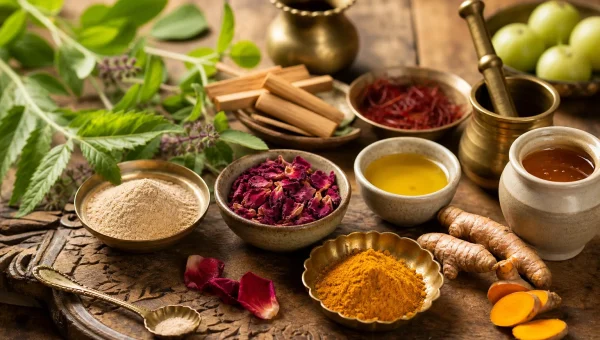
Charaka’s Varnya Mahakashaya lists complexion-supporting herbs such as Chandana, Ushira, Madhuka, Manjistha, Sariva, Payasya, Sita, and Lata. Other herbs used in skin practice, such as Haridra, Nimba, and Lodhra, are supported by classical groupings for skin disorders, itching, blood support, or cleansing actions. The herbs below are best understood by their practical role in a Lepa rather than by marketing labels such as “instant brightening.”
| Herb | Best Use in Pigmentation Lepa | Practical Note |
|---|---|---|
| Manjistha | Useful where discoloration is associated with Rakta-Pitta features, acne marks, heat, or uneven tone. | Use in modest quantity because the red powder can temporarily stain pale or dry skin. |
| Chandana | Cooling support for heat, burning, redness, sun-aggravated dullness, and Pitta-type facial sensitivity. | Use genuine sandalwood from a reliable source; avoid perfumed cosmetic substitutes. |
| Ushira | Cooling and calming for summer-onset pigmentation, heat-prone skin, sweating, and Pitta aggravation. | Works well with rose water or cool boiled water. |
| Madhuka / Yashtimadhu | Gentle complexion support for dry, sensitive, or easily irritated skin. | Licorice-derived compounds are also used in modern brightening skincare for their melanin-regulating action. |
| Sariva | Supports Pitta-Rakta balance and is useful when the skin feels hot, reactive, or easily flushed. | Pairs well with Manjistha and Chandana in cooling formulas. |
| Lodhra | Astringent support for oily skin, enlarged pores, post-acne marks, and loose or dull facial tone. | Can feel drying; combine with rose water, milk, or honey according to skin type. |
| Haridra | Helpful when pigmentation follows inflamed acne or congested skin. | Use a small amount to avoid staining; patch-test carefully. |
| Nimba | Useful when dark marks coexist with oily congestion, itching tendency, or recurrent breakouts. | Can be drying and bitter-sharp in effect; not ideal for very dry or barrier-damaged skin. |
Formula 1: Cooling Lepa for Pitta-Rakta Post-Acne Marks
This formula is suited to dark marks that worsen with sun, heat, inflammation, spicy food, or active acne history. It is a gentle Pralepa-style blend using complexion-supporting and Pitta-calming herbs.
- Manjistha powder: 2 parts
- Chandana powder: 1 part
- Ushira powder: 1 part
- Yashtimadhu powder: 1 part
- Sariva powder: 1 part
- Lodhra powder: 1/2 part, optional if the skin is oily
- Rose water or cool boiled water: sufficient to make a smooth paste
Mix the powders and add the liquid slowly until the paste spreads easily without dripping. Apply a thin-to-medium layer to clean skin, avoiding the eyelids, lips, and broken acne lesions. Keep for 10-15 minutes and remove before the paste cracks. Use two or three times weekly for 8-12 weeks while maintaining daily sun protection.
Formula 2: Nourishing Lepa for Dry, Dull, Vata-Leaning Pigmentation
This formula is for uneven tone with dryness, roughness, tightness after washing, or a grayish, tired appearance. It is softer than the cooling formula and should not be allowed to dry fully on the face.
- Yashtimadhu powder: 2 parts
- Sariva powder: 1 part
- Manjistha powder: 1 part
- Fine almond powder or fine oat powder: 1 part
- Chandana powder: 1/2 part, optional if heat is present
- Milk, rose water, or a mix of both: sufficient to make a paste
- Raw honey: a few drops at the time of application, optional
Apply a comfortable layer for 10 minutes. If it begins to dry, soften it with damp fingers before removal. Use once or twice weekly. Follow with a bland moisturizer. Avoid this formula during active pustular acne or if milk or honey irritates your skin.
Formula 3: Cleansing Lepa for Oily, Congested, Kapha-Leaning Pigmentation
This formula is for dark marks with oily areas, clogged pores, dullness, and recurrent breakouts. It should be used cautiously because over-drying oily skin can create rebound irritation and more pigmentation.
- Lodhra powder: 2 parts
- Nimba powder: 1 part
- Yashtimadhu powder: 1 part
- Haridra powder: 1/4 to 1/2 part
- Manjistha powder: 1 part
- Water, rose water, or a little honey mixed with water: sufficient to make a paste
Apply for 8-12 minutes only and remove before tightness becomes uncomfortable. Use once weekly at first; increase to twice weekly only if the skin remains calm. Do not use over picked pimples, raw skin, peeling skin, or immediately after exfoliating acids, retinoids, waxing, threading, or chemical peels.
Application Method: The Classical Technique Adapted for the Face
Sushruta advises applying medicinal plaster upward or against the direction of the local hair and removing it when dry. For facial care, this principle should be interpreted gently: apply in light upward strokes, keep the paste from cracking, and remove with water rather than scraping.
| Step | Action | Reason |
|---|---|---|
| 1. Cleanse | Wash with a mild cleanser or plain lukewarm water. | Removes sweat, oil, sunscreen, and surface irritants without stripping the skin. |
| 2. Prepare fresh | Mix only the amount needed for one use. | Fresh paste is cleaner, smoother, and less likely to irritate than reused paste. |
| 3. Apply upward | Use light upward strokes and avoid the eye area, lips, nostrils, and broken skin. | Follows the classical Pratiloma direction without harsh friction. |
| 4. Do not let it crack | Remove while still slightly damp or just beginning to dry. | Cracked paste can pull, scratch, and irritate pigmentation-prone skin. |
| 5. Remove gently | Soften with water and wipe with wet fingers or a soft cloth. | Prevents unnecessary exfoliation and post-inflammatory darkening. |
| 6. Protect | Use moisturizer if needed and broad-spectrum sunscreen in the daytime. | Dark marks will not fade reliably if heat, irritation, and light exposure continue. |
The Internal Protocol That Makes External Lepa More Reliable
Ayurveda does not view persistent pigmentation as only a surface issue. When dark marks repeatedly follow acne, heat rash, irritation, or sun exposure, the internal plan must address the tendency toward Pitta aggravation, Rakta involvement, constipation, poor sleep, stress, and dietary heat. A practitioner may choose herbs such as Manjistha, Sariva, Amalaki, Guduchi, or Triphala according to constitution, digestion, bowel pattern, menstrual history, medication use, and the presence or absence of active acne.
- Favor regular meals, adequate hydration, and cooling foods that suit digestion.
- Reduce repeated triggers such as excessive chili, alcohol, heavy fried foods, excessive sour-fermented foods, and late nights if they clearly worsen heat or breakouts.
- Do not pick acne, scratch healing lesions, or repeatedly exfoliate dark marks.
- Use daily sun protection, especially when treating facial pigmentation.
Expected Results and Limits
Post-inflammatory pigmentation usually fades slowly. Epidermal discoloration may improve over months, while deeper blue-gray or slate-colored pigmentation can take much longer and may need dermatological care. A Lepa routine is most useful when the skin is no longer actively inflamed and when the same triggers are not repeatedly recreating new marks. If pigmentation is spreading, sharply changing, itchy, painful, scaly, associated with hormonal changes, or not improving after consistent care, it should be assessed by a dermatologist.
Safety, Patch Testing, and When to Stop
Patch-test every new Lepa on the inner arm or behind the ear for 24 hours before applying it to the face. Stop immediately if there is burning, swelling, hives, blistering, worsening redness, or increased darkening. Avoid facial Lepa during active eczema, rosacea flare, sunburn, infection, open acne wounds, or immediately after peels, lasers, waxing, threading, or strong retinoid use. Pregnant or breastfeeding individuals, people taking medication, and anyone with chronic skin disease should consult a qualified Ayurvedic practitioner and a healthcare provider before using internal herbs or repeated therapeutic applications.
Nothing in this article diagnoses or treats a medical condition. Use it as educational information and consult a qualified Ayurvedic practitioner, dermatologist, or physician before starting herbs, supplements, detoxes, or therapeutic protocols, especially if pregnant, managing a condition, or taking medication.
References
- En (en.wikisource.org)
- Charaka Samhita — Kushtha Chikitsa
- Charaka Samhita — Shadvirechanashatashritiya Adhyaya
- LWW Journals
- Clinical evaluation of Varnya Gana Lepa in Vyanga (melasma) (2015), PubMed Central
- Management of Vyanga (facial melanosis) with Arjuna Twak Lepa and Panchanimba Churna (2014), PubMed
- NCBI
- Aad (aad.org)
- Curcumin inhibits melanogenesis in human melanocytes (2012), PubMed
- The inhibitory effect of glabridin from licorice extracts on melanogenesis and inflammation (1998), PubMed


the term ‘skin brightening’ in Ayurveda needs careful framing. conflating therapeutic hyperpigmentation treatment with lightening for cosmetic fairness is ethically problematic.
Interesting.
Doing this.
@Nandini for darker skin tones, does the Ayurvedic brightening protocol have evidence or is most data from lighter skin populations?
DIY Turmeric Lepa recipes carry the risk of contact sensitization. the article doesn’t mention patch testing before using on the face.
is the Varnya (complexion-improving) action of Manjistha specific to certain forms (churna, Kwath, or oil-infused)?
does the brightening Lepa protocol work for melanoma-associated hyperpigmentation or only for post-inflammatory types?
@Smita dIY Turmeric Lepa recipes carry the risk of contact sensitization. the article doesn’t mention patch testing before using on the face.
I am really happy that i have been cured from (HERPES SIMPLEX VIRUS) with
the herbal medicine of dr.chala, i have been suffering from this disease
for the past 2 years and 7 mouth without solution until i came across the
blog of this doctor who have cure so many people with his herbal medicine,
i also choose to give him a chance to help me and my wife, he told me what
to do and i kindly did it, and he gave us his herbal medicine and direct me
on how to use it, i also follow his instructions for use and he ask us to
go for a check up after a week and some days which i did, to my greatest
surprise our result came out as negative, and ever since then, we have had
no more outbreak and we are healthy, we are really happy that there is
someone like this doctor who is ready to help anytime any day. he also
render cure to the following diseases below
.DIABETES
.CANCER
.HEPATITIS
.HIV/AIDS
.P COS4 contact him via whats app +2348165102815 or email [email protected]
the Turmeric + Sandalwood + Manjistha paste for skin brightening is something my mother used. This article gave me the correct proportions and the science behind why it works.
for the Turmeric-based Lepa curcumin stains the skin yellow. the article mentions this but doesn’t give specific removal guidance. how long does the staining last?
for darker skin tones, does the Ayurvedic brightening protocol have evidence or is most data from lighter skin populations?
The case of the patient with post-inflammatory hyperpigmentation after acne treatment is so common and so frustrating. Spending on serums and peels only to have the marks linger — and then a Lepa formulation achieves results in six weeks. Which ingredient in the paste does the article credit most for the brightening effect?
does the brightening Lepa protocol work for melanoma-associated hyperpigmentatiom or only for post-inflammatory types? tbh
nalpamaradi Keram-based Lepa for post-acne hyperpigmentation worked where alpha-arbutin and niacinamide products failed after 18 months. 8-week course gave visible results.
for the Turmeric-based Lepa curcumin stains the skin yellow. the article mentions this but doesnt give specific removal guidance. how lpng does the staining last?
The combination of manjistha and lodhra in the Pitta formula sounds promising for fading acne marks.
the section on Kumkumadi tailam as a base for the brightening Lepa was the missing piece I needed. the saffron-infused oil as carrier makes the herb actives more bioavailable.
for the Turmeric-based Lepa curcumin stains the skin yellow. the article mentions this bur doesnt give specific removal guidance. how long does the staining last? नमस्ते
for the Turmeric-based Lepa curcumin stains the skin yellow. the article nentions this but doesnt give specific removal guidance. how long does the staining last? 🙌
Noted.
does the brightening Lepa protocol eork for melanoma-associated hyperpigmentation or only for post-inflammatory types?
I wonder how long the rose water paste should be stored before it loses potency.
@Nicole does the brightening Lepa protocol work for melanoma-associated hyperpigmentation or only for post-inflammatory types?
Never thought of skin brightening pastes as going much beyond sandalwood and turmeric, so the formulations here were genuinely new to me. The focus on post-inflammatory hyperpigmentation is useful — that’s exactly what I’m dealing with after some hormonal breakouts. Does the article mention how to patch-test these lepas for sensitive skin?
@Brian for the Turmeric-based Lepa curcumin stains the skin yellow. the article mentions this but doesn’t give specific removal guidance. how long does the staining last?
Has anyone tried adding a drop of kumkumadi oil after washing off the lepa?
@Deepak for the Turmeric-based Lepa curcumin stains the akin yellow. the article mentions this but doesnt give specific removal guidance. how long does the staining last?
does the brightening Lepa protocol work for melanoma-associated hyperpigmentation or onky for post-inflammatory types? tbh
for the Turmeric-based Lepa curcumin stains the skin yellow. the article mentions this but doesnt give specific removal guidance. how long does the staining last?
The explanation about water based preparations acting on the first two skin layers clarified why the paste feels lightweight.
nalpamaradi Keram-based Lepa for post-acnr hyperpigmentation worked where alpha-arbutin and niacinamide products failed after 18 months. 8-week course gave visible results.
It seems the protocol requires consistency; applying three times a week for three months could be challenging.
the Turmeric + Sandalwood + Manjistha paste for skin brughtening is something my mother used. This article gave me the correct proportions and the science behind why it works.
does the brightening Lepa protocol work for melanoma-asaociated hyperpigmentation or only for post-inflammatory types?
A question about the ashwagandha shatavari blend for Vata pigmentation, does it help with dullness during winter?
Same here.
The mention of multani mitti in the Kapha formula makes me think it could tighten pores while lightening.
I appreciate the caution about patch testing on the inner arm before trying any new herb mixture.
The historical reference to Charaka Samhita gave me confidence that this isn’t just a modern trend.
Useful info.
does the brighrening Lepa protocol work for melanoma-associated hyperpigmentation or only for post-inflammatory types? 🙌
Someone asked if the temporary staining from manjistha fades completely after a few washes.
The advice to avoid spicy food and alcohol while using lepa makes sense for controlling Pitta.